
Judge, 1884-01-12 · page 3 of 16
Judge — January 12, 1884 — page 3: what you’re looking at
What you’re looking at
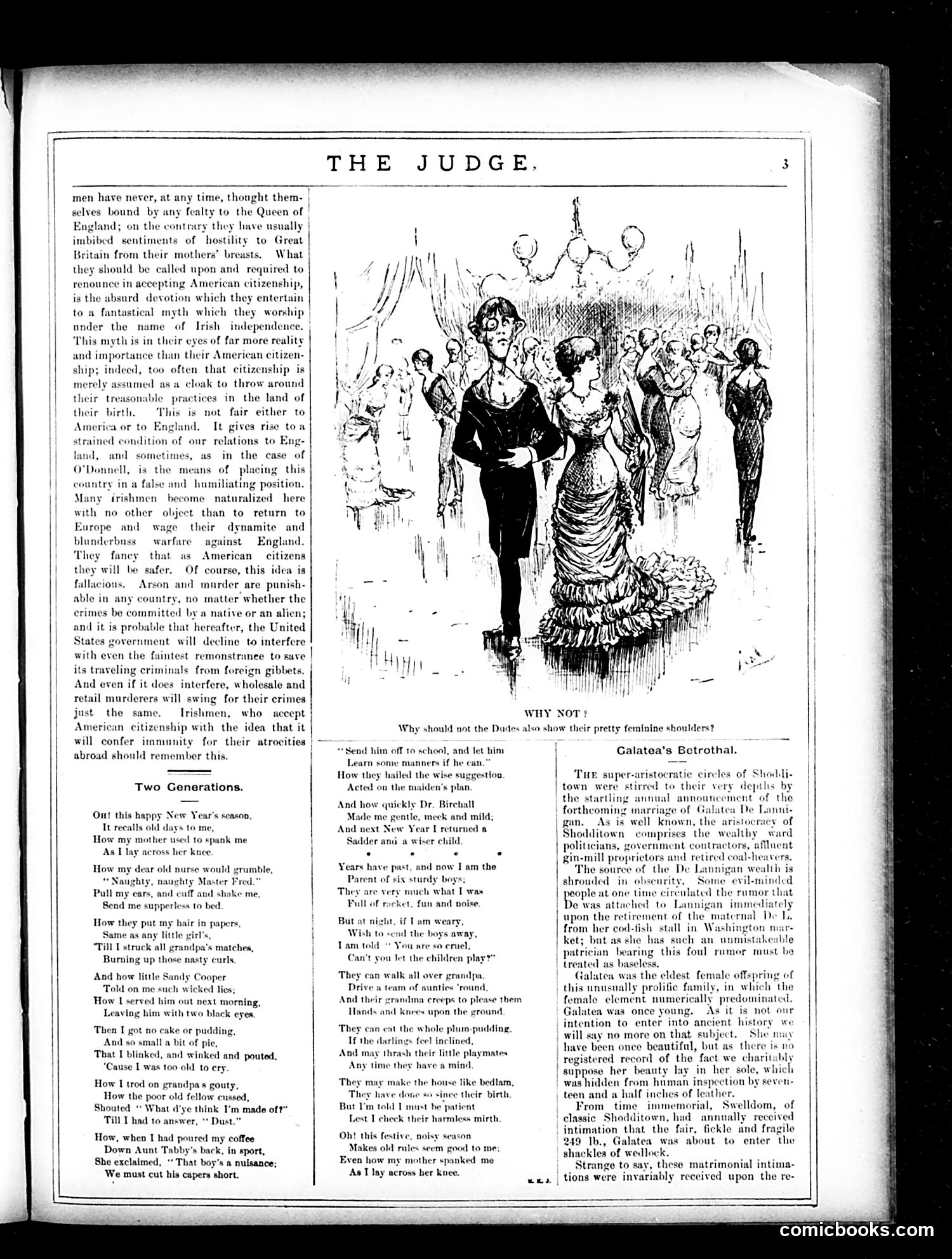
This Judge page contains two distinct pieces of satirical content: **The Main Text (Left Column):** A scathing political essay attacking Irish-American immigrants. The author argues that Irish naturalized citizens secretly maintain loyalty to "Irish independence" rather than America, and use citizenship as cover to commit violent acts (bombings/dynamite attacks) against England while evading prosecution. The piece warns that the U.S. government should stop protecting Irish-Americans accused of crimes abroad. This reflects late-19th-century American nativism and anti-Irish prejudice, portraying Irish immigrants as inherently disloyal terrorists. **The Illustration & Poetry:** Shows a fashionably-dressed couple at a social event. The accompanying poem "Two Generations" humorously contrasts the author's strict Victorian childhood (spanking, punishment) with his lenient parenting of six rowdy sons—a common satirical theme mocking changing parenting styles. **"Why Not?" Caption:** A brief sarcastic quip suggesting male "dudes" (fashionable men) should expose their shoulders like women in contemporary fashion—mocking masculine vanity and fashion trends. The page reflects period anxieties about immigration, morality, and social change in Gilded Age America.
📄 Transcribed text from this page (OCR, searchable)
Machine-transcribed from the original scan — historical spelling and the odd misread are preserved.
men have never, at any time, thought them- selves Lound by any fealty to the Queen of England; on the contrary they have usually imbibed sentiments of hostility to Great Britain from their mothers’ breasts. What | they should be called upon and required to renounce in accepting American citizenship, is the absurd devotion which they entertain to a fantastical myth which they worship under the name of Irish independence. This myth is in their eyes of far more reality and importance than their American citi ship; indeed, too often that citizenship is merely assumed as a cloak to throw around their treasonable practices in the land of their birth. This is not fair either to America or to England. It gives rise toa strained condition of our relations to Eng- land, and sometimes, as in the case of O'Donnell, is the means of placing this intry ina false and humiliating position. Many trishmen become naturalized here with no other object than to return to Europe and wage their dynamite and blunderbuss warfare against England. They fancy that as American citizens they will be safer. Of course, this idea is fallacious, Arson and murder are punish- able in any country, no matter’ whether the crimes be committed by a native or an alien; and it is probable that hereafter, the United States government will decline to interfere with even the faintest remonstranee to save its traveling criminals from foreign gibbets. And even if it does interfere, wholesale and retail murderers will swing for their crimes just the same. Irishmen, who accept American citizenship with the idea that it will confer immunity for their atrocities | abroad should remember this. Two Generations. Ont! this happy New Year's season, It recalls old days tom How my mother used to spank me As I lay across her knee. How my dear old nurse would “Naughty, naughty M Pull my cars, and cuff aud shake me. Send me supperless to bed How they put my hair in papers, Same as any little girl's ‘Till I struck all grandpa’s matches, Burning up those nasty curls. And how little Sandy Cooper Told on me such wicked lies; How I served him out next morning, Leaving him with two black eyes, Then I got no cake or pudding, And so small a bit of p ‘That I blinked, and winked and pouted, “Cause I was too old to ery. How I trod on grandpa gouty, How the poor old fellow cussed, Shouted * What d'ye think I'm made off” Till T had to answer, * Dust.” How, when I had poured my coffee Down Aunt Tabby’s back, in sport, She exclaimed, “That boy's a nuisan We must cut his capers short. WHY NOT? Why should not the Dudes also show their pretty feminine shoulders? Send hin off to school, and let him Learn some manners if How they hailed the wise suggestion, Acted on the maiden’s plan And how quickly Dr, Birchall Made me gentle, neck and mild; And next New Year I returned a Sadde: Years have past, and now Iam the Parent of six sturdy boys; every much what Twas Full of rocket, fun and noise. But at night, if Lam weary, Wish to <cnd the boys away am told“ You are so cruel, t you let the childr n of aunti And their grandma creeps to them Hands and knees upon the ground. They can 6 whole pluin-pudding, 1 inclined, ir little playmates ne they have a mind. use like bedlam, “ their birth. J Timust be patient k their harmless mirth. make the Oh! this festive, noisy season Makes old rules secm good to me Even how my mother spanked me As T Iny across her knee. Galatea’s Betrothal. Tue super-aristocratie circles of Shoddi- | town were stirred to their very dc by the startling ment of the forthcomin: tea De Lanni- As is well known, the aristocracy of Iditown comprises the wealthy ward | politicians, government contractors, aflluent } gin-mill proprietors and retired co The sour ¢ De Lann alth is shrouded in obscurity. Some evil-minded | people at one time circulated the rumo: Je was attached to Lannigan immed | upon the retirement of the maternal De from her cod-tish stall in’ Washin | ket; buta rician bearing this foul rumor must be ated as haseles Galatea was the eldest female offspring of this unusnally prolific family, in which the femalo element numerically predominated. tea was once young. it is not our intention to enter into ancient history we will say no more on that subject. have been once beautiful, but as there is no registered record of the fact we charitably suppose her beauty lay in her sole, which was hidden from human inspection by seven- teen and a half inches of leath From time immemorial, Swelldom, of classic Shodditown, h annually received intimation that the fair, fickle and fragile alatea was about to enter the shackles of wedlock. Strange to say, these matrimonial intima- tions were invariably received upon the re- comicbooks.com