
A complete issue · 16 pages · 1883
Judge — September 8, 1883
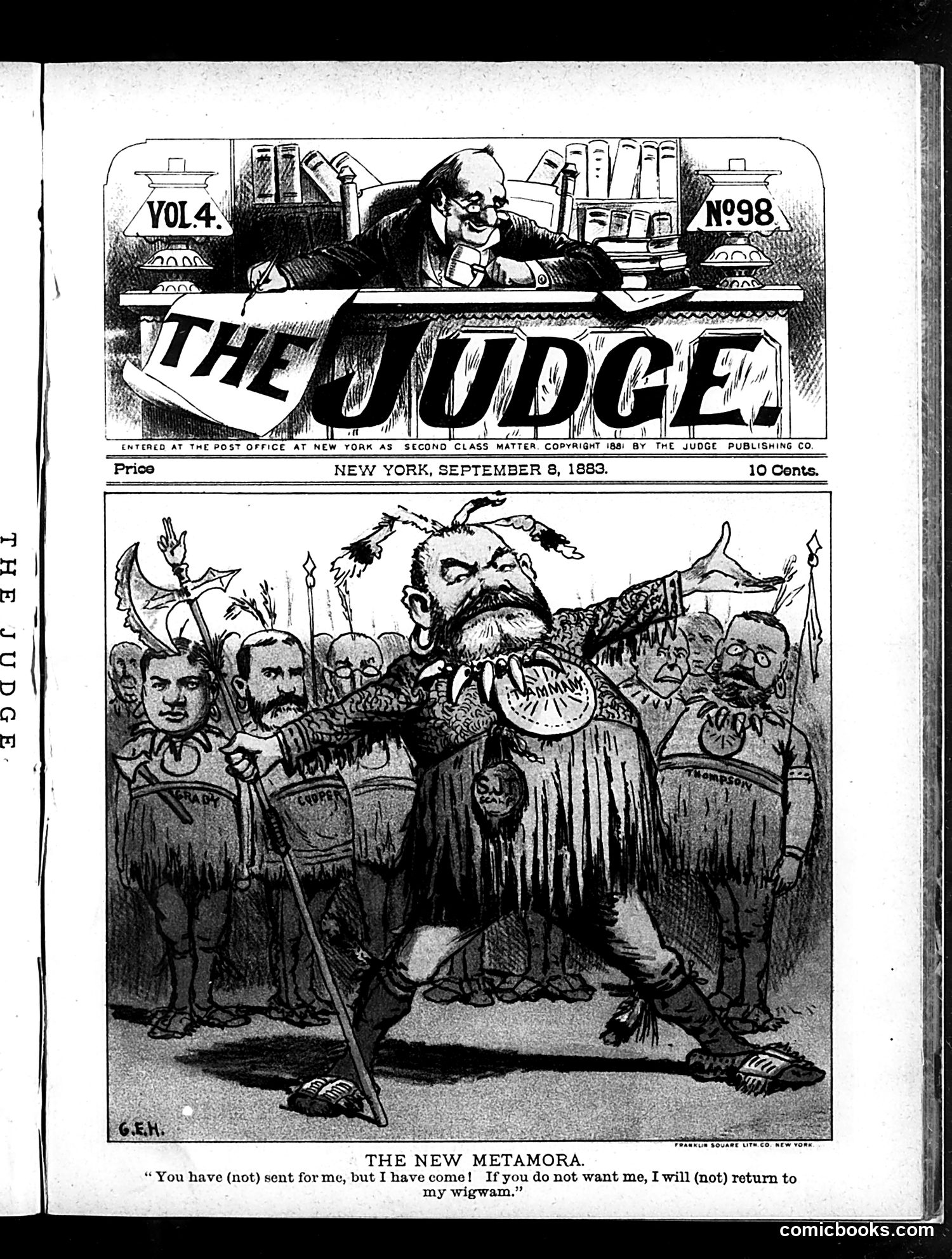
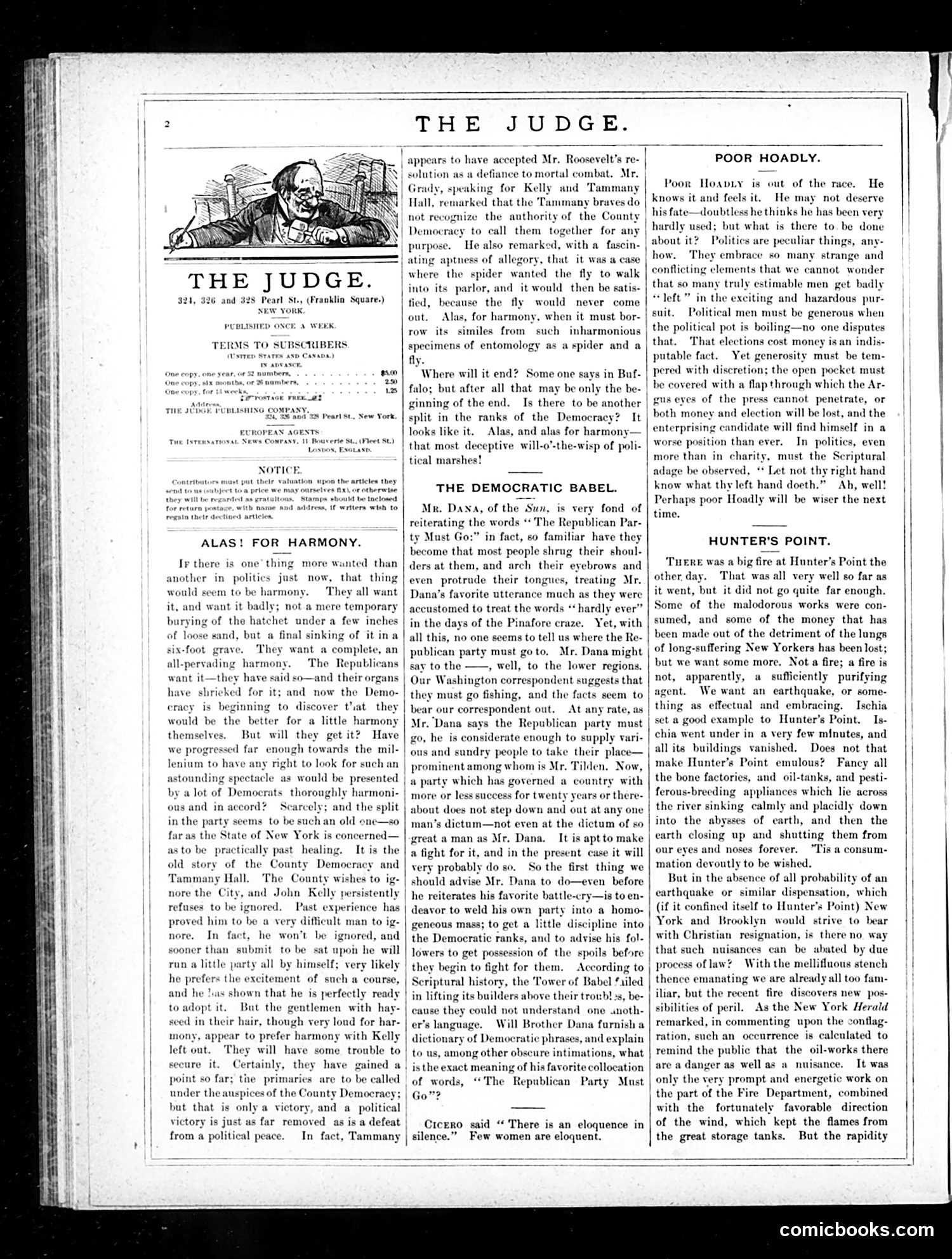
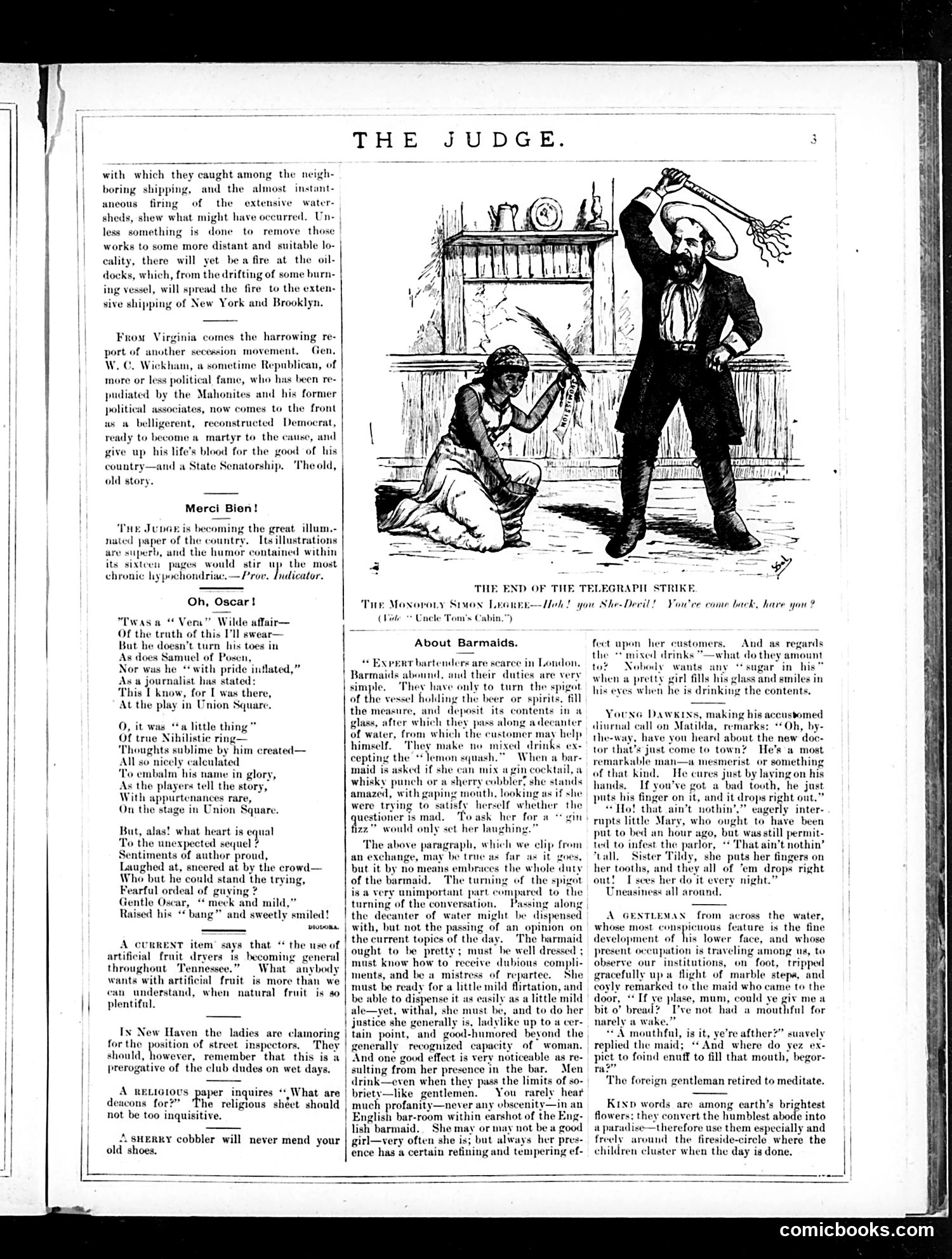
This page's main cartoon depicts the resolution of a telegraph operators' strike. The kneeling figure represents the strikers/workers, while the standing man (likely a telegraph company official or manager) appears triumphant, having won the labor dispute. The accompanying text references "From Virginia comes the harrowing report of another secession movement," mentioning W.C. Wickham—a former Republican turned Democrat willing to sacrifice himself for his cause, described sarcastically as "the old, old story." The page also includes lighter satirical pieces: mockery of Oscar Wilde's theatrical performance at Union Square (where he allegedly raised his "bang" hairstyle and smiled meekly when the crowd laughed), commentary on Tennessee's artificial fruit dryers, and humorous observations about barmaids' duties beyond merely pouring drinks—their role in conversation and mild flirtation. The overall tone blends political commentary with social satire typical of Gilded Age humor magazines.
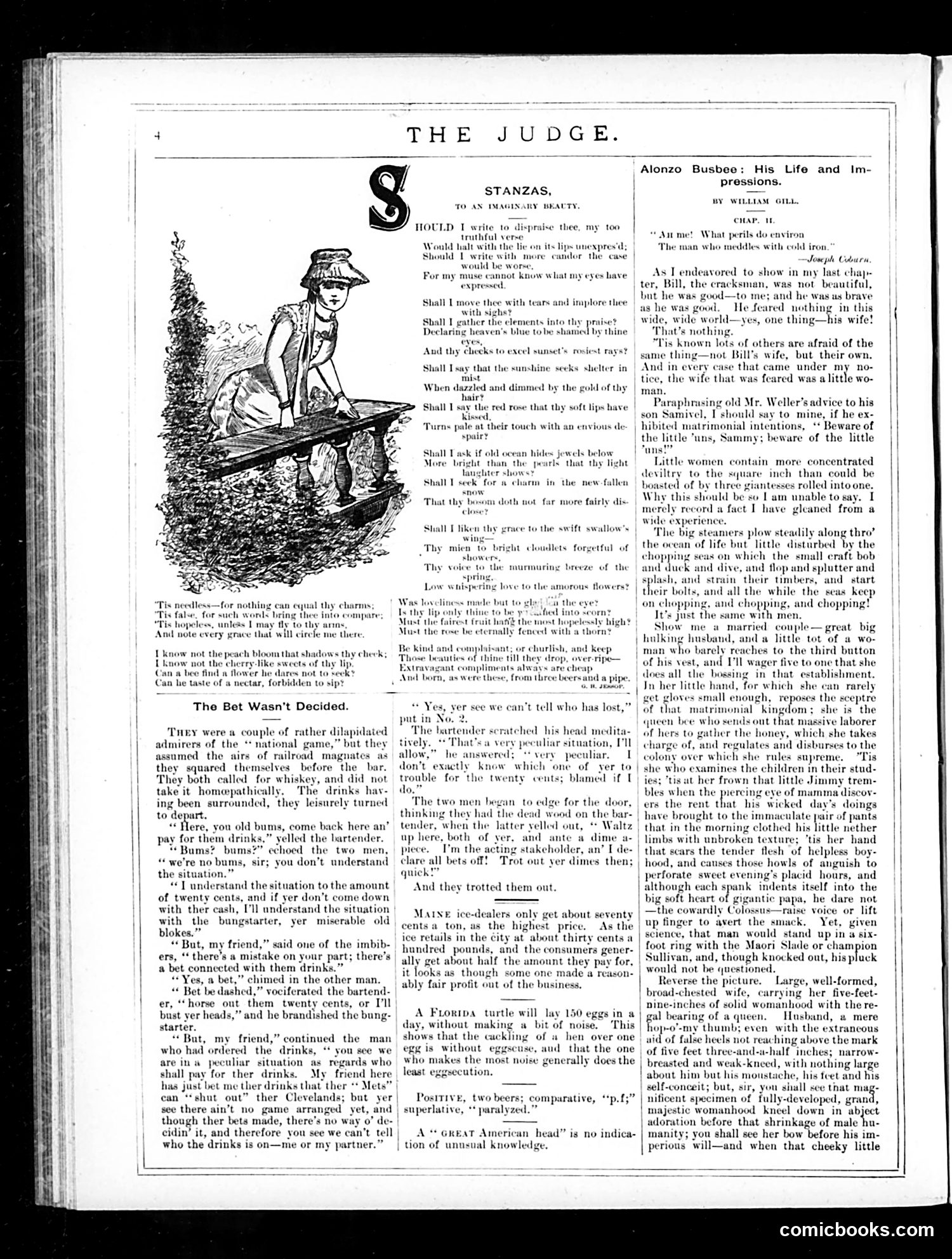
This comic sketch satirizes professional baseball gamblers and bartenders in the 1880s. Two shabby men order whiskey on credit, wagering that Cleveland's baseball team will "shut out" the Mets. When the bartender demands payment, they argue they can't determine who owes the debt until the game is played and the bet is settled. The joke mocks the absurdity of their logic—using an unresolved sports bet as justification for unpaid bar bills. The bartender, recognizing the con, declares himself "acting stakeholder," demands dimes from both men instead, and declares "all bets off!" The satire targets the era's rampant baseball gambling culture and the petty schemes drunken gamblers used to avoid paying debts. References to "Mets" and "Clevelands" are period baseball teams, making this topical humor for contemporary readers following professional baseball rivalries.
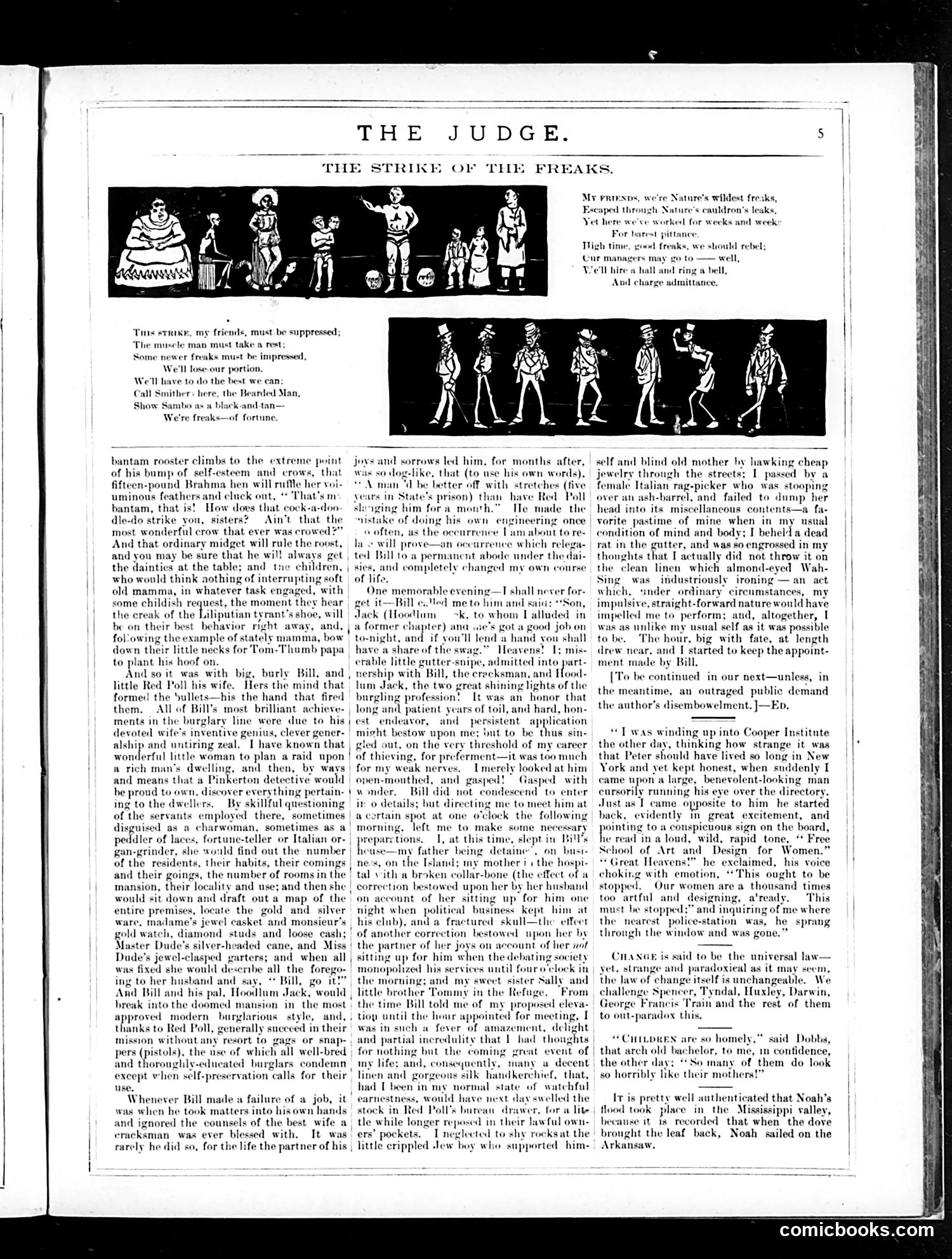
This page satirizes **labor strikes and union organizing** through animal metaphors. The top illustrations show various animals (rooster, hens, and skeletal figures) representing workers and management. The accompanying narrative uses a **bantam rooster** as metaphor: when a small, boastful rooster crows, even a large Brahma hen defers to him. This illustrates how a minor striker or agitator can command disproportionate power and respect within a workplace or social hierarchy—a critique of strike movements' disruptive influence. The lengthy prose narrative about "Bill" and "Red Poll" (a burglar couple) appears unrelated commentary, likely filling space in the magazine. **The satire's point**: Strikes give ordinary workers outsized leverage, allowing even insignificant individuals to dominate their "superiors"—presented here as absurd and socially dangerous. The animal fable format was typical for Judge's anti-labor, pro-management editorial stance during the Industrial Age.
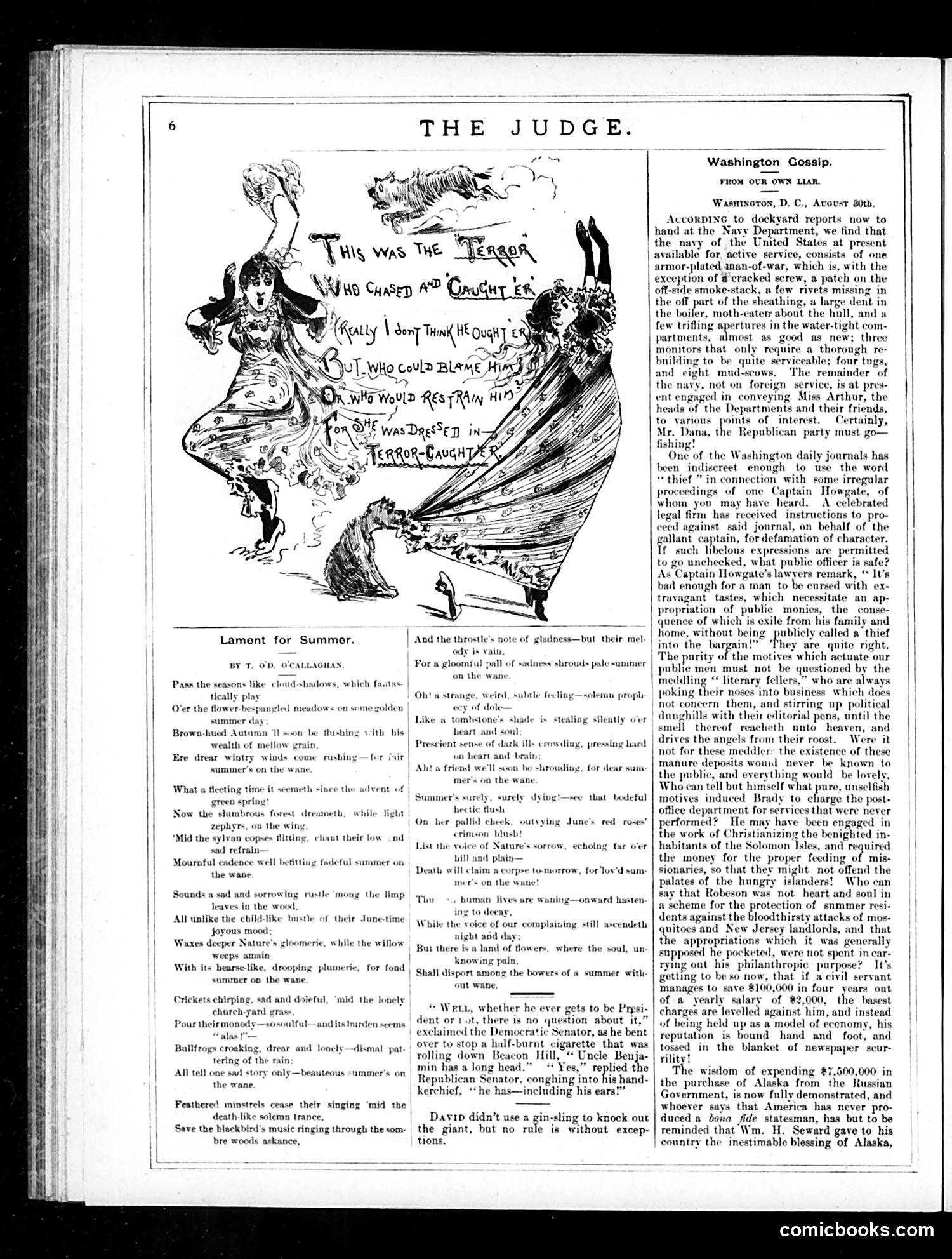
**The Main Cartoon (top left):** This shows a figure riding/being chased by a dragon labeled "TERROR-CAUGHT'ER," with text questioning who is responsible. This appears to be political satire about a scandal involving **Captain Howgate** (mentioned in the gossip column), where the Judge magazine is mocking those defending him from accusations of impropriety. The cartoon suggests whoever hired expensive lawyers to threaten newspapers over calling him a "thief" is complicit in covering up misconduct. **The Poem ("Lament for Summer"):** A conventional melancholic poem about summer's decline—not satirical. **"Washington Gossip" Section:** Satirizes government incompetence: the Navy's supposed single serviceable ship is barely functional (cracked screw, dented boiler, holes). The real navy activity is ferrying Miss Arthur and department officials on pleasure trips. The final anecdote mocks the Howgate situation: a Republican senator's evasive comment about a Democratic senator's presidential ambitions gets a cutting reply about his large ears—light political banter.
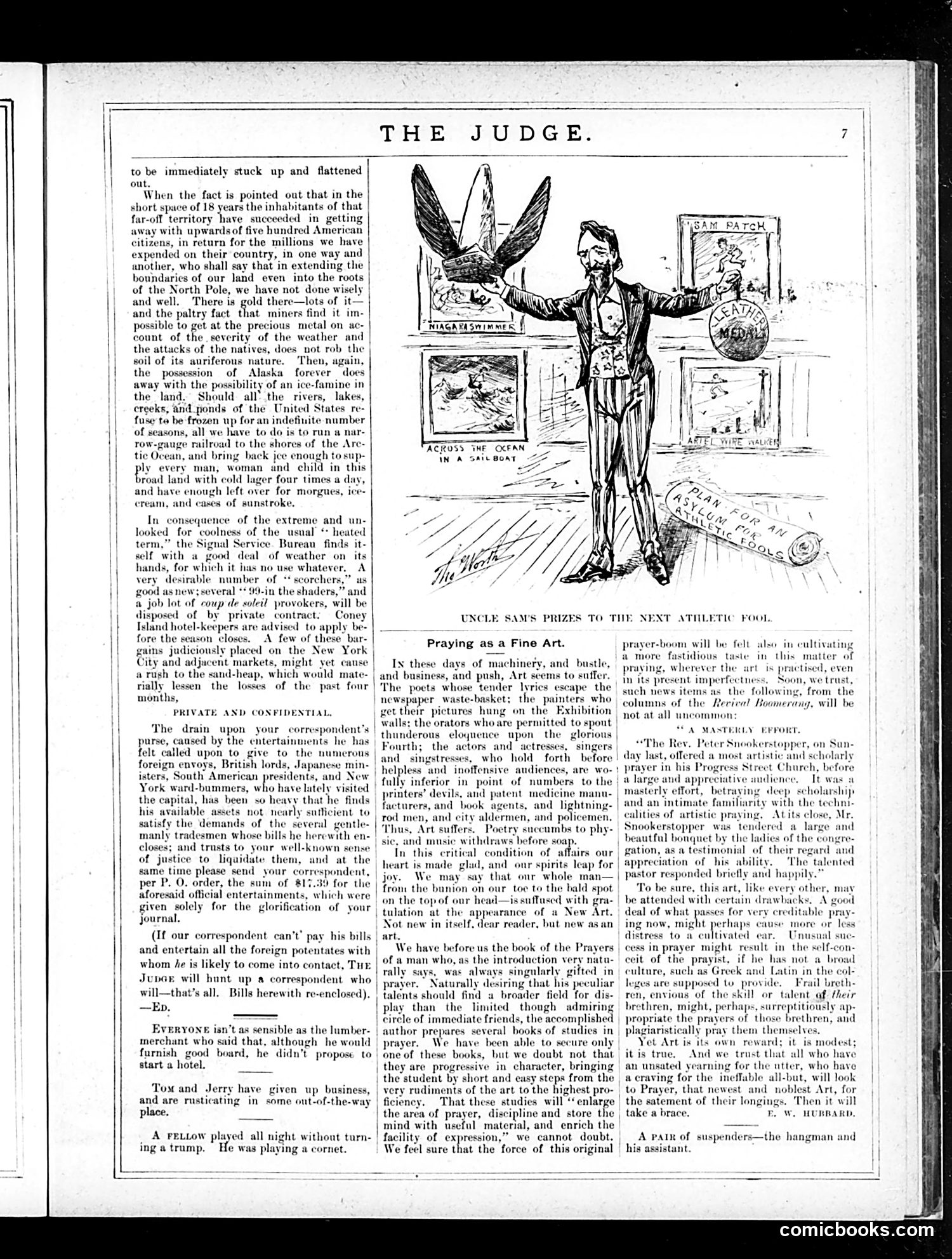
This page from Judge combines political satire with humor pieces. The main cartoon, "Uncle Sam's Prizes to the Next Athletic Fool," depicts Uncle Sam juggling Alaska-related items—apparently mocking American expansion into Alaska. The satirical text discusses Alaska's acquisition, sarcastically questioning its value given indigenous attacks on American settlers and the extreme climate. The author ironically suggests Alaska's worth lies in gold (inaccessible due to weather and hostile natives) and as a future ice supply for America. The accompanying text sections are lighter fare: complaints about entertaining foreign dignitaries, puns about weather ("heated term"), and jokes about entertainers. One piece mocks a lumber merchant's poor business sense; another contains a pun about a cornet player. Overall, the page reflects late-19th-century American skepticism about Alaska's territorial acquisition and satirizes both expansion policy and contemporary social pretensions.
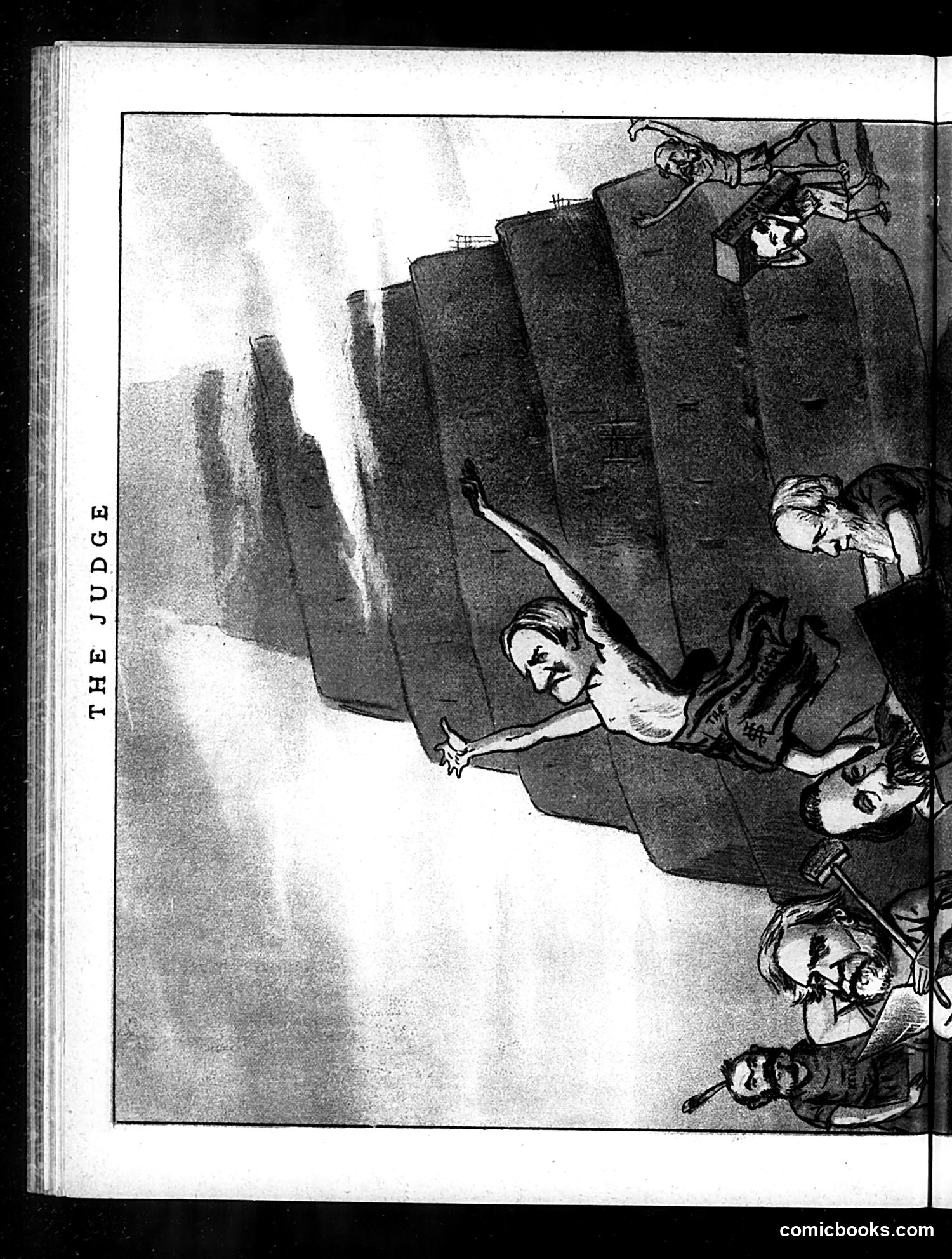
This page appears to be a title page or section header from *Judge* magazine, displaying "THE JUDGE" text vertically along the left margin. The main image, rotated 90 degrees, shows what appears to be a courtroom or judicial scene with multiple figures in formal dress arranged in a hierarchical composition. The figures seem to be judges or court officials, though without clearer resolution or additional context text, I cannot confidently identify specific individuals or the particular case being satirized. The composition suggests commentary on the judicial system or a notable legal proceeding of the era, which was typical satirical fodder for *Judge*. The OCR'd text contains only formatting characters, providing no additional context about the cartoon's specific target or message.
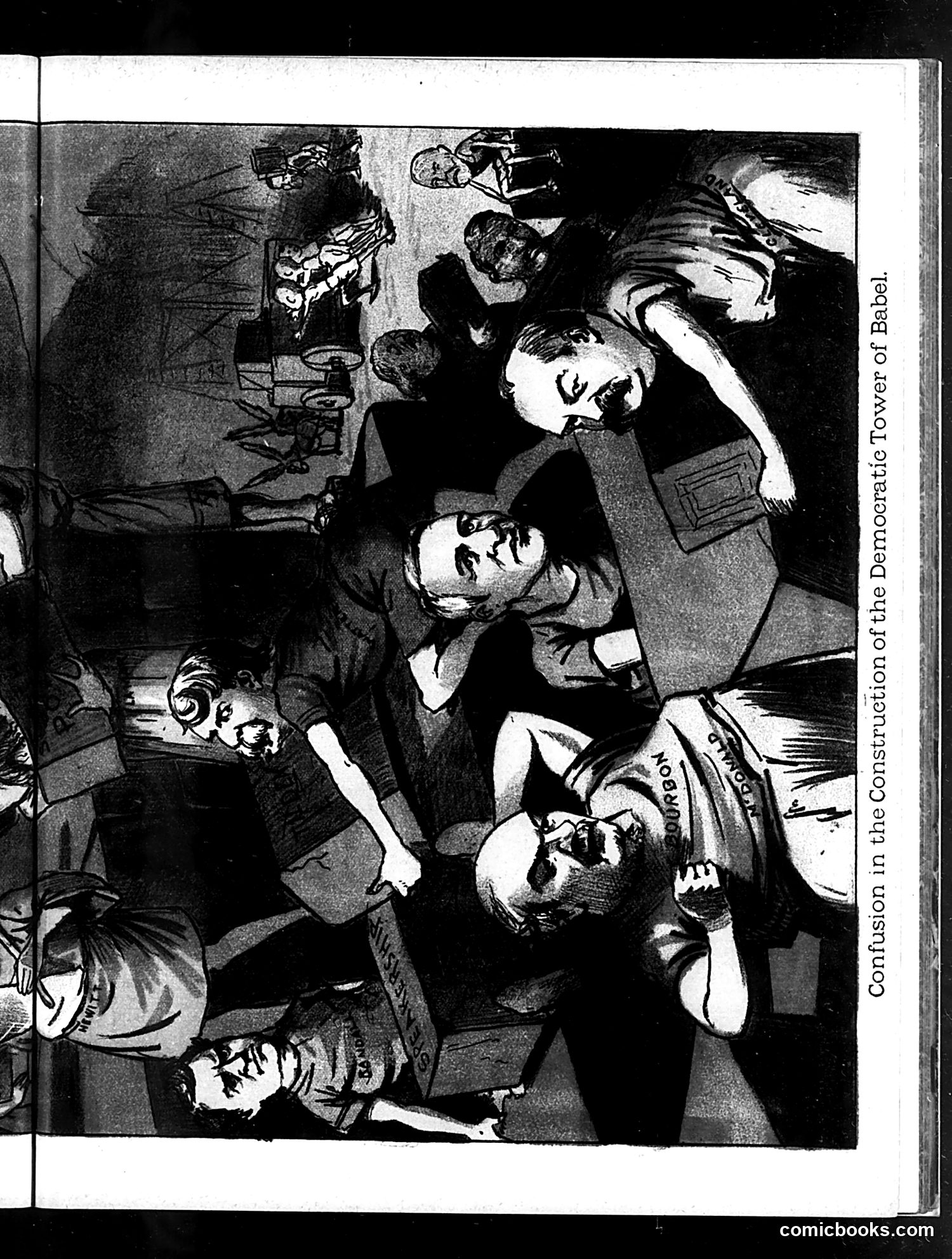
This is a black and white political cartoon showing multiple figures in what appears to be a violent or chaotic scene. The caption reads "Confusion in the Construction of the Democratic Tower of Babel." The cartoon depicts several men in suits engaged in conflict or struggle, likely representing Democratic Party leadership or factions in disarray. The "Tower of Babel" reference—a biblical allusion to a structure that collapsed due to confusion and inability to communicate—suggests the cartoon satirizes internal Democratic Party divisions or chaos during their political operations. The specific figures and historical moment are unclear from the image alone, but this appears to be commentary on Democratic Party infighting or organizational dysfunction, a common satirical theme in *Judge* magazine. Without additional context about the publication date, the identities of specific individuals remain uncertain.
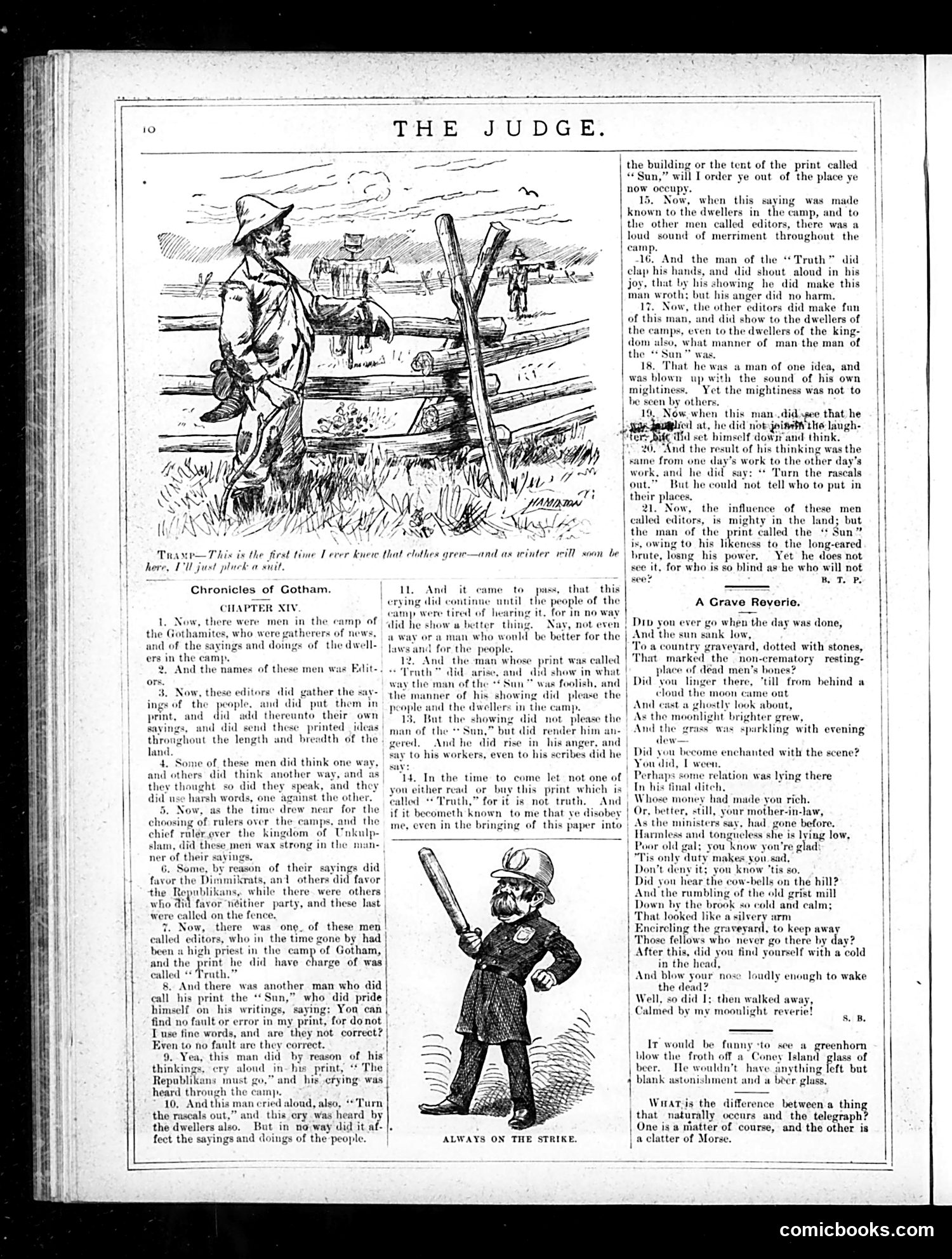
This page contains satirical commentary on **newspaper editors in New York City** (referred to as "Gotham"). The main narrative, "Chronicles of Gotham," mocks the rivalry and ideological conflicts among competing editors and newspapers. The central figures appear to be editors representing different political factions—some favoring Democrats ("Dimmikrats"), others Republicans. One editor, notably of a paper called the "Sun," is portrayed as self-righteous and ineffectual, repeatedly crying "Turn the rascals out!" without offering constructive alternatives. The satire suggests this editor is all bluster, compared to "the long-eared brute" (a donkey)—implying foolishness. The illustrations depict newspaper offices and editorial conflict. The piece ridicules how editors gather public opinion, add their own views, and amplify partisan divisions through print—while their actual influence on governance remains negligible. The secondary poem, "A Grave Reverie," is unrelated political humor about graveyards and mortality. This reflects **Gilded Age press criticism**: Judge satirizes newspapers' self-importance and partisan excess during a period of intense editorial warfare.
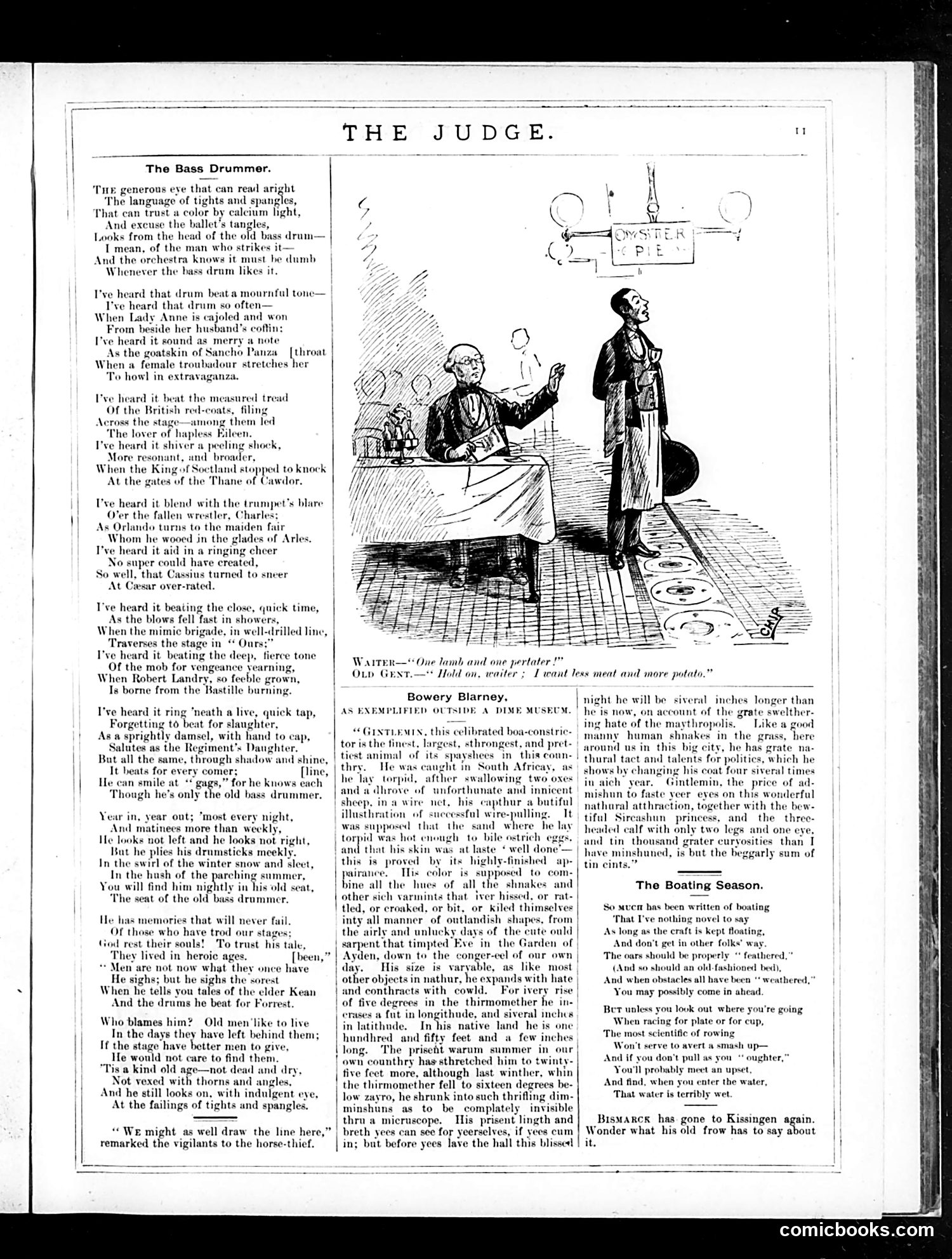
This page contains two distinct pieces: **"The Bass Drummer"** (left): A nostalgic poem celebrating the anonymous orchestra bass drummer—a figure who appears nightly but never receives recognition. The verse catalogs the drum's emotional range across theatrical productions, from melodramas to comedies. The satire targets theatrical pretension: while actors and dancers receive applause, the drummer—essential to every performance—remains invisible, accepting "gags" and indignities. It's sentimental commentary on unsung laborers in entertainment. **"Bowery Blarney"** (right): The cartoon mocks a dime museum barker's exaggerated pitch about a boa constrictor. The barker uses bombastic, phonetically-spelled working-class dialect ("sthrongest," "spayshees," "gintlemin") to bedazzle naive customers with inflated claims. The satire ridicules both the huckster's deception and the credulous audience—typical Judge mockery of lower-class entertainments and their audiences. Together, these pieces contrast theatrical worlds: one earnest (legitimate theater), one fraudulent (dime museums).
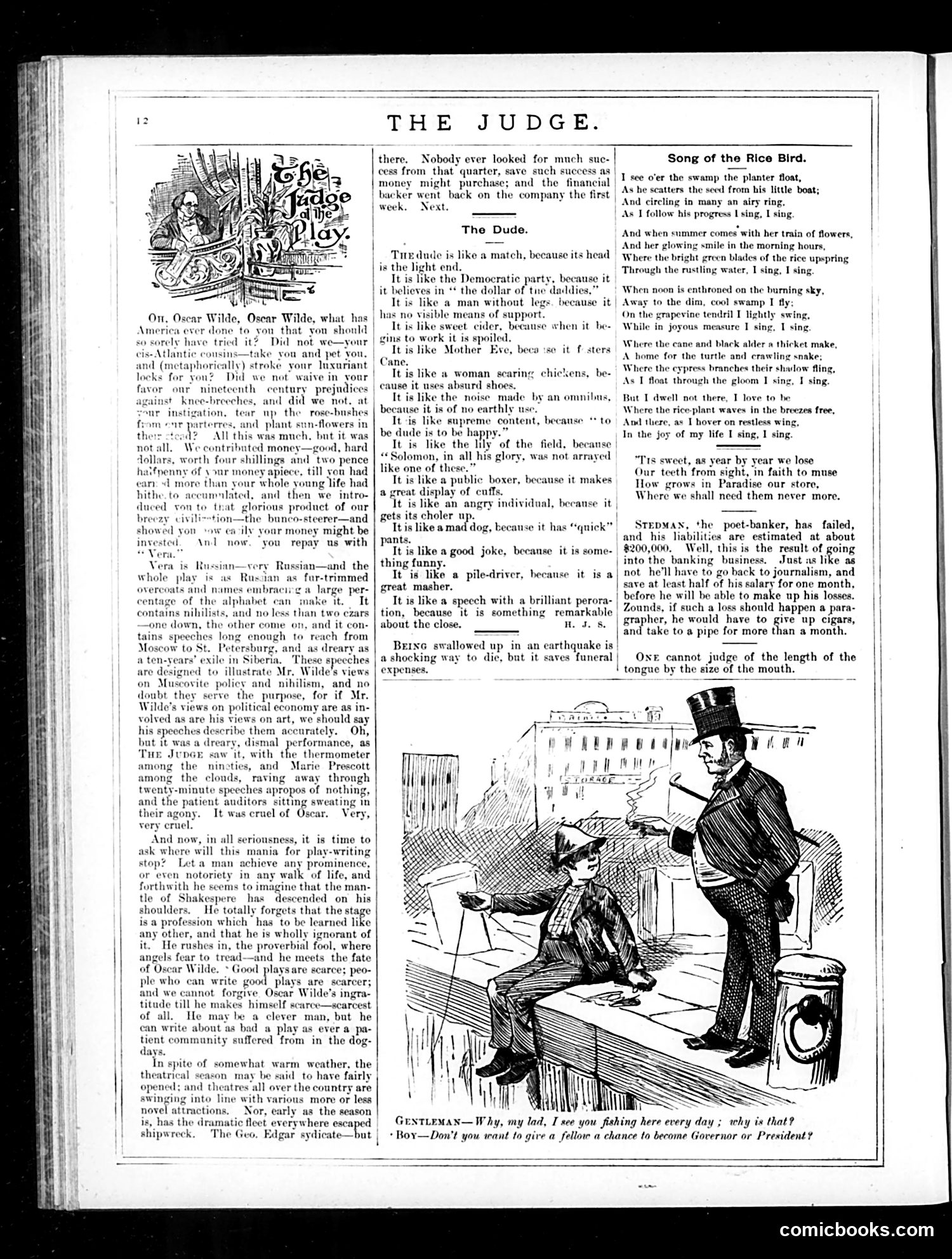
The main cartoon critiques **Oscar Wilde's** visit to America. The text accuses Wilde of ingratitude: Americans welcomed him, invested money in his theatrical ventures, and introduced him to American society. In return, he wrote plays (apparently including one with Russian nihilist themes) that the author finds tedious and poorly constructed. The satire suggests Wilde, despite his cleverness, is an arrogant charlatan who lacks genuine theatrical talent and abuses American hospitality. The page also contains a humorous extended comparison defining "the Dude"—a fashionable but vapid young man—through absurd metaphors (like a match, sweet cider, Mother Eve). This targets the aesthetic movement's fashionable adherents. The cartoon illustration (lower right) shows a gentleman fishing, captioned about giving "a fellow a chance to become Governor or President"—likely satirizing patronage or political favoritism of the era.
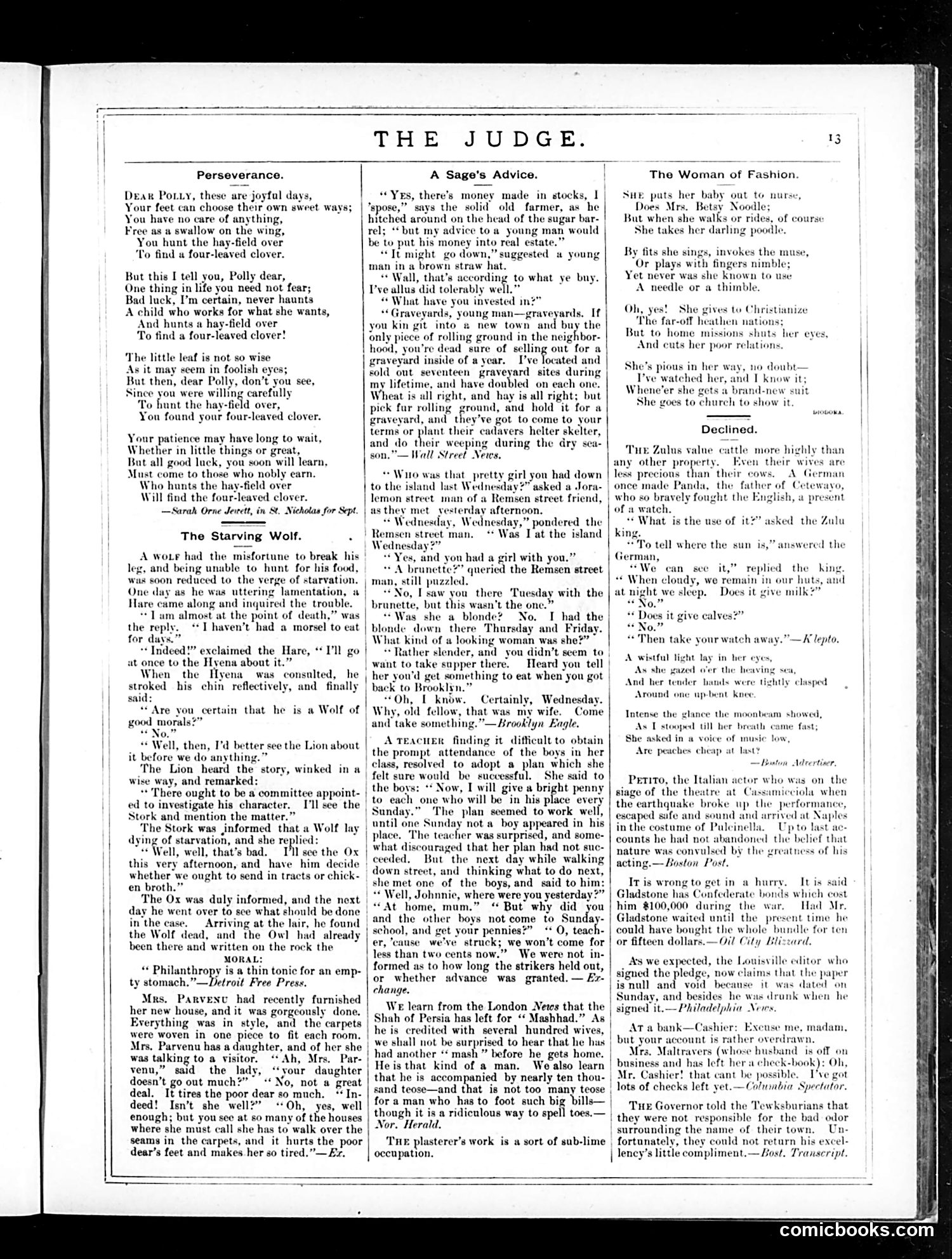
This page from the satirical magazine *Judge* contains three distinct pieces of social commentary: **"Perseverance"** and **"The Starving Wolf"** are moralistic verses—common in 19th-century publications—teaching virtue through fable. The wolf story's moral ("Philanthropy is a thin tonic for an empty stomach") satirizes bureaucratic committees that study problems endlessly while people suffer, a perennial target of American satire. **"A Sage's Advice"** mocks a rural farmer boasting of profiteering from graveyards—buying cheap land in new towns and selling it for burial grounds. This ridicules both rustic opportunism and the speaker's obliviousness to the grim nature of his "business." **"The Woman of Fashion"** and related brief items appear to mock upper-class pretension, particularly Mrs. Parvenu (literally "newly rich"), whose obsession with fashionable carpets causes her daughter pain—satirizing how the nouveau riche prioritize appearances over comfort and common sense. The page reflects *Judge*'s typical blend of moral instruction and class-based humor targeting both rural shrewdness and urban social climbing.
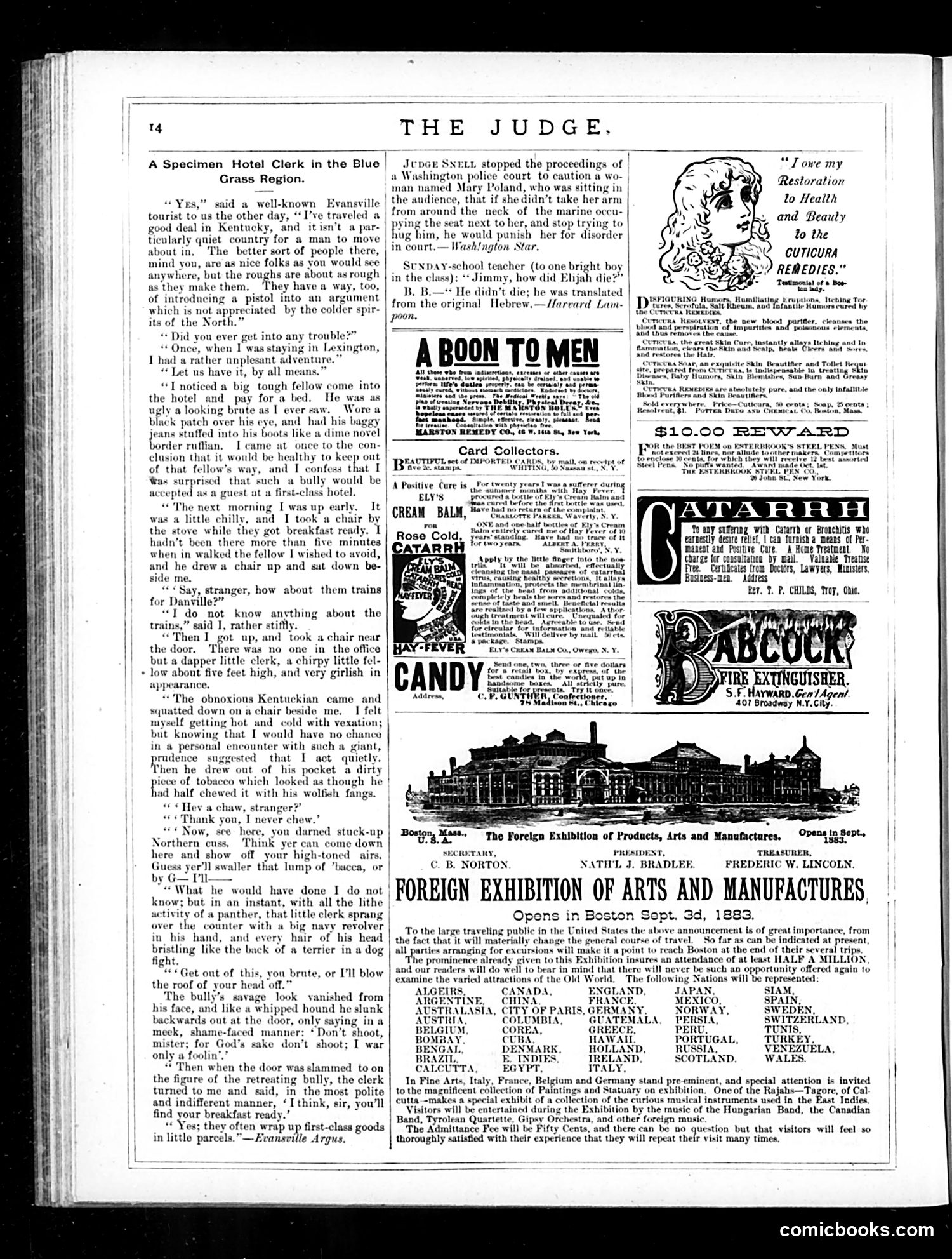
This page from *Judge* magazine contains a humorous anecdote about a confrontation in a Kentucky hotel. A Northern tourist describes encountering a rough, intimidating local man who threatens him over tobacco. The joke's punchline relies on class and regional stereotypes: despite his thuggish appearance, the bully is instantly cowed by the hotel clerk—described as a small, delicate, "girlish" man who pulls a revolver. The satire targets Kentucky's reputation for frontier violence while celebrating an unexpected hero. The humor depends on the surprise reversal: the effeminate-seeming clerk proves tougher than the brutish aggressor. This reflects Victorian-era anxieties about masculinity and regional character. The page also includes brief jokes about Bible translation and courtroom decorum, plus advertisements for patent medicines and exhibitions—typical *Judge* content mixing satire with commercial promotion.
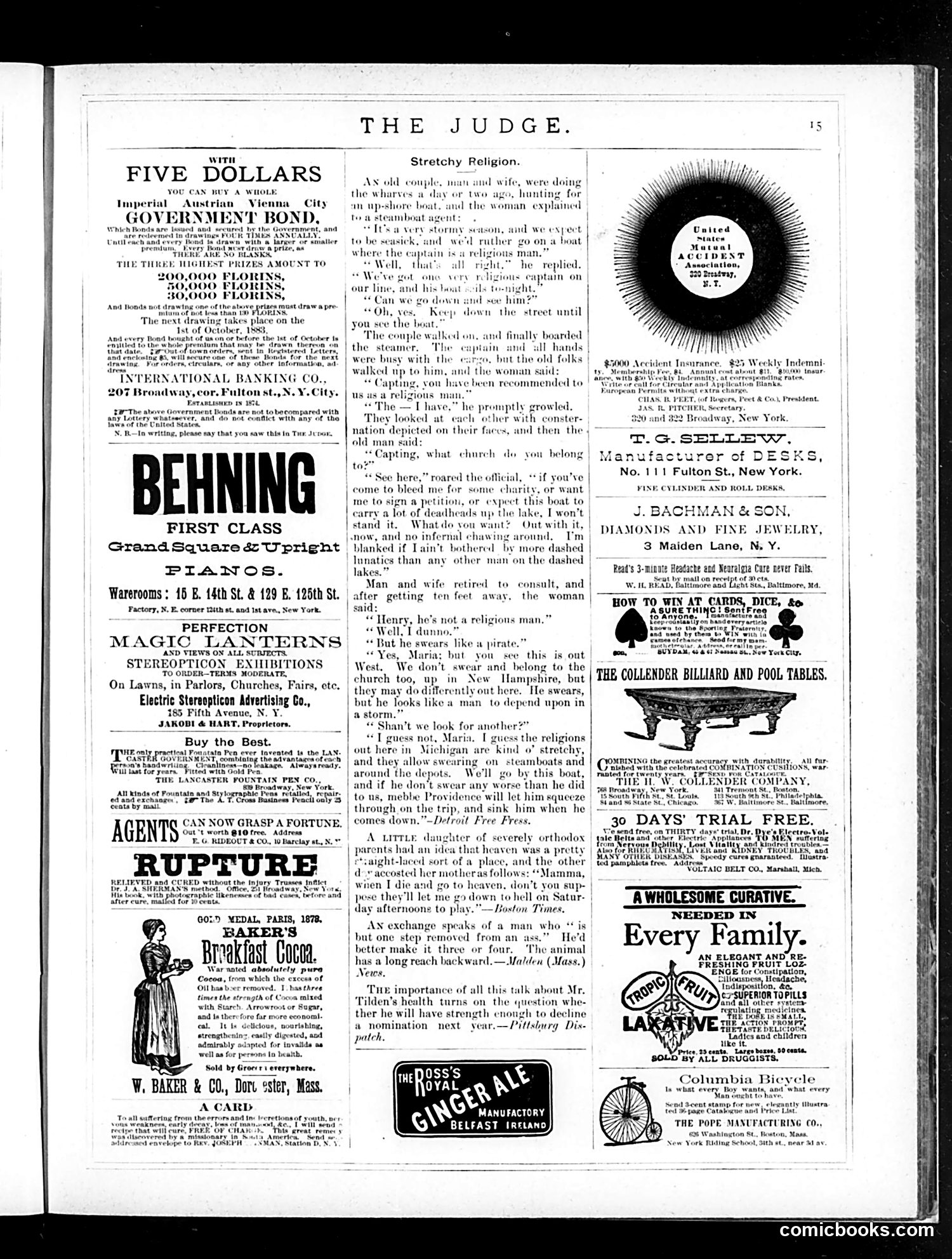
This page's main satirical piece is a short story titled "Stretchy Religion," which mocks the flexibility of religious principles in frontier America. **The Satire:** An elderly couple seeks passage on a riverboat. The captain swears profusely and behaves roughly, yet claims no religious affiliation. When the wife expresses concern, the husband argues that "religions out here in Michigan are kind o' stretchy"—meaning people bend their faith to suit circumstances. He reasons the captain *looks* dependable in a storm, so his lack of piety doesn't matter. The husband even suggests they'll tolerate the captain's worse behavior during their trip. **The Point:** Judge ridicules how practical necessity overrides moral conviction, especially in the West. Frontier communities allegedly adjusted religious standards pragmatically—you don't demand a pious captain if he's competent. The satire suggests this "stretchy" faith is hypocritical accommodation masquerading as tolerance. The rest of the page contains typical Judge advertisements (pianos, jewelry, breakfast cocoa) and brief satirical quips about other topics (Tilden's health, animals' reach).
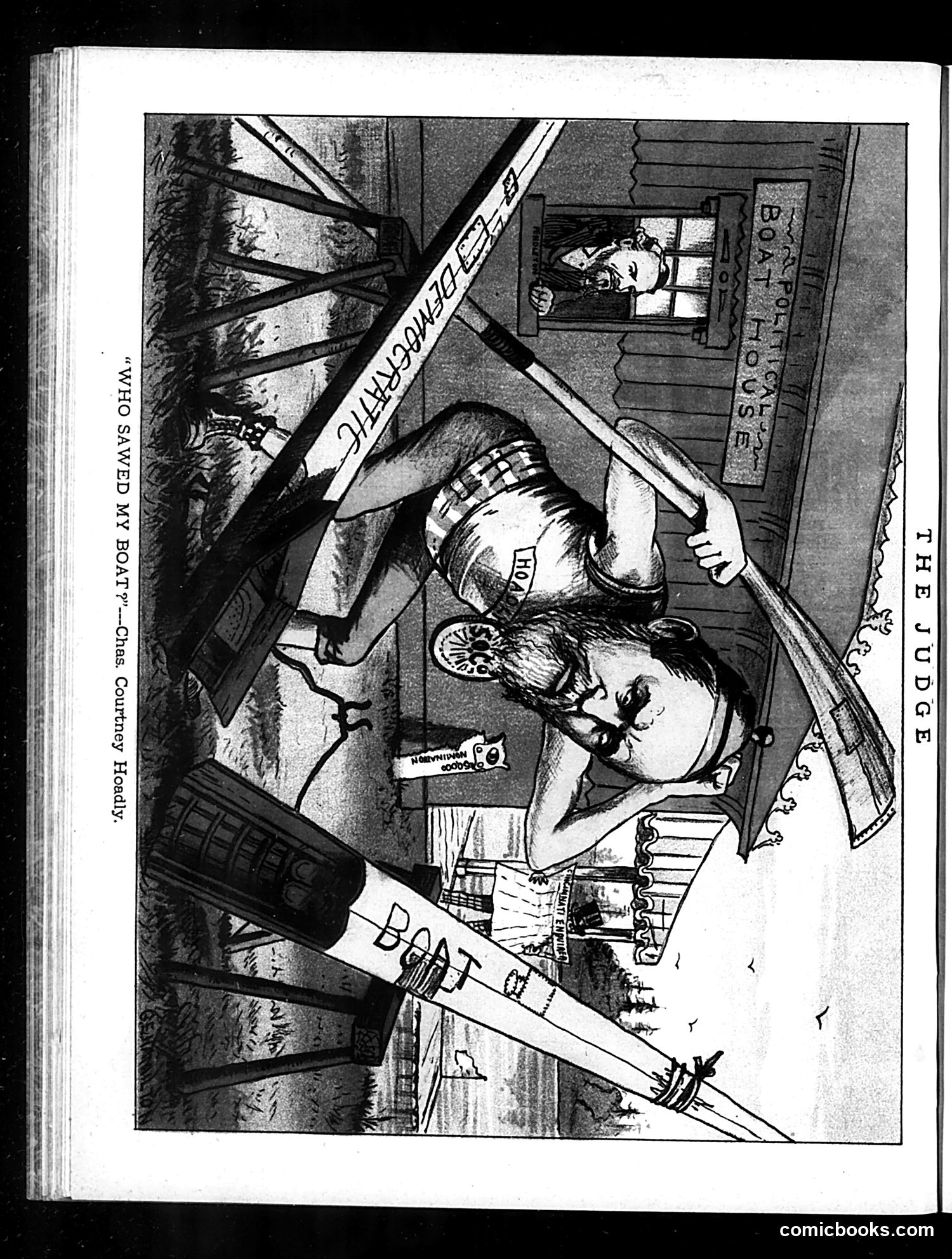
This page from *Judge* magazine features a satirical cartoon by Charles Courtney Hoadly. The image shows a man holding a baseball bat labeled "BOAT," appearing to be in an aggressive or confrontational stance. The cartoon appears to reference baseball as a metaphor for some form of conflict or competition. Without additional context about the publication date or specific historical event, the exact political reference remains unclear. However, the bat labeled "BOAT" suggests the satire may concern naval matters, maritime policy, or possibly labor/industrial disputes during a period when such issues were prominent in American politics. The satirical intent appears to mock either a political figure's aggressive stance or a particular policy position, using baseball imagery as the vehicle for commentary.