
Judge, 1883-09-08 · page 12 of 16
Judge — September 8, 1883 — page 12: what you’re looking at
What you’re looking at
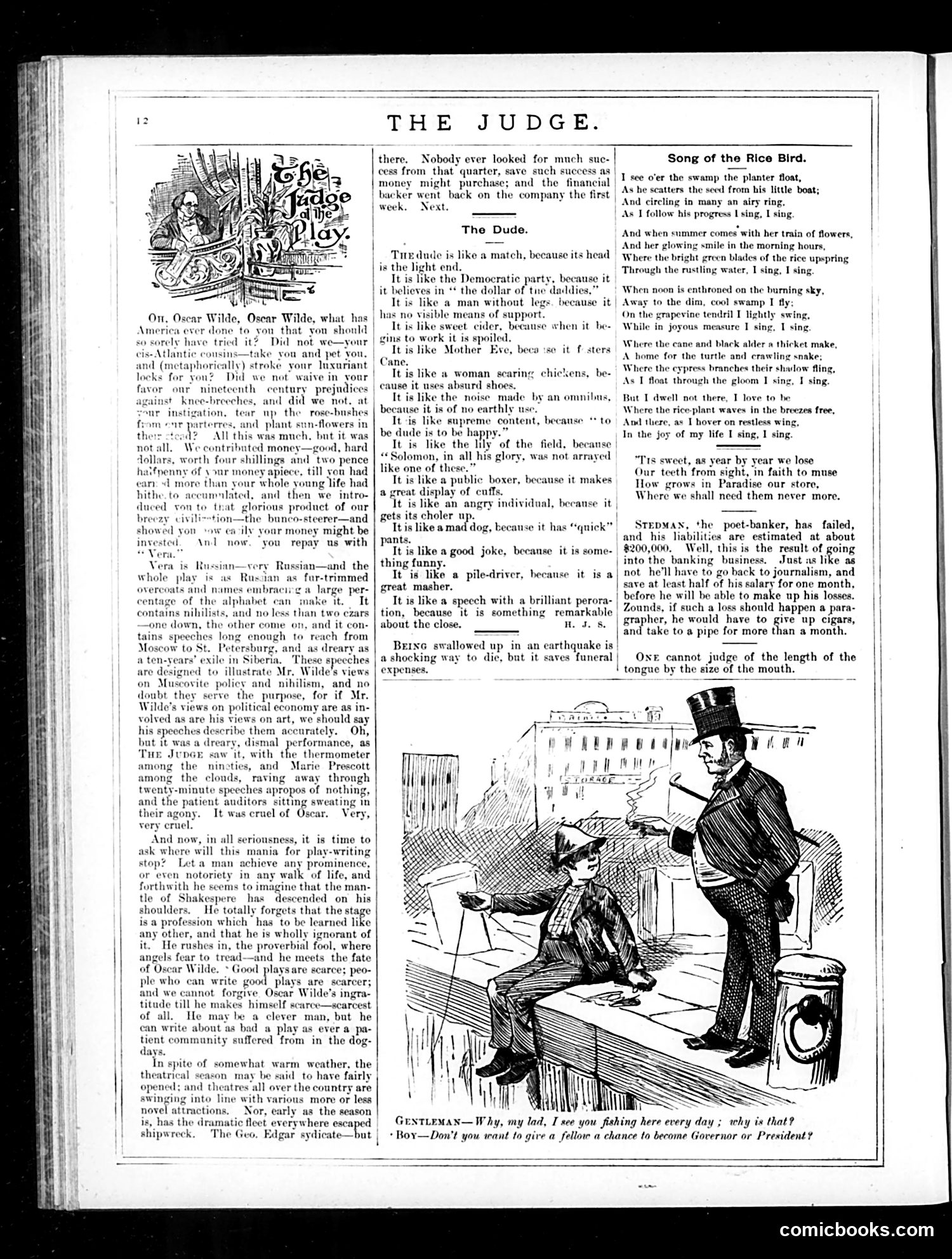
The main cartoon critiques **Oscar Wilde's** visit to America. The text accuses Wilde of ingratitude: Americans welcomed him, invested money in his theatrical ventures, and introduced him to American society. In return, he wrote plays (apparently including one with Russian nihilist themes) that the author finds tedious and poorly constructed. The satire suggests Wilde, despite his cleverness, is an arrogant charlatan who lacks genuine theatrical talent and abuses American hospitality. The page also contains a humorous extended comparison defining "the Dude"—a fashionable but vapid young man—through absurd metaphors (like a match, sweet cider, Mother Eve). This targets the aesthetic movement's fashionable adherents. The cartoon illustration (lower right) shows a gentleman fishing, captioned about giving "a fellow a chance to become Governor or President"—likely satirizing patronage or political favoritism of the era.
📄 Transcribed text from this page (OCR, searchable)
Machine-transcribed from the original scan — historical spelling and the odd misread are preserved.
5 Ph On, Oscar Wilde, Oscar Wilde, what has America ever done to you that you shonld rely have tried it? Did not we—your cis-Atlantic cousins—take you and pet You. and (metaphorically) stroke your Inxuriant locks for you? Did we not waive in your favor onr nineteenth century prejudices knee-brec and did w instigation, tear up the r parterres, and plant stn-flowers in the All this was much, but it was not all. We contributed money—good, hard Aollars, worth four shillings and two pence haifpenny 6f your money apiece. till yon had cart 4 more than your whole young life had hithe. to accunmlited, and then we intro- duced von to that glorious product of our breezy civiliv-tion—the bunco-steerer—and showed you ‘ow ea ily yoar money might be \nl now. “you repay us with very Russian—and the Russian fur-trimmed ind name: urge per- ge of the alphabe make it. It contains nihilists, and no Jess than two czars one down, the other come on, and it con- enough to reach from and as dreary as These spe ed to illustrate Mr. Wilde's views: on Muscovite policy and nihilism, and no doubt they purpose, for if Mr. Wilde’s views on political economy are as in- ¢ his views on art, we should say ibe them accurately. ary, dismal performance, w it, with the thermometer nineties, and » Prescott among the clouds, ‘raving away through twenty-minute speeches apropos hing, and the patient auditors sitting sweating in their agony. It was cruel of Oscar. Very, very cruel. Tur Juper among the And now, in all seriousness, it is time to will this mania for play-writing stop? Leta man ven notoriety forthwith he seem: tle of Sh shoulde: y ets that the stage is a profession which has to be learned like any other, and that he is wholly ignorant of it. He rushes in, the proverbial fool, where angels fear to tread—and he meets the fate Wilde. * Good plays are scarce: nnot forgive O. titude till he makes himself scarce—scarcest of all. He may be a clever man, but he n write about as bad a play as ever a pa- tient community suffered from in the dog- ny walk of life, and wine that the man- or in to im has In spite of somewhat warm weather, the theatrical season may id to have fairly and theatres all over the country are into line with various more or less tracti Nor, early as the season “amatic fleet everywhere escaped he Geo, Edgar sydicate—but chieve any prominence, | nded on his | THE JUDGE. there. Nobody ever looked for mnch sue- | from that quarter, save such s ey might purchase; and the t back on the company the first The Dude. Tue dude is like a match, because its head | is the light end. | it believes in ** the dollar of t It is like the Democratic party, because it daddie It is 1 4 man without legs. because it has no visible means of support. It is like sweet cider, because when it be- gins to work it is spoiled, It is like Mother E: Cane. It is like a woman scaring chickens, cause it uses absurd shoes. It is like the noise made by an omnibus, because it is of nm It is like supreme be dude is to be happy It is like the lily of the field, . in all his glory, was not a beca tse it f sters be- tent, because ** It is like a public boxer, because it makes a great display of cuffs. It is like an angry individual, becanse it gets its choler up. It is like a mad dog, pants. It is like a good joke, becanse it is some- thing funny. It is like a pile-driver, because it is a great masher. It is like a speech with a brilliant perora- | tion, because it is something remarkable about the close, H. J. 8 scanse it has “qnick” arthquake is saves funeral BEinG swallowed up in an ashocking way to die, but it expense eoeen ill i Song of the Rice Bird. I sce o'er the swamp the planter float, As he scatters the seed from his little boat; And circling in many an airy ring, As J follow his progress Ising, I sing. And when summer comes with her train of flowers, And her glowing smile in the morning hours, Where the bright green blades of the rice upspring Through the rustling water, I sing, I sing When noon is enthroned on the burning sky, Away to the dim, cool swamp I fly: On the grapevine tendril I lightly swing, While in joyous measure I sing, I sing. Where the cane and black alder a thicket make, A home for the turtle and crawling snake; press branches their shalow fling, As I float through the gloom I sing, I sing. But I dwell not there, T love to be Where the rice-plant waves in the breezes free, as T hover on restless wing, iy of my life I sing, I sing. “Tis sweet, as year by year we lose Our teeth from sight, in faith to muse How grows in Paradise our store, Where we shall need them never more. STEDMAN, the poet-banker, has failed, and his liabilities are estimated at about $200,000. Well, this is the result of going into the banking business. Just as like as not he'll have to go back to journalism, and save at least half of his salary for one month, before he will be able to make up his losses. Zounds, if such a loss should happen a para- | grapher, he would have to give up cigars, and take to a pipe for more than a month. Ose cannot judge of the length of the tongue by the size of the mouth. Fu Wie i fh fit Ie | id, T see you fishing here every day ; why ix that? + Boy—Don't you want to give a fellor a chance to become Governor or President? comicbooks.com