
Judge, 1883-09-08 · page 10 of 16
Judge — September 8, 1883 — page 10: what you’re looking at
What you’re looking at
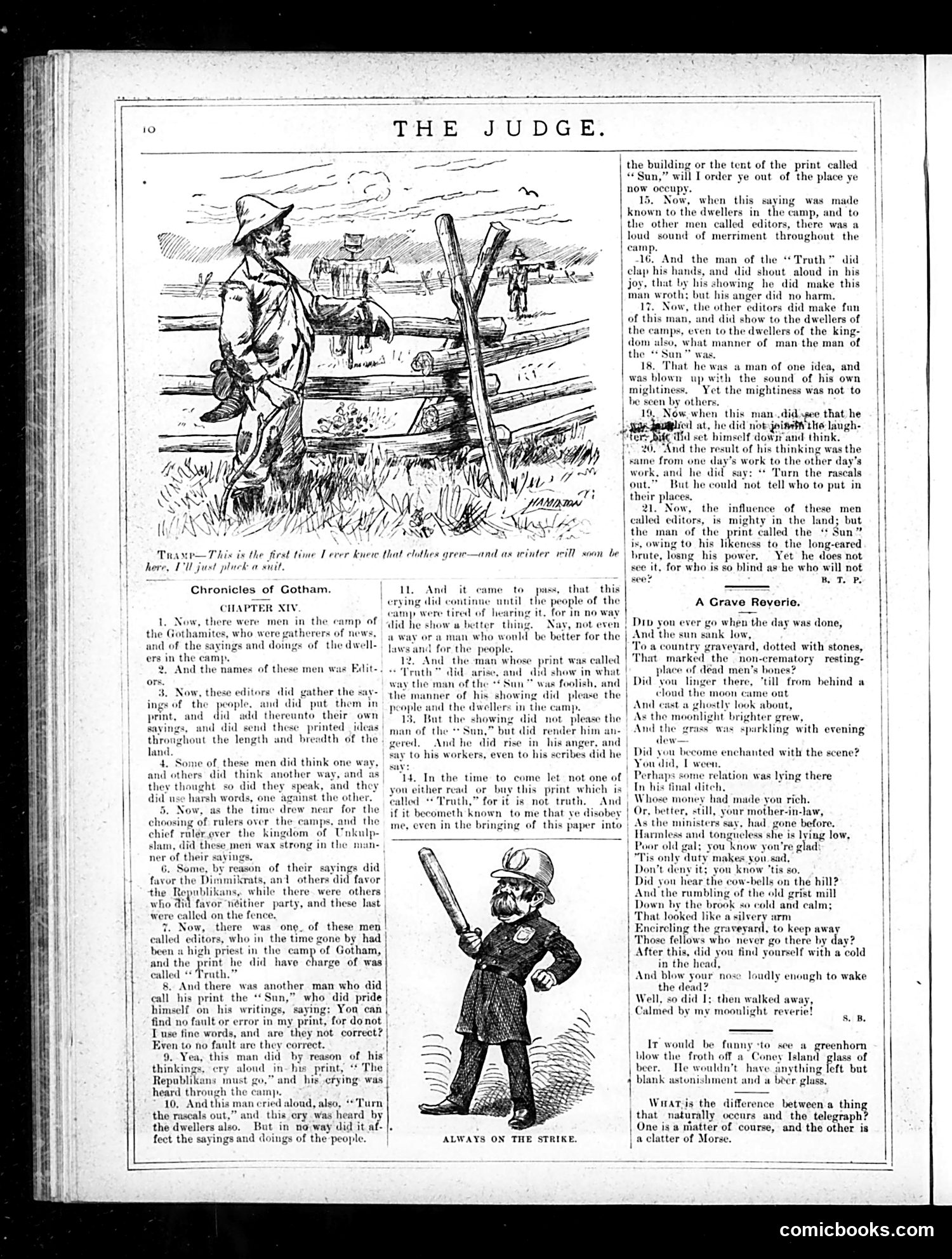
This page contains satirical commentary on **newspaper editors in New York City** (referred to as "Gotham"). The main narrative, "Chronicles of Gotham," mocks the rivalry and ideological conflicts among competing editors and newspapers. The central figures appear to be editors representing different political factions—some favoring Democrats ("Dimmikrats"), others Republicans. One editor, notably of a paper called the "Sun," is portrayed as self-righteous and ineffectual, repeatedly crying "Turn the rascals out!" without offering constructive alternatives. The satire suggests this editor is all bluster, compared to "the long-eared brute" (a donkey)—implying foolishness. The illustrations depict newspaper offices and editorial conflict. The piece ridicules how editors gather public opinion, add their own views, and amplify partisan divisions through print—while their actual influence on governance remains negligible. The secondary poem, "A Grave Reverie," is unrelated political humor about graveyards and mortality. This reflects **Gilded Age press criticism**: Judge satirizes newspapers' self-importance and partisan excess during a period of intense editorial warfare.
📄 Transcribed text from this page (OCR, searchable)
Machine-transcribed from the original scan — historical spelling and the odd misread are preserved.
THE JUDGE. | the building or the tent of the print “Sun,” will Torder ye out of the now occupy. Now, when this saying was made known to the dwellers in the camp, and to the other men called editors, there was a loud sound of merriment throughout the camp. . And the man of the “Truth” did ap his han id did shout aloud in his that by his showing he did make this man wroth: but his anger did no harm. 17. Now, the other editors did make fun Trame—This is the first time Dever kuew that clothes grew—and ax winter will soon be here, LU just pluck a snit. Chronicles of Gotham. CHAPTER XIV 1, Now, there were men in the the Gothamites, who were gathy and of the sayings and doi ers in the camp. 2. And the names of these men was amp of of news, of the dwell- Now, these editors did gather the say- ings of the people, and did put them in print, and did add thereunto their own and did send these printed , ideas hout the length and breadth of the 4. Some of, these men did think one and others did think another way, and they thought so did they speak, and th did use harsh words, one ‘against the othe 5. Now, as the time drew near for the chief ruler ove slam, did these n nkulp- n wax strong in the man- son of their sayings did favor the Dimmikrats, and others did favor the Republikans, while there were others who @ i favor néither party, and these last led on the fence, | ‘ow, there was one, of these men called editors, who in the time gone by had | been a high priest in the camp of Gotham, | and the pri did havo charge of was calle | 8. And there wa nother man who did | call his print. the ‘«Sun,” who did pride | himself on his writing ying: Yon can, find no fault or error in my print, for donot I use fine words, and are they not correct? | Even to no fault are they correct. | 9. Yea, this man did by reason of his thinkings. cry aloud in- bis print, ‘* The | Republikans inus' and his fying was | heard through the cam) t 10, And this man cried aloud, also, “Turn the rascals out,” and this cry was heard by the dwellers But in no way did it af- fect the sayings and doings of the people. nd did show to the dwellers of to the dwellers of the king- was a man of one idea, and was blown up with the sound of his own mightiness. Yet the mightiness was not to be seen by others. 19. Now, when this man did gee that he | span dauapliond at, hie « Mh tle Langh- aS 4 Tid set himself dowsr and think. 20. “And the result of his thinking was the saine from one day's work to the other d work, and he did * Turn the rascals out.” But he could not tell who to put in their places, 21. Now, the influence of | called editors, is mighty in the land; but | the man of the print called the ‘ Sun” is, owing to his likeness to the long-eared brute, losng his power, Yet he does not it. for who is so blind as he who will not BT. P. these men IL, And it came to pass, that this crying did continue until the people of the camp were tired of hearing it, for in no way did he show a better thing. Nay, not even a way or a man who would be better for the laws and for the people. 12. And the man whe = Troth ” did. ari: nied way the man of the *¢ Sw the manner of his showing did pl people and the dwellers in the camp. But the showing did not please the | As the moonlight bright nof the * Sun,” but did render him an- | And the g And he did rise in his anger, and dew Did you become enchanted with the scene? You did, Iw Perhaps some relation was lying there inal diteh, ney had made A Grave Reverie, Dip you ever go when the day was done, And the sun sank low, ‘To a country graveyard, dotted with stones, T resting- » print was called show in what f was foolish, and | Did you linger the ‘loud the moon mes? till from behind a xe the grew, kling with evening ger ay to his workers, even to his scribes did he ne ‘14. In the time to come let not one of you either or bity this. print which is [n his fin callod ** Truth, it is not truth. And if it becometh known to me that ve disc me, even in the bringing of this paper into ministers say, had Harmless and tong’ Poor old gal; you know you | ’Tis only duty makes you sad, Don’t deny it nw “tis so. | Did you hear the cow-bells on the hill? ¢ rumbling of the old grist mill cold and calm; | d like a silvery arm | Encircling the graveyard, to keep away Those fellows who never go there by day? After this, did you find yourself with a cold in the head | And blow your nose loudly enough to wake | the dead? Well, so did 1: then walked away, j Calmed by my moonlight reveri 8. B. Ir would be funny sto see a greenhorn blow the froth off a Ce Island ss of j beer. He wouldn't have anything left but j blank astonishment and a beer. gluse Wuat.is the difference between a thing | that naturally occurs and the telegraph? | One is a miatter of course, and the other is \8 clatter of Morse. ALWAYS ON THE STRIKE. comicbooks.com