
A complete issue · 16 pages · 1883
Judge — May 26, 1883
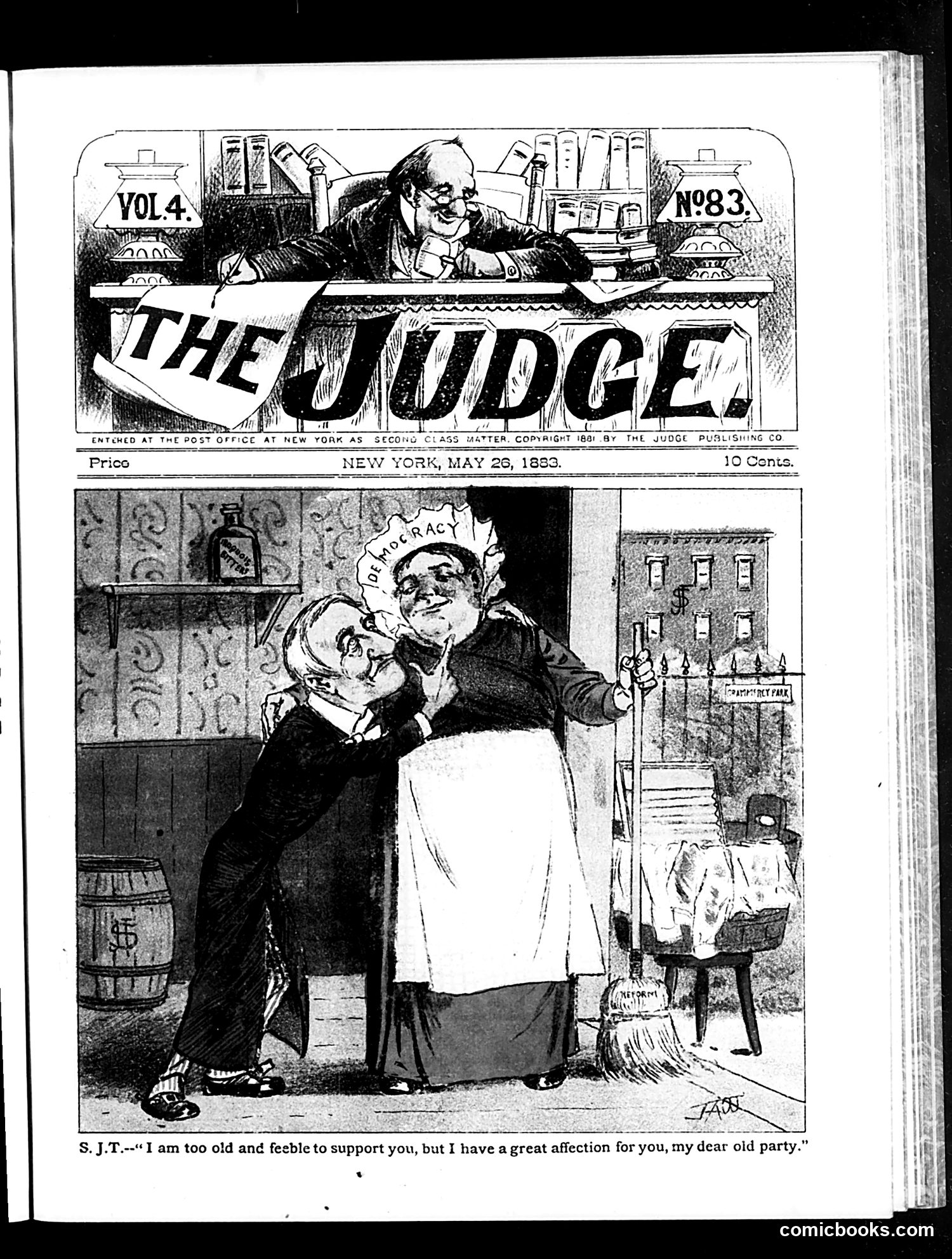
This cartoon satirizes the weakening of the Democratic Party during the Gilded Age. The figure labeled "Of Democracy" (wearing a mask) appears elderly and infirm, being physically supported by another man in formal dress. The caption reads: "I am too old and feeble to support you, but I have a great affection for you, my dear old party." The satire suggests that Democracy itself has become decrepit and unable to sustain the political party depending on it. The setting—a street with institutional buildings visible—implies governance and public affairs. The cartoon likely critiques how Democratic leadership had become ineffectual or corrupt during this era of American political weakness and machine politics. The image conveys pessimism about the party's vitality and future viability.
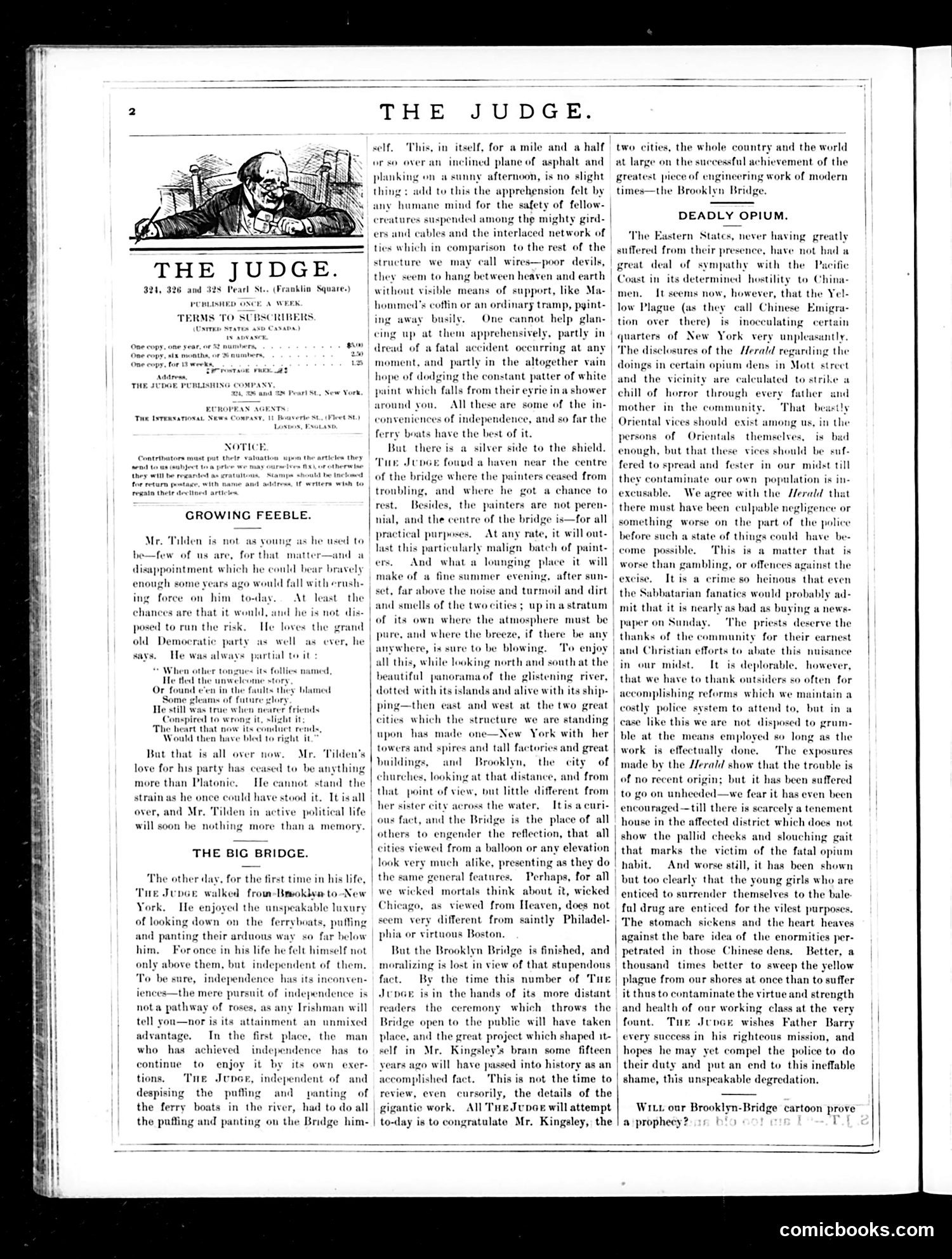
This page contains two satirical articles about American politics and engineering, not single unified cartoons. **"Growing Feeble"** mocks Samuel J. Tilden, the aging Democratic presidential candidate. The piece sarcastically suggests Tilden's love for the Democratic Party has become merely "Platonic"—he can no longer bear the disappointments of active politics and will soon fade from public life. The satire criticizes his weakening political commitment through nostalgic references to his former passion. **"The Big Bridge"** celebrates the newly completed Brooklyn Bridge (finished 1883), describing its engineering marvel while humorously noting the paradoxes of independence—the writer enjoys elevated views above ferry traffic but must endure paint falling from workers and crowds of pedestrians. The satire gently mocks urban smugness about technological progress while acknowledging its genuine achievements. Both pieces reflect Judge magazine's typical blend of political commentary and everyday social observation.
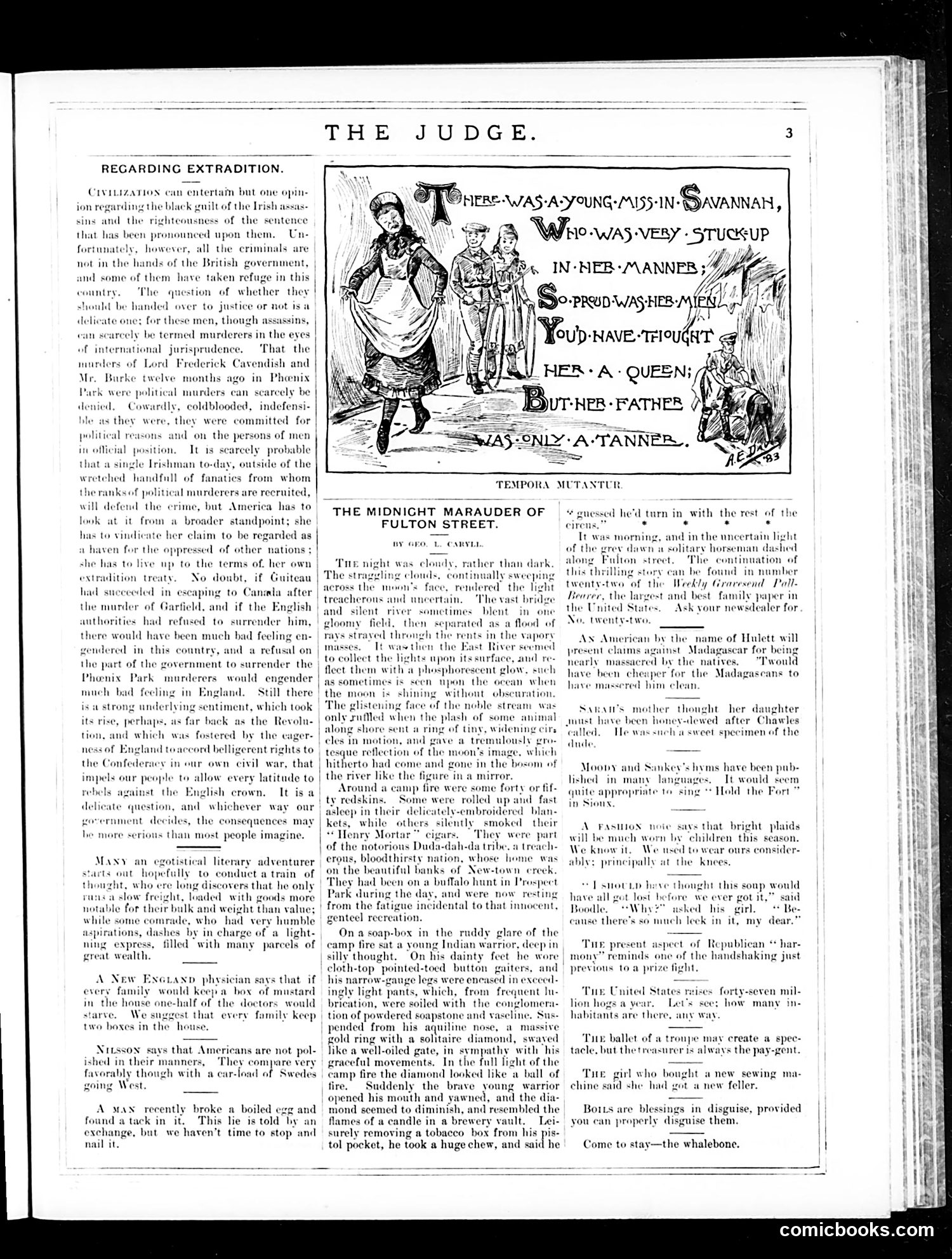
The main cartoon depicts a young woman from Savannah who was "stuck up in her manner" because her father was "only a tanner." The Latin title "Tempora Mutantur" (Times Change) signals the satire: social circumstances shift, and pretension based on inherited status proves foolish. The accompanying article about extradition discusses whether Irish assassins who murdered Lord Frederick Cavendish and Mr. Burke should be extradited from America to Britain for trial. The piece argues these were "political murders" rather than common crimes, creating legal and diplomatic complexity. It notes America would demand extradition if a criminal (like Guiteau, who attempted to assassinate President Garfield) fled to Canada—establishing precedent for mutual cooperation. The "Midnight Marauder of Fulton Street" appears to be a serialized fictional story about Native Americans ("Duda-dah-da tribe") encountered near a river at night. The page reflects late-19th-century *Judge* magazine's mix of social satire, political commentary on international law, and entertainment fiction.
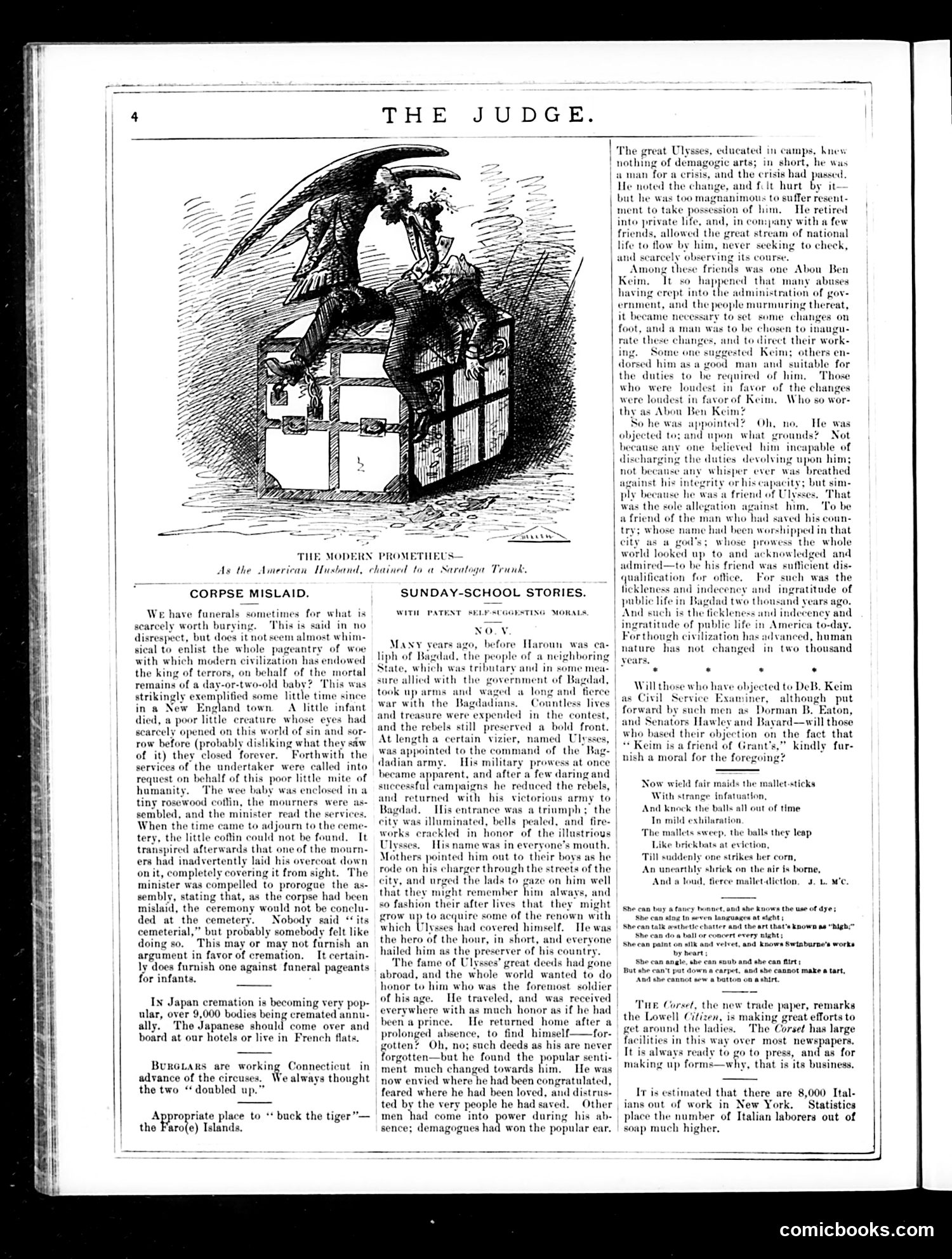
## Main Cartoon: "The Modern Prometheus" The large illustration depicts a husband literally chained to a massive Saratoga trunk—a reference to the popular travel luggage of the era. This satirizes the "American Husband" as enslaved by his wife's excessive luggage and travel demands. The Prometheus reference (the mythological titan punished by the gods) elevates domestic marital complaint to mock-heroic status. The joke targets both wives' materialism and husbands' helplessness in Victorian marriage dynamics. ## Text Content The page includes three distinct pieces: 1. **"Corpse Mislaid"**: A brief humorous anecdote about a funeral where mourners accidentally covered an infant's coffin with an overcoat, preventing burial. It satirizes elaborate funeral pageantry for trivial deaths. 2. **"Sunday-School Stories"**: A longer moral tale about Ulysses, a celebrated military general whose popularity evaporates when he returns home. Demagogues have supplanted him. The story illustrates how public favor is fickle and fleeting—a cautionary tale about fame and political power.
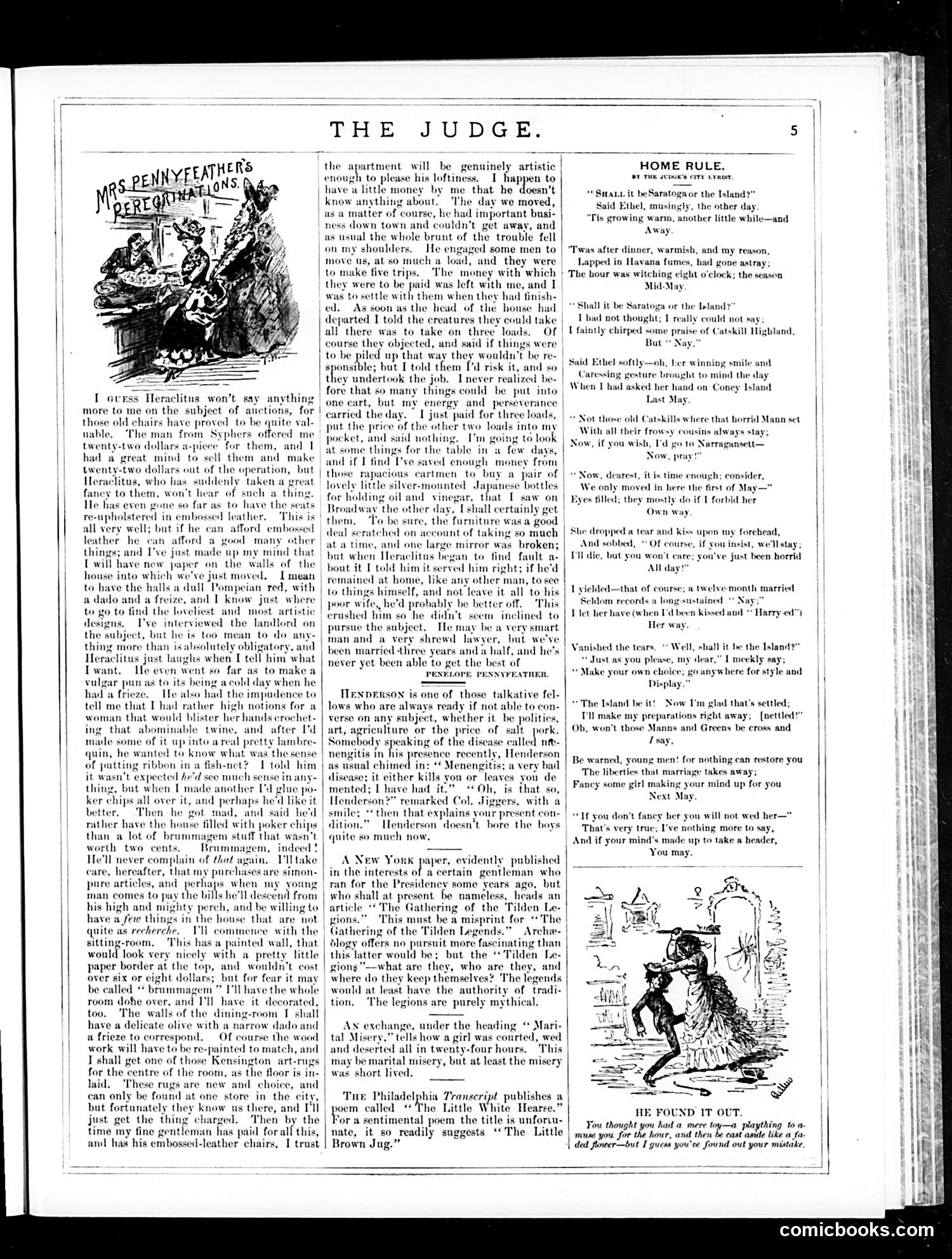
This page from *Judge* magazine features a satirical column titled "Mrs. Pennyfeather's Peregrinations," which mocks upper-middle-class domestic pretensions through the voice of a woman obsessed with fashionable home decoration. **The satire targets:** - **Marital class conflict**: The narrator secretly uses household money to fund elaborate redecorating (Pompeian red walls, Kensington art rugs, embossed leather chairs) without her husband's knowledge, exploiting his inattention. - **Conspicuous consumption and snobbery**: She dismisses her husband's practical concerns as "brummagem" (cheap imitation goods), insisting on expensive "recherche" (rare, refined) items while deceiving him about costs. - **Domestic power dynamics**: The wife outwits her dismissive husband, who makes crude jokes about her tastes, by spending money he doesn't know exists. The humor relies on recognizing the hypocrisy: she criticizes his materialism while engaging in elaborate financial deception to satisfy her own status-seeking impulses. The illustration shows a gossiping scene typical of *Judge's* satirizing of Victorian/Edwardian bourgeois society.
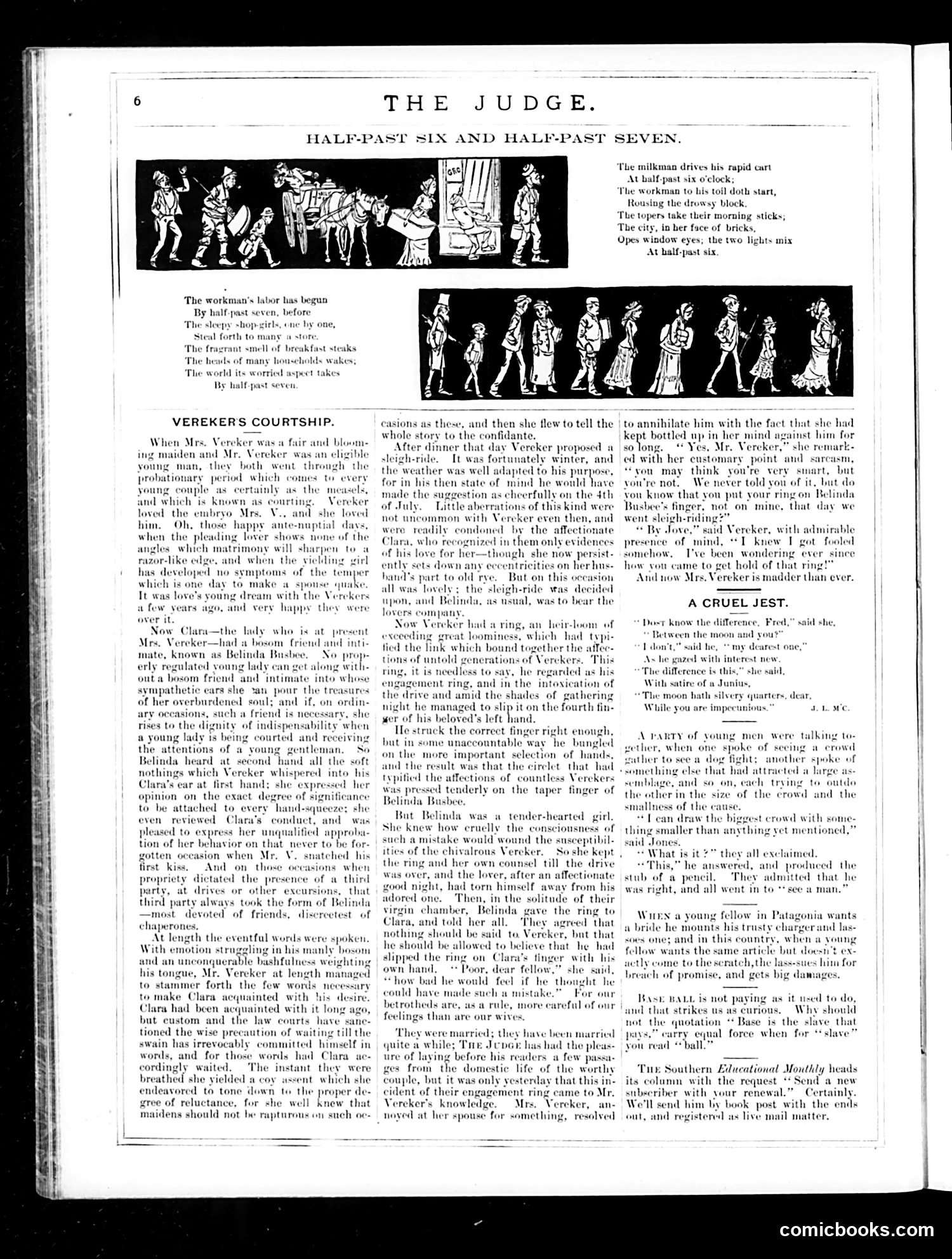
This page contains a serialized story satirizing Victorian courtship conventions. The narrative follows Mr. and Mrs. Vereker's engagement period, mocking the stilted behavior of young lovers of the era. The satire targets several period conventions: the intensity of "bosom friendships" between unmarried women (Belinda serves as Clara's confidante and chaperone); the artificial coyness expected of women receiving marriage proposals; and the elaborate social rituals surrounding courtship. The story's joke centers on an heirloom engagement ring—Vereker attempts a romantic proposal scene during a winter sleigh ride but loses the ring, which becomes tangled in Clara's clothing. The punchline ("Vereker is madder than ever") plays on the gap between romantic intention and comedic reality. The accompanying illustrations show daily life scenes (morning routines, social gatherings) that frame the domestic subject matter. This reflects *Judge* magazine's focus on satirizing American middle-class social life and manners.
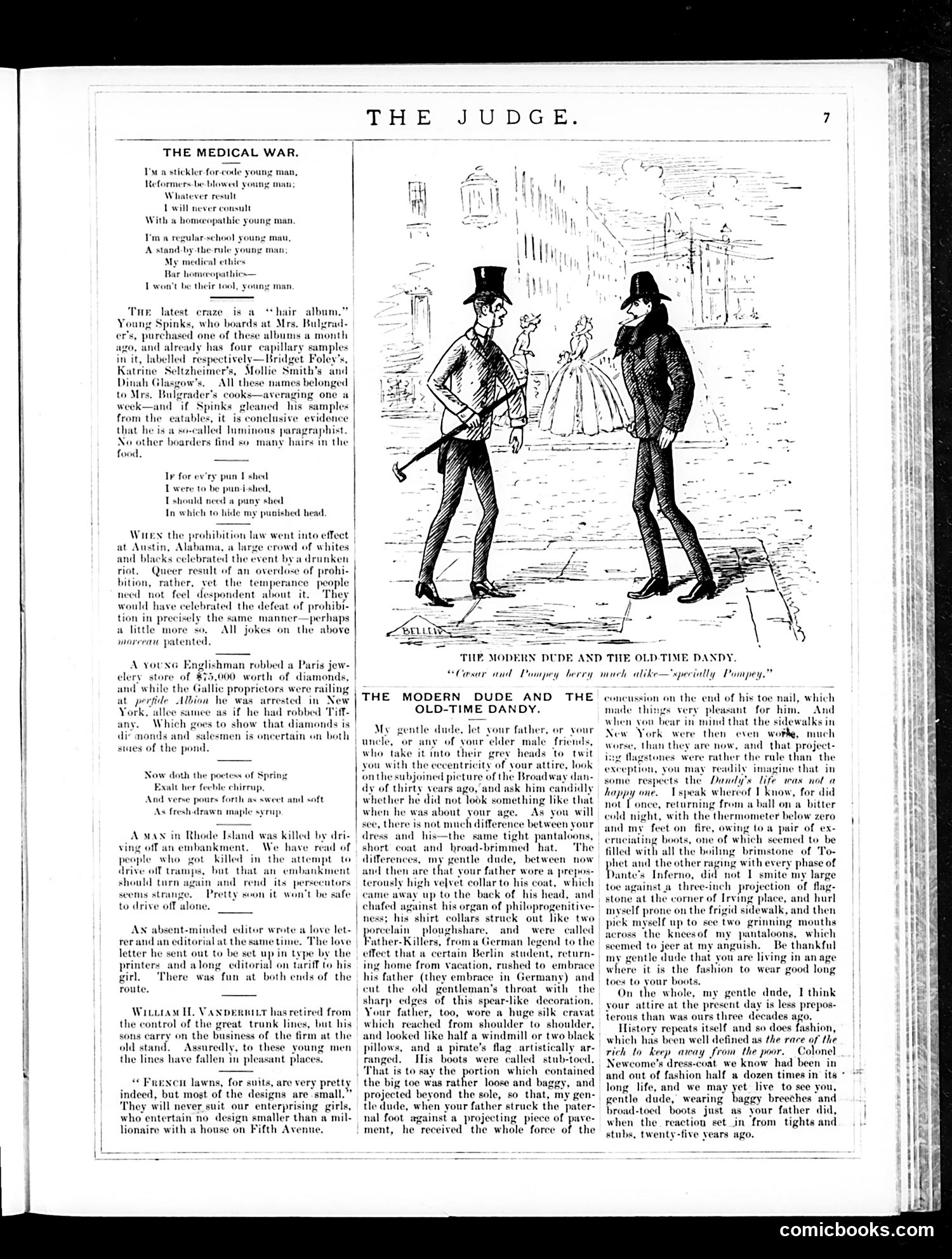
This cartoon contrasts fashionable men across generations. The central illustration shows two figures—a contemporary "modern dude" (left, in top hat) and an "old-time dandy" (right, from thirty years prior). The accompanying essay mocks the modern gentleman for believing his style is original, when actually 1880s-era dandies dressed identically: tight pants, broad-brimmed hats, and high velvet collars. The humor derives from the notion that young men foolishly think themselves fashionably avant-garde when they're merely recycling their fathers' outdated looks. The satirical text humorously recounts the writer's painful experience wearing period boots—so tight they caused blistering agony—suggesting that fashion's discomfort transcends decades. Judge is essentially ridicule young men's vanity about fashion while suggesting that masculine style remains fundamentally unchanged.
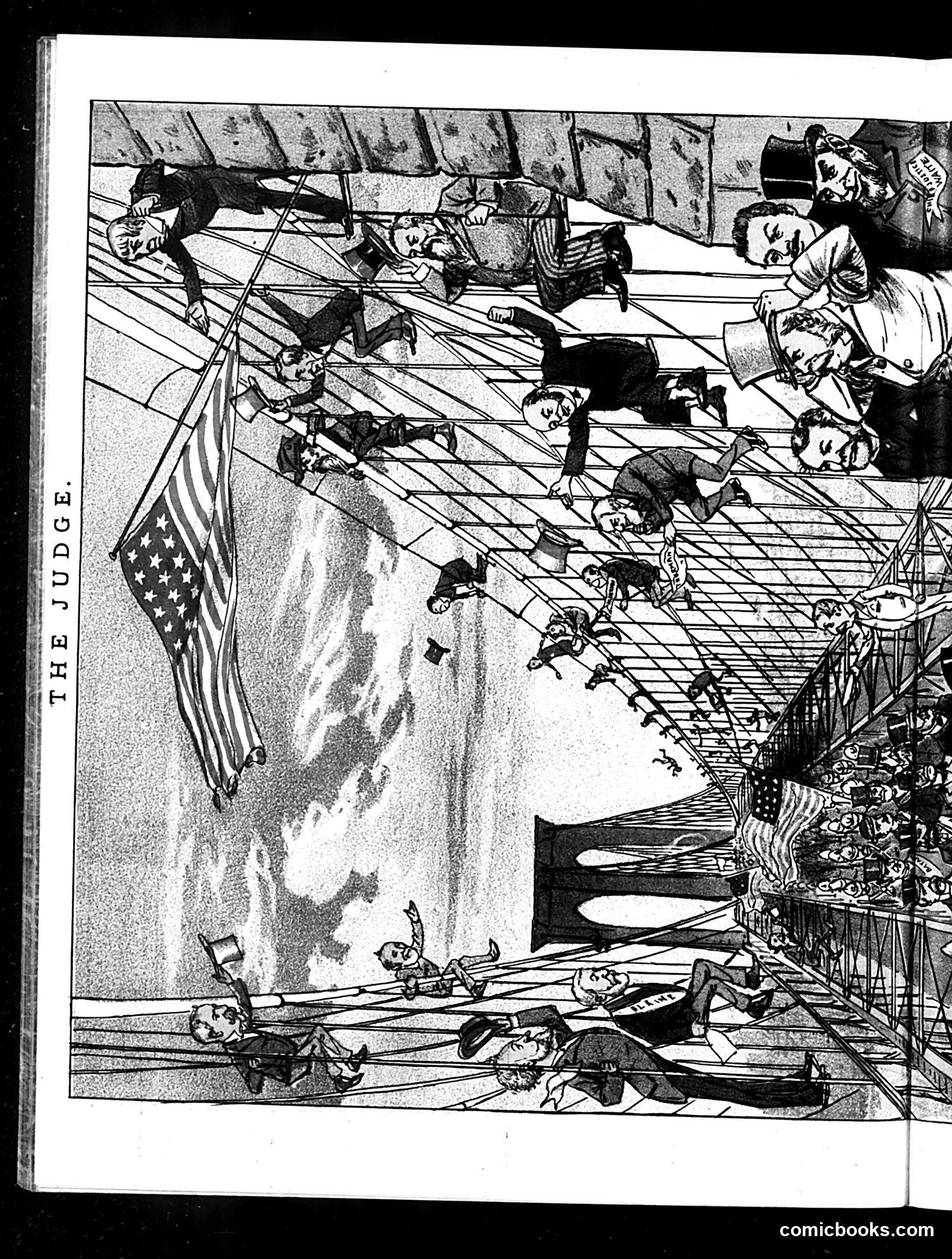
This page appears to be from *Judge* magazine, a satirical publication. The image shows a courtroom or judicial scene rotated 90 degrees, with an American flag visible on the left side. Multiple figures in formal dress are depicted in what seems to be a chaotic or crowded legal proceeding. However, the OCR text provided contains only garbled characters and no legible content, making it impossible to identify the specific political figures, legal case, or satirical point being made. Without readable text or clear caption identifying the figures, I cannot definitively explain what particular scandal, trial, or social issue this cartoon addresses. To properly analyze this satire, clearer text or additional context about the publication date would be necessary.
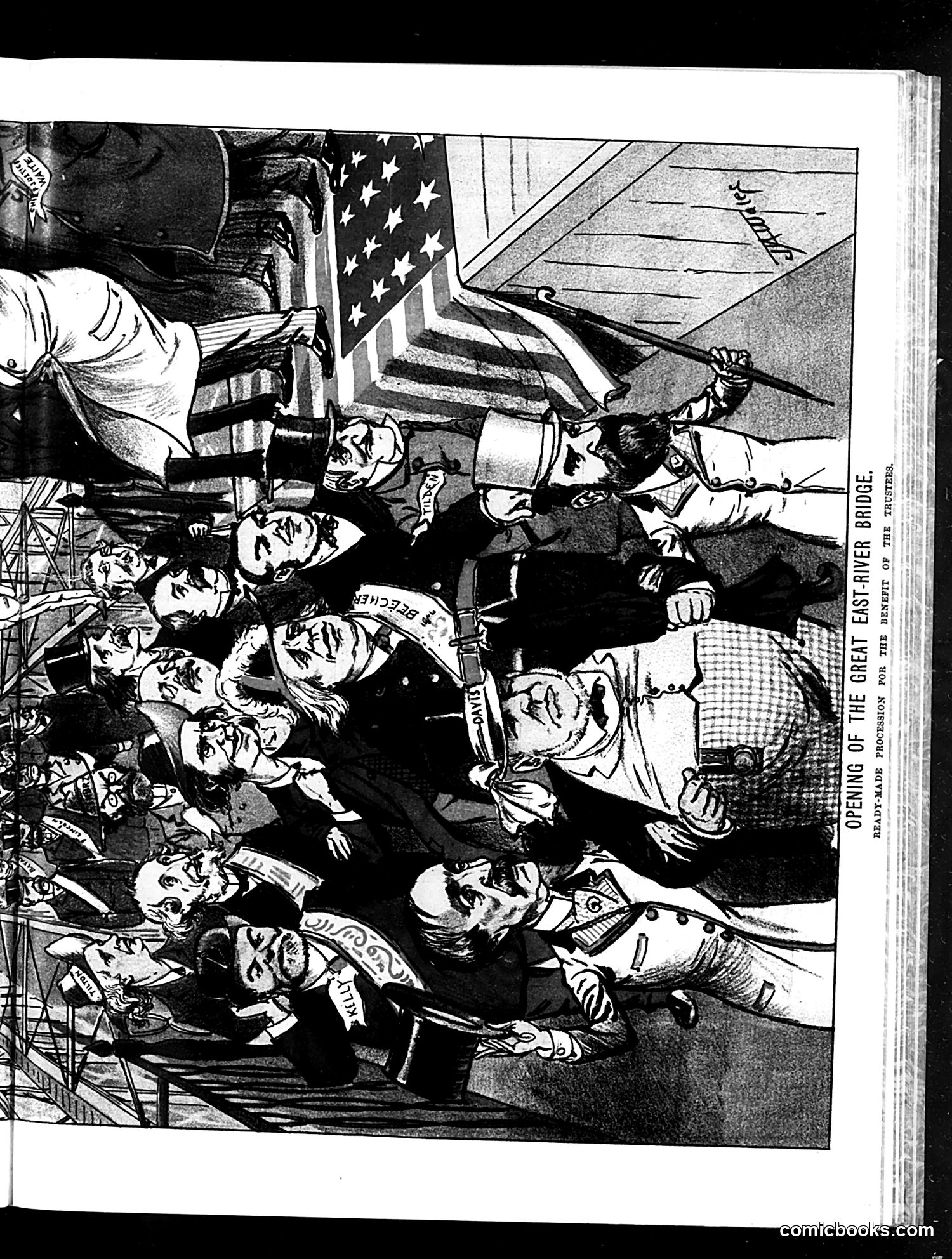
This satirical cartoon depicts a ceremonial bridge-opening attended by numerous dignitaries and military officers. The composition is crowded with caricatured figures in formal dress and uniforms, suggesting a grand public event with political significance. The page references "the Great Eastern River Bridge" dedication ceremony. The American flag prominently displayed indicates this is a U.S. event. The cartoon satirizes the pomp and ceremony surrounding infrastructure projects, likely mocking the numerous officials and politicians who gather for such occasions, often for personal publicity rather than genuine interest in the public work itself. The caricatured faces and exaggerated expressions typical of Judge magazine's style emphasize the self-importance and pretension of the assembled figures. Without clearer identification of specific individuals, the broader satire targets ceremonial officialdom and bureaucratic pomposity rather than particular politicians.
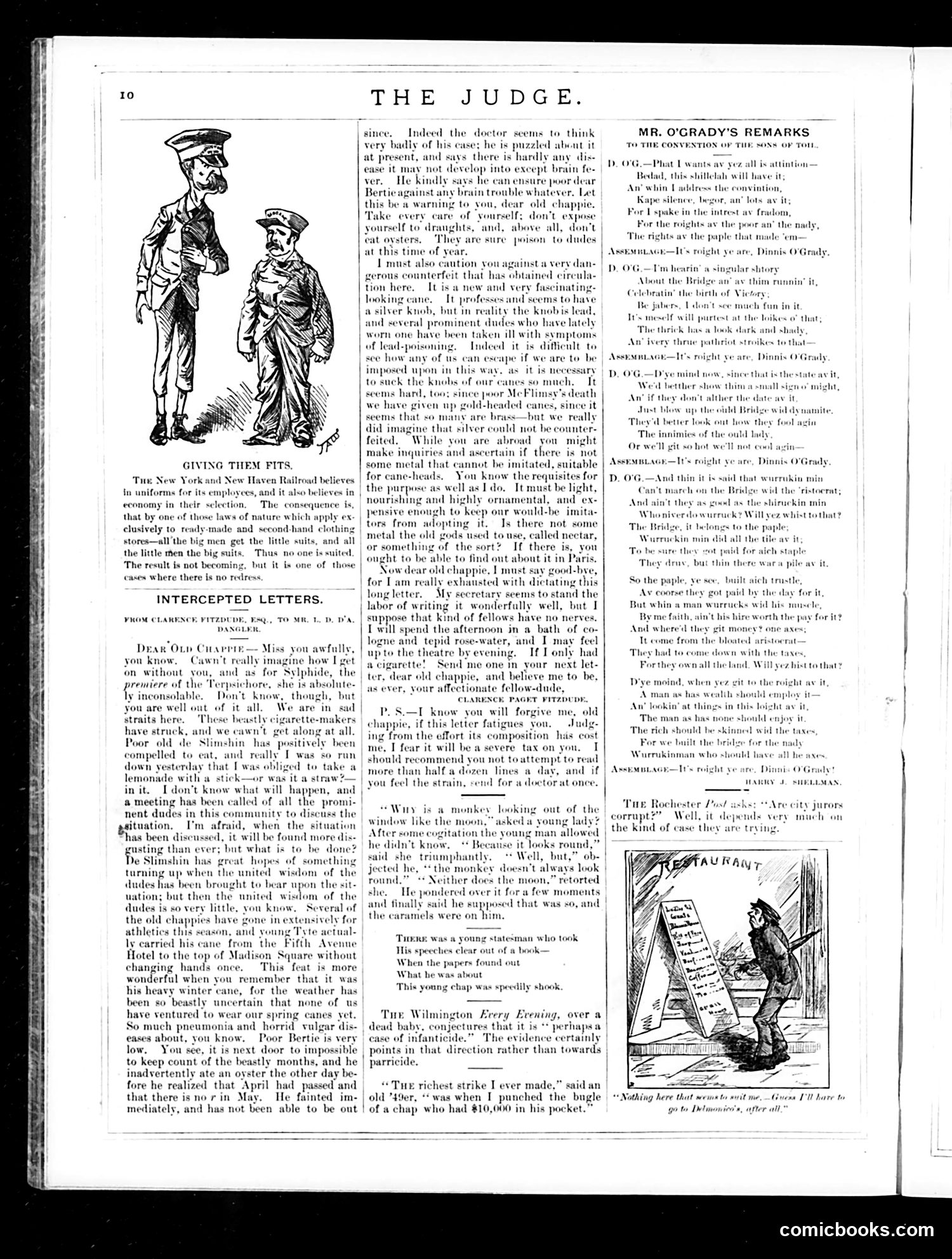
**Main Cartoon: "Giving Them Fits"** This satirizes the New York and New Haven Railroad's uniform policy for employees. The joke: the railroad economizes by having all sizes of men wear uniforms from a limited stock—so large men get small suits and small men get large suits, creating an ill-fitting, ridiculous appearance. The point is absurd bureaucratic cost-cutting that produces comical results rather than actual savings. **"Intercepted Letters" Section** This is satirical correspondence from wealthy, idle "dudes" (upper-class dandies). The humor mocks their vapid concerns: a friend's serious lead-poisoning from counterfeit silver cane-knobs (which dudes apparently *suck* constantly), another's oyster-eating mishap in April, cigarette strikes affecting their leisure, and anxieties about spring canes. The satire targets the leisure class's disconnection from reality and their obsession with fashionable affectations—canes are so culturally important they're discussing what metal to use for ornamental knobs while workers face actual poisoning. Both items mock different social groups: working-class railroad employees and wealthy idle aristocrats.
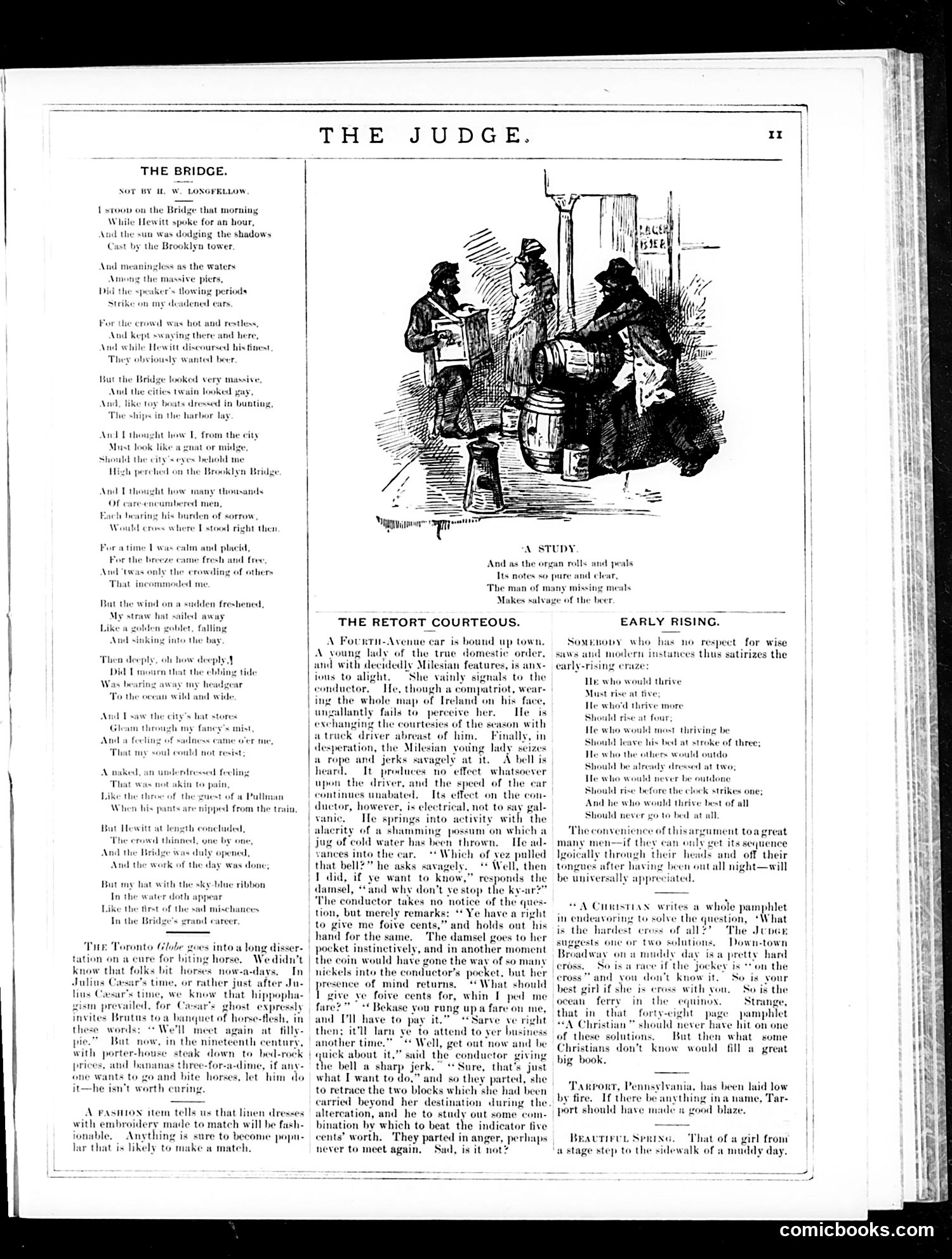
This page from **Judge** magazine contains satirical poetry and humor pieces typical of late 19th-century American comics. **"The Bridge"** is a parody mocking a tedious speech by someone named Hewitt on the Brooklyn Bridge. The narrator is bored by the rhetoric while crowds want beer, and comically loses his hat to the wind—treating this minor mishap as tragic. **"The Retort Courteous"** satirizes Irish immigrants and street-car dynamics. An Irish woman passenger (identified by "Milesian features"—a stereotype for Irish people) rings the bell to stop the car. The Irish conductor, despite being her countryman, refuses to acknowledge her, then demands she pay an extra fare for ringing the bell. She cleverly refuses, arguing she already paid her fare. The joke mocks both ethnic stereotypes and the absurd logic of urban transit workers. The satire targets working-class Irish immigrants, their speech patterns, and the petty tyranny of transit employees—reflecting period prejudices and class tensions in New York City.
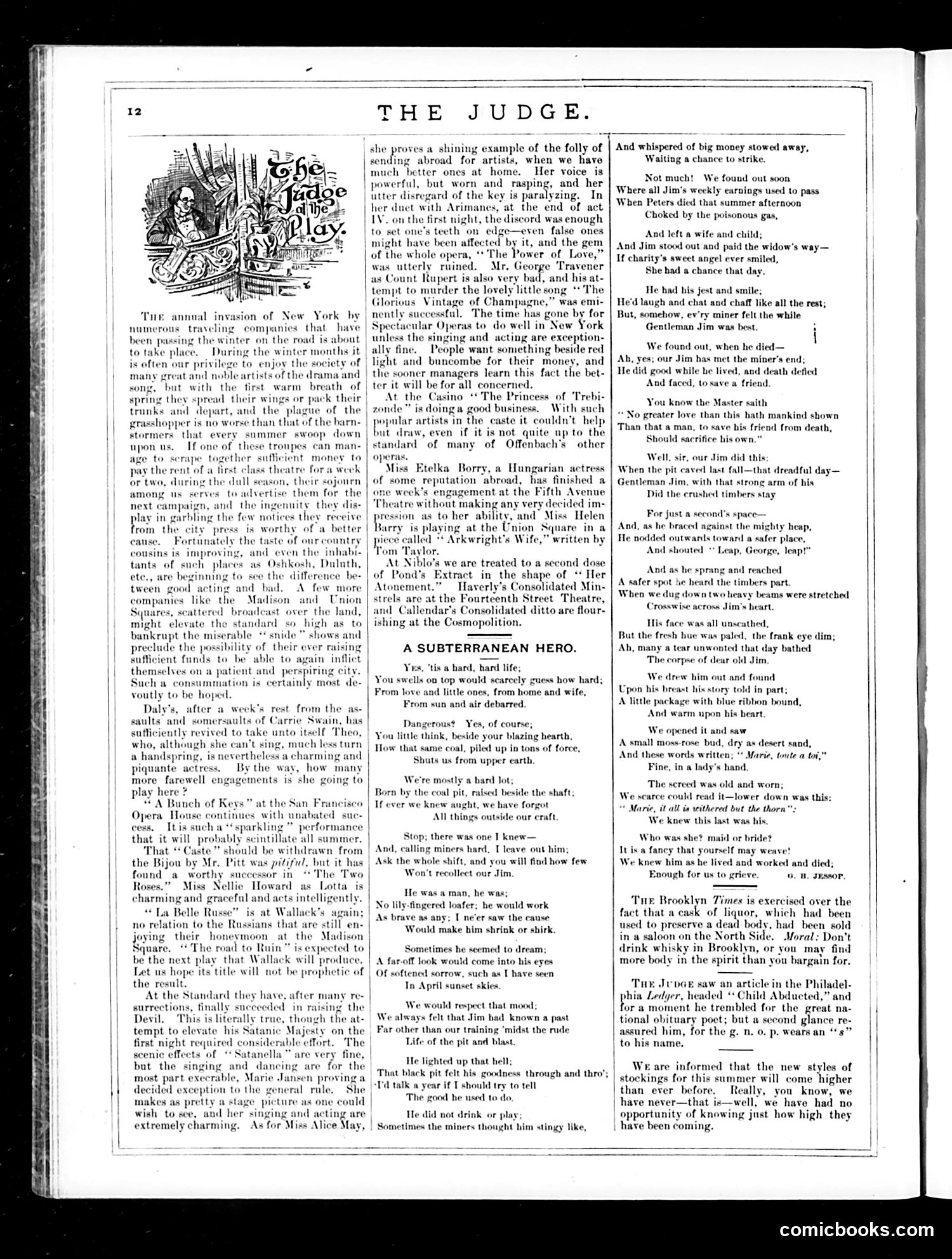
This page from Judge magazine consists primarily of theatrical criticism rather than political satire. The main article criticizes the annual summer invasion of touring theater companies to New York City—dismissing traveling troupes as inferior "barnstormers" who strain to afford even a week's theater rental. The critic attacks several specific performers and productions: Miss Alice May's "worn and rasping" voice in an opera; Marie Jansen is praised as an exception; and various plays are reviewed (notably "Caste," "The Two Roses," and "Satanella"). The tone is snobbish, suggesting that American audiences' improving taste should preclude these mediocre touring shows. The page also contains poetry titled "A Subterranean Hero," appearing unrelated to the theater criticism above it. The left margin features an ornamental title illustration but no distinct political cartoon is visible. This appears to be entertainment journalism rather than satirical commentary on politics or current events.
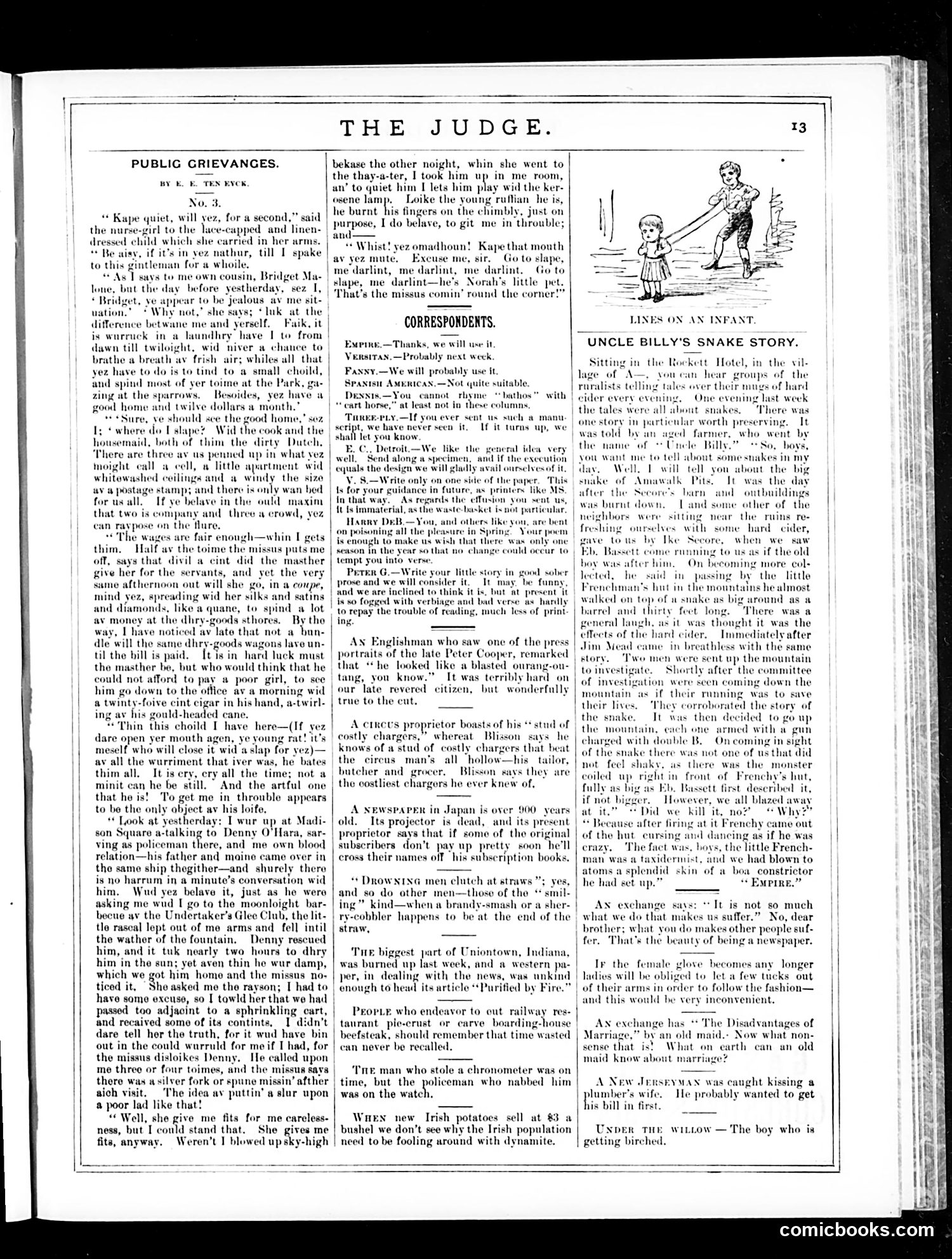
This page presents "Public Grievances No. 3," a satirical monologue by an Irish immigrant nursemaid complaining about her working conditions. The piece uses heavy Irish dialect to create humor through the speaker's voice. The satire targets **class inequality and employer exploitation**. The nursemaid catalogs grievances: she works dawn-to-dusk in a laundry for minimal pay while the mistress spends freely on luxuries; three servants share a tiny, airless room; she receives no days off and is blamed for accidents (like when the child falls into a fountain). The employer refuses to pay her wages but demands perfection. Judge satirizes both **the hypocrisy of wealthy employers** who claim poverty while living lavishly, and **the harsh realities of domestic service**—a major employment sector for immigrant women. The Irish dialect, while reinforcing period stereotypes, allows the character to articulate legitimate labor grievances that middle-class readers would otherwise dismiss. The accompanying illustrations show the nursemaid with her charge, visualizing her constrained domestic world.
This page is primarily **humorous anecdotes and advertisements** rather than political cartoons. The content consists of brief satirical jokes targeting various social groups and behaviors of the era: **Key humor themes:** - **Irish dialect jokes**: A Black character speaking in stereotypical dialect about domestic violence and "anarchy" (arnica) - **Class satire**: Mockery of a saloon-keeper's credit system ("slate") causing customers to lose memory - **Courting humor**: A young man's awkward compliment to a girl and her sister - **Literary wit**: Jokes about Thackeray's habits, prize-fighters, and a proposed home for destitute authors in France (implying they should stay away) **The cartoon** (top right) appears to be a decorative header with classical imagery promoting patent medicines. The page reflects **late-Victorian attitudes**: casual ethnic stereotyping, gender comedy around courtship, class mockery, and cynical social commentary presented as lighthearted entertainment. The surrounding advertisements (Gastrine, insurance, music boxes) target middle-class readers.
This is primarily an **advertising page** from Judge magazine, not a political cartoon page. The page contains mostly commercial advertisements for pianos (Weber, Behning), organs (Beatty's), book binding services, and various patent medicines and consumer goods typical of the 1880s era. The small text snippets scattered throughout appear to be humorous filler quotes rather than substantive satire. One notes that Austrian government bonds can be purchased; another jokes that a dollar bill's lifespan is short, "but it is not as short as the man who hasn't got a greenback to his name." There's a passing reference to "a survivor of Balaklava" (the Crimean War battle of 1854), suggesting these are recycled or generic jokes of unknown authorship. **The page lacks recognizable political cartoons or caricatures of specific public figures.** It represents Judge functioning as a general interest publication mixing advertising with light comedy, rather than hard-hitting political satire.
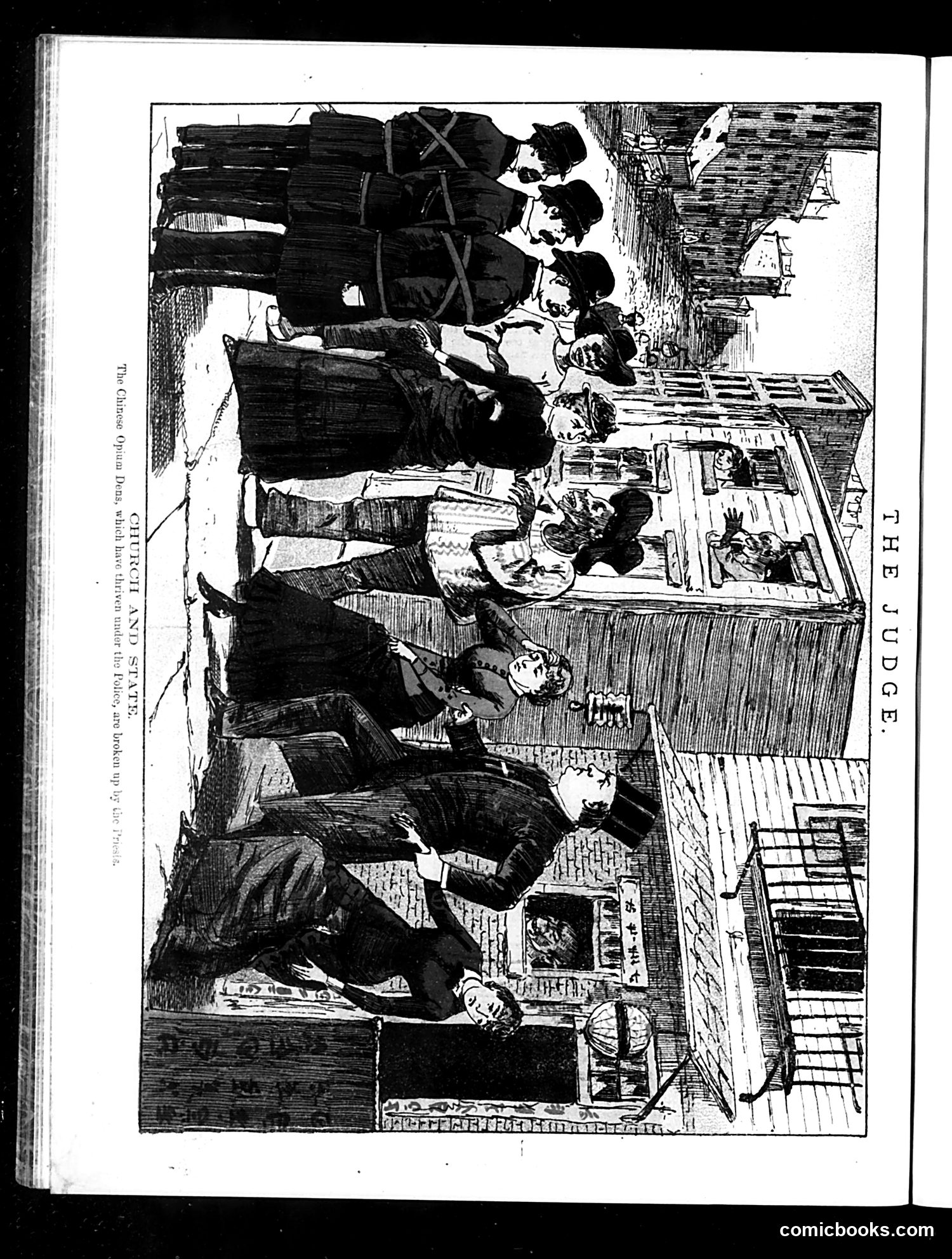
This appears to be a title page or cover from *Judge* magazine, showing the publication's masthead ("THE JUDGE") prominently displayed on the right side of the image. The illustration itself depicts what appears to be a courtroom or legal proceeding scene, shown sideways/rotated. Multiple figures in period dress are gathered, suggesting a trial or judicial scene. However, without clearer visibility of specific caricatured features, facial expressions, or accompanying caption text that would identify the particular case, individuals, or satirical point being made, I cannot reliably identify which specific political or social event this references. The page quality and angle make detailed analysis of the satire's specific target difficult to determine with confidence.