
Judge, 1883-05-26 · page 12 of 16
Judge — May 26, 1883 — page 12: what you’re looking at
What you’re looking at
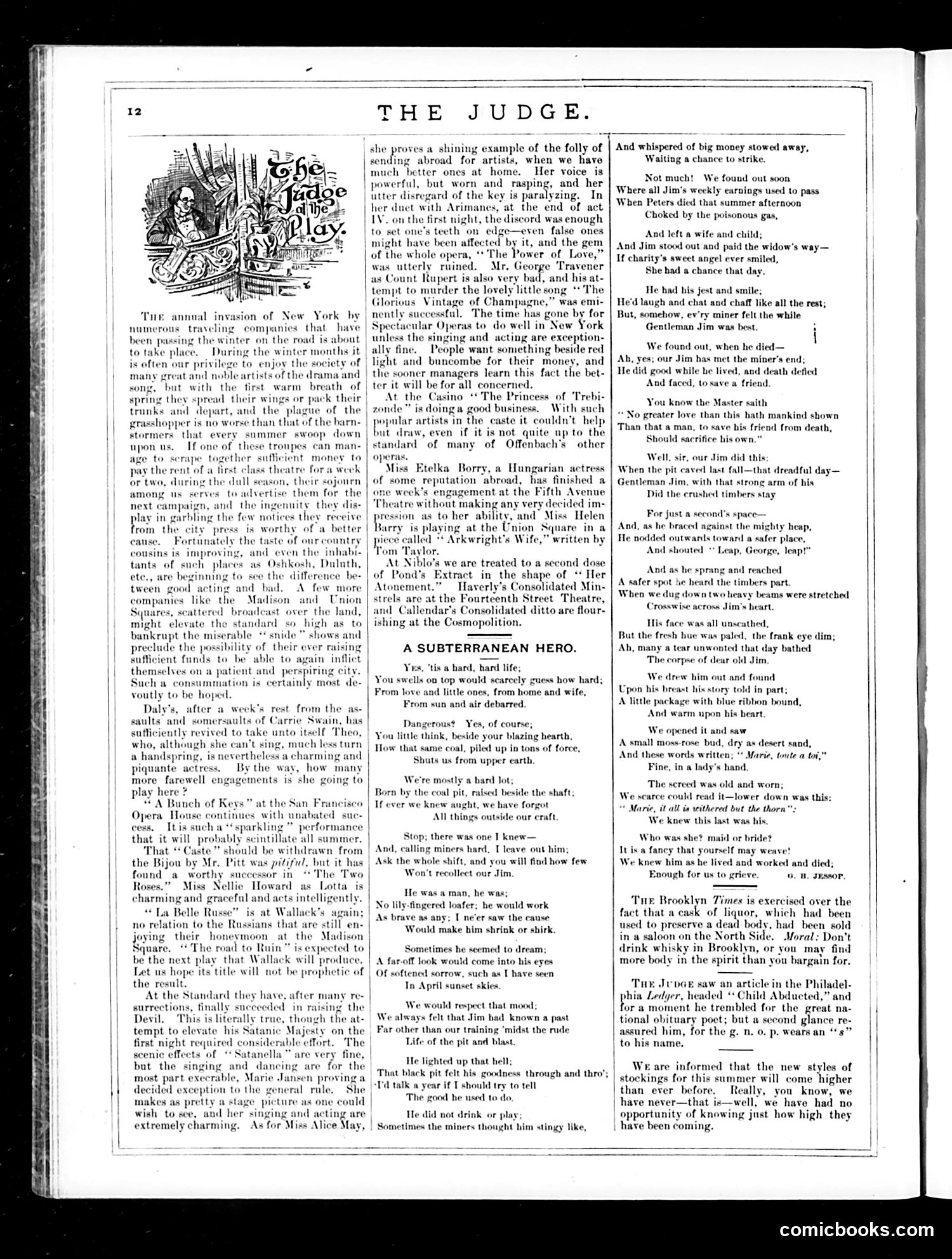
This page from Judge magazine consists primarily of theatrical criticism rather than political satire. The main article criticizes the annual summer invasion of touring theater companies to New York City—dismissing traveling troupes as inferior "barnstormers" who strain to afford even a week's theater rental. The critic attacks several specific performers and productions: Miss Alice May's "worn and rasping" voice in an opera; Marie Jansen is praised as an exception; and various plays are reviewed (notably "Caste," "The Two Roses," and "Satanella"). The tone is snobbish, suggesting that American audiences' improving taste should preclude these mediocre touring shows. The page also contains poetry titled "A Subterranean Hero," appearing unrelated to the theater criticism above it. The left margin features an ornamental title illustration but no distinct political cartoon is visible. This appears to be entertainment journalism rather than satirical commentary on politics or current events.
📄 Transcribed text from this page (OCR, searchable)
Machine-transcribed from the original scan — historical spelling and the odd misread are preserved.
Tue annual invasion of New York by humerous traveling companies that hay been passing the winter on the road is about to take pl During the winter months it is ofte i to enjoy the society of many atand noble artists of the drama and ng. but with the first warm breath of 1 their wings trunks and de and the plague of the grasshopper is no worse than that of the barn- stormers that every summer swoop down upon us, If one of these troupes can man- age to scrape together sufficient money to pay the rent of a first class theatre for a week or two, during the dull season, their journ among us to advertise them for the next camp: nd the ingenuity they dis: play in garbling the few notices they receiv from the city press is worthy of a b cause. Fortunately the taste of our country and even the inhabi- as Oshkosh, Duluth, the difference bad. A few more nm oand Union t over the land, high as to rves cousins is improvin ph tants of such ete., are be tween to and Madi Squar adley might standard bankrupt the miserable * snide preclude the possibility of their ever raising suflicient funds to be able to again inflict themselves on a piring city Such a consum inly most de voutly to be hi hes ing like t t from the rrie Swain, has r f Theo, who, although a handspring piquante actr more farewell en y hei nevertheless a charming and By the way, how many nents is she going to sat the San Francisco ontinues with unabated sue: It is such a ‘sparkling ” performance that it will probably scintillate all summer. That ‘ Caste ” should be withdrawn from the Bijou by Mr. Pitt was pitiful, but it has found worthy successor in ** The Two Roses.” Miss Nellie Howard Lotta is charming and graceful and acts intelligently. “La Belle Rus is at Wallack’s no tion to the Russians that joying their honeymoon atthe Madison Square. “The road to Ruin” is expected to be the next play that Wallack will produc Let us hope its title will not be bth phetic of the result. At the surrections, finally suceee Devil. This is literally true, though the at- tempt to ate his 8 Majesty on the first night required considerable effort. The scenic effects of‘ Satanella ” are very fine but the singing and dancing for th most part execrable, Marie Jansen provin decided exception to the general rule, makes as pretty a stage picture as one wish to see, and her singing and acting are extremely charming. As for Miss Alice May, again; still en- “d the pack their | ter | * shows and | after many re- | pula | THE JUDGE. she proves a shining example ¢ of the folly of sending abroad for artists, when we have much better ones at home. Her voice is powerful, but worn and rasping, and her utter disregard of the key is paralyzing. In et with 2 at the end of act ht, the discord was enough o—even false ones might have been affected by it, and the gem of the whole oper he Power of Love,” was utterly ruined. Mr, George ‘Travener as Count Rupert is also very bad, and his at- tempt to murder the lovely little song ** The lorious Vintage of Champagne,” was emi- nently successful. The time has gone by for Spectacular Operas to. do well in New York unless the singing and acting are exception- ally fine. People want something beside red light and buncombe for their money, and the sooner m ers learn this fact the bet- ter it will be for all concerned. At the Casino ‘ The Princess of Tre zonde” is doing a good business. With such popular artists in the te it couldn't help put draw, even if it is not quite upto the standard of many of Offenbach’s other opera, Miss Etelka Borry, a Hungarian actress some reputation ‘abroad, has finished a week’s engagement at the Fifth Avenue heatre without making any very decided im- pression as to her ability, and Miss Helen Barry is playing at the Union Square in a niece called ** Arkwright’s Wife,” written by Tom Taylor. At Niblo’s we are treated to a second dose of Pond’s Extract in the shape of ‘Ter Atonement.” Haverly’s Consolidated Min- strels are at the Fourteenth Street Theatre, and Callendar’s Consolidated ditto are flour- ishing at the Cosmopolition. A SUBTERRANEAN HERO. Yes, ‘tis a hard, bard life; You swells on top would scarcely guess how hard; | From love and little ones, from home and wife, From sun and air debarred t Yes, of course You little think, beside your blazing hearth, How that same coal, piled up in tons of force, Shuts us from upper earth. y a hard lot; al pit, raised bes If ever we knew aught, we have Born by the ¢ Je the shaft; fore All things outside our craft top; there was one T knew— i. ling miners hard, I leave out him; K the whole shift, and you will flad how few Won't recollect our Jim. He was a man, he was; No lily-tingered loafer; he would work As brave as any; I ne'er saw the cause Would make him shrink or shirk Sometimes he seemed to dream; A far-off look would come into his Of softencd sorrow, such as T have seen In April sunset skies We would respect that mood; always felt that Jim had known a past than our training ‘midst the mde Life of the pit and blast He lighted up that hell; ‘That black pit felt his goodness through and thro’; T'd talk a year if T should try to tell good he used to do He did not drink or play And whispered of big money stowed away, Waiting a chance to strike. Not much! We found out soon Where all Jim’s weekly earnings used to pass When Peters died that summer afternoon Choked by the poisonous gas, And left a wife and child; And Jim stood out and paid the widow's w If charity's sweet angel ever smiled, She had a chance that day. He had his jest and smile; He'd laugh and chat and chaff like all the rest; But, somehow, ev'ry miner felt the while Gentleman Jim was best We found out, when he died— Ab, yes; our Jim has met the mine He did good while be lived, and And faced, tosave a f1 end. h de You know the Master saith “No greater love than this hath mankind shown, Than that a man, to save his friend from death, Should sacrifice his own.” Jim did this When the pit caved last fall—that dreadful day— Gentleman Jim, with that strong arm of his Did the crushed timbers stay For just a se And, as he braced against the y He nodded outwards toward a safer pla And shouted “1 And as he sprang and reached A safer spot rd the timbers part When we dug dow beams were stretched Crosswise across Jim's heart. face was all unscathed, But the fresh hue was paled, the frank eye dim; Ab, many a tear unwonted that day bathed ‘The corpse of dear old Jim. We drew him out and found Upon his breast his story told in part; A little pac ribbon bound, And warm upon his heart We opened it and saw A small moss-rose bud, dry as desert sand, And these words written; Fine, Marie, toute a toi, in a lady's hand. ‘The screed was old and worn; scarce could read it—lower dow * Marie, it all is withered but the thorn” We knew this last was his, was this: Who was she? maid or bride? It is a fancy that yourself may weave! We knew him as he lived and worked and died; Enough for us to gi ©. . aessor. Tne Brooklyn Times is exercised over the fact that a cask of liquor, which had been used to preserve a dead body, had been sold in a saloon on the North Side. Moral: Don't drink whisky in Brooklyn, or you may find more body in the spirit than you bargain for. Tue JvpGe saw an article in the Philadel- phia Ledger, headed * Child Abducted,” and for a moment he trembled for the great na- tional obituary poct; but a second glance re- assured him, for the g. n. 0. p. wears an ‘*s” to his name, _ We are informed that the new styles of stockings for this summer will come higher than ever before. Really, you know, we have never—that is—well, we have had no opportunity of knowing just how high they have been coming. comicbooks.com