
Judge, 1883-05-26 · page 4 of 16
Judge — May 26, 1883 — page 4: what you’re looking at
What you’re looking at
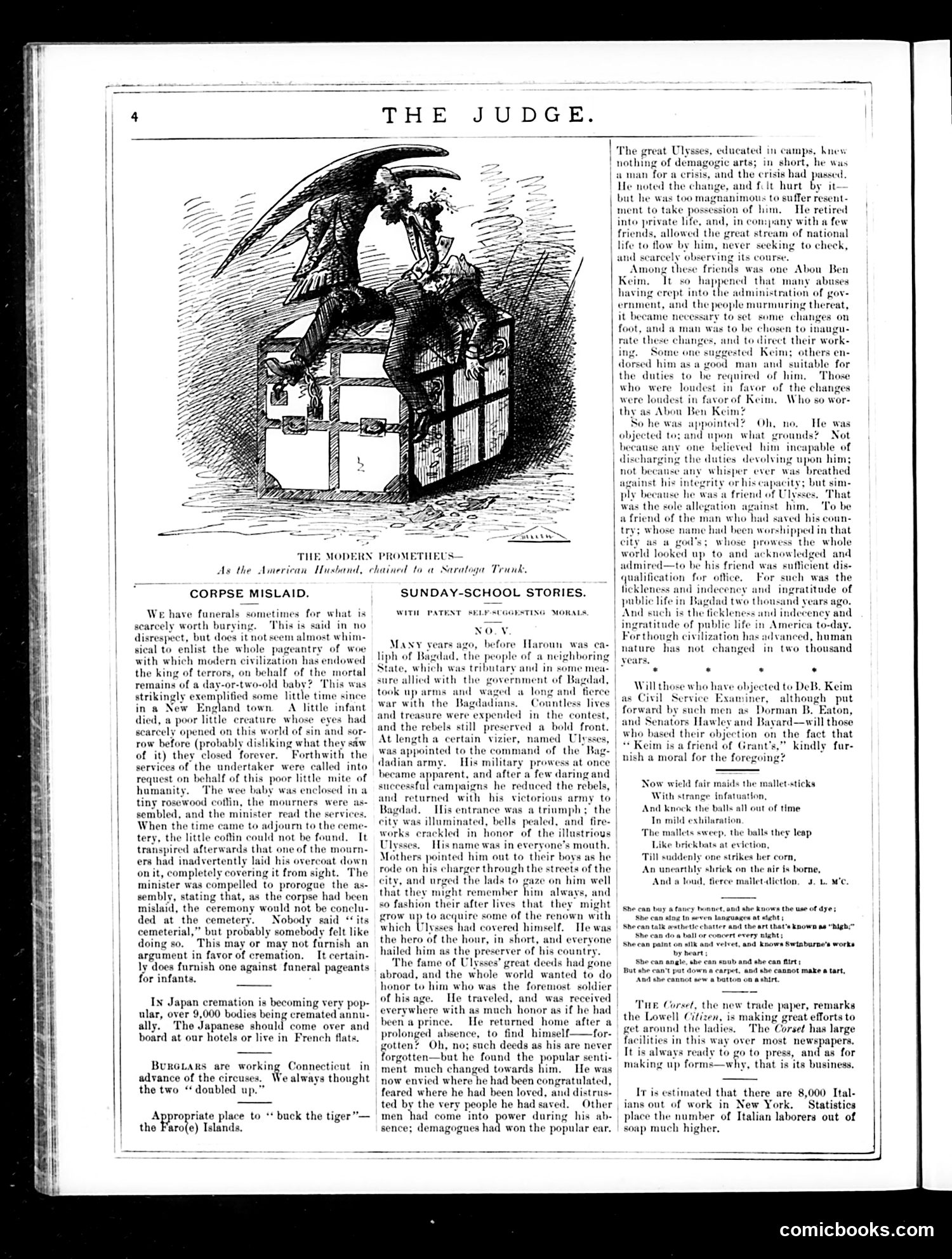
## Main Cartoon: "The Modern Prometheus" The large illustration depicts a husband literally chained to a massive Saratoga trunk—a reference to the popular travel luggage of the era. This satirizes the "American Husband" as enslaved by his wife's excessive luggage and travel demands. The Prometheus reference (the mythological titan punished by the gods) elevates domestic marital complaint to mock-heroic status. The joke targets both wives' materialism and husbands' helplessness in Victorian marriage dynamics. ## Text Content The page includes three distinct pieces: 1. **"Corpse Mislaid"**: A brief humorous anecdote about a funeral where mourners accidentally covered an infant's coffin with an overcoat, preventing burial. It satirizes elaborate funeral pageantry for trivial deaths. 2. **"Sunday-School Stories"**: A longer moral tale about Ulysses, a celebrated military general whose popularity evaporates when he returns home. Demagogues have supplanted him. The story illustrates how public favor is fickle and fleeting—a cautionary tale about fame and political power.
📄 Transcribed text from this page (OCR, searchable)
Machine-transcribed from the original scan — historical spelling and the odd misread are preserved.
THE MODERN PROMETHEUS— As the American Husband, chained ta a Saratoga Trunk. CORPSE MISLAID. ave funerals sometimes for what is scarcely worth burying. ‘This is said in_no disrespect, but does it not seem almost whin sical to enlist the whole pageantry of woe with which modern civilization has endowe the king of terrors, on behalf of the mortal remains of a -or-two-old baby? This w strikingly exemplified some little time since in a New England town A little infant die r little creature whose eyes had searcely opened on this world of sin and sor- row before (probably disliking what they siw of it) they closed forever. Forthwith the services of the undertaker were called into request on behalf of this poor little mite of humanity. The wee baby was enclosed ina tiny rosewood coflin, the mourners were i sembled, and the minister read the services. When the time came to adjourn to the ceme- tery, the little coftin could not be found. It transpired afterwards that one of the mourn- ers had inadvertently laid his overcoat down on it, completely covering it from sight. ‘The minister was compelled to prorogue the as- sembly, stating that, as the corpse had been mislaid, the ceremony would not be conclu- ded at’ the cemetery. Nobody said “its cemeterial,” but probably somebody felt li doing so.’ This may or may not farnish an argument in favor of cremation. It certain- ly does furnish one against funeral pageants for infants. I Japan cremation is becoming very pop- ular, over 9,000 bodies being cremated annu- ally. ‘The Japanese should come over and board at our hotels or live in French flats. BuRGLARS are working Connecticut in advance of the circuses. We always thought the two “doubled up.” the Faro A ropriae place to * buck the tiger”— e) Islands, SUNDAY-SCHOOL STORIES. WITH PATENT PSTING MORALS Masy years ago, before Haroun was ca- liph of Bagdad, the people of a neighboring State, which was tributary and in some mi sure allied with the proment took up arms and waged a | war with the B: dians. € and treasure were expended and the rebels still pre At length a certain vizier, ni s appointed to the command dian army. His military prowe yparent, and after a few daring successful campaigns he reduced the and returned with his victorious army to Bagdad. His entrance was a triumph; the city was illumin 18. pes and works erackled in hor of the illustrious Ul His name was in everyone’s mouth. Mothers pointed him out to t he rode through the streets of the ze on him well im alw and that they might » of the renown with which Ulysses had covered himself. Ie was the hero of the hour, in short, and everyone hailed him as the preserver of his country. he fame of Ulysses’ great deeds had gone abroad, and the whole world wanted to do honor to him who was the foremost soldier of his age. He traveled, and was received everywhere with as much honor as if he had been a prince. He returned home after prolonged absence, to find himself—for- gotten? Oh, no; such deeds as his are never forgotten—but he found the popular senti- ment much changed towards him. He was now envied where he had been congratulated, feared where he had been loved, and distrus- ted by the very people he had saved. Other men had come into power during his ab- sence; demagogues had won the popular ear. ad, and fierce ountless lives the contest, a bold front. med Ulysse in so fashion their grow up to a | The great Ul ueated in camp | nothing of demagogic arts; in shor man for a crisis, and the crisis had passe He noted the change, and folt hurt by but he was too m nimous to suffer re | ment to take p nof him. He retired into private lif in conspany with a few friends, allowed the great stream of national life to flow by him, never seeking to check, dd scarcely observing its cours Among these friends was one Abou Ben im. It so happened that many abu having crept into the administration of gov- ernment, and the people murmuring thereat, it became necessary to set some changes on foot, and a man was to be chosen to inaugu- rate these changes, and to direct their work }ing. Some one suggested Keim; others en- dorsed him as od man and suitable for the duties to be required of hin who were loudest in favor of the ch were loudest in favorof Keim. Who so wor- thy as Abou Ben Kein ppointed? Oh, no. He nd upon what : because any one believed him ine discharging the duties devolving uy not bec ay whi ever wa inst his integrity or his capacity | ply because he was'a friend of UL hat was the sole allegation nst him, ‘To be a friend of the man who had saved his coun- n worshipped in that ; prowess the whole 1d looked up to and acknowledged and admired—to be his friend was sufficient dis- qualification for office. For such was the | fickleness and indecency and itude of public life in Bagdad two thou And such is the fickler ingratitude of public life in America Forthough civilization has advanced, human nature has not changed in two thousand years, . . . . Willthose who ted to DeB. Keim as Civil Service Examiner, although put forward by such men as Dorman B. Eaton, and Senators Hawley and Bayard—will those who based their objection on the fact that Keim is a friend of Grant's,” kindly fur- ish a moral for the foregoing knew | was Not him; breathed but sim- ency and ave oll Now wield fair maids the mallet-sticks With strange infatuation, And knock the balls all out of time In mild exh ‘The mallets swe ation ». the balls they leap Like brickbats at eviction, Till sud Ap une: And a ly one strikes her corn, ly shrick on the air is borne fierce mailetaliction, 4, L. M’e She can buy fancy hunnet, and she Rnows the use of dye; She can alag in seven languages at sight ; n talk wsthetiechatter and the art that's known aa “high.” can doa ball or concert every night; She can paint on slik and velvet, and knows Swinburpe’s works by heart can angle, sbe can snub and she can fiirt; ‘arpet, and she cannot make a tart, sew a batton on a shirt THE Corset, the new trade pape Lowell Citizen. ound the ladies. facilities in this Tt is always ready making up forn remarks ng great efforts to The Corset has large over most newspapers, go to press, and as for why, that is its business. Iv is estimated that there are 8,000 Ital- ians out of work in New York. Statistics place the number of Italian laborers out of soap much higher, comicbooks.com