
A complete issue · 17 pages · 1882
Judge — October 21, 1882
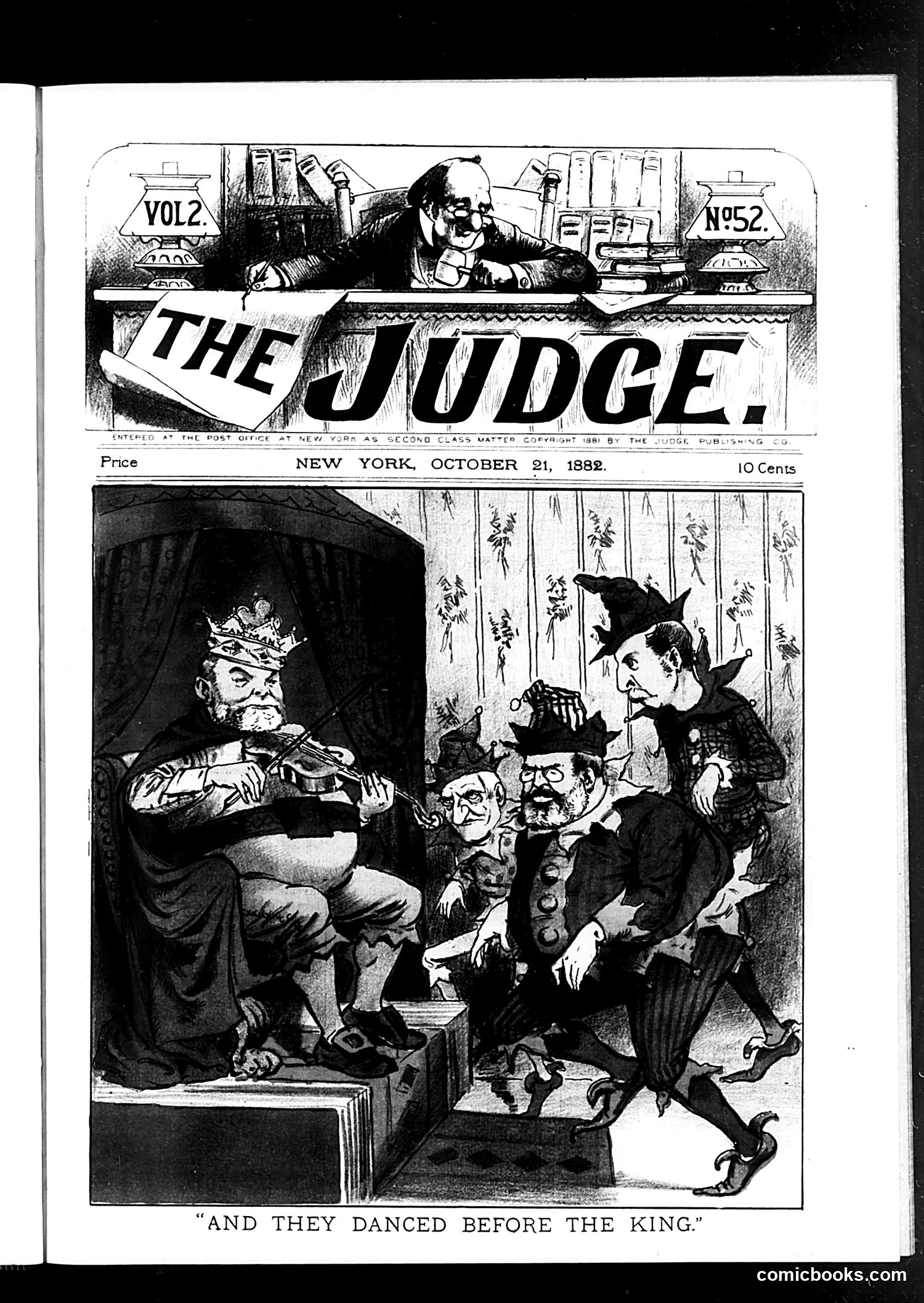
This October 1882 *Judge* cartoon satirizes political figures performing obsequiously before a monarch figure (likely representing wealth, corporate power, or a foreign ruler). The caption references the Biblical story of dancing before the king—implying degradation or loss of dignity. The exaggerated caricatures with demon-like features suggest these are corrupt politicians or businessmen compromising their principles. The formal attire and theatrical poses emphasize the performance aspect—these figures are "putting on a show" rather than acting with integrity. The satire critiques political corruption and the willingness of leaders to abandon dignity for favor or profit. The dehumanizing caricatures reinforce the moral judgment that such behavior is beneath human standards.
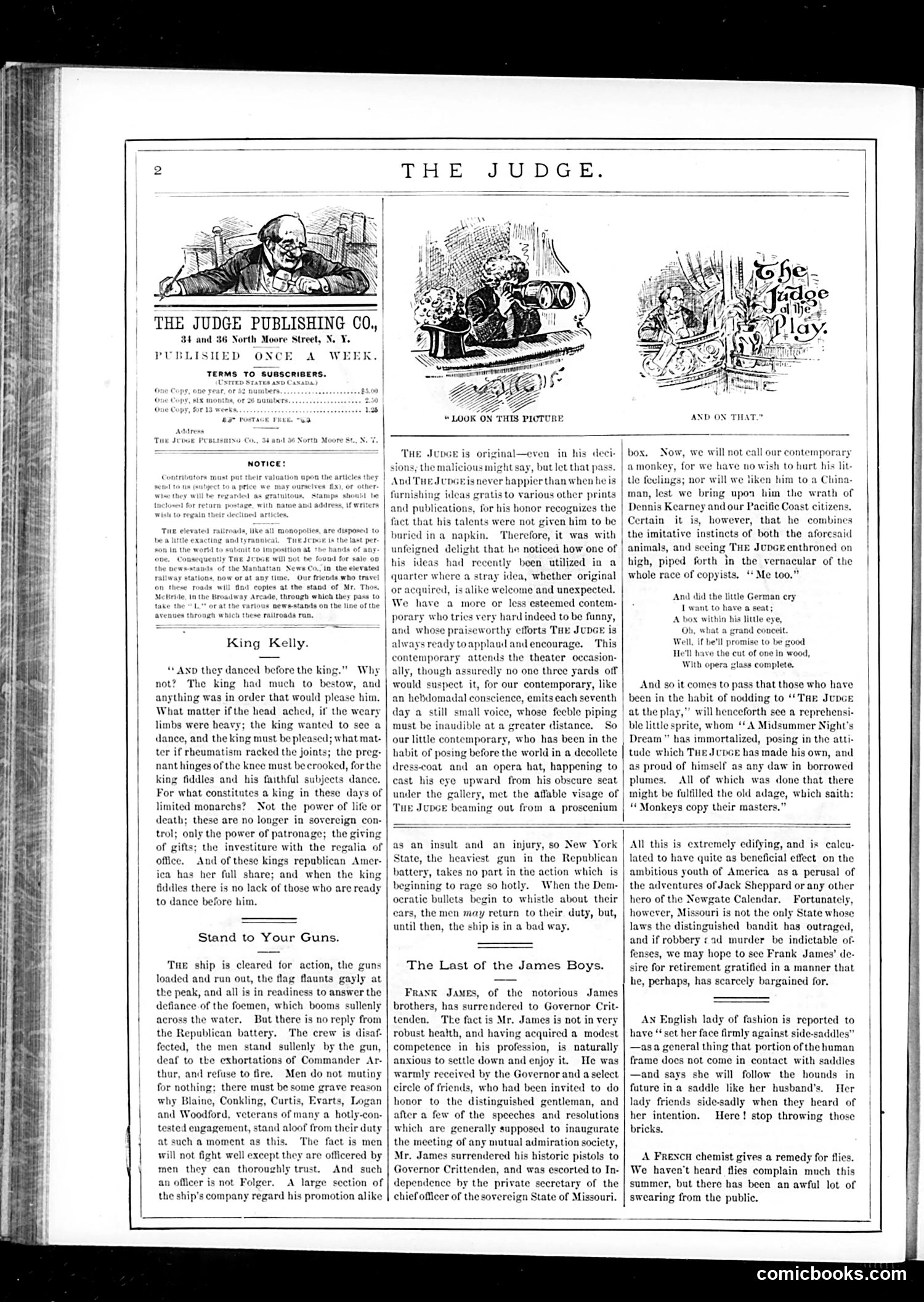
This page contains satirical commentary on Republican political leadership during what appears to be the Gilded Age (likely 1880s, given references to figures like Blaine, Conkling, and Arthur). **"King Kelly"** criticizes how politicians and office-seekers obsequiously defer to those in power—dancing before political "kings" who control patronage and appointments rather than genuine authority. **"Stand to Your Guns"** uses a naval metaphor to critique Republican leadership. The ship (Republican Party) is ready for battle, but the crew refuses to fire under their current commander (Folger). The satire suggests men won't fight for leaders they don't trust—specifically implying distrust in Republican leadership around a succession dispute or policy disagreement. The page also includes self-congratulatory commentary about Judge magazine itself, suggesting competitors imitate its ideas, and a brief joke about an "English lady of fashion" adopting her husband's habits. The overall tone mocks political cowardice and blind party loyalty among Republican figures.
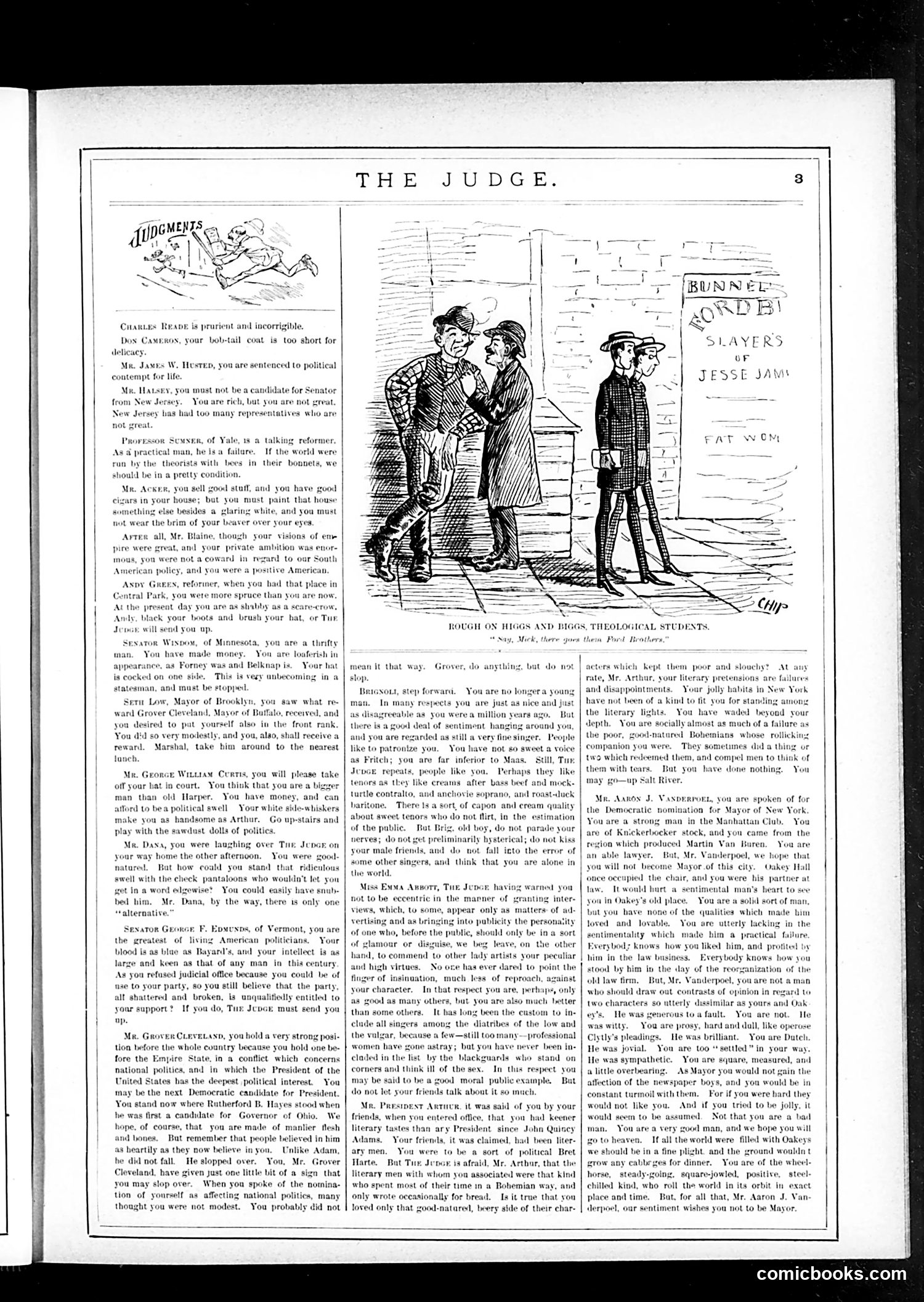
This page contains a series of mock judicial "sentences" addressing prominent American political figures of the Gilded Age (likely 1880s based on references). The Judge, acting as stern arbiter, issues criticism and "corrections" to various politicians and public figures. **Key targets include:** - **Charles Reade** and **Don Cameron** (criticized for vanity/poor judgment) - **James Blaine** (praised for ambition but faulted for inconsistency) - **Grover Cleveland** (told to avoid indecision) - **Arthur** (mocked for pretentiousness and bohemian affectations) - **Senator Windom** (Minnesota) and **Mayor Low** (Brooklyn) - **Aaron Vanderpoel** (Democratic mayoral candidate in New York) **The satire's point:** Judge positions itself as moral arbiter, lecturing politicians on character flaws—vanity, laziness, opportunism, pretension—rather than specific policies. The cartoon format (showing figures in conversation) reinforces the "courtroom judgment" conceit. This reflects Judge's role as a vehicle for elite Republican-leaning commentary on public morality and political fitness during the post-Reconstruction era.
This is a humorous short story rather than a political cartoon. It satirizes the Victorian obsession with romantic conventions and gender norms through absurdist fiction. The plot: A young woman named Sibylla MacClintock becomes engaged to Roland Maguire, a notably short man. Upon their engagement, Sibylla inexplicably begins growing taller—seven and a half inches in four months. Roland, humiliated by public mockery and nightmares about the height difference, abandons her and elopes with an even shorter woman, Serena Muldoon. Sibylla then stops growing and accepts a proposal from another short man, Theobold Jack. The satire mocks both the arbitrary nature of romantic attraction ("tall men always fall in love with short women") and the shallow social pressures that govern Victorian courtship. The absurd premise—unexplained growth triggered by engagement—exaggerates how ridiculous these conventions appear when examined closely. The ending, where Sibylla simply accepts another short suitor, suggests resignation to society's expectations rather than genuine resolution.
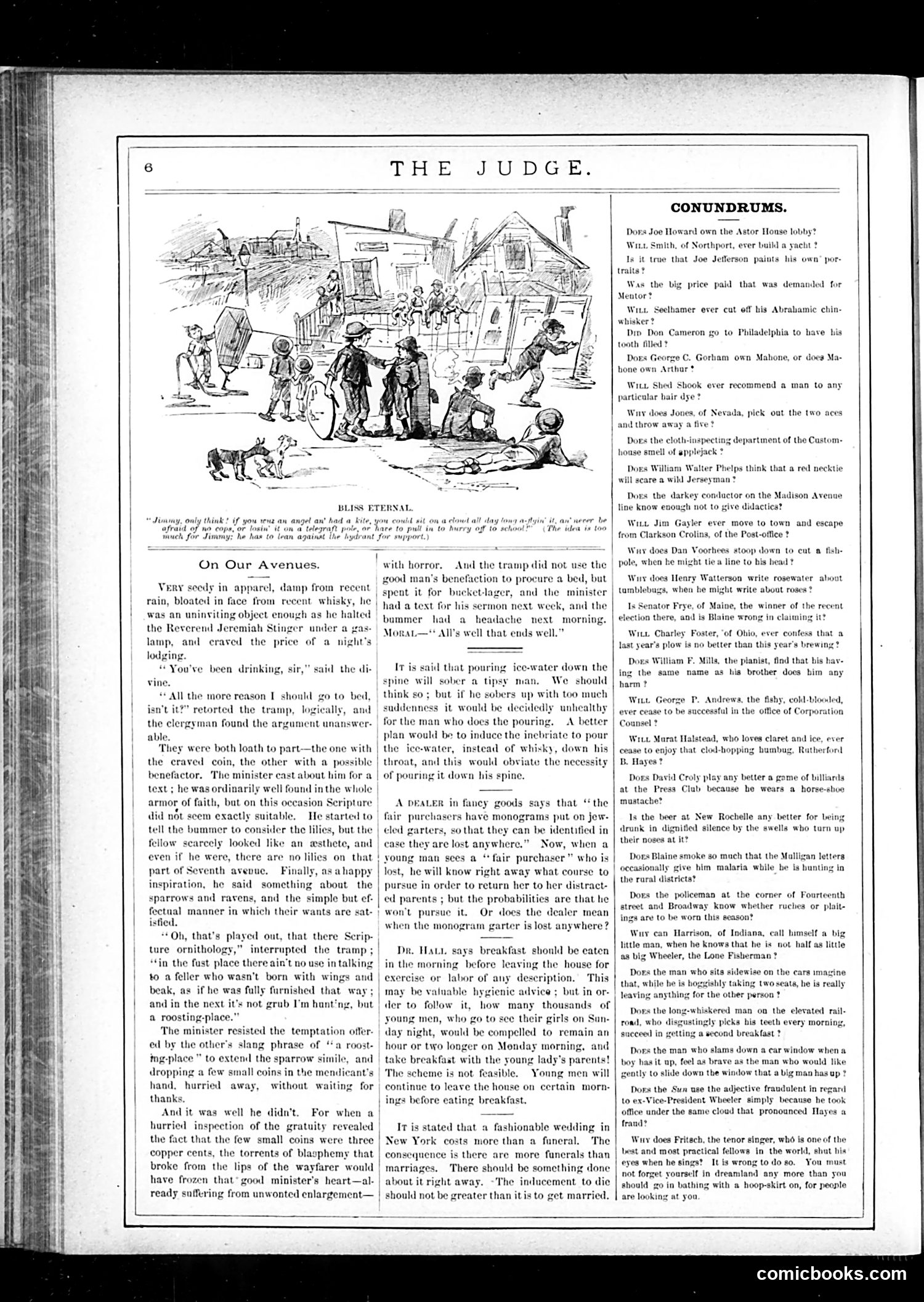
This satirical sketch mocks both urban poverty and well-intentioned but ineffectual charity. A disheveled, drunk tramp accosts Reverend Jeremiah Sting for money to buy lodging. When the minister offers Biblical platitudes about how God provides for sparrows and ravens, the tramp pragmatically replies that religious metaphors don't help—he needs actual shelter, not spiritual comfort. The joke culminates when the reverend gives three copper cents (essentially worthless). The tramp spends it on cheap beer instead of lodging, and the minister gains sermon material about the incident's "moral," while the vagrant gets drunk and a headache. The satire targets: sanctimonious clergy who offer scripture instead of real aid; the inadequacy of charitable gestures; and urban poverty itself. The tramp's logical responses expose the gap between religious idealism and practical need on Seventh Avenue.
This cartoon parodies *Macbeth*'s witches' scene, depicting Republican machine politics as supernatural corruption. The "witches" (likely representing party operatives) brew a cauldron containing electoral fraud: stuffed ballot boxes, proxy forgery, bribed officials, Star Route contracts, and assessed campaign contributions from government employees. Key figures include **Hubbell** (Chester Hubbell, a Republican operative), **Robeson** (likely Secretary of the Navy George Robeson), and apparitions of **David Davis**, **Colfax**, and **Tilden**—political figures associated with past scandals. The satire targets systematic Republican corruption: vote-buying, patronage abuse, embezzlement schemes, and coercion of federal workers to fund campaigns. The witches' chant—"Fair is foul, and foul is fair"—suggests the normalization of corruption within the party apparatus. This reflects Judge magazine's 1880s-era criticism of Gilded Age machine politics and electoral fraud.
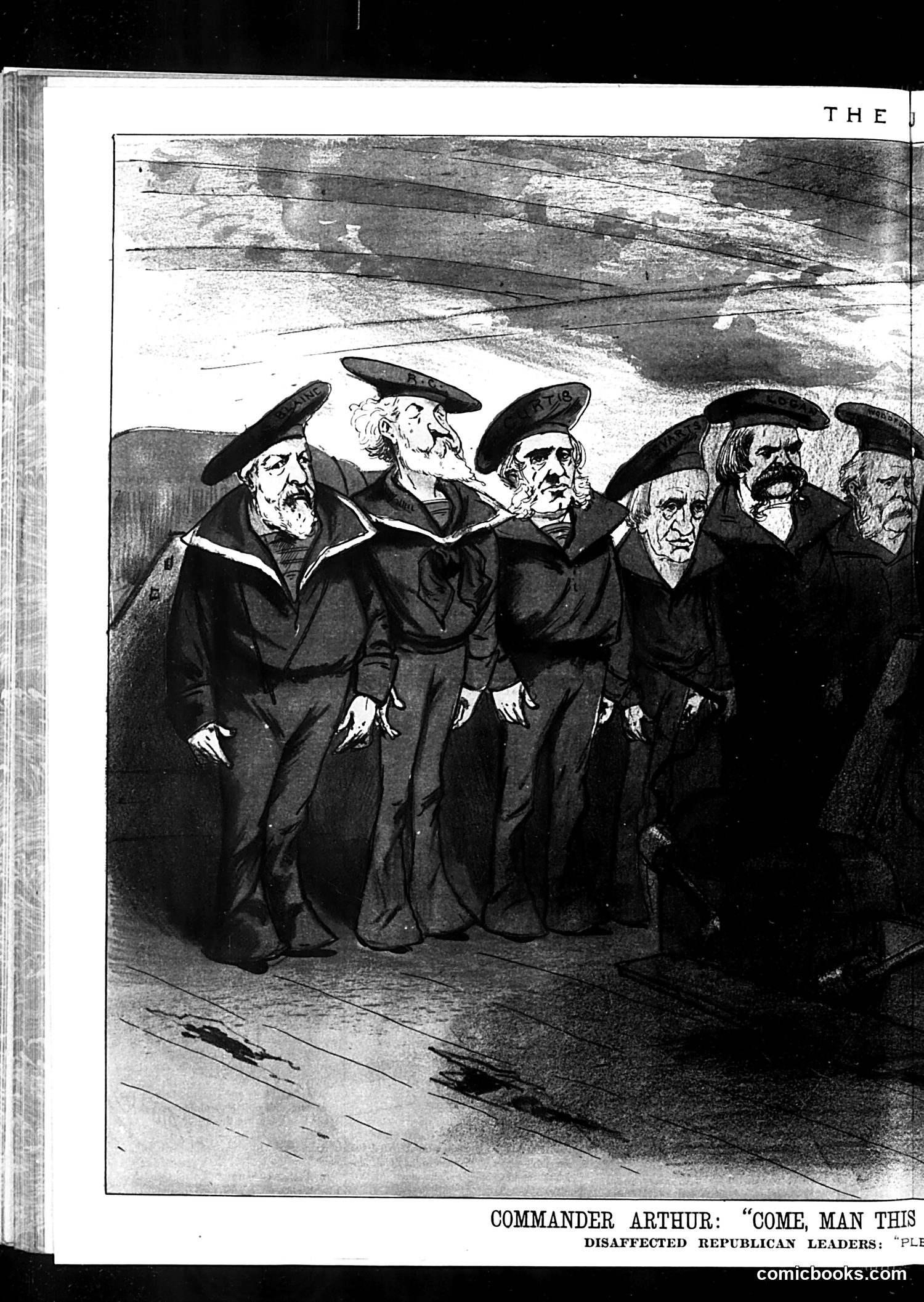
This appears to be a satirical cartoon from *Judge* magazine depicting "Disaffected Republican Leaders." The image shows six men in dark coats and period hats (appearing to be from the late 19th or early 20th century) standing together, apparently dejected or troubled. The caption references "Commander Arthur" instructing them to "Come, man this..." though the complete text is cut off. The cartoon satirizes Republican party members who have broken with party leadership—likely over a specific policy dispute or internal conflict. The figures' expressions and body language suggest reluctance or dissatisfaction with their situation. Without the complete caption and publication date visible, the specific political crisis being lampooned remains unclear, though the image effectively conveys editorial commentary on Republican party discord.
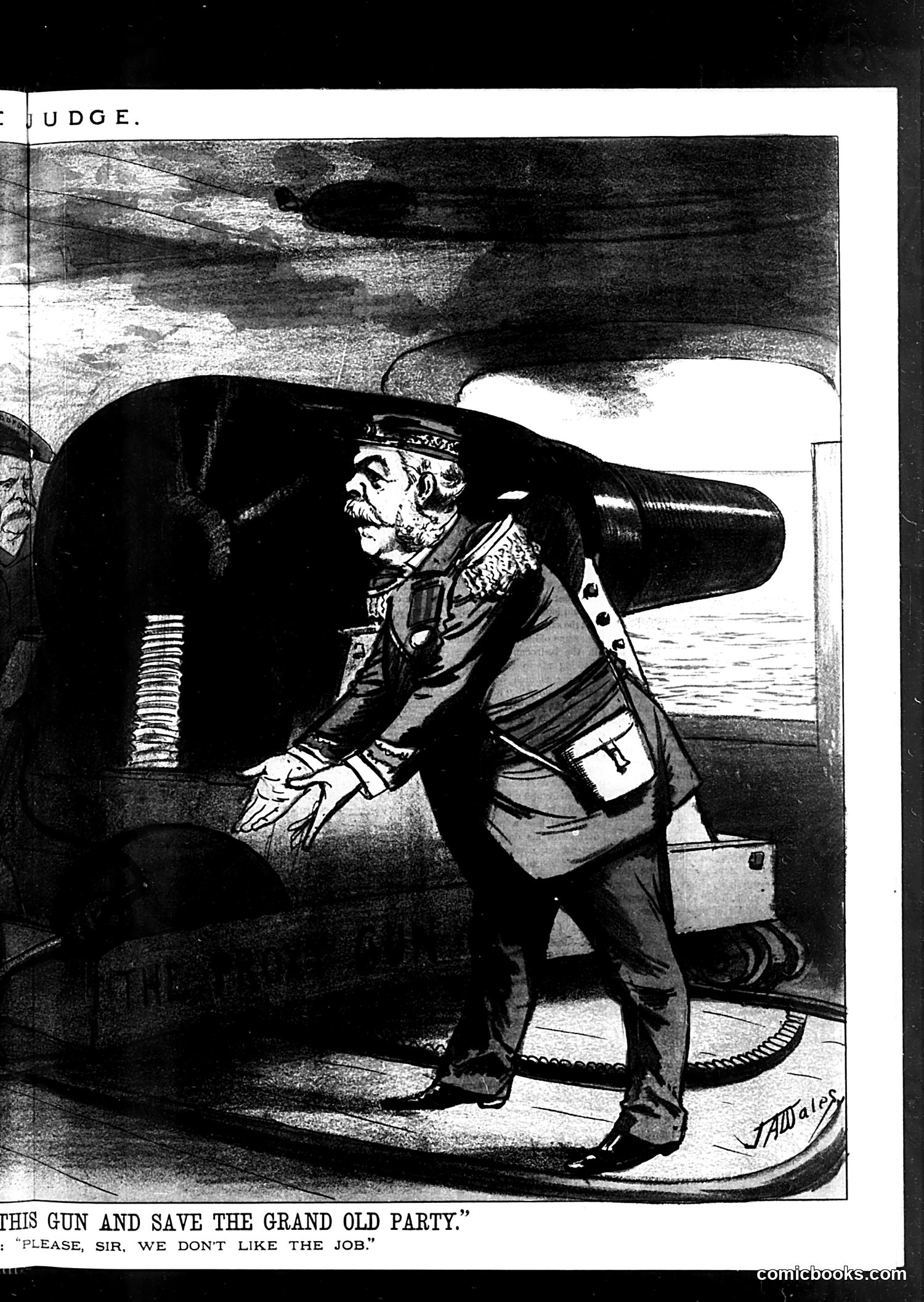
This Judge magazine cartoon depicts a uniformed military or political figure wielding a large cannon, with the caption "'Please, Sir, We Don't Like the Job'" and partial text referencing saving "the Grand Old Party" (the Republican Party). The satire appears to address internal Republican Party conflict, suggesting that someone in authority is forcing reluctant party members to take unpopular action—metaphorically "firing the gun." The figure's discomfort and protest indicate the policy or action is unwelcome among party rank-and-file. Without a visible date or clearer context, the specific political crisis remains uncertain, though the imagery suggests early 20th-century Republican Party discord, possibly related to a controversial military action or internal party split.
This page from **Judge** contains satirical commentary rather than illustrated cartoons. The main pieces address: **"Resurrection"**: A poem lamenting that disgraced politicians are returning to power. It references Jersey politician "Oliver" (likely Oliver H. P. Morton or similar figure), mentioning calls to resurrect other fallen politicians like Belknap and Williams. The satire suggests public corruption cycles—that voters "bounced" corrupt officials, only to see them resurface. **Brooklyn Bridge dating jest**: Judge mocks disputes about when construction began, humorously claiming it's older than the pyramids and Susan B. Anthony, deflating civic boosterism. **Irish immigrant hypocrisy**: Satirizes naturalized citizens who opposed rent-paying in Ireland but exploit tenants after gaining American wealth—commentary on class mobility and principle-abandonment. **Sawdust uses**: A tongue-in-cheek list of sawdust applications (mattresses, floor scatter, tea adulteration, fake fabric stiffening, oyster frying, oatmeal padding) critiques food fraud and consumer deception—common Progressive-era concerns. The page reflects **Gilded Age skepticism** toward politics, immigration, and commercial dishonesty.
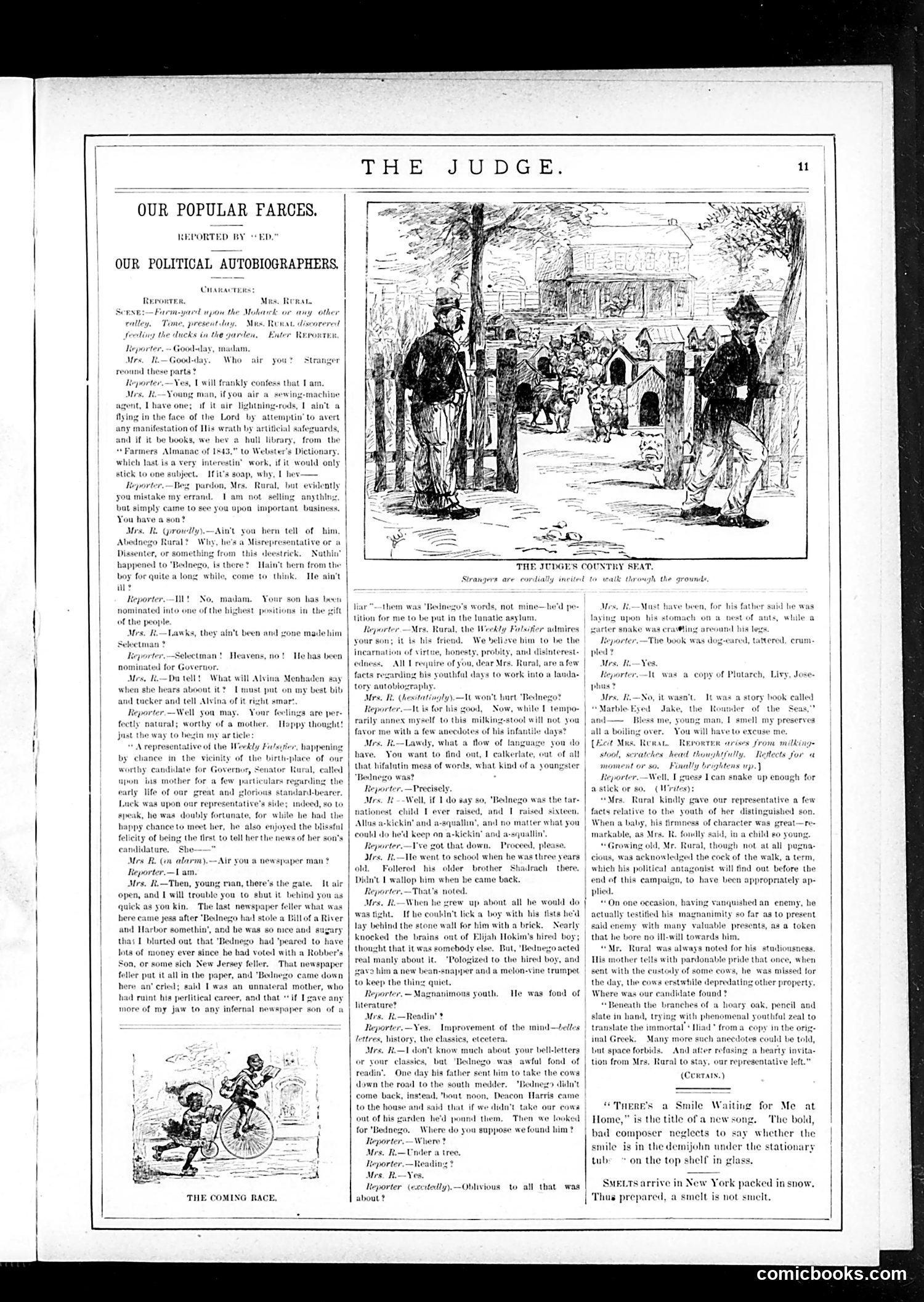
This page satirizes politicians' campaign autobiographies through a mock interview between a Weekly *Fulsifier* reporter and Mrs. Rural, mother of "Bednego," an apparently rural candidate for Governor. The satire targets how politicians construct idealized life narratives. Mrs. Rural initially distrusts the reporter (having been burned before when he published unflattering facts about her son), but gradually provides a comically unflattering "autobiography"—describing young Bednego as perpetually kicking and squealing, difficult to control, and generally obstinate. The joke is twofold: politicians' self-promotional writings sanitize their true characters into fabricated virtue, while this mother's honest account reveals the opposite of campaign mythology. The cartoon (showing the interview scene) and text together mock the absurdity of turning questionable rural characters into statesmanlike candidates through ghostwritten "autobiographies." The satire was likely directed at specific contemporary politicians, though identities aren't specified on this page.
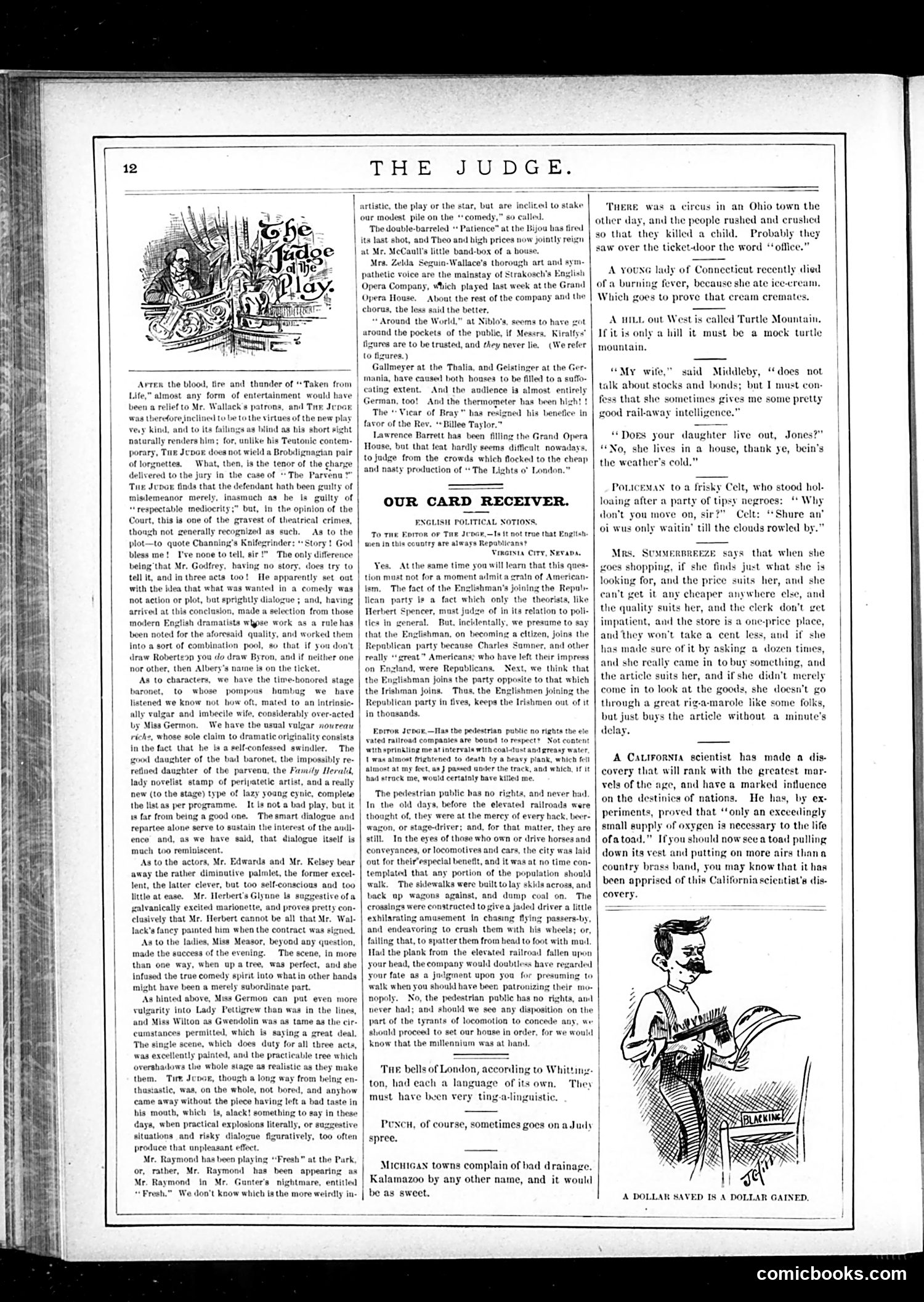
This page contains a theater review of a play called "The Parvenu" at Wallack's Theatre. The critic finds the production guilty of "respectable mediocrity"—a grave theatrical crime despite lacking dramatic energy or originality. The review criticizes the play's plot as merely a vehicle for witty dialogue borrowed from other sources, and faults the stock characters: a disreputable baronet, a nouveau riche swindler, refined heroines, and a lazy cynic. Performances are mixed. Actors Edwards and Kelsey earn praise; Herbert's performance disappoints; Miss Measor steals the show with a comedic tree-climbing scene that brings genuine humor to weak material. The illustration (bottom right) shows a woman climbing a tree—likely depicting Measor's praised scene. Overall, Judge's verdict: technically competent but creatively bankrupt theater that doesn't offend, but doesn't inspire either.
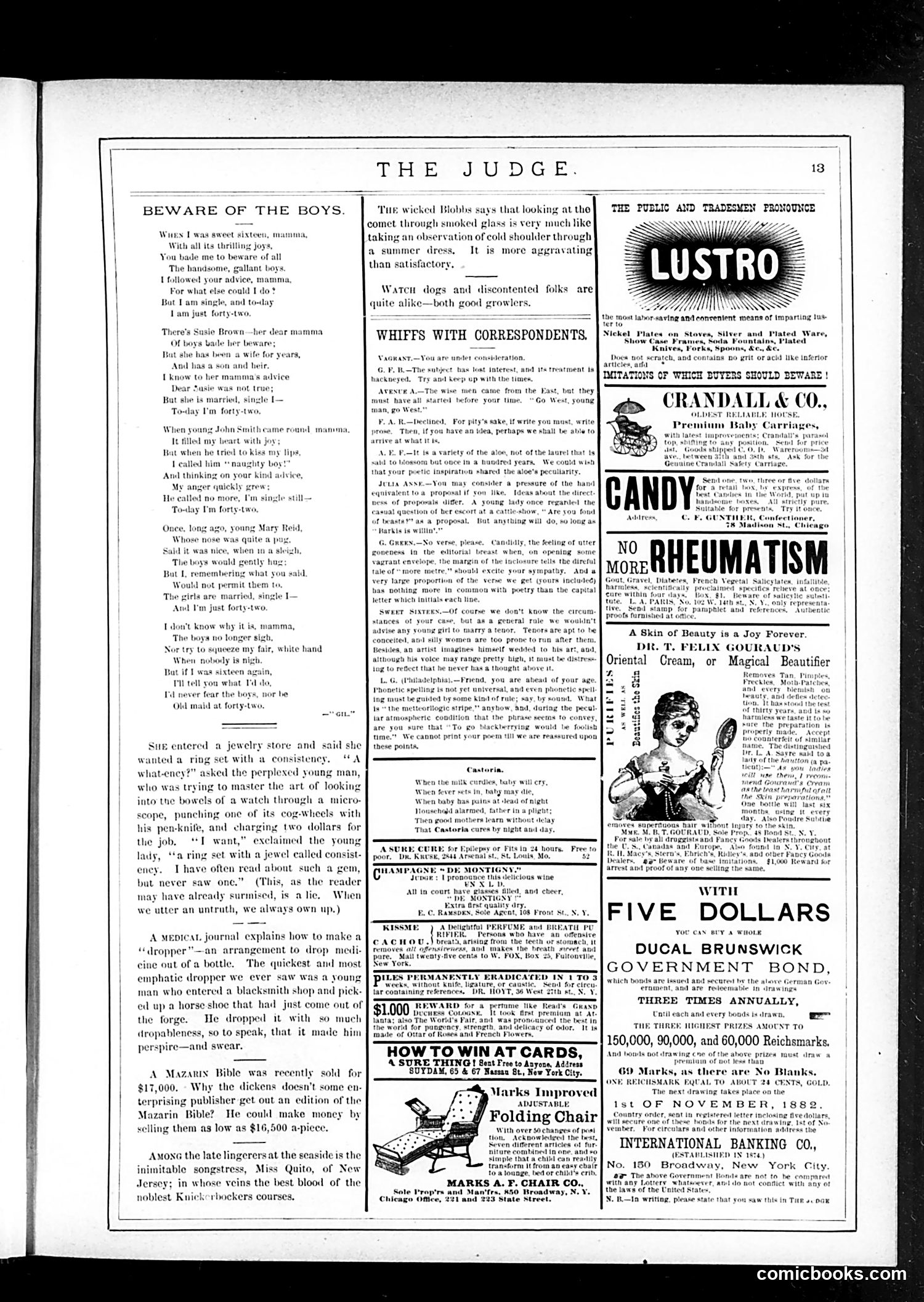
This page contains primarily **humorous fiction and advice columns** rather than political satire. The main content includes: **"Beware of the Boys"** — A sentimental poem about a woman now forty-two, reflecting on her mother's warnings against boys in youth. The joke: by heeding this advice too well, she remained unmarried while her contemporaries married. It's social satire on outdated Victorian courtship restrictions. **"Whiffs with Correspondents"** — A humor column responding to reader letters. The jokes mock romantic predicaments and overly-earnest submissions, including absurd scenarios (a woman seeking a ring set with "consistency"; misunderstandings about proposals). **Various brief humorous anecdotes** about everyday foolishness—a woman punching watch gears, someone dropping a horseshoe—relying on wordplay and absurdist humor. The page is primarily **entertainment-focused** rather than overtly political, with advertisements interspersed. The satire targets social conventions (restrictive courtship rules, romantic naiveté) rather than specific political figures or events.
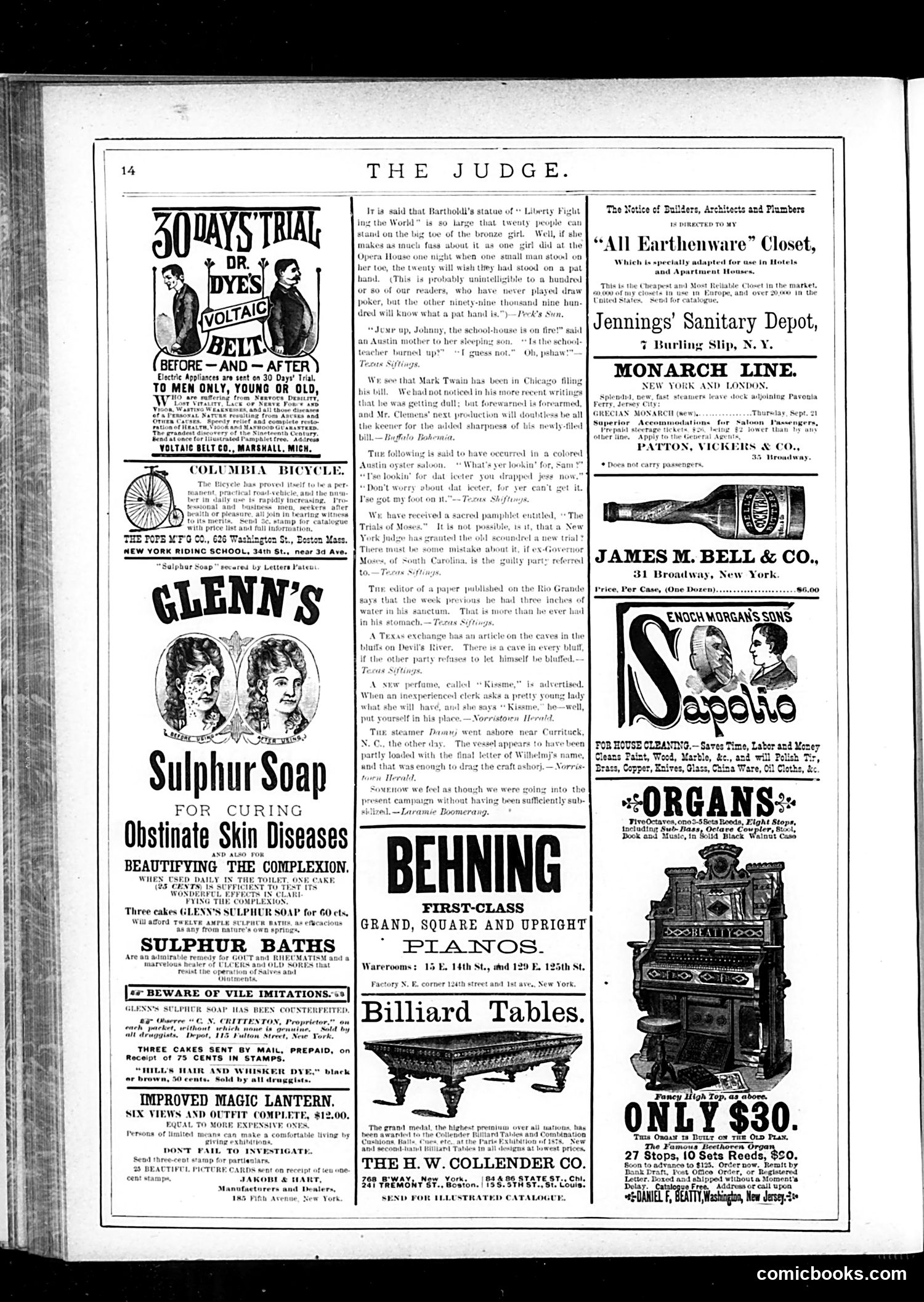
This page is primarily **advertising** rather than editorial content. The main cartoon visible is "Dr. Dyes' Voltaic Belt (Before and After)," a common 19th-century medical quack advertisement claiming an electrical belt could cure male ailments—the "before and after" showing rejuvenation. This reflects the era's fraudulent patent medicine industry. Other ads include Glenn's Sulphur Soap (for skin diseases), Columbia Bicycles, a Magic Lantern (early projection device), Behning Pianos, and Bell Organs—all legitimate period products alongside dubious medical devices. The page also contains brief gossipy notes referencing theater and current events, typical of Judge's lighter content. The **satire** here is implicit: Judge's pages juxtaposed serious editorial with obviously fake medical claims, perhaps mocking both quackery and readers' gullibility, though this wasn't necessarily the intent—such ads were simply standard magazine fare.
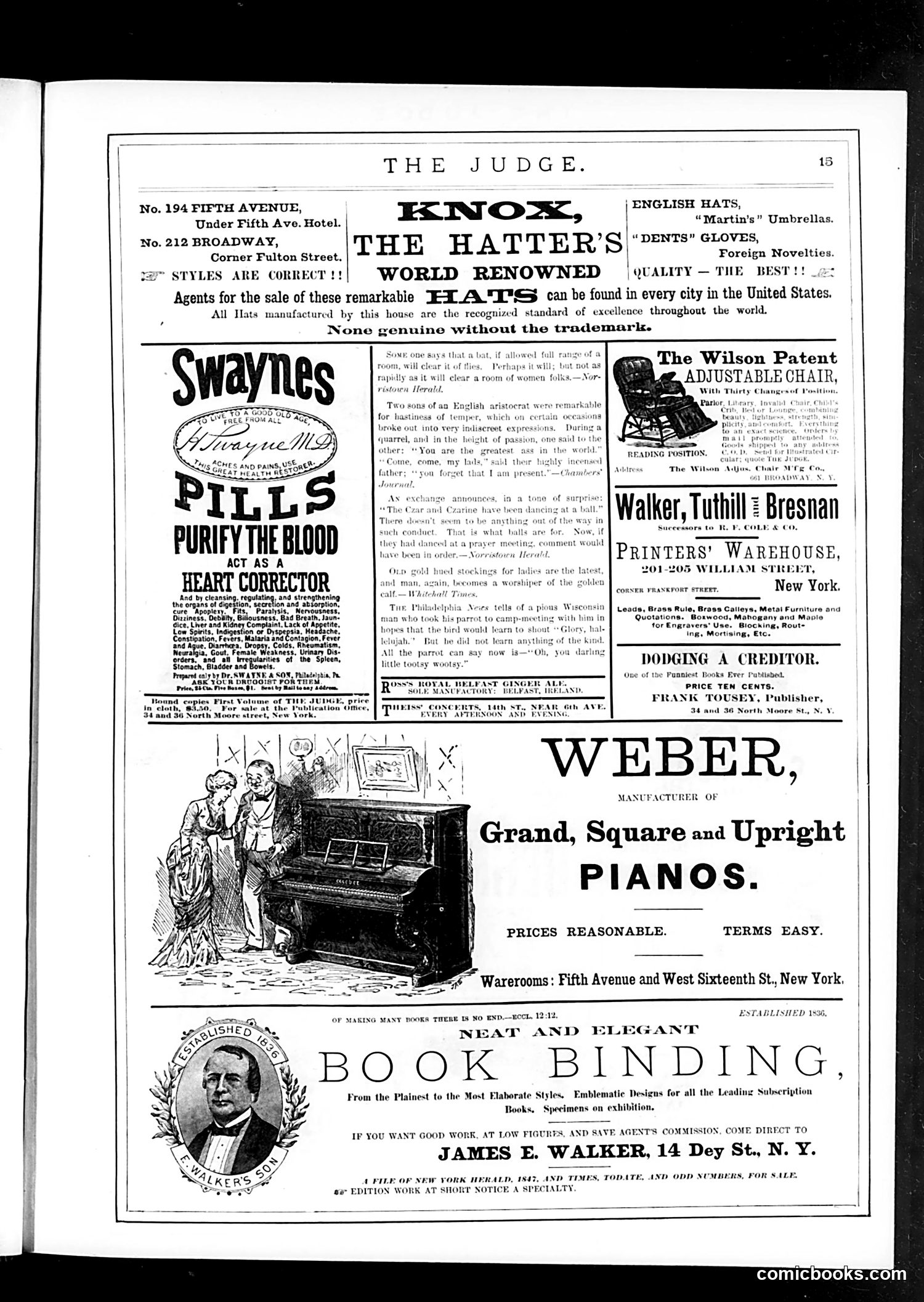
This page is primarily **advertisements** for period products and services (hats, pills, pianos, book binding). However, it includes one cartoon titled **"Dodging a Creditor"** (lower left), which depicts a domestic scene with two figures near a piano. The cartoon illustrates a common social anxiety of the era: debt collection. A man and woman appear to be avoiding someone—likely attempting to hide from a creditor (bill collector). The piano setting suggests middle-class pretensions; despite financial troubles, the couple maintains an appearance of respectability and leisure through possessing a piano. The humor lies in the gap between **appearance and reality**—they own cultural markers of wealth while unable to pay debts. This reflects 19th-century anxieties about maintaining social status while facing financial insecurity. The scene's cramped composition and the couple's nervous positioning emphasize the shame and stress surrounding unpaid obligations. The surrounding advertisements ironically emphasize consumer goods and services, reinforcing the page's implicit theme: the consumer pressures that created such debts.
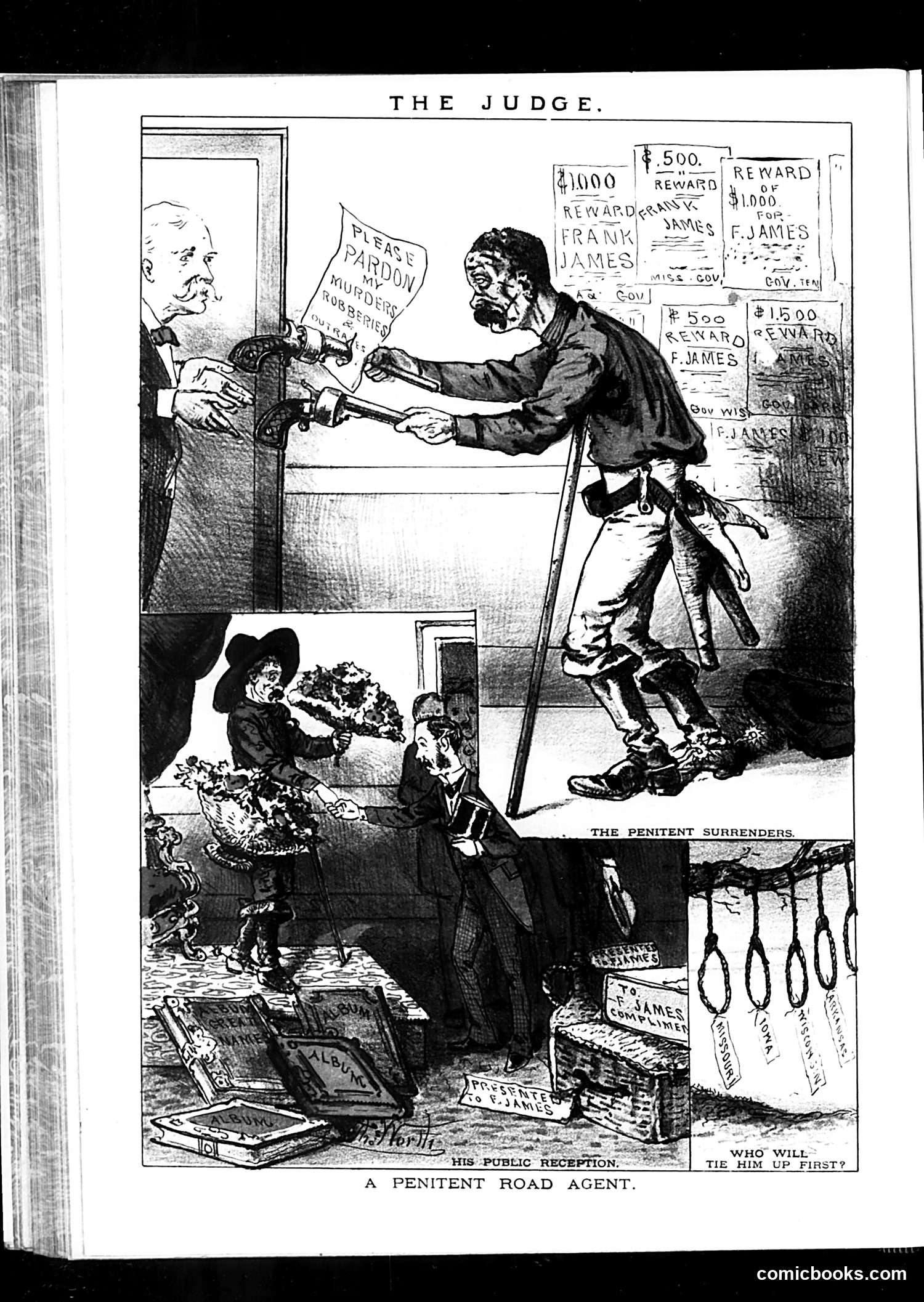
This three-panel satirical cartoon depicts a criminal ("road agent"—a period term for bandit/outlaw) seeking clemency. The top panel shows him pleading with a judge, surrounded by reward posters offering bounties for his capture under the name "Frank James." The middle panel shows his "public reception"—people throwing flowers and gifts. The bottom panel asks "Who will tie him up first?"—suggesting competing clemency seekers. The satire critiques the public's romanticization of outlaws and the inconsistent justice system. The reward posters invoking "Gov." (governor) suggest political involvement in pardons. The cartoon mocks how notorious criminals could gain sympathetic public support and preferential treatment, undermining legitimate judicial authority. This reflects late-19th-century concerns about favoritism and corruption in criminal justice.

I can see this is a page from Judge magazine (as indicated by the "comicbooks.com" watermark at the bottom), but the page itself appears to be blank or nearly blank—no visible cartoon, illustration, text content, or advertisements are discernible in the image. Without visible content to analyze, I cannot identify specific figures, political references, or satirical points. This may be a blank page from the original publication, a scanning error, or a page that has faded significantly over time. To provide meaningful analysis of the cartoon or political satire, a clearer image of the actual content would be needed.