
Judge, 1882-10-21 · page 4 of 17
Judge — October 21, 1882 — page 4: what you’re looking at
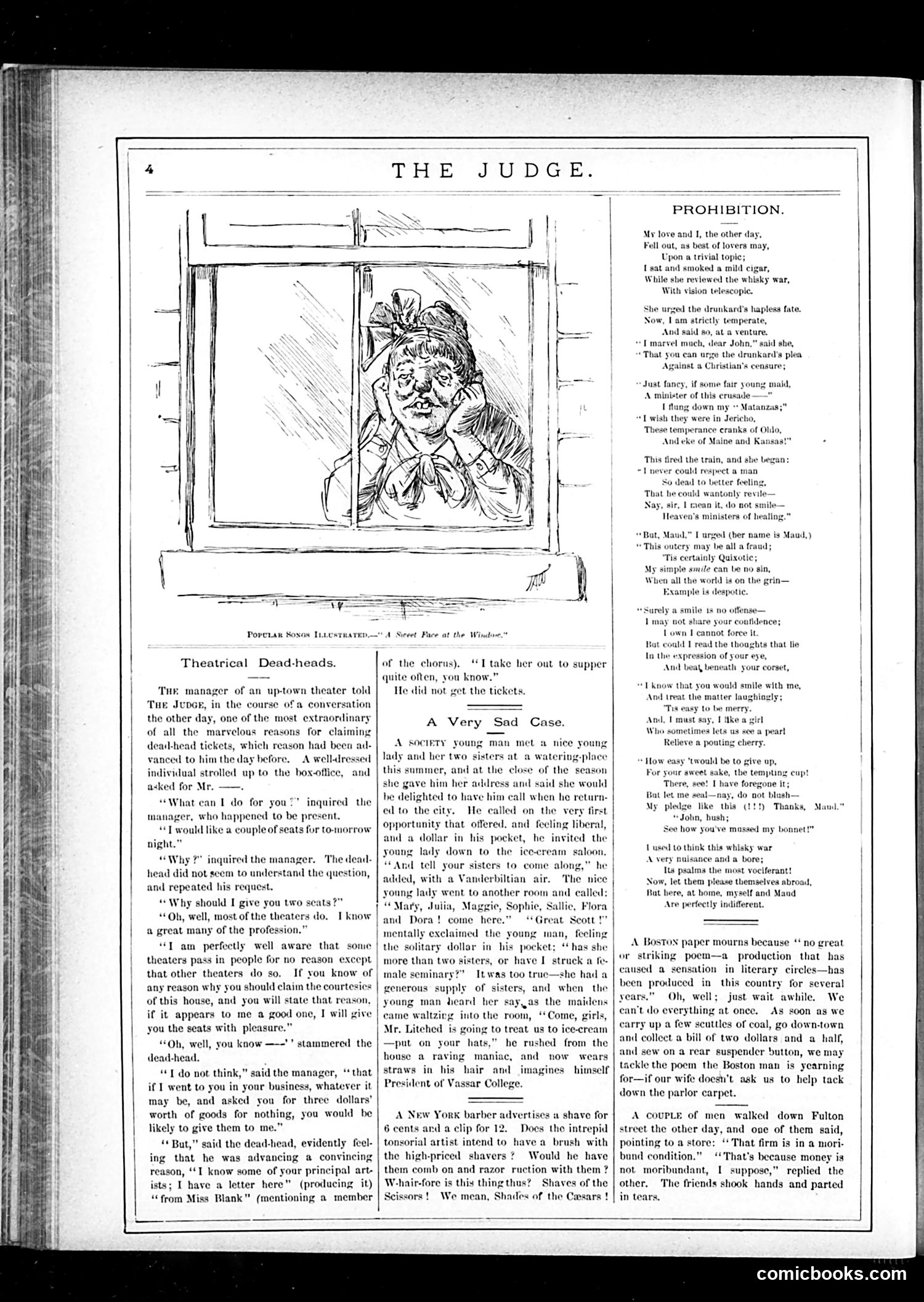
A restored page from Judge, 1882-10-21. Page through the whole issue in the reader above.
📄 Transcribed text from this page (OCR, searchable)
Machine-transcribed from the original scan — historical spelling and the odd misread are preserved.
THE JUDGE. Poreran Soxas [.LcsTnare Dead-heads. Theatrical THe manager of an up-town theater told Tue Jupee, in the course of a conversation the other day, one of the most extraordinary of all the marvelous reasons for claiming dead-head tickets, which reason had been ad- vanced to him the day before. A wellalressed individual strolled up to the box-oflice, and asked for Mr. —. “What can I do for you!’ inquired the manager, who happened to be present. “T would like a couple of seats for to-morrow night.” “Why? inquired the manager. The dead- head did not seem to understand the question, and repeated his request “Why should I giv “Oh, well, most of the theaters do, great many of the profession I know “1 am perfectly well aware that some | theaters pass in people for no reason except that other theaters do so. If you know of any reason why you should claim the courte: of this house, and you will state that reason, | if it appears to me a good one, I will ¢ you the seats with pleasure.” “Oh, well, you know ——'’ stammered the dead-head. «1 do not think,” said the manager, ‘that if I went to you in your business, whatever it may be, and asked you for three dollars’ worth of goods for nothing, you would be likely to give them to me.” ‘+ But,” said the dead-head, evidently feel- ing that he was advancing a convincing reason, ‘I know some of your principal art- ists; I have a letter here” (producing it) “from Miss Blank” (mentioning a member ve of the chorus), I take her out to supper quite often, you know.” He did not get the tickets. A Very Sad Case. A society young man met lady and her two sisters at ay this summer, and at the ¢ ve him her address he delighted to have him eall when he return: ed to the city. He called on the very first opportunity that offered. and feeling liberal, and a dollar in his pocket, he invited th young lady down to the ice-cream saloon. ‘And tell your sisters to come along,” he added, with a Vanderbiltian air. The nice young lady went to another room and called: “Mary, duiia, Maggie, Sophie, Sallie, Flor: nd Dora! come here.” ‘Great Scott !” mentally exclaimed the young man, feeling the solitary dollar in his pocket: “ha more than two sisters, or have I struck a fe- male seminary?” It was too truc—she had generous supply of sisters, and when the young man heard her saycas the mai came waltzing into the room, ‘Come, girls, Mr. Litehed is going to treat us to ice-cream —put on your hats,” he rushed from the house a raving maniac, and now wear straws in his hair and imagines him: President of Vassar College. 1 nice young atering-place © of the season nd said she would loon. she jens If A New York barber advertises a shave for 6 cents ard a clip for 12. Does the intrepid tonsorial artist intend to have a brush with the high-priced shavers ? Would he have them comb on and razor ruction with them ? W-hair-fore is this thing thus? Shaves of the Scissors! We mean, Shades of the Carsars ! PROHIBITION. My love and I, the other day, Fell out, as best of lovers may, Upon a trivial topi Isat and smoked a mild cigar, While she reviewed the whisky With vision telescopic, She urged the drunkard’s hapless fate, Now, Fam strictly temperate, And said 80, at a venture, * [marvel much, dear John,” said she, “That you can urge the drunkard’s plea Against a Christian‘s censun Just fancy, if some fair young maid, down my * *Lwish they were in J ese temperance cranks of Olio, And eke of Maine and Kansast” This tired the train, and st = Tnever could respect a So deail to better feel e could wantonly revile— sir, I mean it, do not smile— Heaven's ministers of healing. That Nay But, Maud,” urged (ber name is Maud,) y be all a fraud; aly Quixotic; smile can be no sin, a all the world is on the grin— Example is despotic. My simpt Whe “Surely a smile 1s no offense— hot share your coutidet force It Hat could I read the thoaghts that lie In the expression of your eye, And bs Lown I cann ath your corset, “+L know that you would smile with me, And treat the matter laughingly “Tis easy to be merry. And, | must a pouting cherry. + How easy *twould be to give up, For your aweet sake, the There, see! I have foregone it; Bat | eal—nay, do not blush- My pledge like this (11!) Thanks, M. *Jobn, bus! See how you've massed my bonne fempting cup! 1 used to think this whisky war A very nuisance and a bore Its psalms the most voclferant! Now, let them please themselves abroad, Rat bere, at home, myself and Mand Are perfectly indifferent. A Boston paper mourns because “ no gre: or striking poem—a production that has caused a sensation in literary circles—has been produced in this country for several years.” Oh, well; just wait awhile. We can't do everything at once. As soon as we carry up a few scuttles of coal, go down-town and collect a bill of two dollars and a half, and sew on a rear suspender button, we may tackle the poem the Boston man is yearning for—if our wife doesn't ask us to help tack down the parlor carpet. A coupLe of men walked down Fulton street the other day, and one of them said, pointing to a store: ‘That firm is in a mori- bund condition.” ‘That's because money is not moribundant, I suppose,” replied the other. The friends shook hands and parted in tears, comicbooks.com