
A complete issue · 16 pages · 1882
Judge — October 14, 1882
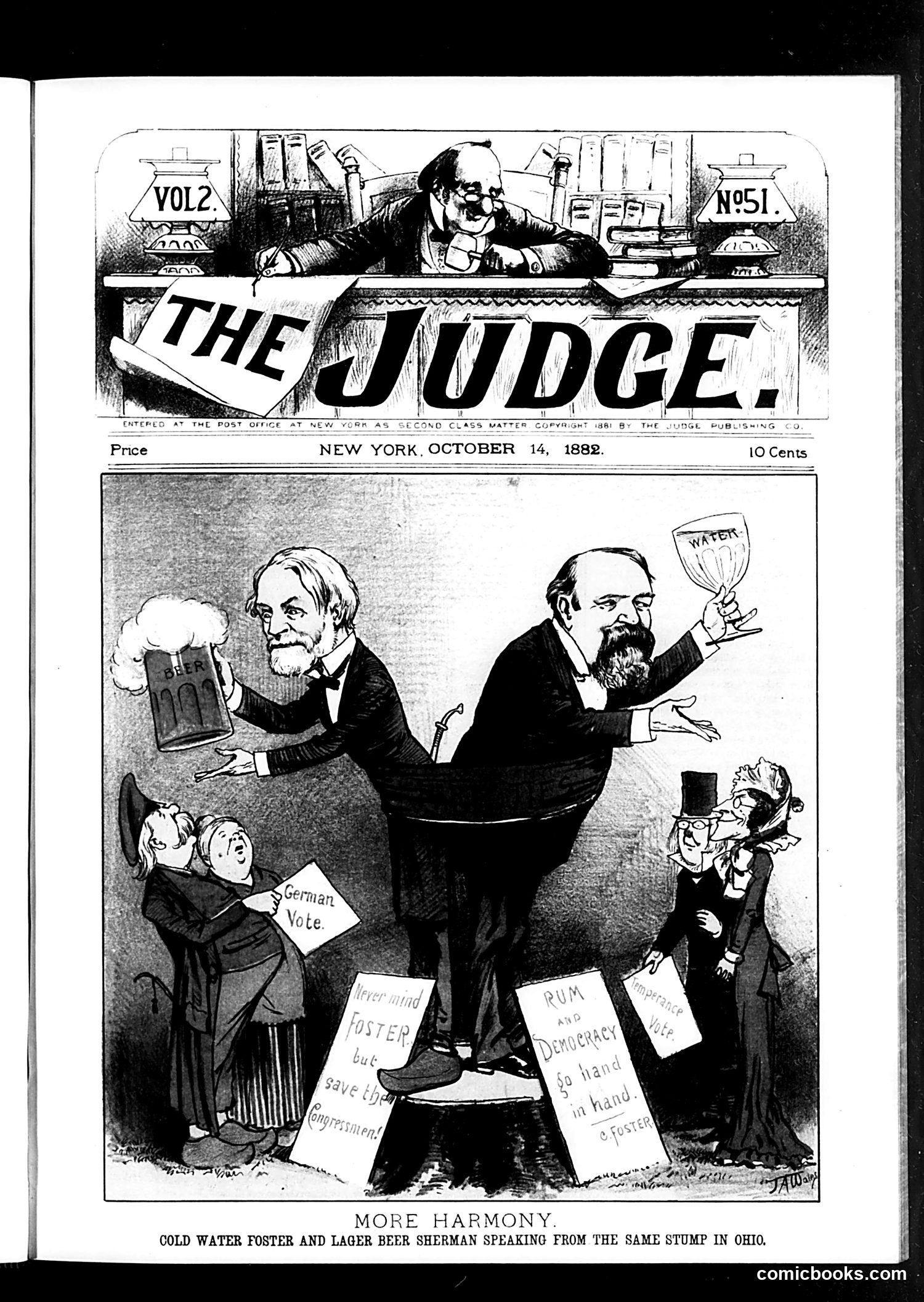
This 1882 Judge cartoon satirizes political alliance between two figures opposing each other: "Cold Water Foster" (likely a temperance advocate) and "Lager Beer Sherman" (presumably General William Tecumseh Sherman, depicted as favoring alcohol). The caption's ironic title "More Harmony" mocks their unlikely cooperation from the same Ohio stump. The cartoon shows these opposing figures juggling contradictory platforms—Foster holds a beer mug labeled "BEER," while the other displays "WATER" and placards reading "RUM AND DEMOCRACY" and "FOSTER DEMOCRACY." Small caricatured figures (possibly representing German voters and other constituencies) surround them holding "German Vote" signs. The satire targets the political compromises and contradictions of the 1882 election cycle, particularly tensions between temperance movements and immigrant voters (Germans) who supported beer, while candidates attempted to appeal to both groups simultaneously.
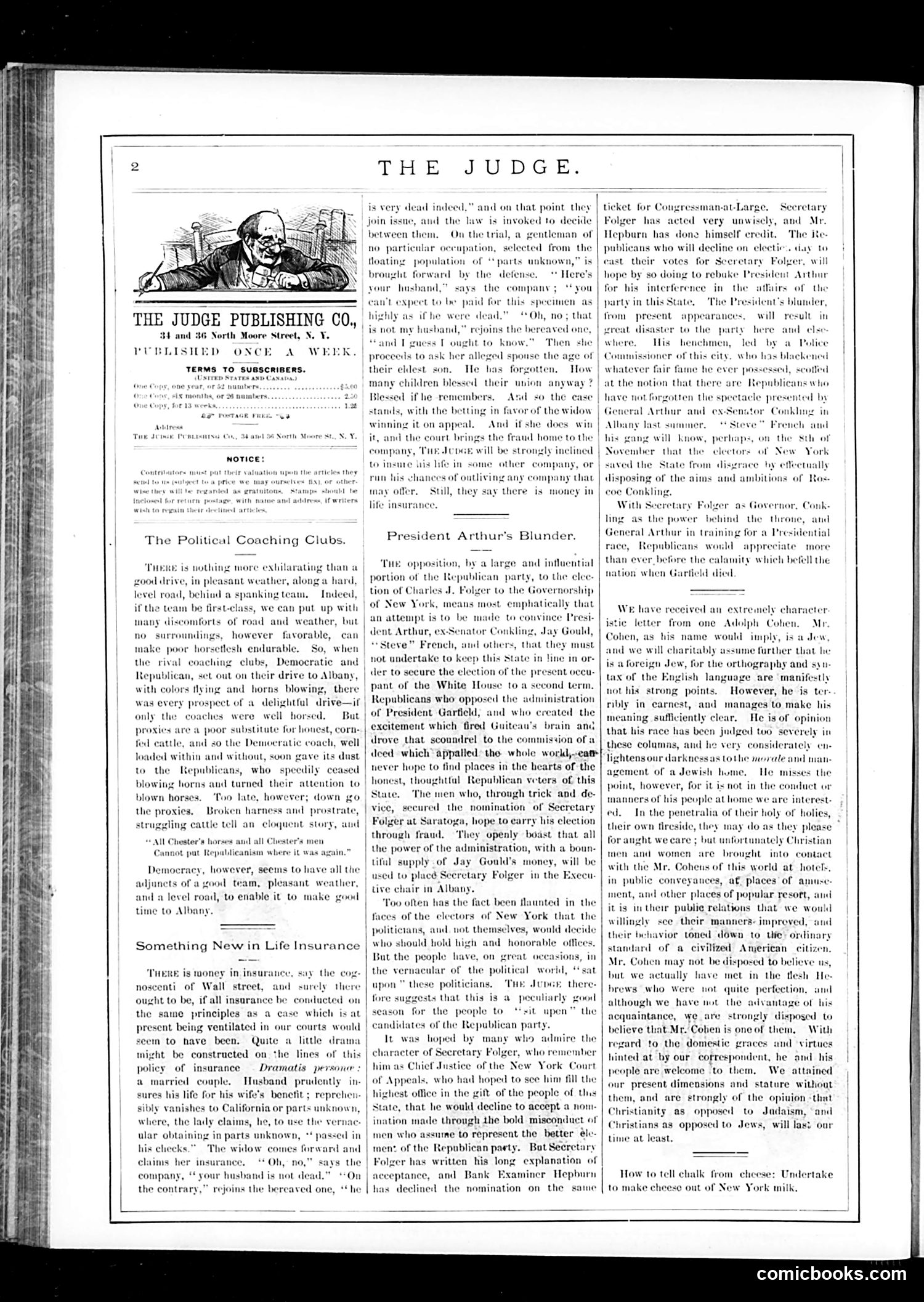
This page contains political satire about 1880s Republican Party infighting, specifically opposing Charles J. Folger's gubernatorial nomination in New York. **The Main Cartoon** (top left) depicts a caricatured figure, illustrating the lead article "The Political Coaching Clubs," which uses extended metaphor: the Republican and Democratic parties are rival coaches with horses. Democrats have better "horseflesh" (voters/support), causing Republicans' proxies to break down—a commentary on GOP organizational weakness or electoral struggles. **"President Arthur's Blunder"** discusses opposition to Folger's nomination from within the Republican party itself, including figures like ex-Senator Conkling and Jay Gould. The satire suggests that Arthur and allies are attempting to impose an unpopular candidate, warning they'll lose influence with the electorate. The reference to Guiteau (Garfield's assassin) implies Republican divisions over patronage created dangerous rifts. The secondary piece on life insurance appears unrelated political satire about a widow's disputed insurance claim. **Context**: This reflects real 1882 NY Republican Party divisions over patronage and leadership following Garfield's assassination.
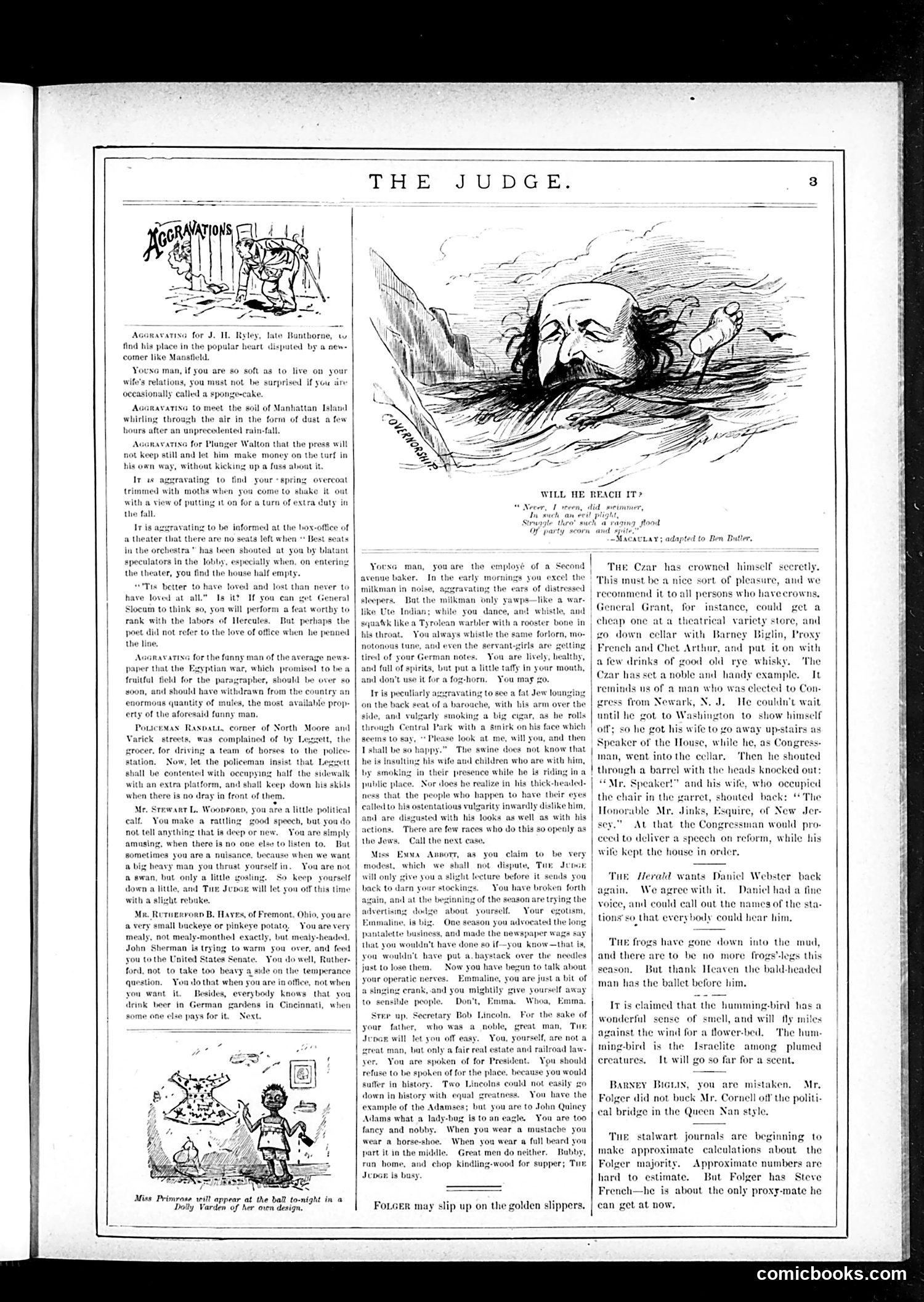
This page features "The Judge," a satirical advice column format common to the magazine. The illustrated figure at top right appears to be a caricatured judge or authority figure dispensing criticism. The text consists of mock "admonitions" (complaints) directed at various public figures and types. These include disparaging remarks about: - Politicians and public servants (references to General Slocum, Secretary Bob Lincoln, John Quincy Adams) - Social types (a pretentious Jewish man in Central Park, theatrical performers, government employees) - Specific individuals like "Mr. Stewart L. Woodford" and "General R. B. Hayes of Fremont" The humor relies on Victorian-era class prejudices and ethnic stereotyping now considered deeply offensive. The satire targets social pretension, incompetence in office, and perceived moral failings. The bottom illustration appears to show "Miss Primrose" in costume. Without precise dating visible on this page, the specific grievances remain difficult to contextualize historically, though the reference to Hayes and Lincoln suggests 1870s publication.
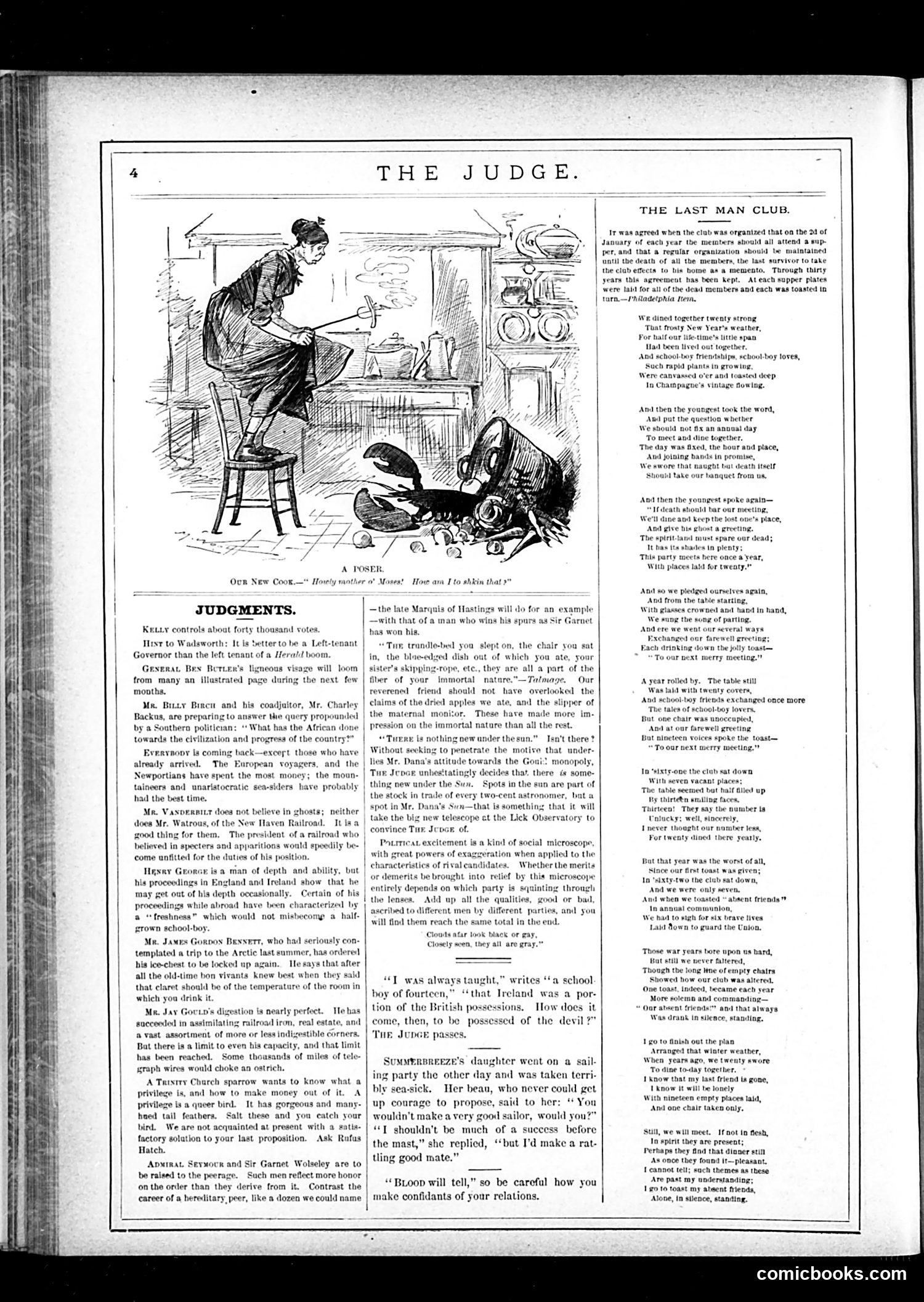
This page contains a satirical cartoon titled "A Poser" depicting a cook struggling with a large fish. The caption reads: "Our New Cook—'Howly mother o' Moses! How am I to skin that?'" The humor relies on ethnic stereotyping (the Irish brogue in the speech) and the visual comedy of the cook's bewilderment at preparing an oversized fish—likely a topical reference to a recent hiring or kitchen scandal, though the specific event isn't identifiable from the page alone. The "Judgments" column below offers satirical observations about prominent figures of the era (Kelly, General Ben Butler, Henry George, Jay Gould, and others), mocking their various character flaws, political positions, and personal foibles through brief, witty commentaries. These were recognizable public figures to contemporary readers but require historical knowledge to fully appreciate. The writing style is typical Judge magazine commentary—clever, caustic, and assuming reader familiarity with current events.
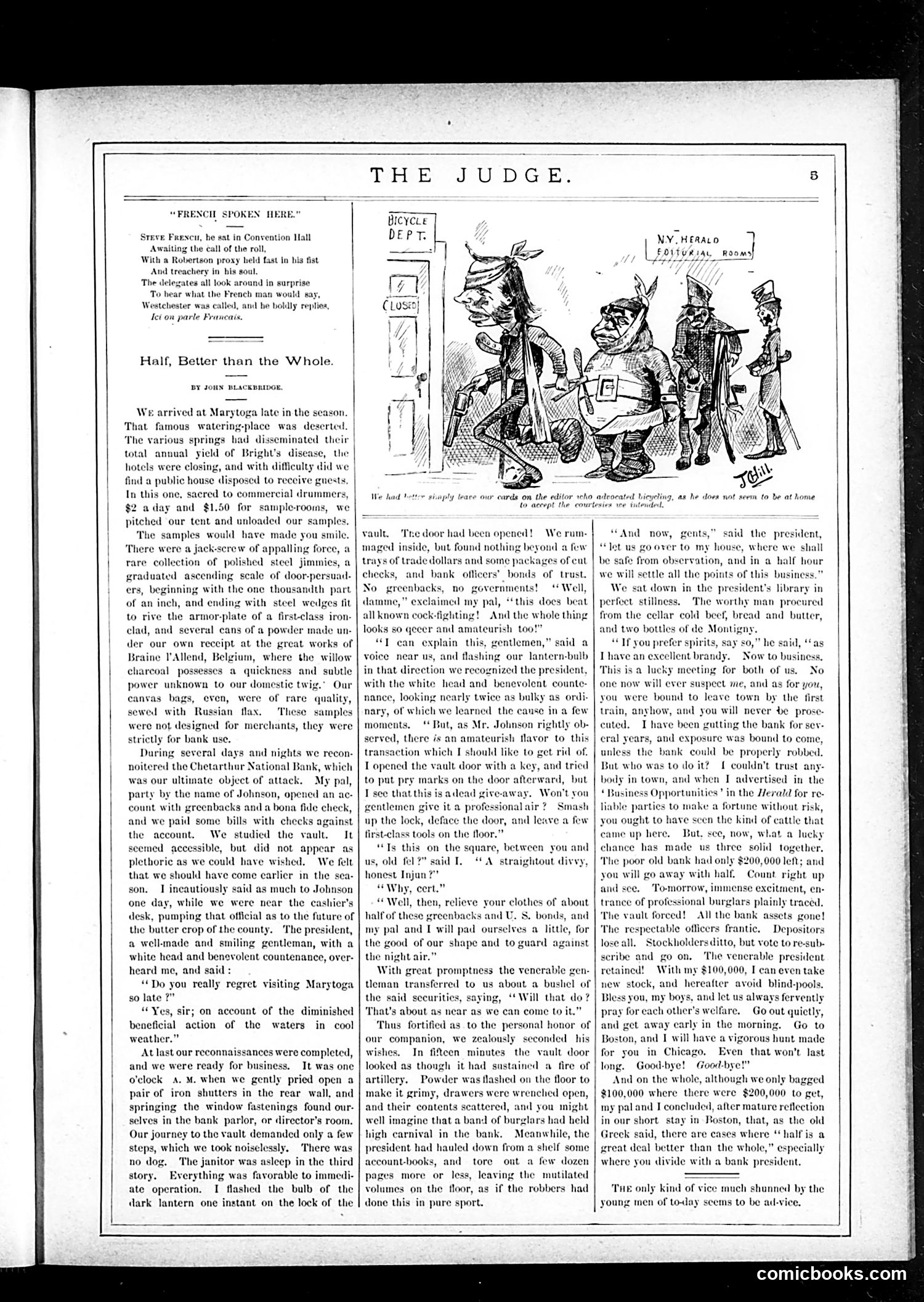
This Judge magazine page contains two distinct pieces of satire: **"French Spoken Here"** (top): A brief poem mocking a delegate at a political convention (likely Republican, based on the "Robertson proxy" reference) who betrays his party's interests. The joke is that he speaks French—implying pretentious European sympathies—while committing political treachery. **"Half, Better than the Whole"** (main story): A humorous fictional account of bank robbers who arrive at a resort town late in the season to case a bank. The satire targets the robbers' surprise at finding the vault already empty—suggesting commentary on financial corruption or bank instability of the era. The president's explanation (cut off) apparently reveals the bank itself engaged in questionable practices, making the criminals' theft somewhat justified. This satirizes banks and financial institutions rather than celebrates crime. Both pieces employ irony: apparent villains (traitor, thieves) are recontextualized through satire to critique larger institutions and hypocrisy.
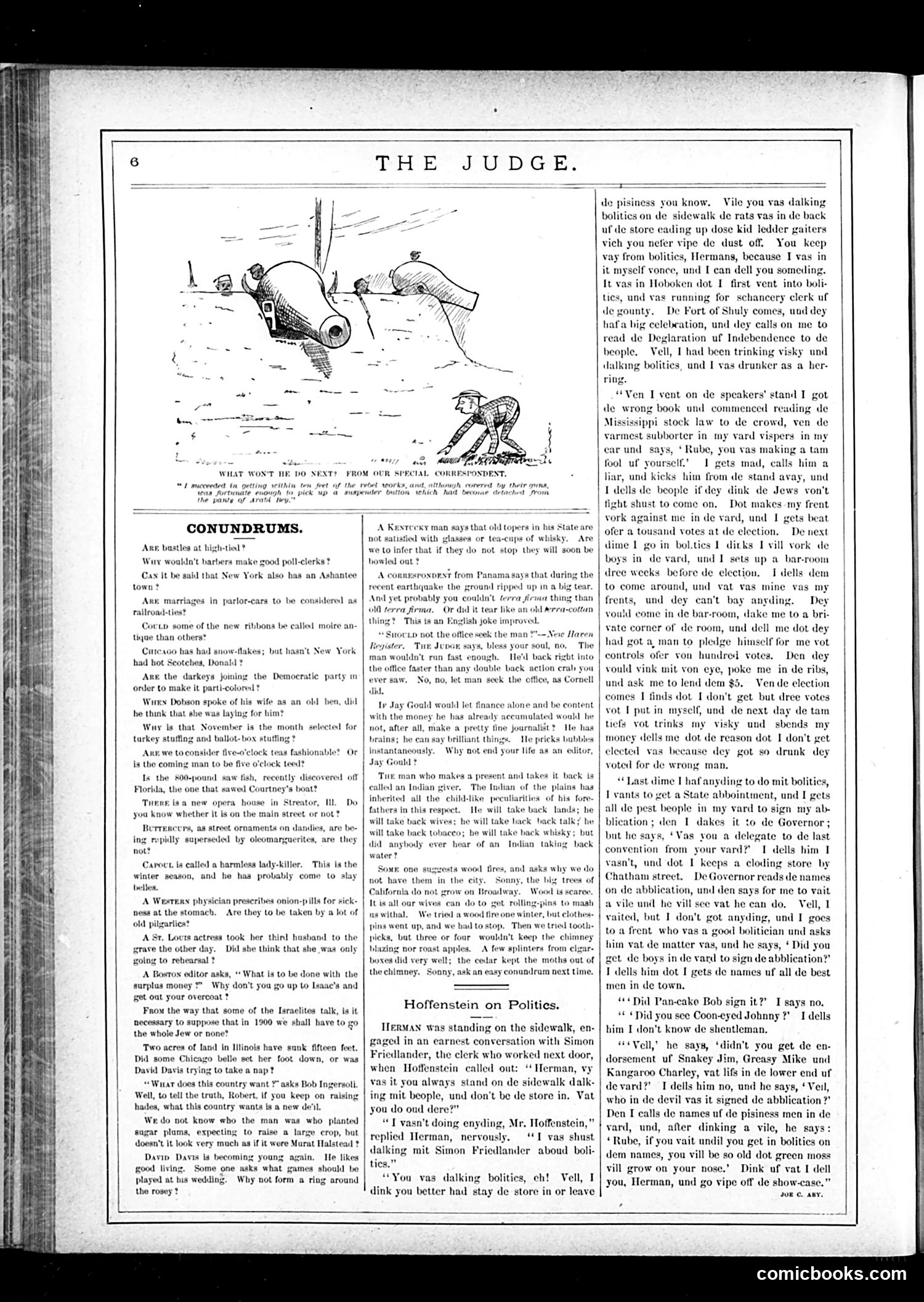
This page from *Judge* magazine contains two main elements: a political cartoon and a "Conundrums" section (riddles/jokes). **The Cartoon:** Titled "What Won't He Do Next?" it depicts a figure appearing to operate some kind of mechanical device or cannon near "rebel works," likely referencing Civil War-era politics or reconstruction-era political maneuvering. The specific figure is unclear from the image alone. **The Conundrums Section:** This is a collection of topical riddles satirizing contemporary American life circa the 1870s-80s, including references to: - Political corruption ("ballot-box stutting") - Racial attitudes ("darkeys joining the Democratic party") - Contemporary public figures (David Davis, Jay Gould, Murat Halstead) - Social absurdities (Indian treaties, oleomargarine, railroad travel) The humor relies on wordplay and references to current events, scandals, and public figures that would have been immediately recognizable to *Judge*'s readership but require historical context today. The satire targets politics, business figures, and social pretension.
This page from the satirical magazine *Judge* contains three distinct pieces of social humor: **"À La Mode"** mocks wealthy aspirations through a mother-daughter dialogue. A poor mother promises her daughter a fashionable wardrobe and marriage to a wealthy suitor (Algernon de Snobs), though the family lacks means. The satire targets nouveau riche pretension and social climbing. **"Owning the Corn"** is a physical comedy piece: a country woman, misunderstanding a chiropodist's advertisement promising "corns extracted without pain," literally shows the streetcar conductor her foot (complete with corn) when asked for her fare instead of payment. The humor relies on rural ignorance of city advertisements. **"A Very Hard Case"** features a formerly wealthy man relating how he lost his fortune through poor investments (apparently in railroads). He boasts of knowing Jay Gould and Vanderbilt, who he satirizes as incompetent businessmen. The story critiques both financial speculation and the nouveau riche's delusions of grandeur. All three pieces satirize class pretension and financial instability during the Gilded Age.
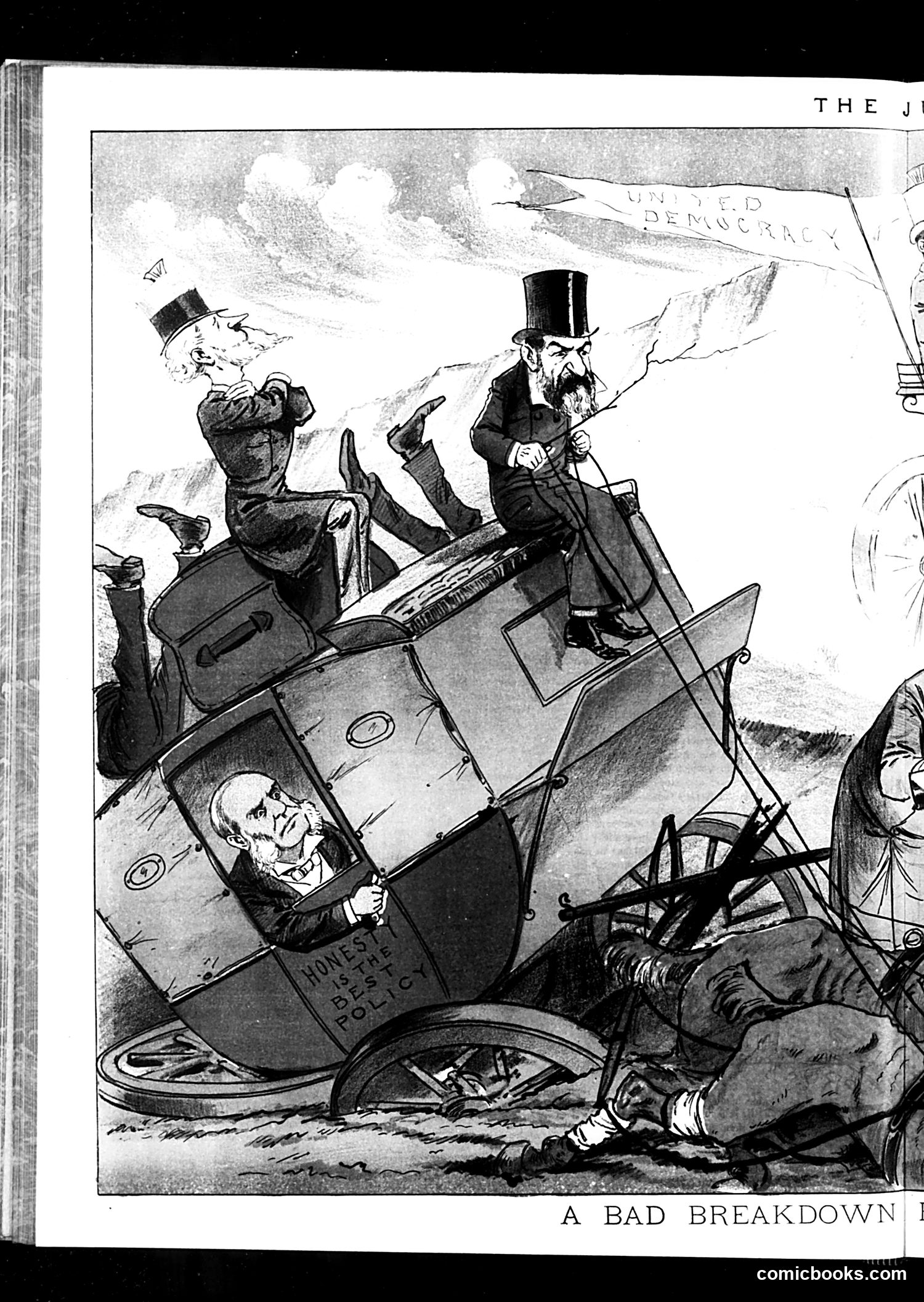
This political cartoon depicts a broken-down vehicle labeled "HONEST OLD POLICE" with two top-hatted figures sitting atop it in distress. A third figure appears trapped or positioned beneath the vehicle. The imagery suggests a critique of police institutional failure or corruption—the "breakdown" is literal (a broken carriage) but metaphorically represents a collapse in police integrity or function. The caricatured figures and formal dress suggest this comments on specific political or administrative figures responsible for police matters, though without additional context or visible labels identifying them specifically, I cannot definitively name them. The satire appears to mock those in charge of law enforcement for allowing its standards or operations to deteriorate into disrepair.
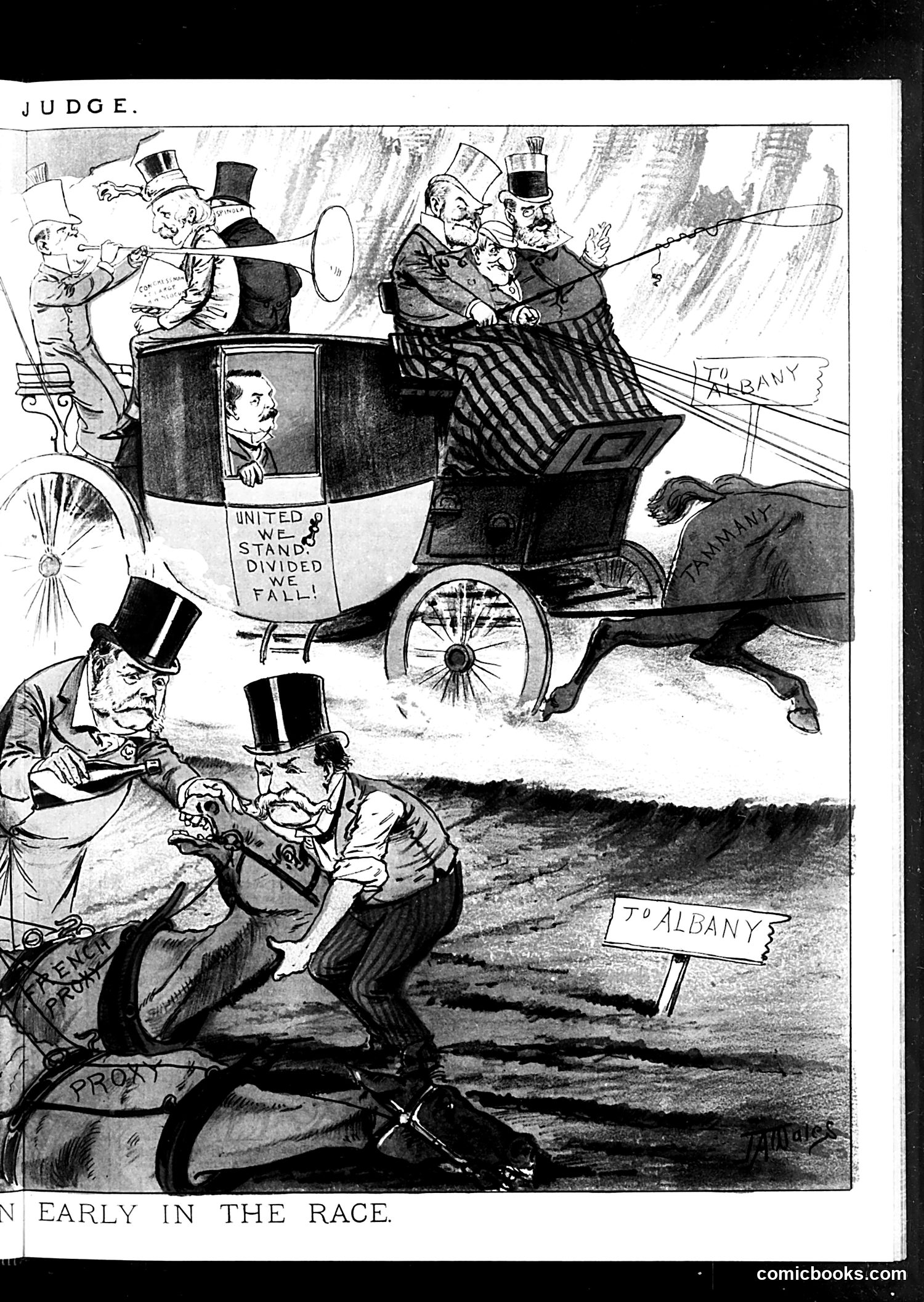
This political cartoon satirizes a divided America heading toward conflict. A carriage labeled "United We Stand Divided We Fall" carries political figures toward "Albany" and "Tammany," while a horse labeled "Anarchy" or similar strains to pull it. Figures in top hats (likely representing different political factions or parties) use megaphones and tools, seemingly unable to cooperate or steer the vehicle effectively. The bottom shows two men labeled "Proxy" grappling or fighting on the ground—apparently representing proxy wars or factional disputes playing out among ordinary citizens. The overall message: political division and partisan conflict are destabilizing the nation, threatening the unity needed for national stability. The "race" metaphor suggests this is an electoral or political competition threatening to tear the country apart rather than unify it.
This page contains two satirical pieces mocking American life circa the 1880s-90s. **"The Wail of the Skirmisher"** depicts Irish-American frustration—likely referencing *Judge's* satirical character "The Skirmisher," an Irish immigrant figure. The poem laments money spent on publications and causes that disappoint subscribers, with dialect humor targeting Irish speakers. **"Three Times and Out"** satirizes the struggling life of a magazine editor. A poor woman attempts to submit poetry to the *Runkinville Journal* editor, who's literally burning old manuscripts for warmth. The humor targets both the pretensions of amateur poets flooding editors with unsolicited work AND editors' dismissive treatment of such submissions. The editor's exasperation—combined with his poverty—creates dark comedy about publishing's economic realities. Both pieces reflect *Judge's* class-based humor, mocking working-class immigrants and struggling artistic aspirants while appealing to middle-class readers who enjoyed seeing "lesser" social groups ridiculed.
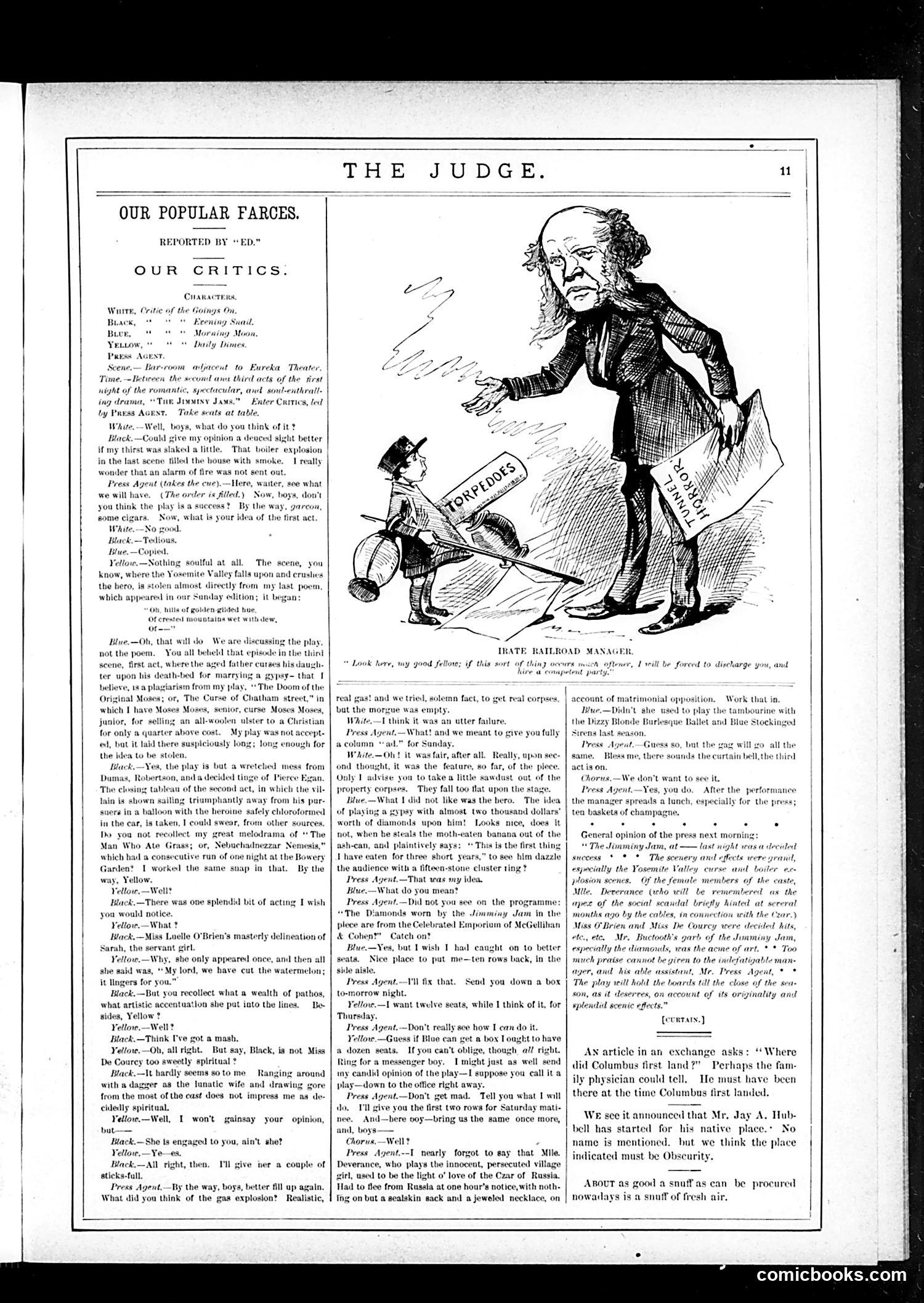
This is a theatrical satire featuring critics discussing a melodrama called "The Jimminy Jaws" at the Eureka Theater. The cartoon depicts an "Irate Railroad Manager" confronting the theater's press agent about using real explosives and actual corpses in performances for "realism." The satire mocks two things: (1) **sensationalist theater** of the era, which relied on spectacle and increasingly extreme special effects to attract audiences, and (2) **the absurdity of theatrical "realism"** — the critics' debate whether props should be authentic (real gas explosions, actual dead bodies) versus artistically convincing fakes. The railroad manager's anger suggests the theater's explosions caused actual damage to property nearby. The joke is that in pursuing theatrical authenticity, the producers created genuine public hazards, turning art into dangerous reality. This reflects late-19th-century concerns about both theatrical excess and industrial safety.
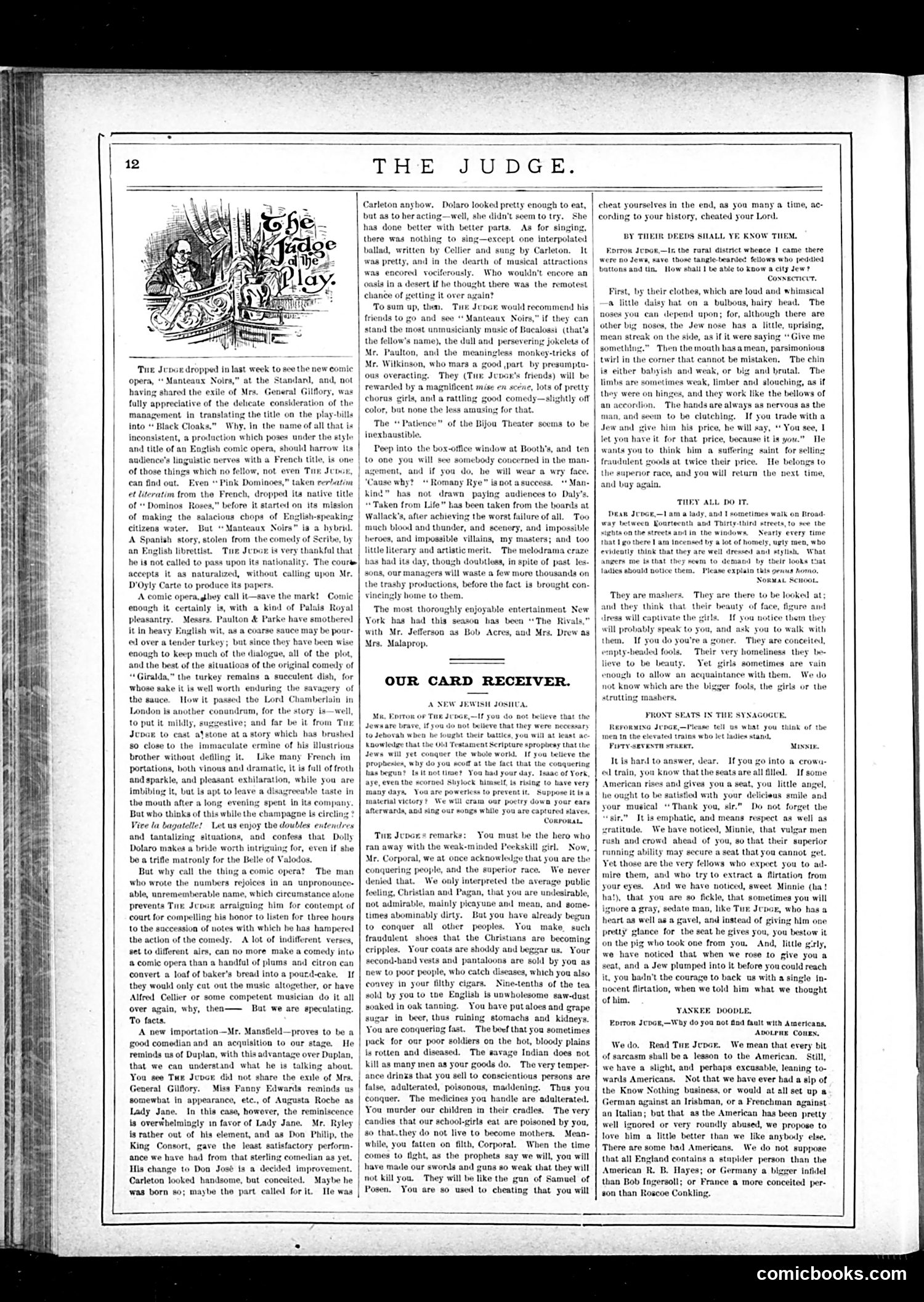
This page reviews a new comic opera, "Manteaux Noirs" (translated as "Black Cloaks"), performed at the Standard Theater. The cartoon illustrates the production. The critic complains about the show's confused identity: it's based on a Spanish comedy by Scribe, given an English libretto, yet retains a French title—an unnecessarily pretentious choice when other French imports (like "Pink Dominoes") had been anglicized. The reviewer praises the plot and dialogue as witty and amusing, comparing the experience to champagne—pleasant but leaving no lasting impression. However, he harshly criticizes the musical score by the unnamed composer, arguing that poor music cannot elevate a comedy into true comic opera. He praises actress Dolaro as an appealing bride character, and approves of comedian Mansfield and actress Fanny Edwards, though he finds actor Ryley miscast as King Consort. The satire targets the pretentiousness of theatrical adaptation and the mediocrity of operatic composition in contemporary productions.
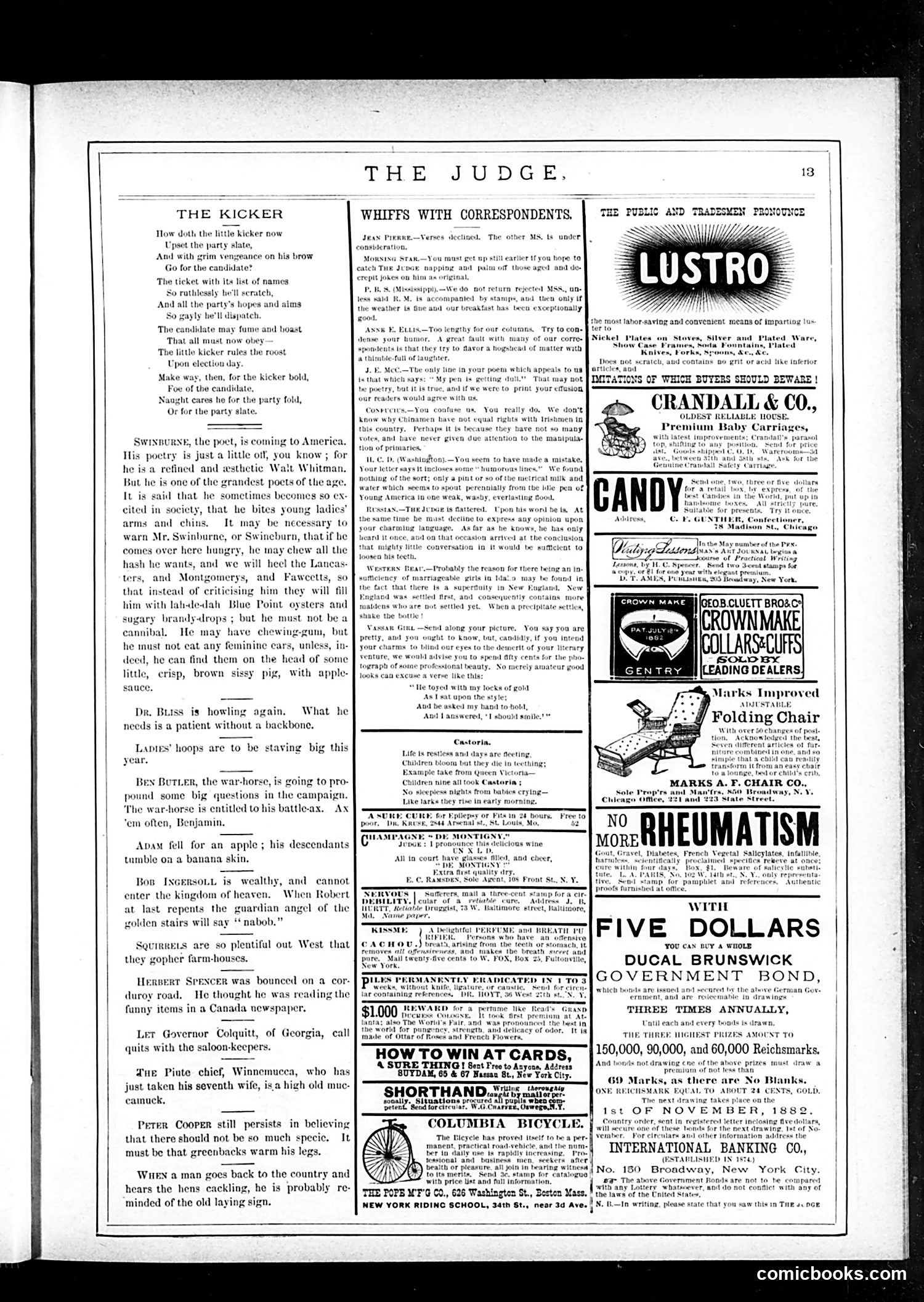
This page from Judge magazine (circa late 19th century) contains a humorous poem titled "The Kicker" mocking independent voters who split their party tickets during elections. The verse satirizes voters who ignore party loyalty and "scratch" official slates—a contemporary political practice. The term "kicker" referred to voters who independently selected candidates rather than voting the straight party ticket, which was controversial in an era of strong party discipline. The page also features scattered brief satirical items about public figures (Swinburne the poet, Robert Ingersoll, Winnemucca the Native American leader) and social commentary typical of Judge's humor. The right column contains reader correspondence ("Whiffs with Correspondents"), showing editors dismissing submitted poetry and literary contributions from readers—itself a humorous feature mocking amateur writers. The advertisements reflect period consumer goods (carriages, bicycles, medical remedies). Overall, this is typical Judge satirical content: political commentary, social mockery, and reader submissions.
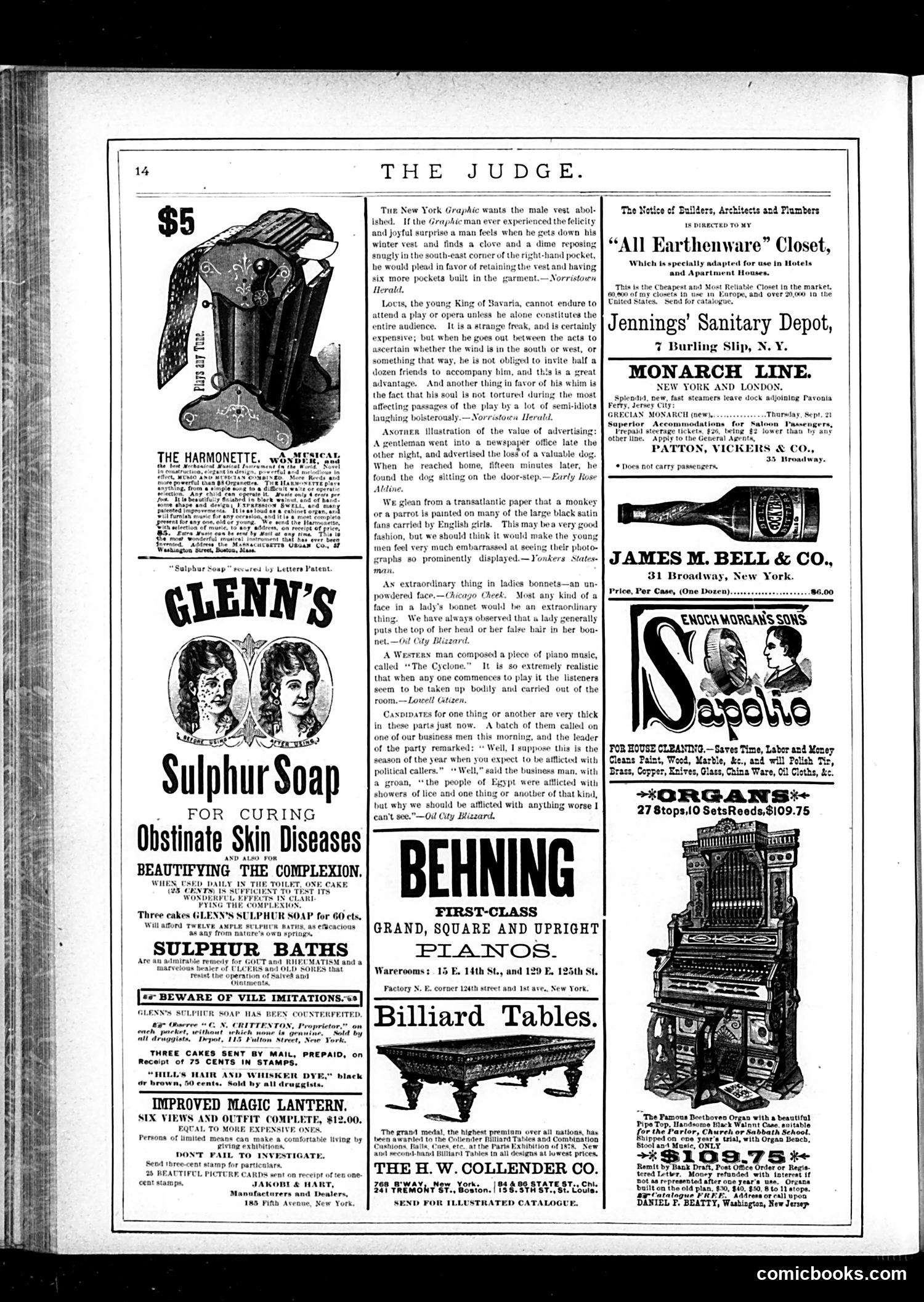
This page is predominantly **advertising**, typical of Judge magazine. The main advertisements include Glenn's Sulphur Soap (for skin diseases), a Magic Lantern (projection device), pianos by Behning, and billiard tables by H.W. Collender. The editorial content consists of brief, humorous observations reprinted from other newspapers, touching on mundane topics: a man finding coins in his winter vest, King Louis of Bavaria preferring solitary theater attendance, advertising's effectiveness, ladies' fashions, and a candidate's complaints about political solicitation. There is **no political cartoon** on this page—no caricatures or satirical illustrations of public figures. The only substantial image is the Harmonette musical device at top left. The page reflects Judge's typical format: a mix of humor, reprinted editorial commentary, and commercial advertising. The jokes are gentle social satire rather than political commentary.
This page is primarily **advertising**, not editorial content or satire. It showcases late 19th-century New York businesses including Knox hats, Swaynes pills, Weber pianos, and book binding services. The one illustrated element is a **Swaynes Pills advertisement** featuring a couple at a piano—a common marketing trope suggesting the product enables leisure and romance. The pills promised to "purify the blood" and act as a "heart corrector," typical patent medicine claims of the era. There's also a small illustration for "The Wilson Patent Folding Chair" and a portrait for James E. Walker's book binding business. The page lacks clear political satire or cartoon commentary. It represents Judge's revenue model: satirical editorial content subsidized by advertisements for patent medicines, furniture, and services targeting middle-class readers. The "DODGING A CREDITOR" reference appears to be a book title being advertised, not commentary on the page itself.
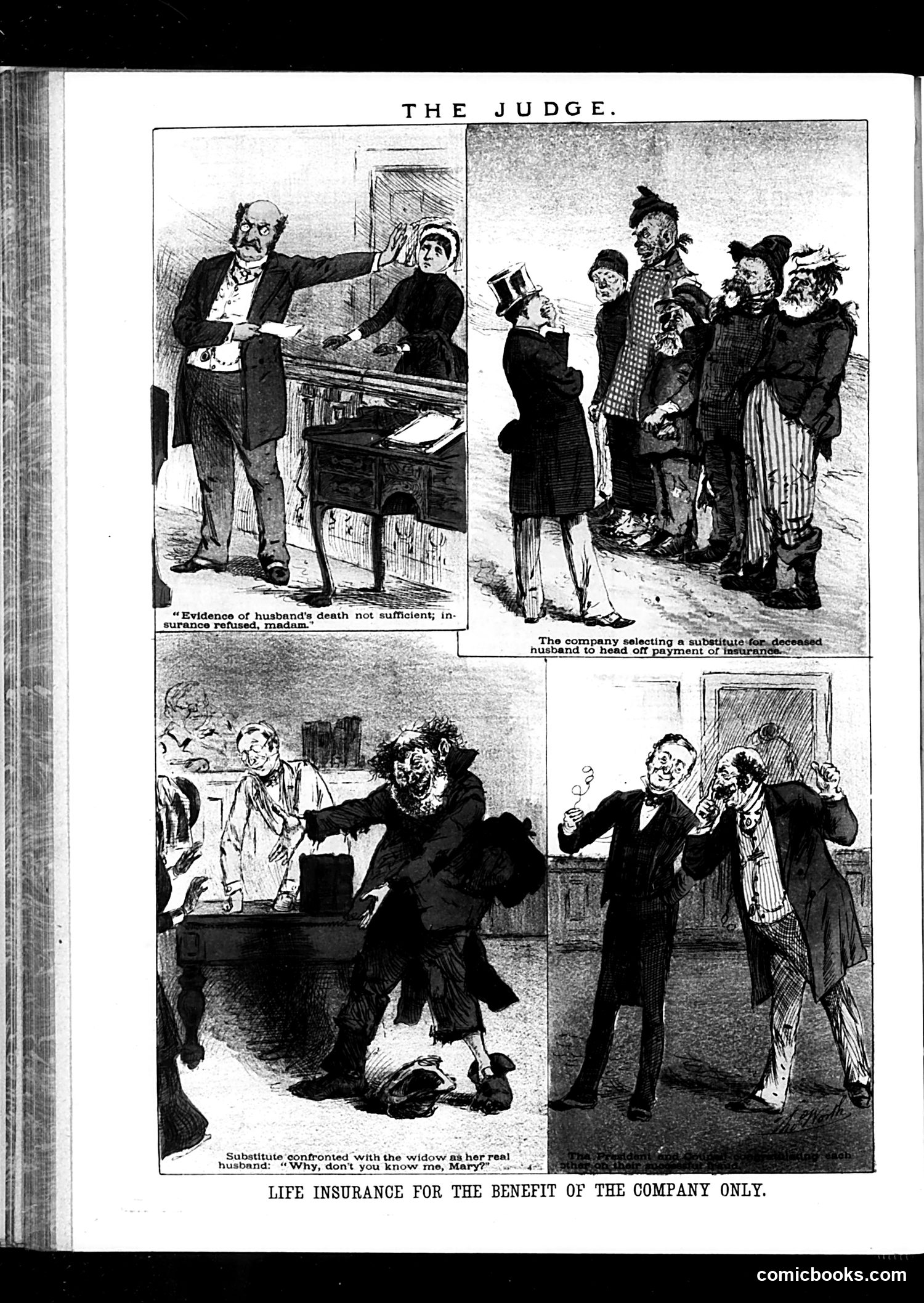
This satirical comic attacks corrupt life insurance practices. The narrative follows a widow whose husband's death claim is refused. The insurance company then attempts to fraudulently substitute another man as her "real" husband to avoid payment obligations. When confronted, the substitute denies knowing the widow ("Why, don't you know me, Mary?"), exposing the company's deception. The title "Life Insurance for the Benefit of the Company Only" sarcastically notes that these policies protected corporate profits rather than widows and families. This reflects early-20th-century criticism of insurance industry fraud and bad-faith claim denial—a significant consumer protection issue before modern insurance regulation. The cartoon satirizes corporate dishonesty and the powerlessness of ordinary people against large companies.