
Judge, 1882-10-14 · page 4 of 16
Judge — October 14, 1882 — page 4: what you’re looking at
What you’re looking at
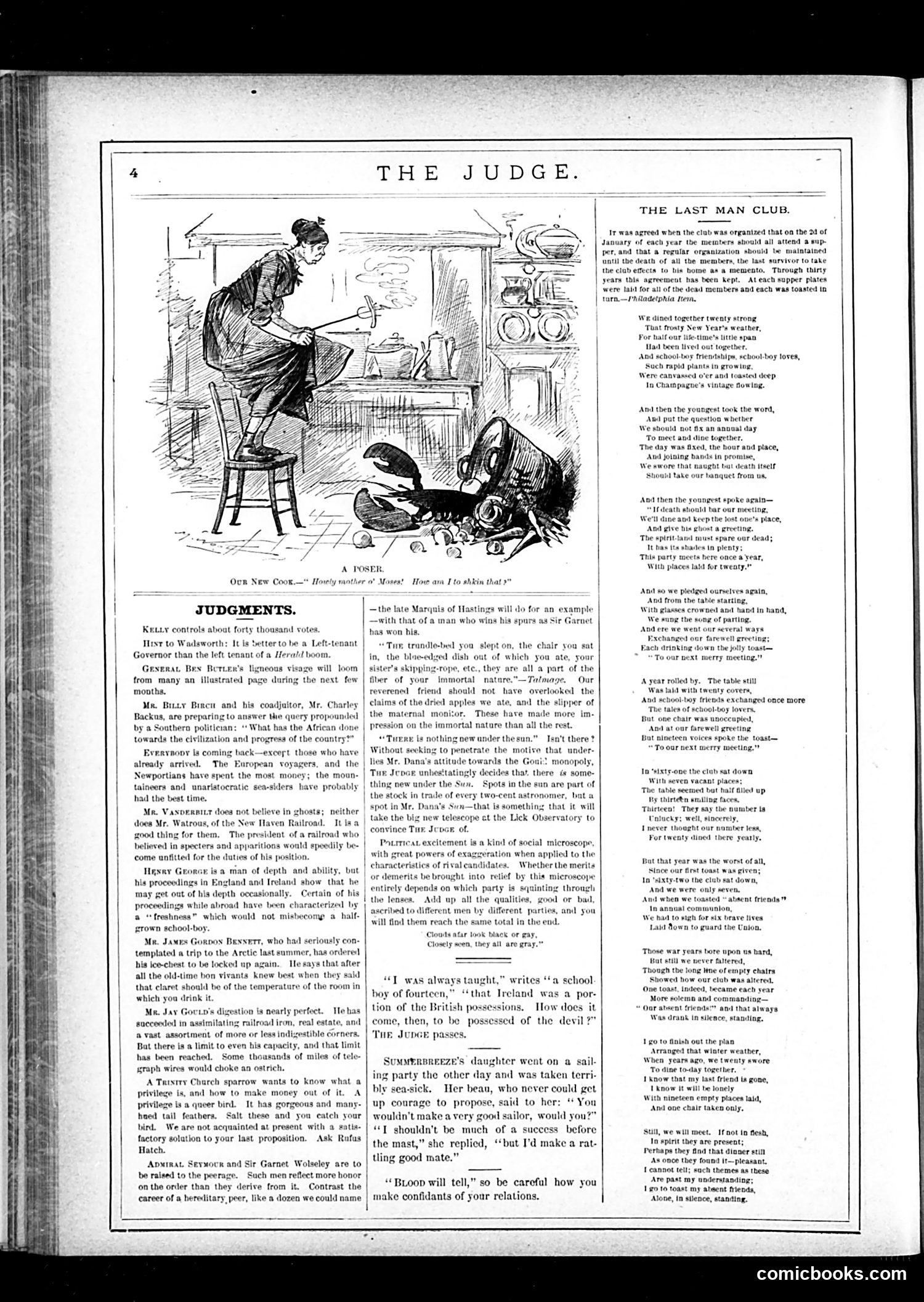
This page contains a satirical cartoon titled "A Poser" depicting a cook struggling with a large fish. The caption reads: "Our New Cook—'Howly mother o' Moses! How am I to skin that?'" The humor relies on ethnic stereotyping (the Irish brogue in the speech) and the visual comedy of the cook's bewilderment at preparing an oversized fish—likely a topical reference to a recent hiring or kitchen scandal, though the specific event isn't identifiable from the page alone. The "Judgments" column below offers satirical observations about prominent figures of the era (Kelly, General Ben Butler, Henry George, Jay Gould, and others), mocking their various character flaws, political positions, and personal foibles through brief, witty commentaries. These were recognizable public figures to contemporary readers but require historical knowledge to fully appreciate. The writing style is typical Judge magazine commentary—clever, caustic, and assuming reader familiarity with current events.
📄 Transcribed text from this page (OCR, searchable)
Machine-transcribed from the original scan — historical spelling and the odd misread are preserved.
a Sonne TEESE BOS 52 5 THE “J°UCD Gib: A POSER. Ovn New Coox.—"* Hovly mother 0 Moses! How am Ito shkin that >” JUDGMENTS. KeLty controls aboat forty thousand votes. Iltyt to Wadsworth: It is better to be a Li overnor than the left tenant of a Herald boom. tenant Geverat Bex Betuer’s ligneous visage will loom from many an illustrated page during the next few months. Mx. Buty Bincu and his coadjuitor, Mr. Charley Backus, are preparing to answer We query propounded by a Southera politician: “What has the African done towards the civilization and progress of the country?” Evervnopy is coming hack—excert those who have already arrived. The European voyagers, and th Newportians have spent the most taineers and unaristocratic sea-s had the best time. Mr. Vaxpernitr does not believe in ghosts; neither does Mr. Watrous, of the New Maven Railroad. It is a good thing for them, The president of a railroad who believed in specters and appar come unfitted for the duties of his the moun- lers have probably Hexry Grorce isa man of depth and abilit his proceedings in England and Ireland show that he may get out of his depth occasionally. Certain of his proceedings while abroad have been characterized a “freshness” which would not misbecomp a half- grown school-boy. Mn. Jawes Gorvos Besser, who had seriously con- templated a trip to the Arctic last summer, has ordered his ico-chest to be locked up again. He says that after all the old-time bon vivants knew best when they sald that claret shoald be of the temperature of the room in which you drink it Mr. Jay Govun's digestion is nearly perfect. Me bas succeeded in assimilating railroad irom, real est Avast assortment of more or less indizestible Bat there is a limit to even his capacity, and t has been reached. Some thousands of miles of tele- graph wires would choke an ostrich. A Trixrry Church sparrow wants to know what a pri . and how to make money out of it. A privilege is a queer bird. It has gorgeous and many haed tail feathers. Salt these and you eatch your bird. We are not acquainted at present with a satis- factory solation to your last proposition. Ask Rufus Hatch. Apwinat, Seywock and Sir Garnet Wolseley are to bbe raised to the peerage. Such men reflect more honor on the order than they derive from it, Contrast the career of a hereditary, peer, like a dozen we could name | Tur Je} —the late Marquis of Hastings will do for an example ith that of a nan who wins his spurs a has won bis. Sir Garnet Tu, trundle-bel you stepton, the chalr you sat in, the blueedged dish out of which you ate, your sister's skipping-rope, ete., they are a of the fiver of your immortal nature.’ reverened friend should not have overlooked claims of the dried apples we ate, and the slipper of maternal monitor. These le more im- n on the immortal nature than all the rest. Talmage. Our Tuene is nothing new under thesun.” Isn't there? Without seeking to penetrate the motive that under- lies Mr. Dana's attitude towards the Goui monopoly, g unhesttatingly decides tha’, there is some- thing new under the Sun. Spots in the sun are part of the stock in trade of every two-cent astronomer, bat a spot in Mr. Dana’s Sim—that is something that it will take the big new telescope ct the Lick Observatory to convince Tur Jcpar of. Potrricar excitement is a kind of social microscope with great powers of exagzeration when applied to the characteristics of rival candidates. Whether the merits or demerits be brought into retief by this microscope y depends on which party is squinting through Add up all the qualities, good or bad ascribed to different men by different parties, and you will flod them reach the same total in the end. Clouds atar took biack oF gay Closely acen, they all are gray.” “Twas always taught,” writes “a school boy of fourteen,” ‘that Ireland was a por- tion of the British possessio How does it come, then, to be possessed of the devil 7” Tur June passes. UMMERBREEZE’S daughter went on a sail- ing party the other day and was taken terri- bly sea-sick. Her bean, who never could get up courage to propose, said to her: * You wouldn't make a very good sailor, would you?” “T shouldn't be much of a success before the mast,” she replied, ‘but I'd make a rat- tling good mate. ‘*Broop will tell,” so be careful how you make confidants of your relations. THE LAST MAN CLUB. Ir was agreed when the club was organized that oa the 24 of January of each year the members should all attend a sup- per, and that a regular organization should be maintained until the death of all the members, the last survivor to take the clabemtects to bis home memento. Through thirty years this agreement has been Kept. At each supper plates ‘were laid for all of the dead members and each was toasted in tarn.—Pniladetphia Mem. We dined together twenty strong ‘Tuat frosty New Year's weather, For half our life-time's little span Haid been lived out together. And school-bos friendships, school-boy lores, Such rapid plants in growing, Were canvassed o'er and toasted deep In Chatnpagne’s vintage owing. Anil then the youngest took the word, Ani put the question whether We should not fx an annual day ‘To meet ai togetber, ‘The day was Axed, the hour and place, And joining hands in promise, We awore that naught but death itself Shoubl take our banquet from us, And then the youngest spoke again— *Hfdeath should bar our meeting, I dine apd keep the lost one’s place, ta greeting. spare our dead; It has ita shades in plenty; This party meets here once a Year, With places latd for tweaty.” Ani so we pledged ourselves again, And from the tabie starting, With glasses crowned and hatd In hand, We sung the song of parting. And ete we went our several ways Exchanged our farewell greeting Fach drinking down the jolly toast— “To our next merry meeting."” A year rolled by. The table stil Was laid with twenty covers, add achool-boy friends exchanged once more The tales of school-boy lovers, ye chair was unoceuple, And at our farewell greeting Bat nineteen voices spoke the toast— “To our next merry meeting. In “sixty-one the club sat down, With seven vacant places The table seetmed bat half Aik Ry thirtetn emailing faces, ‘Thirteen! They say the n Unlucky; well, sincere! Inever thought our nom Bat that year was the worst of all, Since our first toast was given; In ‘sixty-two the club sat down, And we were only seven. And when we toasted “absent friends” union, six brave tiv guard the Calon, ‘Those war years hore upon us bard, Bat atill we never faltered, Though the long ne of empty chatrs ‘Showed how our clob was altered, One toast, indeed, became each sear More solemp and commanding— Our atwent friends and that always Was drank in silence, standing, 1 go to finish out the plan Arranged that winter weather, When years ago, we twenty «wore To dine to-day together, I know that my last friend ts gone, T know it will be lonely With nineteen empty places taid, Ani one chair taken only, SUI, we will meet. Ifnot in fea, In spirit they are present; Perhaps they find that dinner stilt As once they found it—pleasant, I cannot tell; sach themes as these Are past my understanding; Igo to toast my absent friends, Alone, In sence, standing, comicbooks.com