
A complete issue · 16 pages · 1882
Judge — August 19, 1882
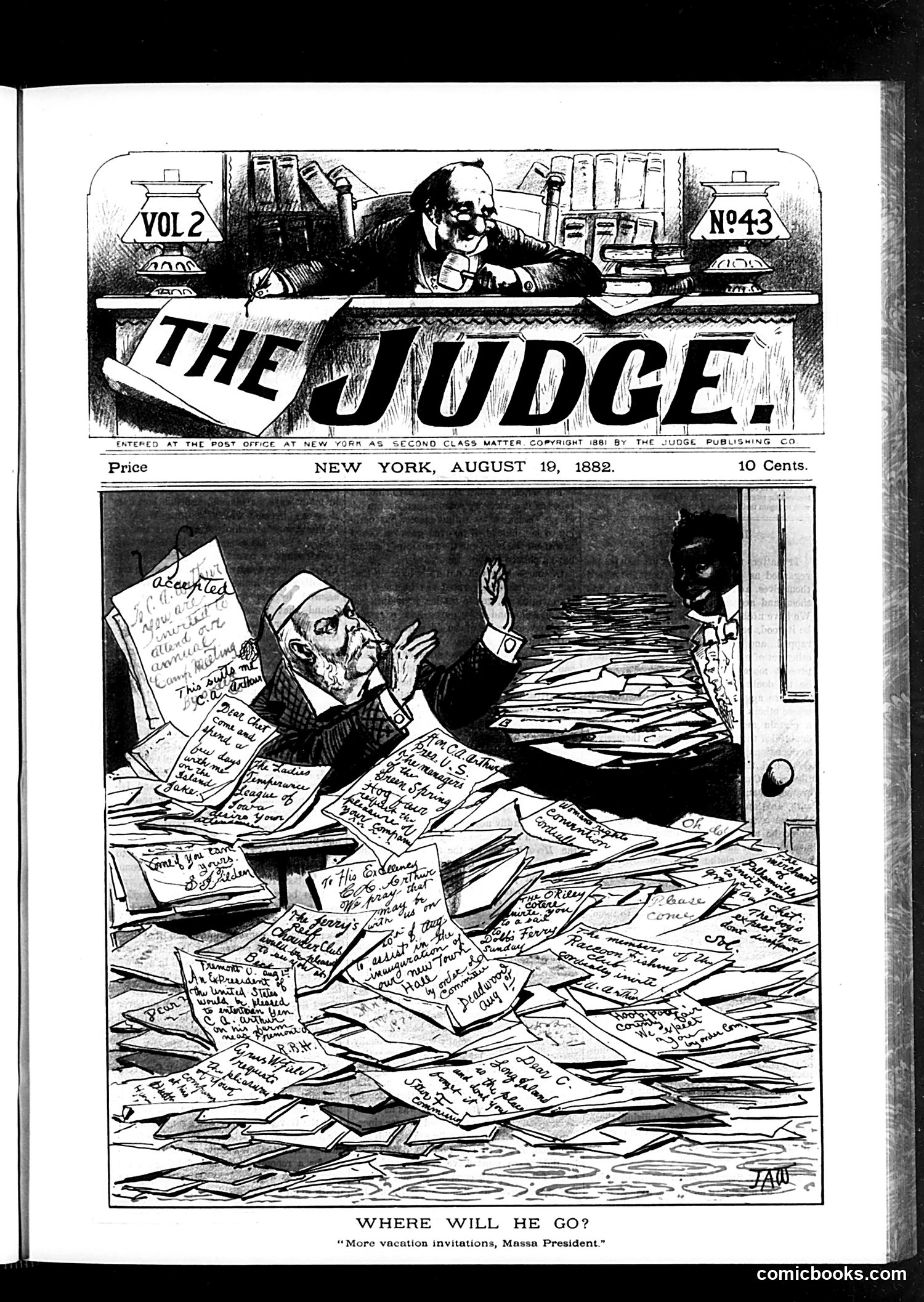
This cartoon from *Judge* (August 19, 1882) satirizes the presidency during the Gilded Age. It depicts a figure (likely President Chester Arthur) overwhelmed by stacks of vacation invitations, suggesting he prioritizes leisure over governing. The cartoon criticizes what appears to be perceived presidential negligence or absenteeism. The servant's dialect ("Massa President") employs period-typical racial caricature conventions of the era. The satire targets the disconnect between executive responsibilities and apparent indulgence—a common critique of Gilded Age politics when wealthy elites, including presidents, were seen as detached from serious governance. The visual metaphor of drowning in social invitations mocks the president's apparent priorities and lifestyle.
This page contains two distinct pieces of satirical commentary: ## "Israel's Finest" A contentious editorial attacking Jewish immigrants and working-class Jewish merchants. The piece complains that while refined, wealthy Jews are acceptable, poorer Jewish immigrants from Russia are "vulgar" and "obnoxious"—invading superior social spaces, monopolizing train cars and seaside resorts, and reflecting poorly on their entire race. The author argues charity should instead "civilize" those already in America. This reflects virulent anti-Semitic attitudes common in late 19th-century American publications, presenting stereotype-based class contempt as social criticism. ## "Corinthian Races" A lighter satirical piece about yacht racing. It mocks wealthy amateur sailors ("Corinthians") who personally captain their yachts during amateur races, contrasting them with professionals. The satire pokes fun at incompetent rich men attempting seamanship while leaving navigation to hired captains in regular races—poking gentle fun at upper-class pretension. The page illustrates Judge's range: crude ethnic prejudice alongside genteel social mockery of the wealthy.
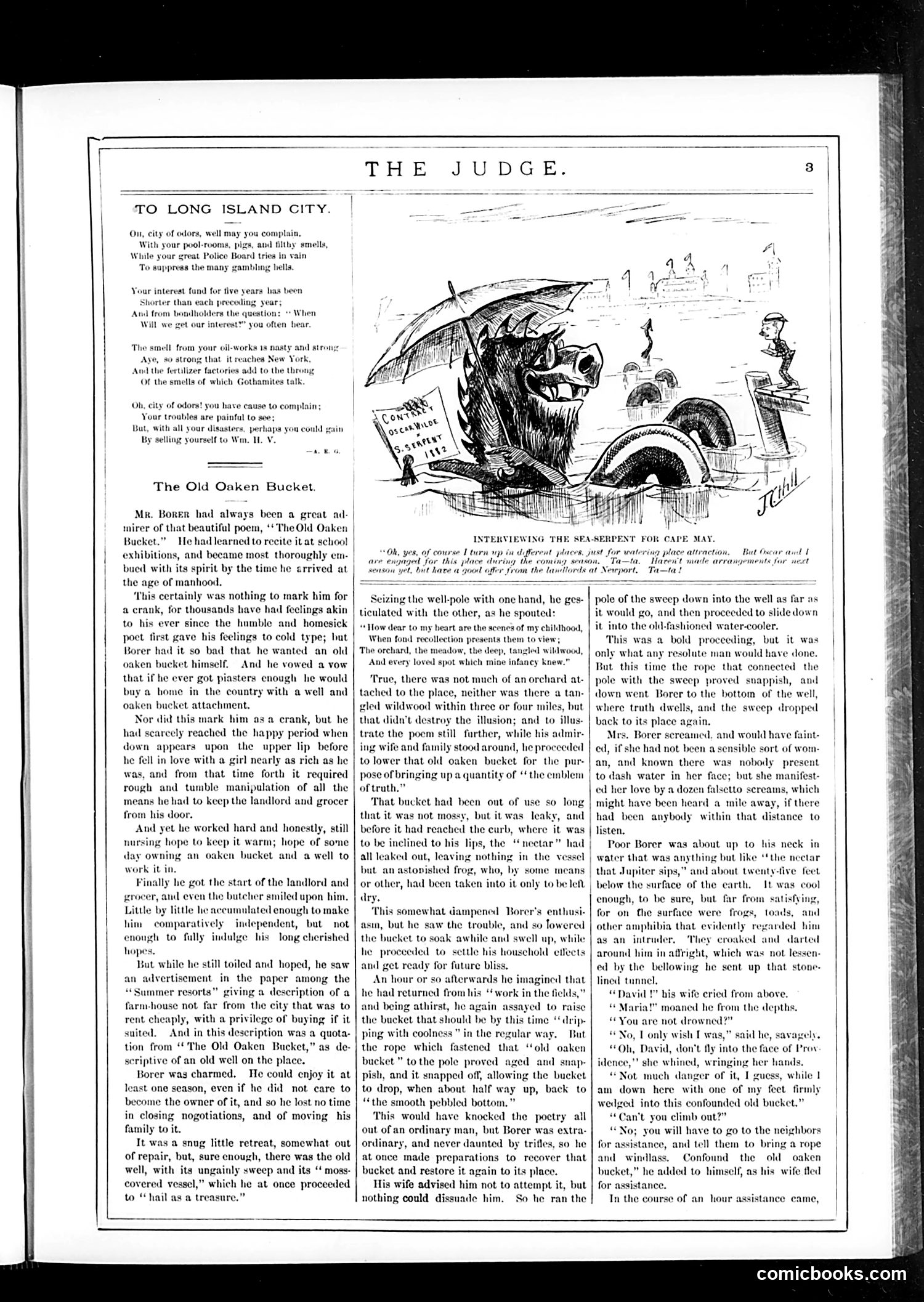
This page from *Judge* contains two items: a poem mocking Long Island City's pollution problems (factories, gambling dens, and foul odors), and a humorous story about Mr. Borer, a sentimental man. Borer idolizes the famous poem "The Old Oaken Bucket" (a nostalgic 1818 work celebrating rural childhood innocence). After years of hard work, he rents a farmhouse specifically because its advertisement quotes the poem and features an old well. Upon arrival, he romantically recites the poem while drawing water—only to discover the bucket is leaky, empty, and contains a bewildered frog. The satire targets romantic sentimentality: Borer's idealization of rustic simplicity and poetic nostalgia collides with reality's mundane disappointments. The joke punctures both his naïve romanticism and, implicitly, the false advertising of the rental property. It's a gentle mockery of those who mistake literary fantasy for actual pastoral virtue.
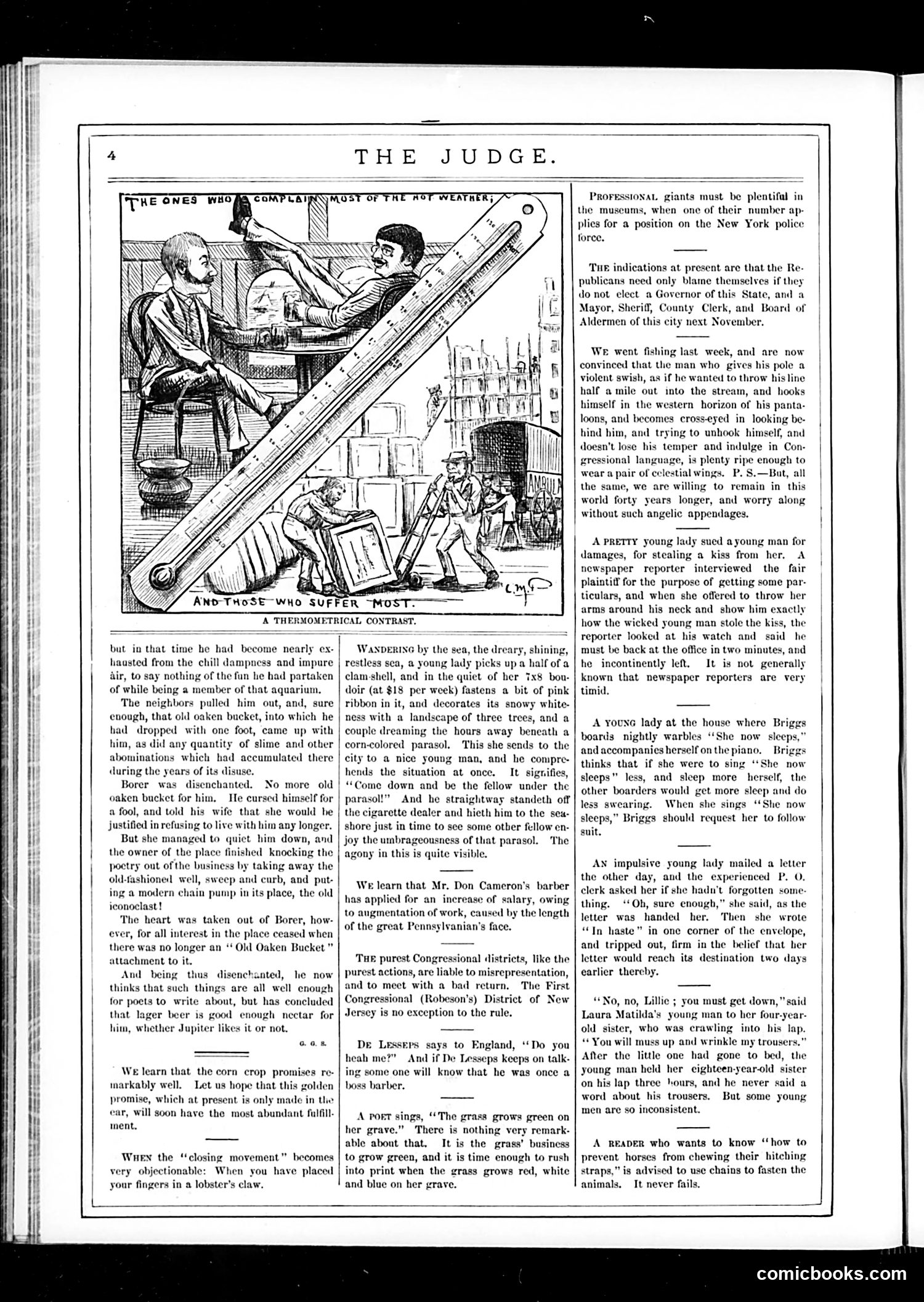
This cartoon contrasts two men's comfort levels in opposing conditions. The upper figure appears content in harsh weather (indicated by the hatching and "most of the foul weathers"), while the lower figure suffers in pleasant conditions. The title suggests ironic reversal—what should comfort actually discomforts, and vice versa. The accompanying text story about "Borer" illustrates this theme: a man nostalgically revisits an old well ("Old Oaken Bucket"), but finds it filthy and disgusting upon retrieval. His romantic poetry-inspired expectations clash with reality. The satire critiques those who cling to idealized notions of the past while rejecting modern improvements (the new chain pump), suggesting sentimentality blinds people to actual conditions. The page also contains miscellaneous satirical notes mocking politicians (Don Cameron's allegedly long face, De Lesseps's verbosity) and social absurdities—typical Judge fare mixing visual and textual humor.
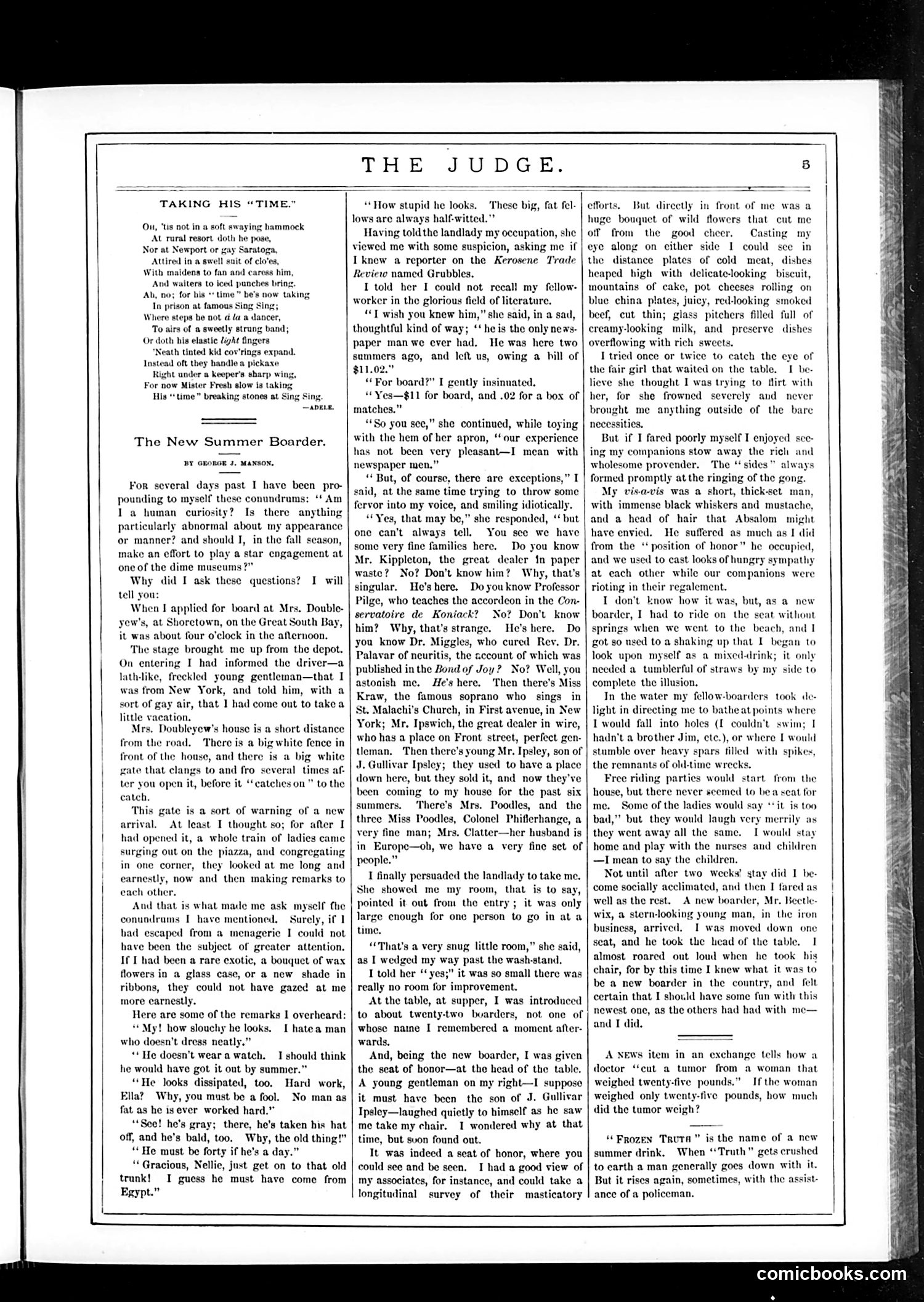
This page contains two pieces of social satire typical of late-19th-century Judge magazine. **"Taking His 'Time"** (poem, top): A pun-based joke about a criminal serving time at Sing Sing prison, where the subject labors breaking stones rather than lounging at fashionable resorts like Newport or Saratoga. The humor relies on the double meaning of "taking his time" as leisure versus serving a sentence. **"The New Summer Boarder"** (main story): Satirizes both the nouveau riche tourist culture and small-town boarding-house life. A man arrives at a seaside boarding house and is subjected to intense, rude scrutiny by the female residents, who openly mock his appearance, clothing, and presumed profession. The landlady's suspicion of "newspaper men" (apparently a disreputable class) adds class-conscious humor. The satire targets both the shallow materialism of summer tourists and the provincial cattiness of rural boarding-house society.
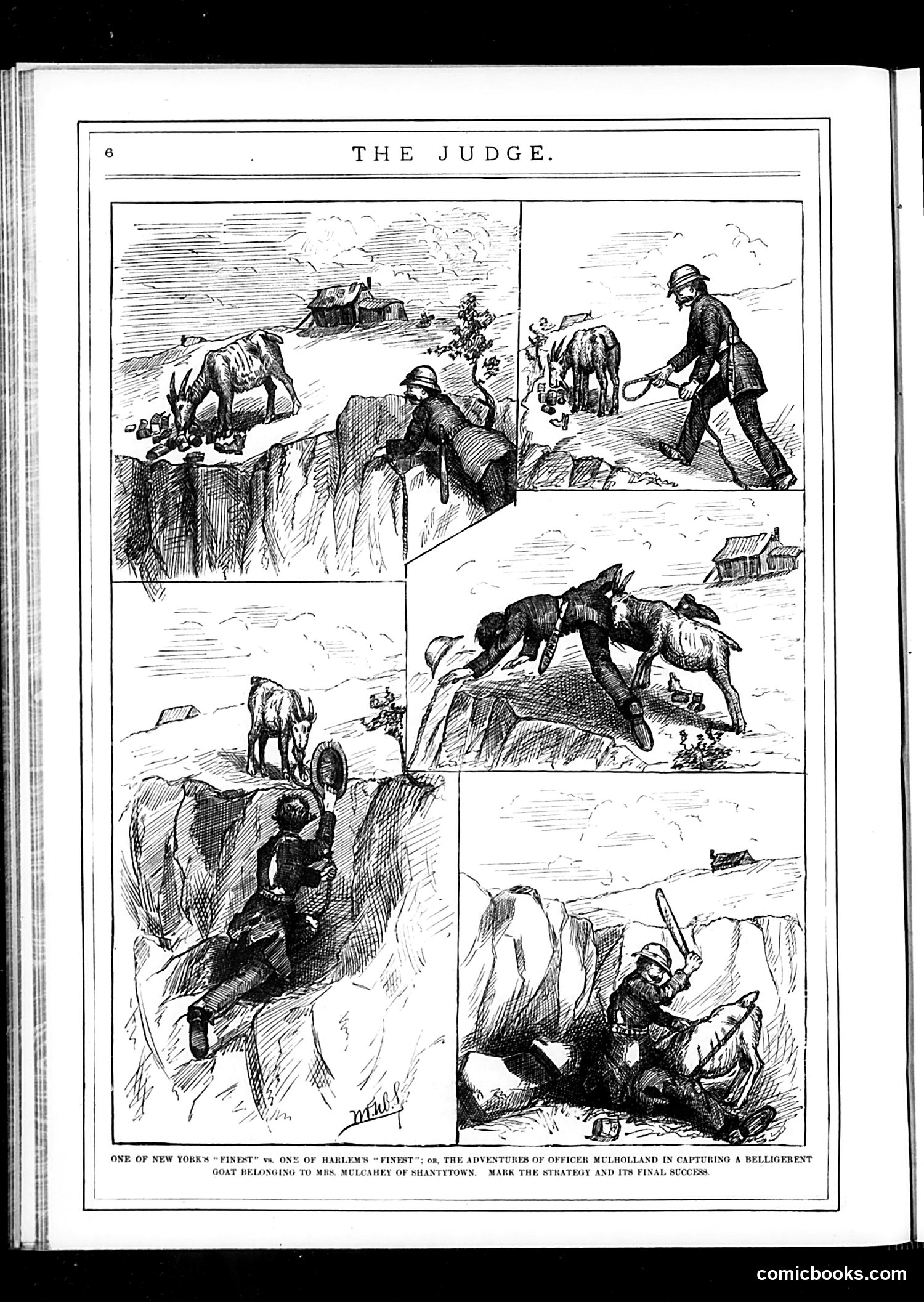
This satirical comic from *Judge* magazine mocks the New York Police Department's self-designation as "the Finest." The narrative follows Officer Mulholland's struggle to capture a belligerent goat belonging to Mrs. Mulcahey in Shantytown (a poor neighborhood, likely Irish immigrant area). The humor contrasts the police's grandiose reputation against the absurd reality of an officer battling a farm animal—suggesting the NYPD's actual competence falls far short of their boastful claims. The sequential panels show escalating chaos as the goat outwits the officer, undermining the force's prestige. The "strategy and final success" caption is ironic, given the comedic disaster depicted. This reflects contemporary skepticism about police effectiveness and class-based satire about working-class neighborhoods.
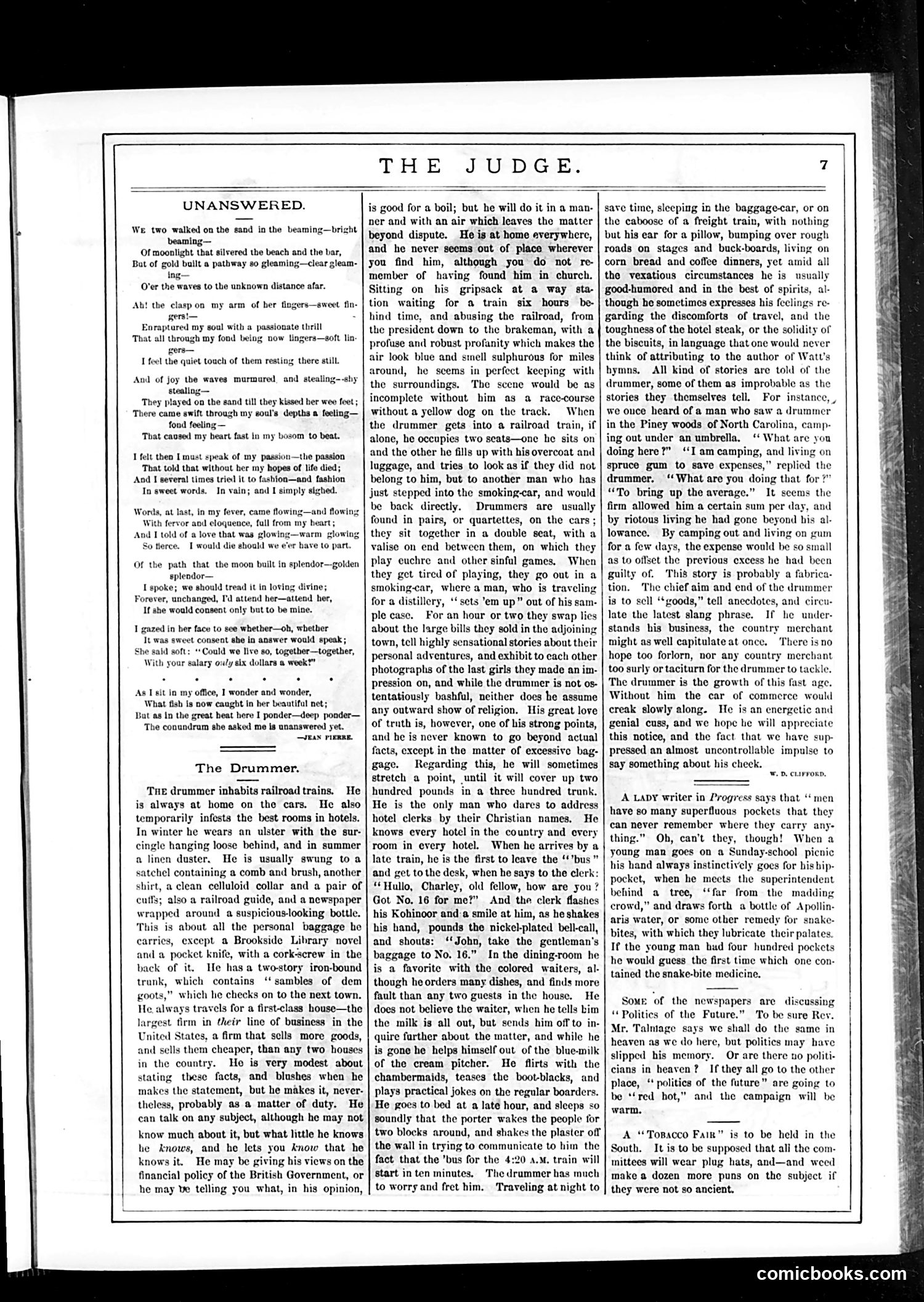
This page contains two distinct pieces: a romantic poem titled "Unanswered" and a satirical character sketch called "The Drummer." **"The Drummer"** is the main satirical content. It mocks the traveling salesman—a ubiquitous figure of late 19th-century commerce. The sketch ridicules the drummer's stereotypical traits: his brash confidence, his constant boasting about his employer's superiority, his ability to pontificate on any subject despite limited knowledge, and his casual profanity. The satire targets his false sophistication and aggressive salesmanship. The drummer represents anxieties about commercialization and the rise of aggressive business culture. He inhabits liminal spaces (trains, hotels) and carries minimal personal possessions—suggesting rootlessness and superficiality. The accompanying poem "Unanswered" uses romantic sentiment ironically to mock class anxiety: a man's passionate marriage proposal is deflated when his beloved asks if he can support her on six dollars weekly—the implied punchline being that even romance cannot overcome economic desperation among the working poor. Together, these pieces satirize American business culture and economic precarity.
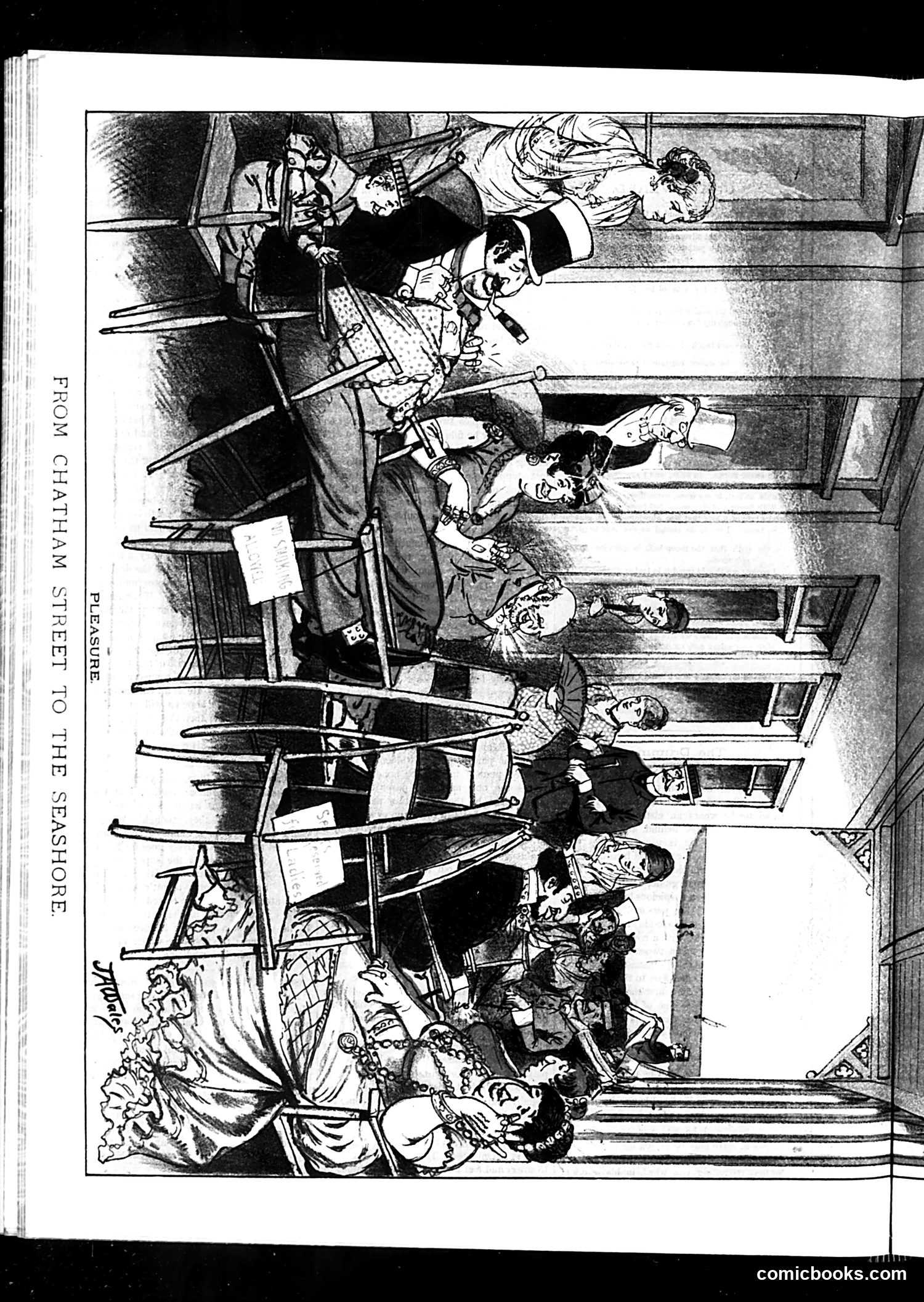
The OCR text is too corrupted to read clearly. However, examining the image itself: this appears to be a satirical illustration showing elegantly dressed figures in what looks like an indoor social setting, possibly a dining or gathering scene. The figures are drawn in late 19th/early 20th-century style clothing and are arranged vertically (the page is rotated 90 degrees). Without legible text identifying the specific figures or political/social references, I cannot reliably determine who is being caricatured or what particular event or issue this satire addresses. The artistic style and composition suggest social commentary on upper-class behavior or a specific contemporary event, but the corrupted OCR and image orientation prevent precise identification of the satire's target. To properly analyze this *Judge* cartoon, a clearer version of the text would be essential.
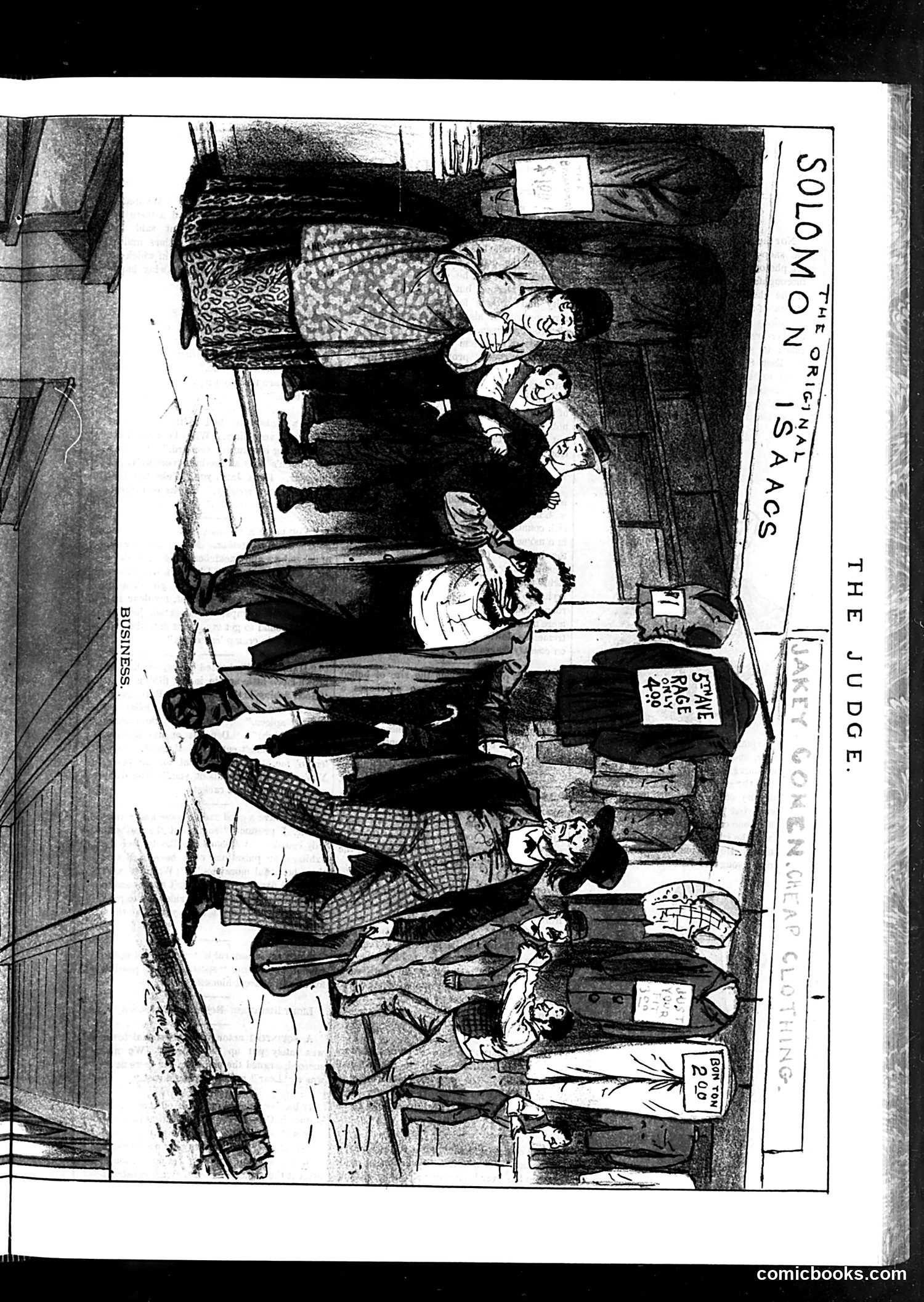
This appears to be a satirical cartoon page from *Judge* magazine, though the OCR text is largely unreadable. The visible headline reads "SOMON IS A SACS" (likely corrupted OCR). The image shows what appears to be a domestic or social scene with multiple figures in period clothing arranged vertically on the page. The cartoon seems to depict a humorous situation involving several people, possibly illustrating a social commentary or domestic satire typical of *Judge's* editorial content. Without clearer text or identifying labels visible in the image itself, I cannot confidently identify the specific figures, political references, or precise satirical intent. The style and composition suggest early-to-mid 20th century American humor, but the specific point of the satire remains unclear from this reproduction.
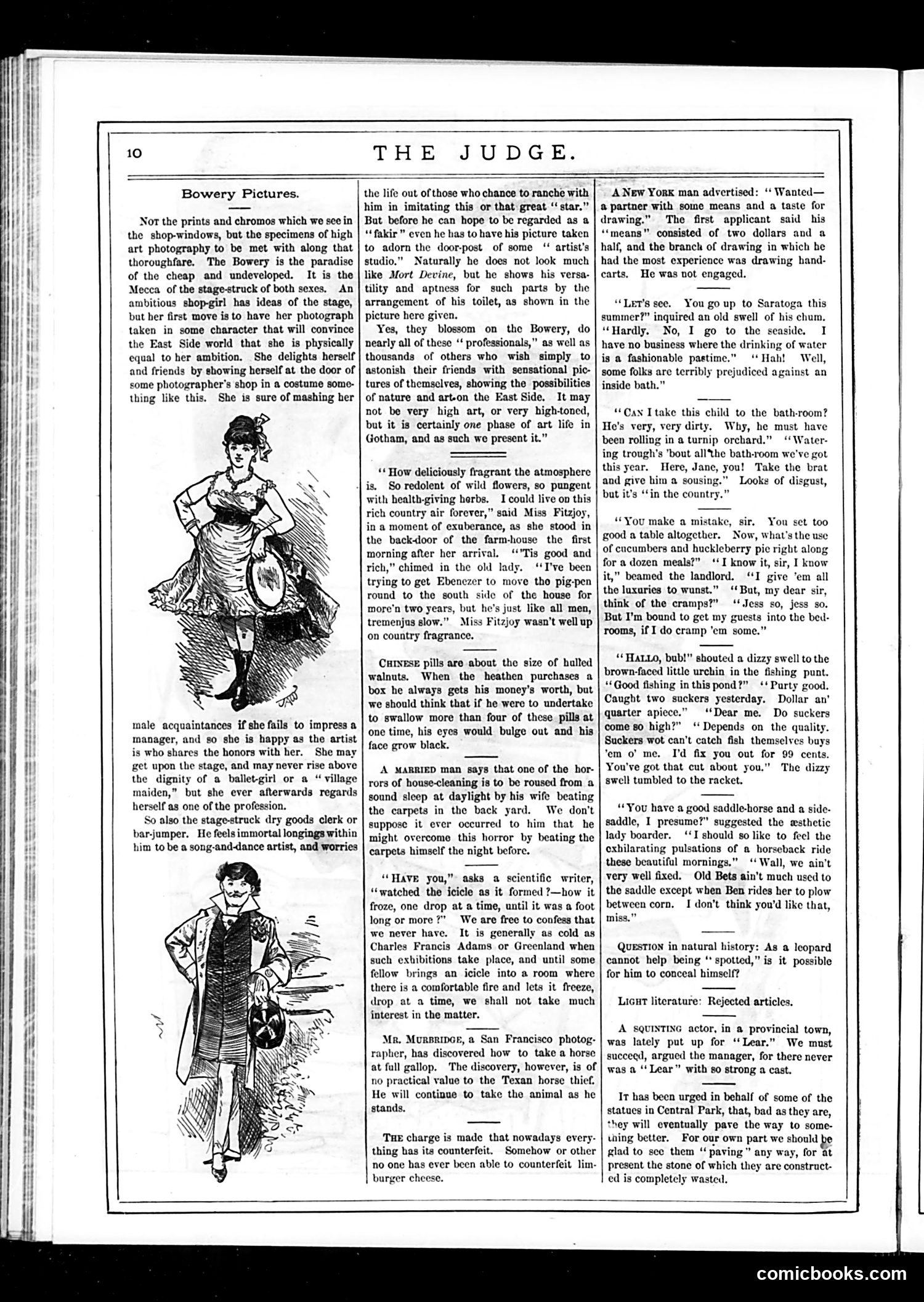
This page satirizes the aspirations of working-class New Yorkers on the Bowery who dream of theatrical careers. The two illustrated figures—a shop-girl and a bar-clerk—represent stage-struck young people who pay photographers to take costumed portraits, hoping these images will impress theater managers or convince friends of their theatrical potential. The satire mocks their delusions: these amateur "artists" lack genuine talent but perform elaborate self-presentation through costume photography. The article notes they may never rise above minor roles like "ballet-girl" or "village maiden," yet forever regard themselves as professionals based on these photographs alone. The piece gently ridicules both the dreamers and the photographers who exploit their aspirations, presenting it as a peculiar but genuine "phase of art life" in the city—simultaneously pathetic and oddly earnest.
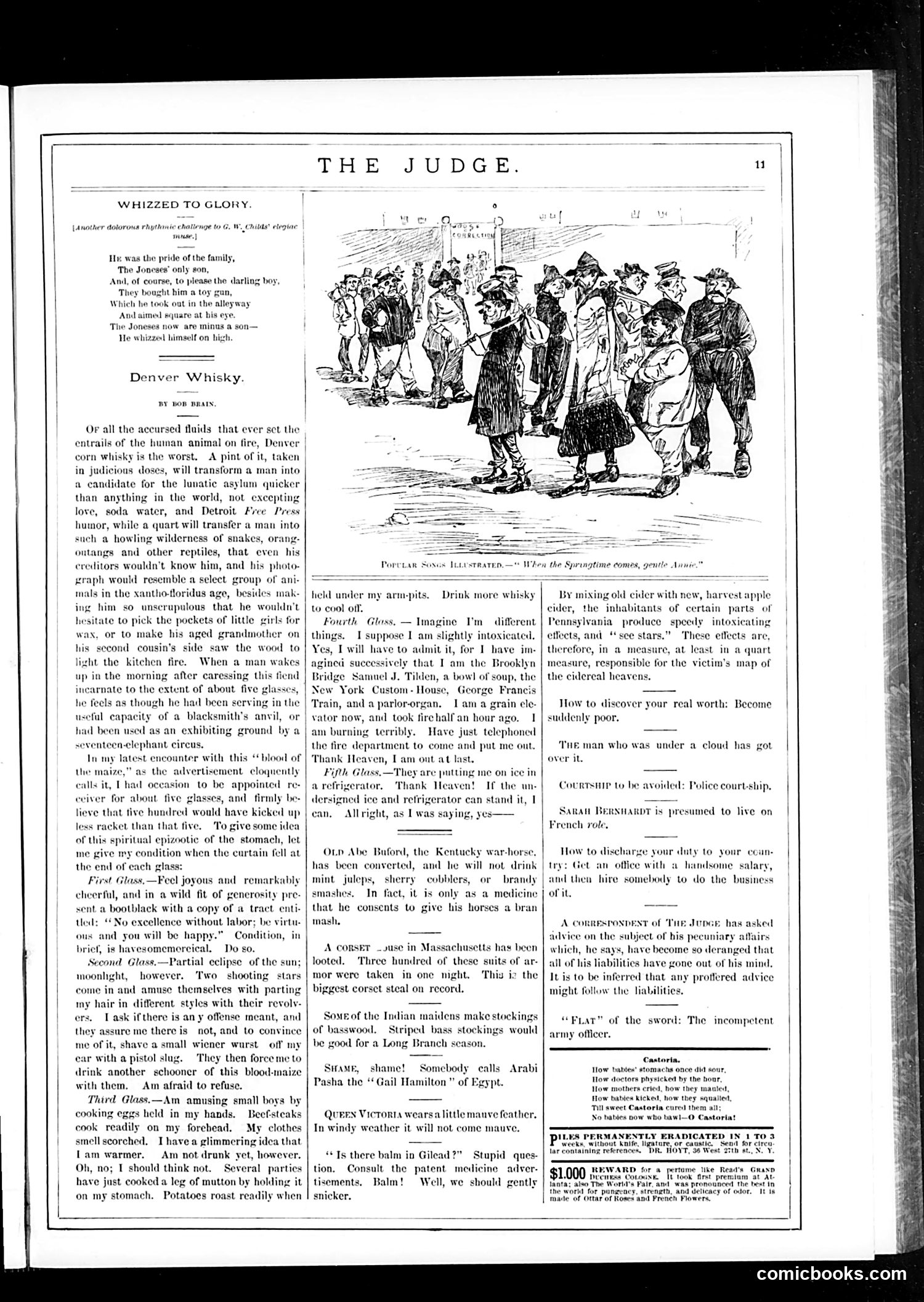
This is a satirical piece mocking cheap whiskey's supposed effects. "Denver Whisky" represents low-quality corn liquor, and the author (Bob Brain) uses hyperbolic humor to document his progressive intoxication across five drinks. The opening poem "Whizzed to Glory" presents a dark joke: a boy accidentally shoots himself with a gun while playing, killing himself—the "whisky" reference suggests parental negligence or recklessness. The main article exaggerates whiskey's destructive properties through increasingly absurd scenarios: the author imagines he's a bridge, a political figure (Samuel Tilden), and a grain elevator; he cooks meat on his own body; shooting occurs around him. The satire targets both the product's danger and the drinking culture of the era. The accompanying illustration shows a crowd of rough-looking men, likely depicting the sort of establishments where such whiskey was consumed. Judge's point: cheap whiskey degrades both health and dignity, turning respectable people into comic disasters.
This page is primarily **advertisements and miscellaneous content** rather than political cartoons. The few satirical items are brief, unsigned jokes typical of Judge's humor section: **The satire present:** - A story about a couple whose engagement was delayed until spoons happened to touch in a sugar bowl (folk superstition about weddings)—mocking Victorian superstition - A joke about a lawyer's suicide motivated by a friend owing him $14.50—dark humor about debt collection - A quip about tooth extraction by electricity being "less shocking than the old way"—a pun on electricity - A letter from a Goshen reader asking what to do with milk selling for 2.5 cents a quart, told to "cheese it"—a pun **The bulk of the page** consists of period advertisements for products like Sapolio soap, Glenn's Sulphur Soap, Hale's Honey and Horehound Tar, organs, and patent medicines—typical of 19th-century magazine layouts. There are no identifiable political figures or major satirical commentary visible.
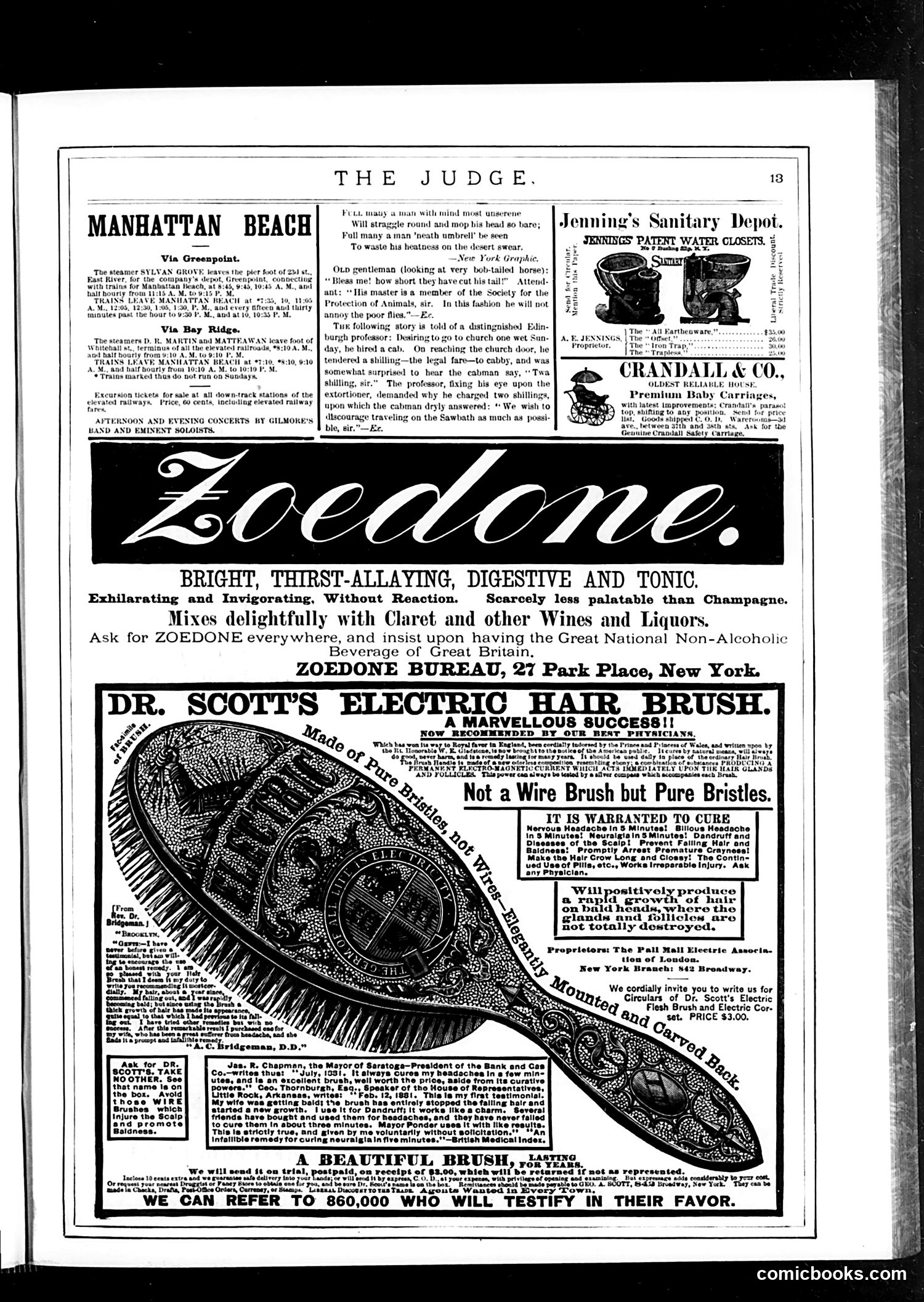
This page is primarily **advertising**, not political satire. The dominant content consists of large commercial advertisements for patent medicines and consumer products typical of the late 19th century. The small text items at the top appear to be brief anecdotes or jokes from readers rather than editorial cartoons: - One jokes about a man with an "umbrella" (unclear reference) - Another mocks a gentleman who got a short haircut, joking the Society for Prevention of Cruelty to Animals would approve since it won't "annoy the poor flies" - A third tells of a cab driver charging double fare on Sunday to "discourage traveling on the Sabbath" These are gentle social humor rather than sharp political satire. The bulk of the page advertises **Dr. Scott's Electric Hair Brush** (claiming miraculous hair growth), **Zoedone** (a non-alcoholic "tonic" beverage), and transit/sanitary services. These reflect Victorian-era consumer culture and dubious medical claims typical of the period.
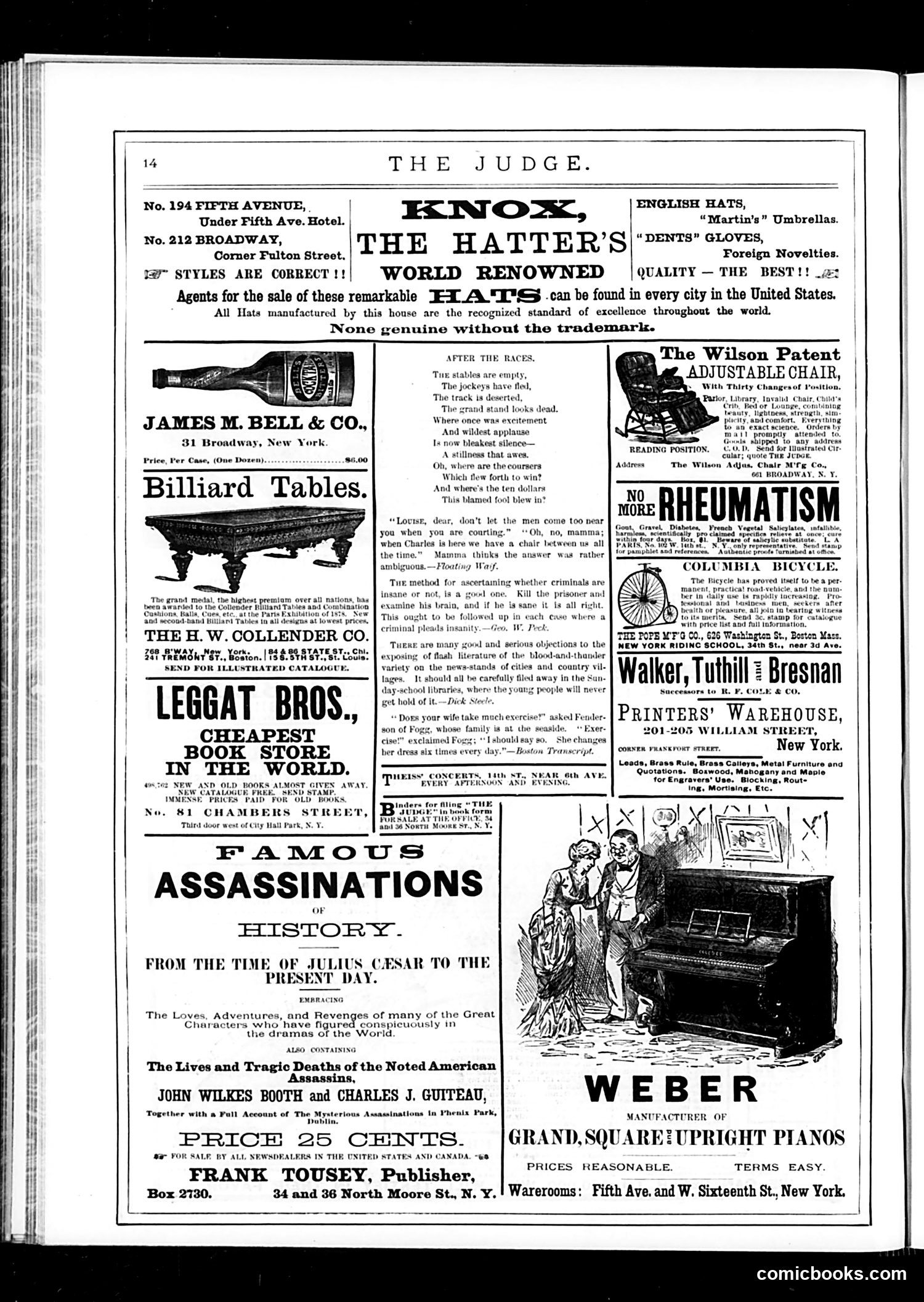
This page is primarily **advertising**, typical of late 19th-century publications. However, it contains one notable cartoon section titled "After the Races." ## The Cartoon The "After the Races" section presents a brief satirical poem about horse racing and gambling. It depicts the melancholy aftermath at a racetrack—empty stands, departed horses, and silence replacing excitement. The humor targets **foolish gamblers** who lost money ("This blamed fool blew in"). A secondary domestic joke follows: a young woman assures her mother that having a chair between herself and her suitor Charles prevents impropriety, though the author suggests this answer is evasively ambiguous. ## Context The satire addresses common Victorian anxieties: reckless gambling losses and unchaperoned courtship. The "After the Races" material mocks both the futility of betting and youthful romantic deception. The remaining page consists of period advertisements for hats, billiard tables, pianos, books (including a sensational volume on famous assassinations), and furniture—reflecting Judge's commercial function alongside satire.
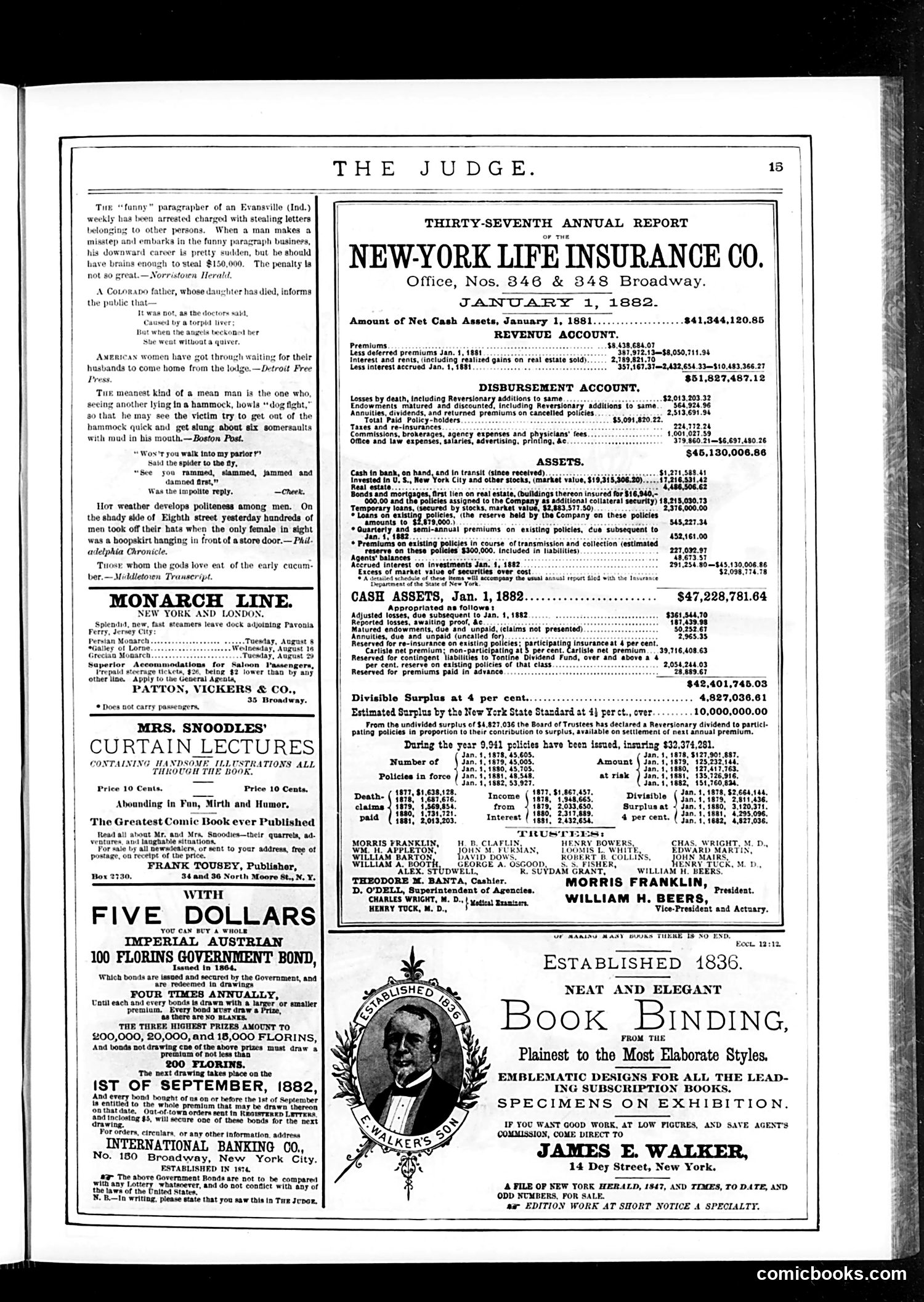
This page is primarily **advertising and business notices** rather than satirical content. The dominant feature is the thirty-seventh annual report of the New-York Life Insurance Company, displaying financial statements and assets. The upper portion contains brief humorous paragraphs typical of Judge's satirical style—short, punchy jokes mocking social behavior: a man stealing letters instead of money; women no longer waiting for husbands returning from lodge meetings; and men removing hats out of politeness when seeing women's fashionable "hoopskirts." The remaining space features commercial advertisements for steamship lines, book publishers, and investment opportunities (Austrian government bonds and lottery schemes). **For modern readers:** This reflects 1880s American life priorities—insurance was becoming important, steamship travel connected major cities, and "get rich quick" bond schemes were common. The scattered humor reflects Judge's purpose: inserting satire amid advertisements to attract readers.
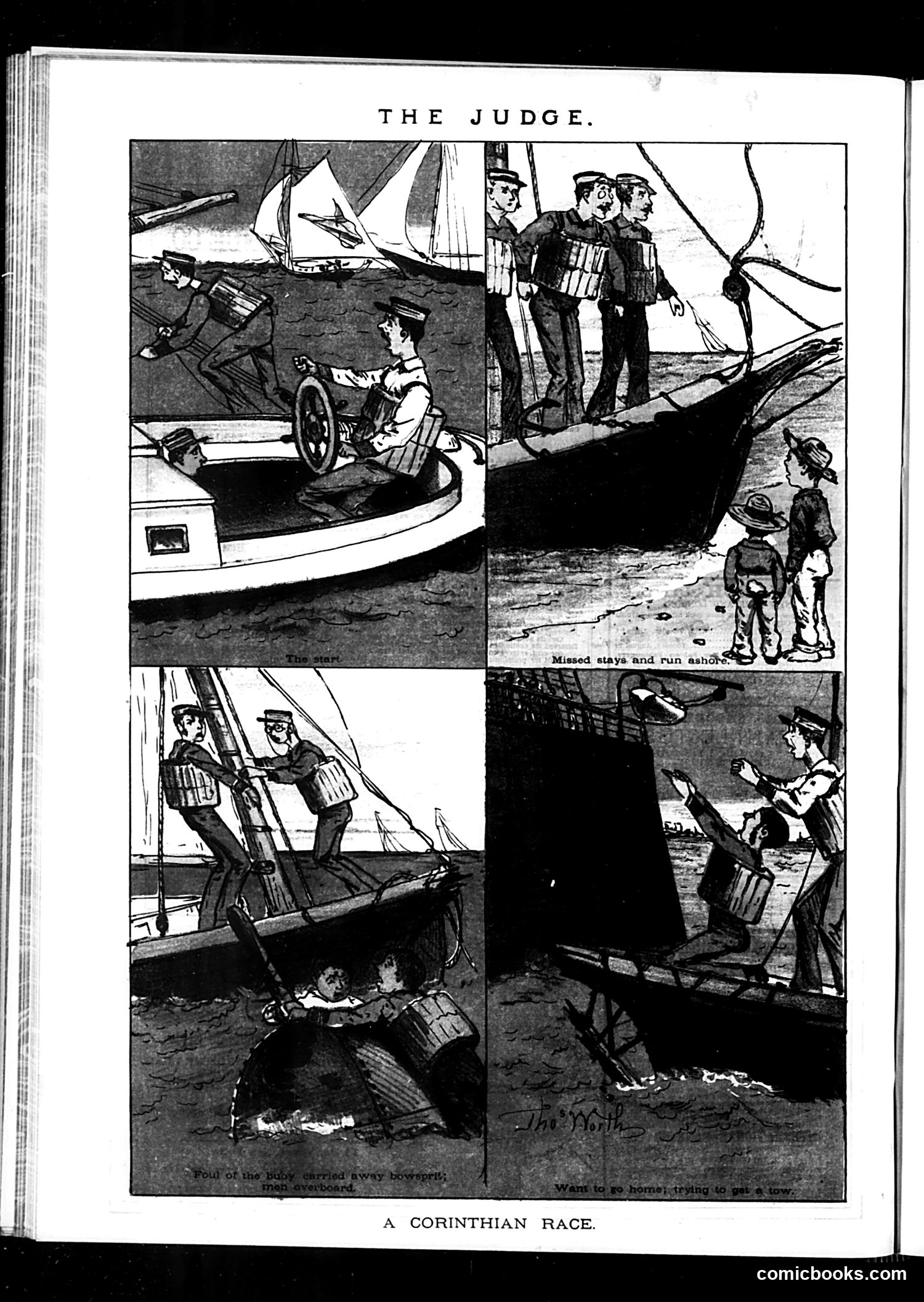
This comic strip satirizes what appears to be a naval or maritime competition. The title references "Corinthian" — historically, wealthy amateur sportsmen — suggesting the satire targets privileged amateurs competing in a serious context. The narrative shows military or naval officers overseeing a race involving a ship's wheel and what seems to be children or small figures as competitors. Key captions mention "Missed stays and run ashore" and "Want to go honest, trying to get a crook." The satire likely mocks either incompetent amateur sailors, or possibly political figures (naval officers) mismanaging a competition. The progression from the organized race to apparent chaos and failure suggests commentary on bungled leadership or the folly of allowing amateurs to handle serious maritime matters. The exact political reference remains unclear without additional historical context.