
Judge, 1882-08-19 · page 5 of 16
Judge — August 19, 1882 — page 5: what you’re looking at
What you’re looking at
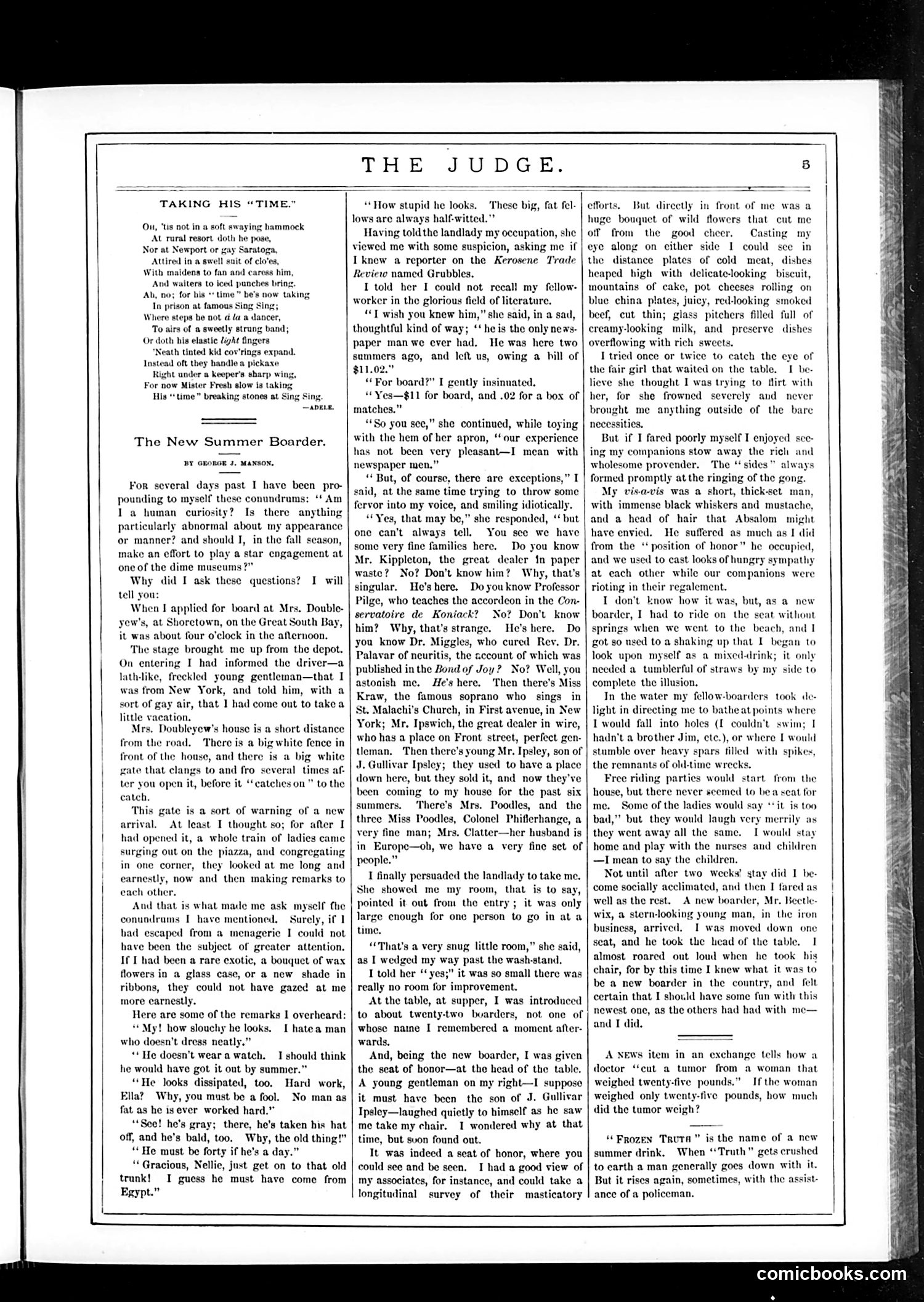
This page contains two pieces of social satire typical of late-19th-century Judge magazine. **"Taking His 'Time"** (poem, top): A pun-based joke about a criminal serving time at Sing Sing prison, where the subject labors breaking stones rather than lounging at fashionable resorts like Newport or Saratoga. The humor relies on the double meaning of "taking his time" as leisure versus serving a sentence. **"The New Summer Boarder"** (main story): Satirizes both the nouveau riche tourist culture and small-town boarding-house life. A man arrives at a seaside boarding house and is subjected to intense, rude scrutiny by the female residents, who openly mock his appearance, clothing, and presumed profession. The landlady's suspicion of "newspaper men" (apparently a disreputable class) adds class-conscious humor. The satire targets both the shallow materialism of summer tourists and the provincial cattiness of rural boarding-house society.
📄 Transcribed text from this page (OCR, searchable)
Machine-transcribed from the original scan — historical spelling and the odd misread are preserved.
THE JUDGE. TAKING HIS “TIME.” Ou, “Us not in a soft swaying hammock AL rural resort doth he pose, Nor at Newport or gay Saratoga, Attired in a swell suit of clo'es, With maidens to fan and caress him, And waiters to iced punches bring. Ab, no; for his + time” In prison at famous Si Where steps be not dla a da To airs of a sweetly strung band; Or doth his elastic light Singers "Neath tinted kid cov'rings expand. Instead oft they handle a pickaxe Right under a keeper's sharp wing, For now Mister Fresh slow is taking His “time” breaking stones at Sing Sing ADELE. The New Summer Boarder. BY GEORGE J, MANSON. For several days past I have been pro- pounding to myself these conundrums: Am 1 a human curiosity? Is there anything particularly abnormal about my appearance or manner? and should I, in the fall season, make an effort to play a star engagement at one of the dime museums?” Why did I ask these questions? tell you: When I applied for board at Mrs. Double- yew's, at Shorctown, on the Great South Bay, it was about four o'clock in the afternoon, The stage brought me up from the depot. On entering I had informed the driver—a lath-like, freckled young gentleman—that I trom New York, and told him, with a sort of gay air, that I had come out to takea little vacation. Mrs. Doubleyew's house from the road. There is a big white fence in front of the house, and there is a big white gate that clangs to and fro several times af- ter you open it, before it ‘catches on” to the catch. This gate is a sort of warning of a new an At least I thought so; for after I had opened it, a whole train of ladies came surging out on the piazza, and congregating in one corner, they looked at me long and earnestly, now and then making remarks to each other. And that is what made me ask myself the conundrams I have mentioned. Surely, if 1 had ped from a menagerie I could not have been the subject of greater attention. If I had been a rare exotic, a bouquet of wax flowers in a glass case, or a new shade in ribbons, they could not have gazed at me more earnestly. Here are some of the remarks I overheard: “My! how slouchy he looks. I hatea man who doesn't dress neatly.” “* He doesn’t wear a watch. I should think he would have got it out by summer.” “He looks dissipated, too. Hard work, Ella? Why, you must be a fool. No man as fat as he is ever worked hard.” “See! he's gray; there, he’s taken his hat off, and he’s bald, too. Why, the old thing!” “He must be forty if he’s a day.” “Gracious, Nellie, just get on to that old trunk! I guess he must have come from Egypt.” I will a short distance “How stupid he looks. ‘These big, fat fel- lows are always half-witted.”* Having told the landlady my occupation, she viewed me with some suspicion, asking me if I knew a reporter on the Kerosene Trade Review named Grubbles. I told her I could not recall my fellow- worker in the glorious field of literature. “T wish you knew him,” she said, in a sad, thoughtful kind of way; ‘‘ he is the only new: paper man we ever had. He was here two summers ago, and left us, owing a bill of $11.02." “For board?” I gently insinuated, “Yes—$11 for board, and .02 for a box of matches.” “*So you see,” she continued, while toying with the hem of her apron, ‘our experience has not been very pleasant—I mean with newspaper men.” “But, of course, there are exceptions,” I said, at the same time trying to throw some fervor into my voice, and smiling idiotically. “Yes, that may be,” she responded, “ but one can't always tell, You see we have some very fine familics here. Do you know Mr. Kippleton, the great dealer in paper waste? No? Don't know him? Why, that’s singular, He'shere. Do you know Professor Pilge, who teaches the accordeon in the Con- servatoire de Koniack? No? Don't know him? Why, that’s strange. He's here. Do you know Dr. Miggles, who cured Rev. Dr. Palavar of neuritis, the account of which was published in the Bond of Joy? No? Well, you astonish me. He's here. Then there's Miss Kraw, the famous soprano who sings in St. Malachi’s Church, in First avenue, in New York; Mr. Ipswich, the great dealer in wire, who has a place on Front street, perfect gen- tleman. ‘Then there's young Mr. Ipsley, son of J. Gullivar Ipsley; they used to have a place down here, but they sold it, and now they've been coming to my house for the past six summers. ‘There's Mrs. Poodles, and the three Miss Poodles, Colonel Phiflerhange, a very fine man; Mrs. Clatter—her husband is in Europe—oh, we have a very fine set of people.” I finally persuaded the landlady to take me. She showed me my room, that is to say, pointed it out from the entry; it was only large enough for one person to go in ata time. “That's a very snug little room,” she said, as I wedged my way past the wash-stand, I told her “ yes;” it was so small there was really no room for improvement. At the table, at supper, I was introduced to about twenty-two bvarders, not one of whose name I remembered a moment after- wards, And, being the new boarder, I was given the seat of honor—at tho head of the table. A young gentleman on my right—I suppose it must have been the son of J. Gullivar Ipsloy—laughed quietly to himself as he saw me take my chair, I wondered why at that time, but svon found ont. It was indeed a seat of honor, where you could see and be seen. I had a good view of my associates, for instance, and could take a longitudinal survey of their masticatory —=— efforts. But directly in front of me was a huge bouquet of wild flowers that cut me of from the good cheer. Casting my eye along on cither side I could see in the distance plates of cold meat, dishes heaped high with delicate-looking biscuit, mountains of cake, pot cheeses rolling on blue china plates, juicy, red-looking smoked beef, cut thin; glass pitchers filled full of creamy-looking milk, and preserve dishes overflowing with rich sweets. I tried once or twice to catch the eye of the fair girl that waited on the table. I be- lieve she thought I was trying to flirt with her, for she frowned severely and never brought me anything outside of the bare necessities. But if I fared poorly myself I enjoyed see- ing my companions stow away the rich and wholesome provender. The “sides” always formed promptly at the ringing of the gong. My vis-a-vis was a short, thick-set man, with immense black whiskers and mustache, and a head of hair that Absalom might have envied. He suffered as much as I did from the ‘position of honor” he occupied, and we used to cast looks of hungry sympathy at each other while our companions were rioting in their regalement. T don’t know how it was, but, as a new boarder, I had to ride on the seat without springs when we went to the beach, and 1 got so used to a shaking up that I began to look upon myself as a mixed-drink; it only needed a tumblerful of straws by my side to complete the illusion. In the water my fellow-boarders took de- light in directing me to batheat points where I would fall into holes ({ couldn't: swim; 1 hadn't a brother Jim, etc.), or where I would stumble over heavy spars filled with spikes, the remnants of old-time wreck: Free riding parties would start from the house, but there never seemed to bea seat for me. Some of the ladies would s: bad,” but they would laugh very merrily they went away all the same, I would stay home and play with the nurses and children —I mean to say the children. Not until after two weeks’ stay did I be- come socially acclimated, and then I fared as well as the rest. A new boarder, Mr. Bectle wix, a stern-looking young man, in the iron business, arrived, I was moved down one seat, and he took the head of the table. 1 almost roared out loud when he took his chair, for by this time I knew what it was to be a new boarder in the country, and felt certain that I should have some fun with this newest one, as the others had had with mc— and I did. it is too A News item in an exchange tells how a doctor “cut a tumor from a woman that weighed twenty-five pound If the woman weighed only twenty-five pounds, how much did the tumor weigh? “Frozen Truta” is the name of a new summer drink, When Truth” gets crushed to earth a man generally goes down with it. But it rises again, sometimes, with the assist- ance of a policeman. comicbooks.com e