
Judge, 1882-08-19 · page 4 of 16
Judge — August 19, 1882 — page 4: what you’re looking at
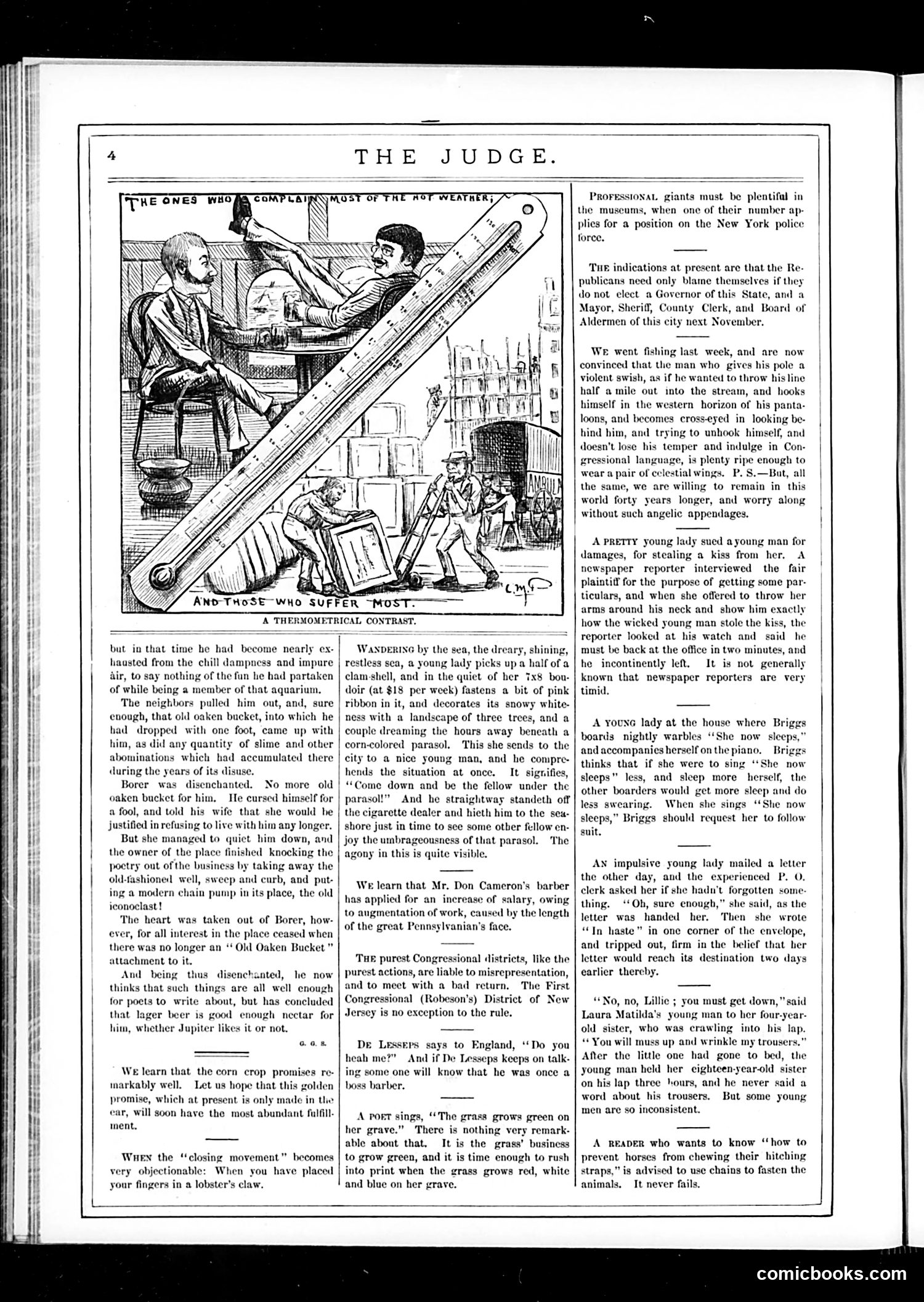
What you’re looking at
This cartoon contrasts two men's comfort levels in opposing conditions. The upper figure appears content in harsh weather (indicated by the hatching and "most of the foul weathers"), while the lower figure suffers in pleasant conditions. The title suggests ironic reversal—what should comfort actually discomforts, and vice versa. The accompanying text story about "Borer" illustrates this theme: a man nostalgically revisits an old well ("Old Oaken Bucket"), but finds it filthy and disgusting upon retrieval. His romantic poetry-inspired expectations clash with reality. The satire critiques those who cling to idealized notions of the past while rejecting modern improvements (the new chain pump), suggesting sentimentality blinds people to actual conditions. The page also contains miscellaneous satirical notes mocking politicians (Don Cameron's allegedly long face, De Lesseps's verbosity) and social absurdities—typical Judge fare mixing visual and textual humor.
📄 Transcribed text from this page (OCR, searchable)
Machine-transcribed from the original scan — historical spelling and the odd misread are preserved.
A THERMOMETRICAL CONTRAST. but in that time he had become nearly ex- hausted from the chill dampness and impure ir, to say nothing of the fun he had partaken of while being a member of that aquarium. The neighbors pulled him out, and, sure enough, that old oaken bucket, into which he had dropped with one foot, came up with him, as did any quantity of slime and other abominations which had accumulated there during the years of its disuse. Borer was disenchanted. No more old oaken bucket for him. He cursed himself for a fool, and told his wife that she would be justified in refusing to live with him any longer. But she managed to quict him down, and the owner of the place finished knocking the poetry out ofthe business by taking away the old-fashioned well, sweep and curb, and put- ing a modern chain pump in its place, the old iconoclast! The heart was taken out of Borer, how- ever, for all interest in the place ceased when there was no longer an ‘ Old Oaken Bucket ” attachment to it. And being thus disenchanted, he now thinks that such things are all well cnough for poets to write about, but has concluded that lager beer is good enough nectar for him, whether Jupiter likes it or not. We learn that the corn crop promises re- inarkably well. Let us hope that this golden promise, which at present is only made in the r, will soon have the most abundant fulfill- ment, Wuew the “closing movement” becomes very objectionable: When you have placed your fingers in a lobster’s claw. WanbeniNG by the sea, the dreary, shining, restless sea, a young lady picks up a half of a clam-shell, and in the quiet of her 7x8 bou- doir (at $18 per week) fastens a bit of pink ribbon in it, and decorates its snowy white- ness with a landscape of three trees, and a couple dreaming the hours away beneath a corn-colored parasol. This she sends to the city to a nice young man, and he compre- hends the situation at once. It signifies, “Come down and be the fellow under the parasol!” And he straightway standeth off the cigarette dealer and hieth him to the sea- shore just in time to see some otber fellow en- joy the umbrageousness of that parasol. agony in this is quite visible. We learn that Mr. Don Cameron's barber has applied for an increase of salary, owing to augmentation of work, caused by the length of the great Pennsylvanian’s face. Tue purest Congressional districts, like the purest actions, are liable to misrepresentation, and to meet with a bad return, The First Congressional (Robeson’s) District of New Jersey is no exception to the rule. De Lessrps says to England, “Do you heah me?” And if De Lesseps keeps on talk- ing some one will know that he was once a boss barber. A port sings, ‘‘The grass grows green on her grave.” There is nothing very remark- able about that, It is the grass’ business to grow green, and it is time enough to rush into print when the grass grows red, white and blue on her grave. PROFESSIONAL giants must be plentifal in the museums, when one of their number ap- plies for a position on the New York police foree. Tue indications at present are that the Re- publicans need only blame themselves if they do not elect a Governor of this State, and a Mayor, Sheriff, County Clerk, and Board of Aldermen of this city next November. We went fishing last week, and are now convinced that the man who gives his pole a violent swish, as if he wanted to throw his line half a mile out into the stream, and hooks himself in the western horizon of his panta- loons, and becomes cross-eyed in looking be- hind him, and trying to unhook himself, and doesn't lose his temper and indulge in Con- gressional language, is plenty ripe enough to wear a pair of celestial wings. P. S. , all the same, we are willing to remain in this world forty years longer, and worry along without such angelic appendages. A PRETTY young lady sued ayoung man for damages, for stealing a kiss from her. A newspaper reporter interviewed the fair plaintiff for the purpose of getting some par- ticulars, and when she offered to throw her arms around his neck and show him exactly how the wicked young man stole the kiss, the reporter looked at his watch and said must be back at the office in two minutes, and he incontinently left. It is not generally known that newspaper reporters are very timid. he A younG lady at the house where Briggs boards nightly warbles ‘She now sleep: and accompanies herself onthe piano. Briggs thinks that if she were to sing ‘She now sleeps” less, and sleep more herself, the other boarders would get more sleep and do less swearing. When she sings ‘She now sleeps,” Briggs should request her to follow suit. AN impulsive young lady mailed a letter the other day, and the experienced P. O. clerk asked her if she hadn't forgotten some: thing. ‘Oh, sure enough,” she said, as the letter was handed her. Then she wrote “In haste” in one corner of the envelope, and tripped out, firm in the belief that her letter would reach its destination two days earlier thereby. “No, no, Lillie ; you must get down,” said Laura Matilda's young man to her four-year- old sister, who was crawling into his lap. “ You will muss up and wrinkle my trousers.” After the little one had gone to bed, the young man held her eighteen-year-old sister on his lap three ‘ours, and he never said a word about his trousers. But some young men are so inconsistent. A READER who wants to know “‘how to prevent horses from chewing their hitching straps,” is advised to use chains to fasten the animals. It never fail comicbooks.com