
Judge, 1882-08-19 · page 3 of 16
Judge — August 19, 1882 — page 3: what you’re looking at
What you’re looking at
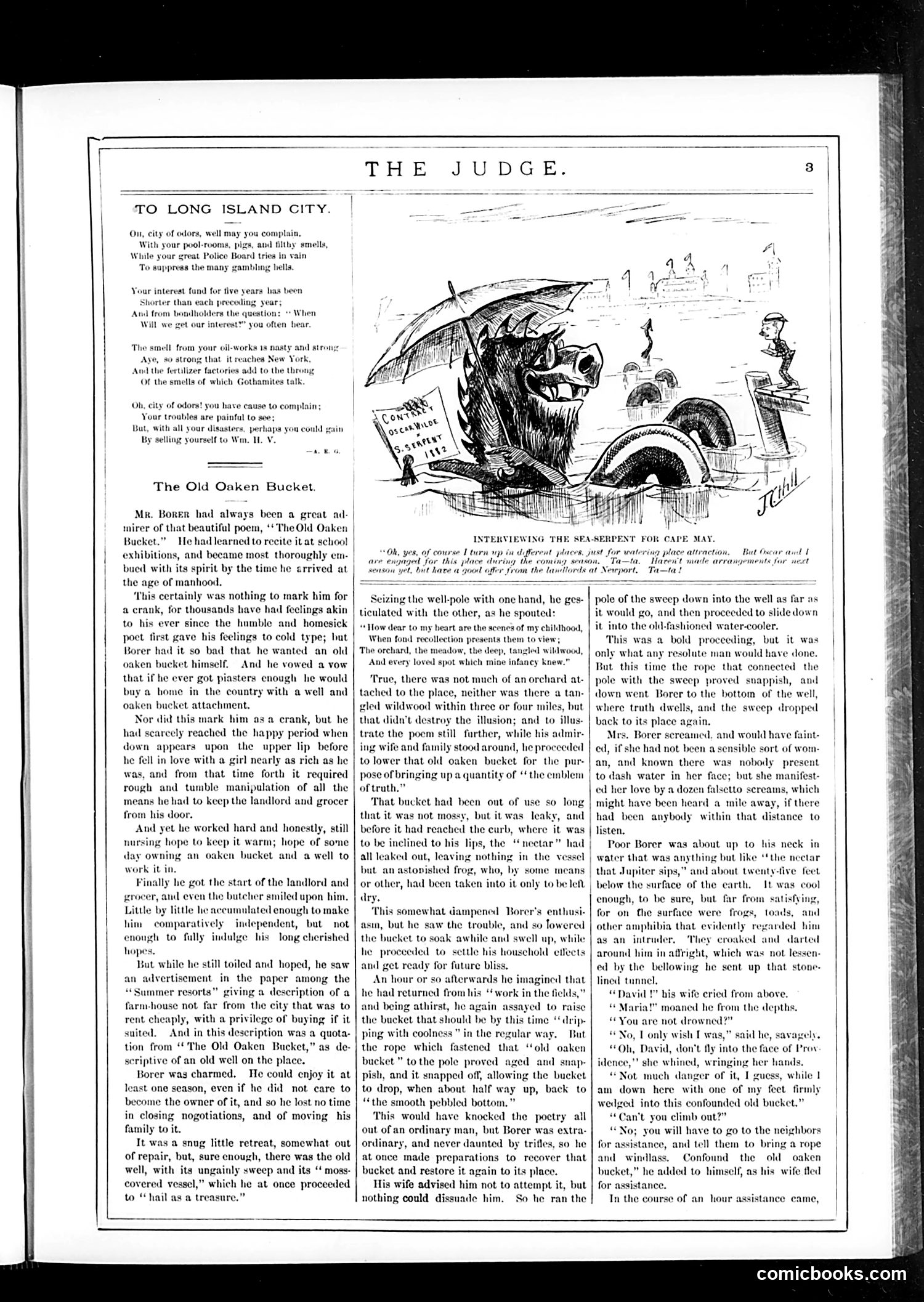
This page from *Judge* contains two items: a poem mocking Long Island City's pollution problems (factories, gambling dens, and foul odors), and a humorous story about Mr. Borer, a sentimental man. Borer idolizes the famous poem "The Old Oaken Bucket" (a nostalgic 1818 work celebrating rural childhood innocence). After years of hard work, he rents a farmhouse specifically because its advertisement quotes the poem and features an old well. Upon arrival, he romantically recites the poem while drawing water—only to discover the bucket is leaky, empty, and contains a bewildered frog. The satire targets romantic sentimentality: Borer's idealization of rustic simplicity and poetic nostalgia collides with reality's mundane disappointments. The joke punctures both his naïve romanticism and, implicitly, the false advertising of the rental property. It's a gentle mockery of those who mistake literary fantasy for actual pastoral virtue.
📄 Transcribed text from this page (OCR, searchable)
Machine-transcribed from the original scan — historical spelling and the odd misread are preserved.
TO LONG ISLAND CITY. On, city of odors, well may you complain, our pool-rooms, pigs, and filthy smells, your great Police Board tries in vain To suppress the many gambling hells. y c for tive years has been year; And from bondholders the questi Will w When fertilizer factories add to th Of the smells of which Got Ob, city of odors! you b Your troubles are cause to complain; nful Lo see perhaps you could ourself to Wm. HV. =a. ko. The Old Oaken Bucket. Mr. Borer had always been a great ad- mirer of that beautiful poem, ‘‘The Old Oaken Bucket.” He had learned to recite it at school exhibitions, and became most thoroughly em- bued with its spirit by the time he errived at the age of manhood. ‘This certainly was nothing to mark him for a crank, for thousands have had feelings akin to his ever since the humble and homesick poet first gave his feelings to cold type; but Borer had it so bad that he wanted an old oaken bucket himself, And he vowed a vow that if he ever got piasters enough he would buy a home in the country with a well and oaken bucket attachment, Nor did this mark him as a crank, but he had scarcely reached the happy period when down appears upon the upper lip before he fell in love with a girl nearly as rich as he was, and from that time forth it required rough and tumble manipulation of all the means he had to keep the landlord and grocer from his door, And yet he worked hard and honestly, still nursing hope to keep it warm; hope of some day owning an oaken bucket and a well to Finally he got the start of the landlord and even the butcher smiled upon him. by little he accumulated enough to make him com ively independent, but not enough to fully indulge his long cherished hopes. But while he still toiled and hoped, he saw an advertisement in the paper among the “Summer resorts” giving a description of a farm-house not far from the city that was to rent cheaply, with a privilege of buying if it suited. And in this deseription was a quota- tion from ‘The Old Oaken Bucket,” as de- scriptive of an old well on the place. Borer was charmed. He could enjoy it at least one season, even if he did not care to become the owner of it, and so he lost no time in closing nogotiations, and of moving his family to it. It was a snug little retreat, somewhat out of repair, but, sure enough, there was the old well, with its ungainly sweep and its “ moss- covered vessel,” which he at once proceeded to “hail as a treasure.” | ticulated with the other, as he spouted: THE JUDGE. A-SERPENT FOR CAP 8, of course L turn up in different places, just fo “ds at Neweport, MAY. watering place Ta—ta. Haven't made arrangements for next Ta izing the well-pole with one hand, he g “How dear to my heart are the scene’ of my chi recollection presents them to view; w, the deep, tangled wildwood, xl spot which mine infaney knew.” ‘True, there was not much of an orchard at- tached to the place, neither was there a tan- gled wildwood within three or four miles, but that didn’t destroy the illusion; and to illus- trate the poem still further, while his admir- ing wife and family stood around, he proceeded to lower that old oaken bucket for the pur- pose of bringing up a quantity of “the emblem of truth.” That bucket had been out of use so long | that it not mossy, but it was leak: before it had reached the curb, where it was to be inclined to his lips, the ‘ neetar” ha all leaked out, leaving nothing in the v but an astonished frog, who, by some means or other, had been taken into it only to be left | ary. ‘This somewhat dampened Borer's enthusi- asm, but he saw the trouble, and so lowe: the bucket to soak awhile a ell up, while he proceeded to settle his household etlvets and get ready for future bliss, An hour or so afterwards he imagined that he had returned from his ‘work in the fields,” and being athirst, he again assayed to rais the bucket that should be by this time “drip- ping with coolness” in the regular way, But the rope which fastened that “old oaken bucket” tothe pole proved aged and snap- pish, and it snapped off, allowing the bucket to drop, when about half way up, back to “the smooth pebbled bottom.” This would have knocked the poetry all out ofan ordinary man, but Borer was extra- ordinary, and never daunted by trifles, so he at once made preparations to recover that bucket and restore it again to its place. His wife advised him not to attempt it, but nothing could dissuade him. So he ran the pole of the sweep down into the well as far as it would go, and then proceeded to slidedown. it into the old-fashioned water-cooler. This was a bold proceeding, but it was only what any resolute man would have done. But this time the rope that connected the pole with the sweep proved snappish, and down went Borer to the bottom of the well, where truth dwells, and the sweep dropped back to its place again. Mrs. Borer screamed, and would have faint- ed, if she had not been a sensible sort of wom- an, and known there was nobody present | todash water in her face; but she manifest- etto screams, which mile away, if there in that distance to ed her love by a dozen might have been heard had been anybody wit listen, Poor Borer was about up to his neck in water that was anything but like “the nectar that Jupiter sips,” and about twenty-five feet below the surface of th he enongh, to be sure, but far from satisfvin: for on the surface were frogs, tos and other amphibia that evidently regarded hin as an intruder, ‘They croaked and darted around him inadright, which was not lessen- ed by the bellowing he sent up that stone- lined tunnel. “David !” his wife cried from above. “ Maria!” moaned he from the depths. “You are not drowned?” “No, [only wish T was,” said he, “Oh, David, don't fly into the face of Prov idence,"’ she whined, wringing her hands. Not much danger of it, I guess, while 1 am down here with one of my feet firmly wedged into this confounded old bucket.” “Can't you climb out?” you will have to go to the neighbors tance, and tell them to bring a rope and windlass. Confound the old oaken bucket,” he added to himself, as his wife fled for assistance. In the course of an hour assistance came, It was cool comicbooks.com