
Judge, 1882-08-19 · page 7 of 16
Judge — August 19, 1882 — page 7: what you’re looking at
What you’re looking at
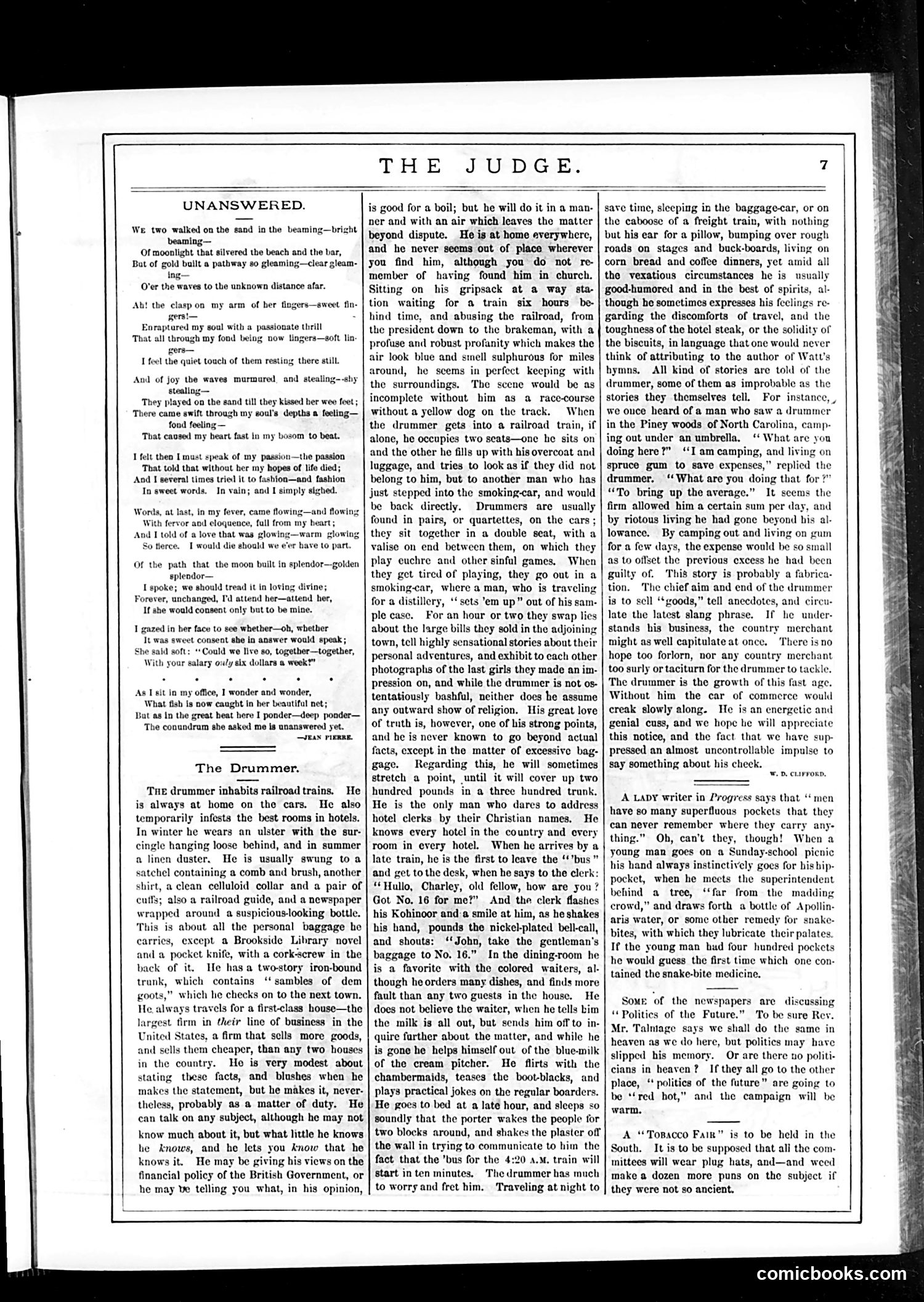
This page contains two distinct pieces: a romantic poem titled "Unanswered" and a satirical character sketch called "The Drummer." **"The Drummer"** is the main satirical content. It mocks the traveling salesman—a ubiquitous figure of late 19th-century commerce. The sketch ridicules the drummer's stereotypical traits: his brash confidence, his constant boasting about his employer's superiority, his ability to pontificate on any subject despite limited knowledge, and his casual profanity. The satire targets his false sophistication and aggressive salesmanship. The drummer represents anxieties about commercialization and the rise of aggressive business culture. He inhabits liminal spaces (trains, hotels) and carries minimal personal possessions—suggesting rootlessness and superficiality. The accompanying poem "Unanswered" uses romantic sentiment ironically to mock class anxiety: a man's passionate marriage proposal is deflated when his beloved asks if he can support her on six dollars weekly—the implied punchline being that even romance cannot overcome economic desperation among the working poor. Together, these pieces satirize American business culture and economic precarity.
📄 Transcribed text from this page (OCR, searchable)
Machine-transcribed from the original scan — historical spelling and the odd misread are preserved.
THE JUDGE. UNANSWERED. We two walked on the sand in the beaming—bright beaming— Of moonlight that silvered the beach and the bar, Bat of gold built a pathway so gleaming—clear gleam- ing— O’er the waves to the unknown distance afar. Ab! the cl gers Enraptured my soul with a passionate thrill ‘That all through my fond belng now lingers—soft lin: gers— I feel the quiet touch of them resting there still. on my arm of ber fiogers—sweet fin And of joy the waves murmured, and stealing--shy stealing— ‘They played on the gand till they kissed her wee feet; There came swift through my soul's depths a fecling— fond feeling — That caused my heart fast in my bosom to beat. Ifelt thea I must speak of my passion—the passion That told that without her my hopes of life died; And I several times tried it to fashion—and fashion In sweet words. In vain; and I simply sighed. Words, at last, in my fever, came flowing—and flowin, With fervor and eloquence, full from my beart; And I told of a love that was glowing—warm glowing So tierce. I would die shoald we eer bave to part. Of the path that the moon built in splendor—golden splendor— I spoke; we should tread it in loving divine; Forever, unchanged, I'd attend her—attend her, If she would consent only but to be mine. I gazed in her face to see whether—ob, whether It was sweet consent she in answer would speak; She said soft: ‘Could we live so, together—together, With your salary ouly six dollars a week?” As [sit in my office, I wonder and wonder, What fish is now caught in her beautiful net; Bat as in the great heat here I ponder—deep ponder— ‘The conundrum she asked me is unanswered yet. WEAN PUERRE. The Drummer. Tue drummer inhabits railroad trains. He is always at home on the cars. He also temporarily infests the best rooms in hotels. In winter he wears an ulster with the sur- cingle hanging loose behind, and in summer a linen duster, He is usually swung to a satchel containing a comb and brush, another shirt, a clean celluloid collar and a pair of culls; also a railroad guide, and a newspaper wrapped around a suspiciouslooking bottle. ‘This is about all the personal baggage he carries, except a Brookside Library novel and a pocket knife, with a corkScrew in the back of it. He has a two-story iron-bound trunk, which contains ‘sambles of dem goots,” which he checks on to the next town. He always els for a first-class house—the largest firm in their line of business in the United States, a firm that sells more goods, and sells them cheaper, than any two houses in the country. He is very modest about stating these facts, and blushes when he makes the statement, but he makes it, never- theless, probably as a matter of duty. He can talk on any subject, although he may not know much about it, but what little he knows he knows, and he lets you know that he knows it. He may be giving his views on the financial policy of the British Government, or he may ve telling you what, in his opinion, is good for a boil; but he will do it in a man- ner and with an air which leaves the matter beyond dispute. He is at home everywhere, and he never seems out of place wherever you find him, although you do not re- member of ‘ing found him in church. Sitting on his gripsack at a way sta- tion waiting for a train six hours be- hind time, and abusing the railroad, from the president down to the brakeman, with a profuse and robust profanity which makes the air look blue and smell sulphurous for miles around, he scems in perfect keeping with the surroundings. The scene would be as incomplete without him as a race-course without a yellow dog on the track. When the drummer gets into a railroad train, if alone, he occupies two seats—one he sits on and the other he fills up with his overcoat and luggage, and tries to look as if they did not belong to him, but to another man who has just stepped into the smoking-car, and would be back directly. Drummers are usually found in pairs, or quartettes, on the cars ; they sit together in a double seat, with a valise on end between them, on which they play euchre and other sinful games. When they get tired of playing, they go out in a smoking-car, where a man, who is traveling for a distillery, ‘‘ sets em up” out of his sam- ple case. For an hour or two they swap lies about the large bills they sold in the adjoining town, tell highly sensational stories about their personal adventures, and exhibit to cach other photographs of the last girls they made an im- pression on, and while the drummer is not os- tentatiously bashful, neither does he assume any outward show of religion. His great love of truth is, however, one of his strong points, and he is never known to go beyond actual facts, except in the matter of excessive bag- gage. Regarding this, he will sometimes stretch a point, until it will cover up two hundred pounds in a three hundred trunk, He is the only man who dares to address hotel clerks by their Christian names, He knows every hotel in the country and every room in every hotel. When he arrives by a late train, he is the first to leave the ‘‘’bus ” and get to the desk, when he says to the clerk: “Hullo, Charley, old fellow, how are you ? Got No, 16 for me?” And the clerk flashes his Kohinoor and-a smile at him, as he shakes his hand, pounds the nickel-plated bell-call, and shouts: ‘John, take the gentleman's baggage to No. 16.” In the dining-room he is a favorite with the colored waiters, al- though he orders many dishes, and finds more fault than any two guests in the house. He does not believe the waiter, when he tells kim the milk is all out, but sends him off to in- quire farther about the matter, and while he is gone he helps himself out of the blue-milk of the cream pitcher. He flirts with the chambermaids, teases the boot-blacks, and plays practical jokes on the regular boarders. He goes to bed at a late hour, and sleeps so soundly that the porter wakes the people for two blocks around, and shakes the plaster off the wall in trying to communicate to him the fact that the 'bus for the 4:20 a.M. train will start in ten minutes. The drummer has much to worry and fret him. Traveling at night to save time, sleeping in the baggage-car, or on the caboose of a freight train, with nothing but his ear for a pillow, bumping over rough roads on stages and buck-boards, living on corn bread and coffee dinners, yet amid all the vexatious circumstances he is usually good-humored and in the best of spirits, al- though he sometimes expresses his feclings re- garding the discomforts of travel, and the toughness of the hotel steak, or the solidity of the biscuits, in language that one would never think of attributing to the author of Watt's hymns. All kind of stories are told of the drummer, some of them as improbable as the stories they themselves tell. For instance, , we once heard of a man who saw a drummer in the Piney woods of North Carolina, camp- ing out under an umbrella, ‘ What are you doing here?” ‘‘I am camping, and living on spruce gum to save expenses,” replied the drammer, ‘What are you doing that for?” “To bring up the average.” It scems the firm allowed him a certain sum per day, and by riotous living he had gone beyond his al- lowance. By camping out and living on gum for a few days, the expense would be so small as to offset the previous excess he had been guilty of. This story is probably a fabrica- tion. The chief aim and end of the drumm is to sell ‘*goods,” tell anecdotes, and cil late the latest slang phrase. If he under- stands his business, the country merchant might as well capitulate at once. There is no hope too forlorn, nor any country merchant too surly or taciturn for the drummer to tackle. The drummer is the growth of this fast age. Without him the car of commerce would creak slowly along. He is an energetic and genial cuss, and we hope he will appreciate this notice, and the fact that we have sup- pressed an almost uncontrollable impulse to say something about his cheek. Ww. D. CLIFFORD. A Lapy writer in Progress says that “men have so many superfluous pockets that they can never remember where they carry any- thing.” Ob, can't they, though! When a young man goes on a Sunday-school picnic his hand always instinctively goes for hiship- pocket, when he meets the superintendent behind a tree, ‘fur from the madding crowd,” and draws forth a bottle of Apollin- aris water, or some other remedy for snake- bites, with which they lubricate their If the young man bud four hundred pockets he would guess the first time which one con- tained the snake-bite medicine. Some of the newspapers are di: pg ‘Politics of the Future.” To be sure Rev. Mr. Talntage says we shall do the same in heaven as we do here, but politics may have slipped his memory. Or are there no politi- cians in heaven? If they all go to the other place, ‘politics of the future” are going to be “red hot,” and the campaign will be warm, A ‘“Topacco Fain” is to be held in the South. It is to be supposed that all the com- mittees will wear plug hats, and—and weed make a dozen more puns on the subject if they were not so ancient. comicbooks.com