
A complete issue · 16 pages · 1882
Judge — August 5, 1882
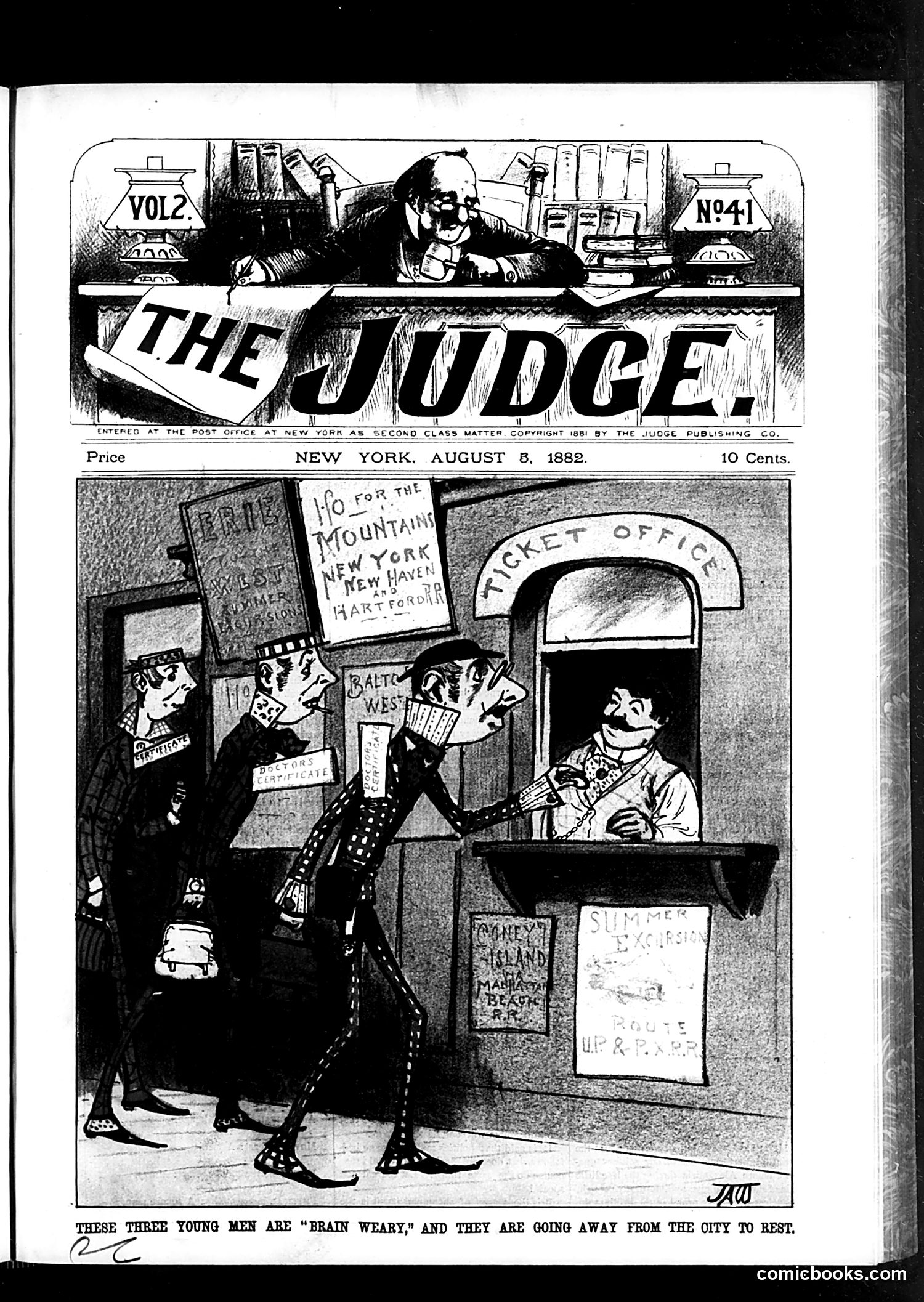
This cartoon satirizes young men seeking rest cures by traveling away from the city. Three fashionably-dressed gentlemen stand at a ticket office holding travel posters for mountain and seaside destinations (New York to New Haven, Baltimore & Ohio Railroad, summer excursion routes). The ticket agent observes them from the window. The caption states these men are "brain weary" and escaping the city to recuperate—likely a reference to the period's widespread concern about neurasthenia, a diagnosis attributed to mental exhaustion from modern urban life and overwork. The satire appears to mock this fashionable trend of wealthy men fleeing cities for therapeutic travel, suggesting their "brain weariness" was perhaps an affectation of the leisure class rather than genuine medical necessity. The detailed travel advertisements suggest commerce capitalized on this anxiety.
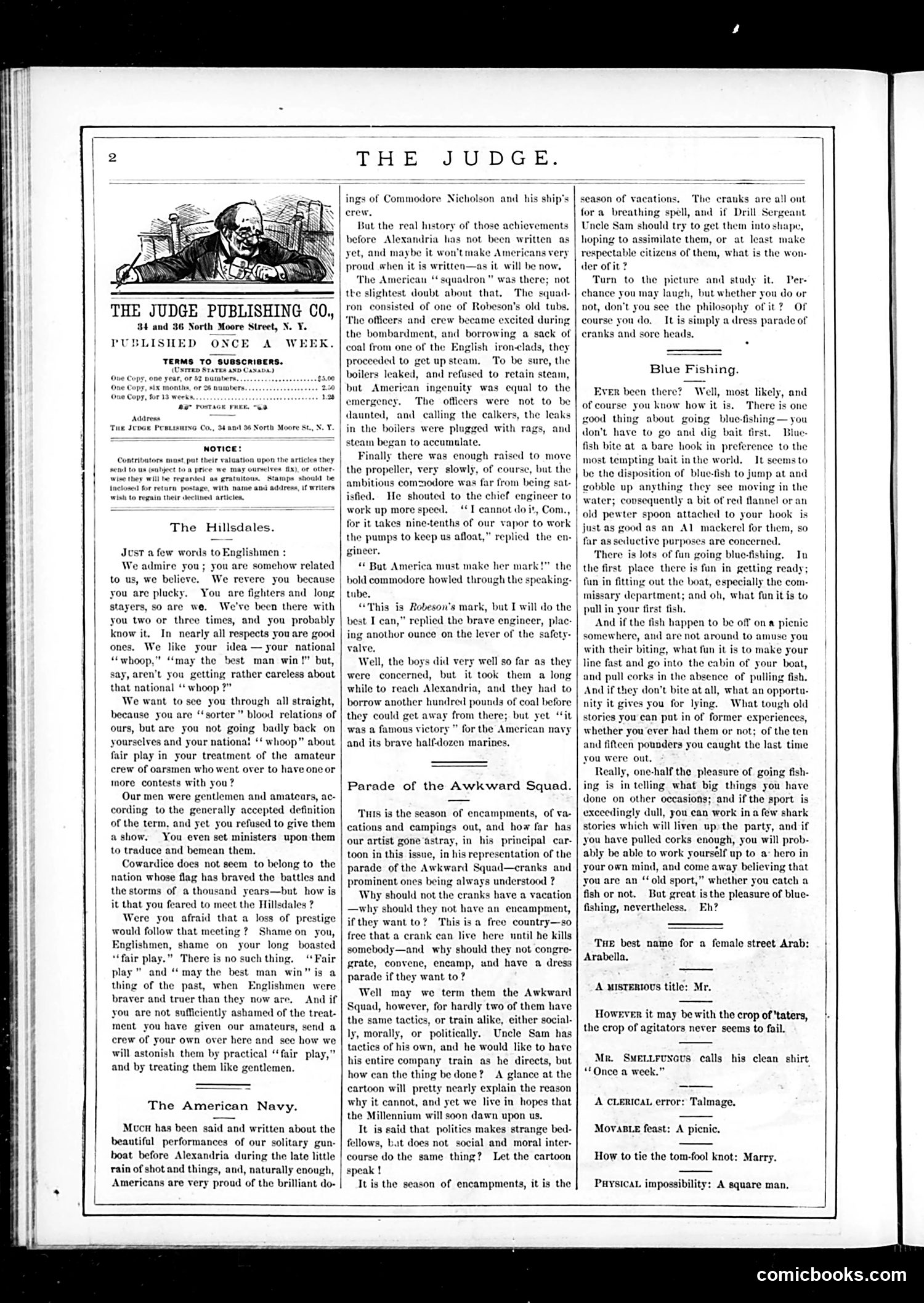
This page primarily contains **subscription information and editorial content** rather than political cartoons. The main satirical pieces are three articles: **"The Hillsdales"** attacks British treatment of American amateur oarsmen (likely the Hillsdale rowing crew), accusing England of abandoning its "fair play" ideals by refusing to compete against American amateurs and even deploying ministers to discredit them. **"The American Navy"** satirizes a U.S. naval engagement at Alexandria, likely referencing the 1882 bombardment. The piece ridicules an American warship's poor condition—featuring leaking boilers, rags used as plugs, and a ship so underpowered it can barely move. The joke is that Commodore Nicholson's boasted military "mark" is actually just evidence of Secretary Robeson's (presumably a Navy Secretary) incompetence in maintaining vessels. Both pieces use humor to critique American/British relations and domestic naval mismanagement, typical of Judge's satirical approach to contemporary affairs.
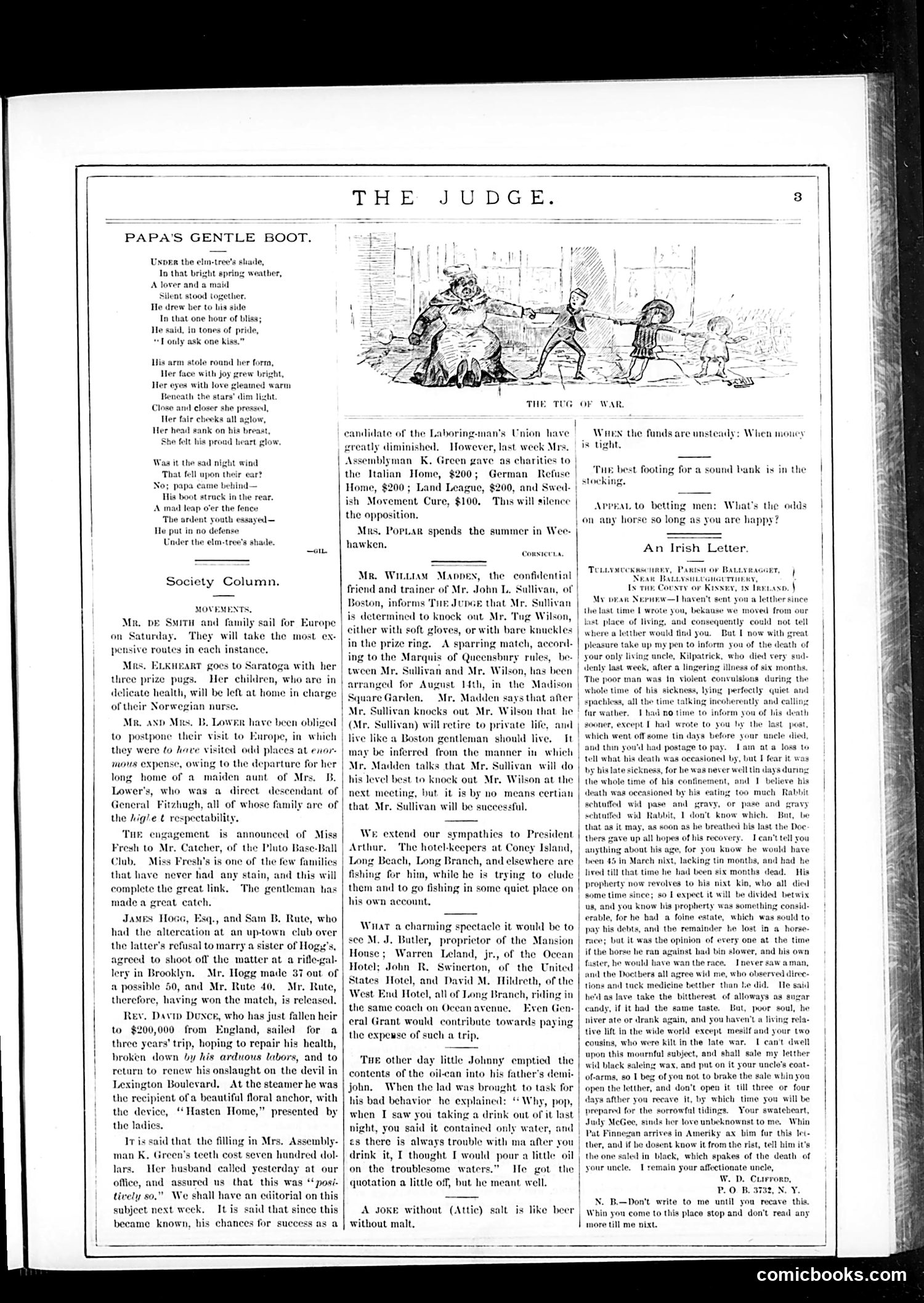
This page contains a humorous poem and society gossip typical of Judge magazine's satirical approach to upper-class life. **The Main Cartoon/Poem:** "Papa's Gentle Boot" mocks romantic young couples. It depicts a sentimental scene where a lover steals a kiss from his sweetheart under the stars—only to be violently interrupted by her father, who literally boots the suitor over a fence. The satire ridicules both the overwrought sentimentality of courtship literature AND strict paternal authority. The humor lies in the physical comedy: romantic pretense meets crude reality. **Society Column Satire:** The gossip section mocks wealthy New York society's affectations—people spending enormous sums on trivial matters (a woman's dental work costing $700), conspicuous charitable giving to silence criticism, and obsessive travel. The engagement announcement praising the groom as a "great catch" because the bride's family has "never had any stain" satirizes class-consciousness and social climbing. The overall tone: Judge ridicules both romantic excess and bourgeois pretension through exaggeration and absurdist humor.
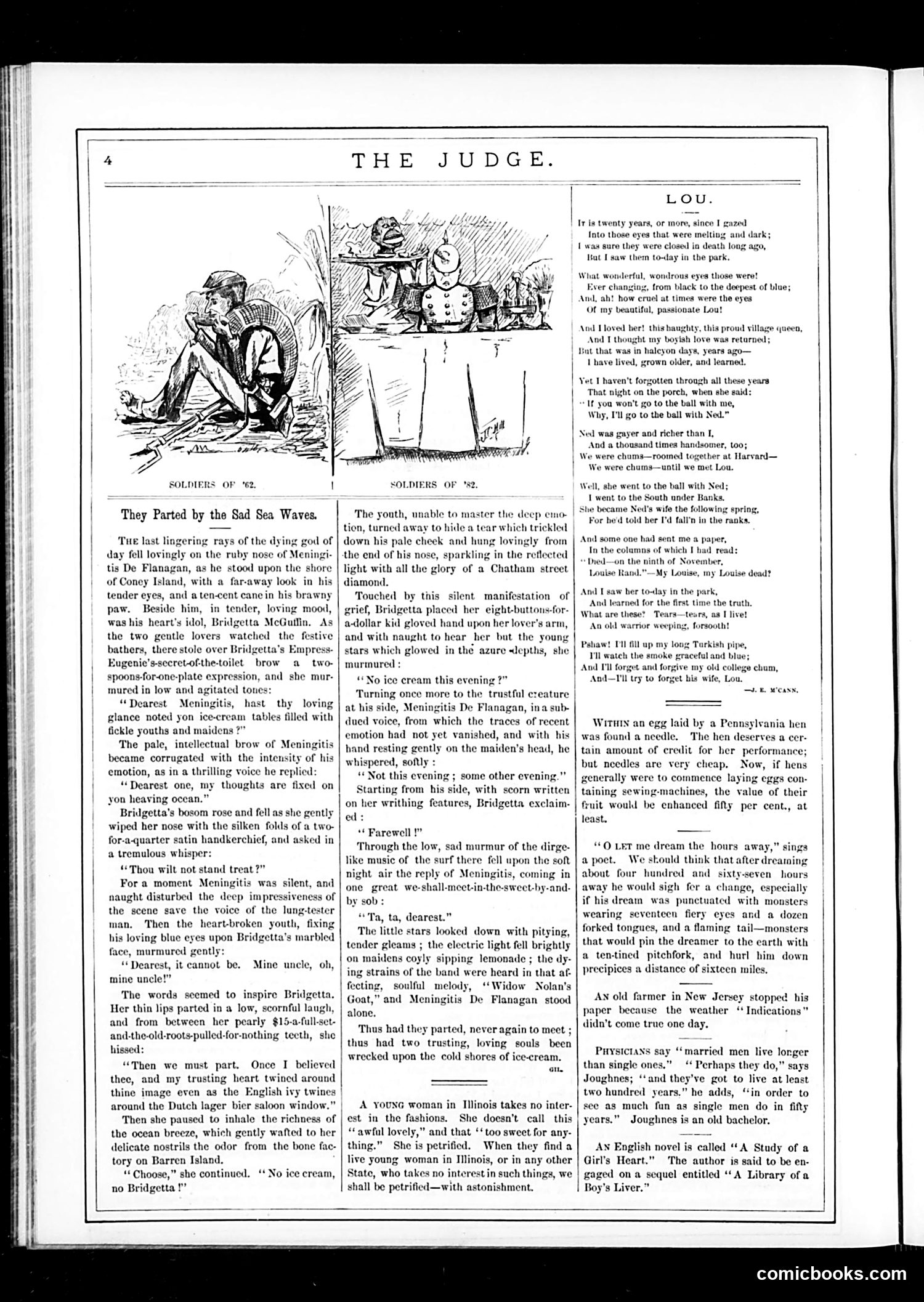
This page contains a lengthy satirical romance parody titled "They Parted by the Sad Sea Waves," mocking sentimental Victorian literature through deliberately absurd characterization and melodramatic language. **The satire works by:** - Creating ridiculous character names (Meningitis De Flanagan, Bridgetta McGuilin) and physical descriptions ("ruby nose," teeth valued at "$15-a-full-set") - Parodying flowery romantic prose with comic juxtapositions: lovers amid Coney Island bathers, Barren Island bone factories, cheap satin handkerchiefs - Escalating the melodrama absurdly—the central conflict is whether he'll buy her ice cream - Using mock-heroic language ("wrecked upon the cold shores of ice-cream") for trivial circumstances The title "Soldiers of '62" is unclear but may reference Civil War nostalgia or working-class humor. The overall effect ridicules both the overwrought sentimental literature popular in Judge's era and the penny-dreadfuls consumed by lower-class readers—making fun of bad writing and emotional excess simultaneously.
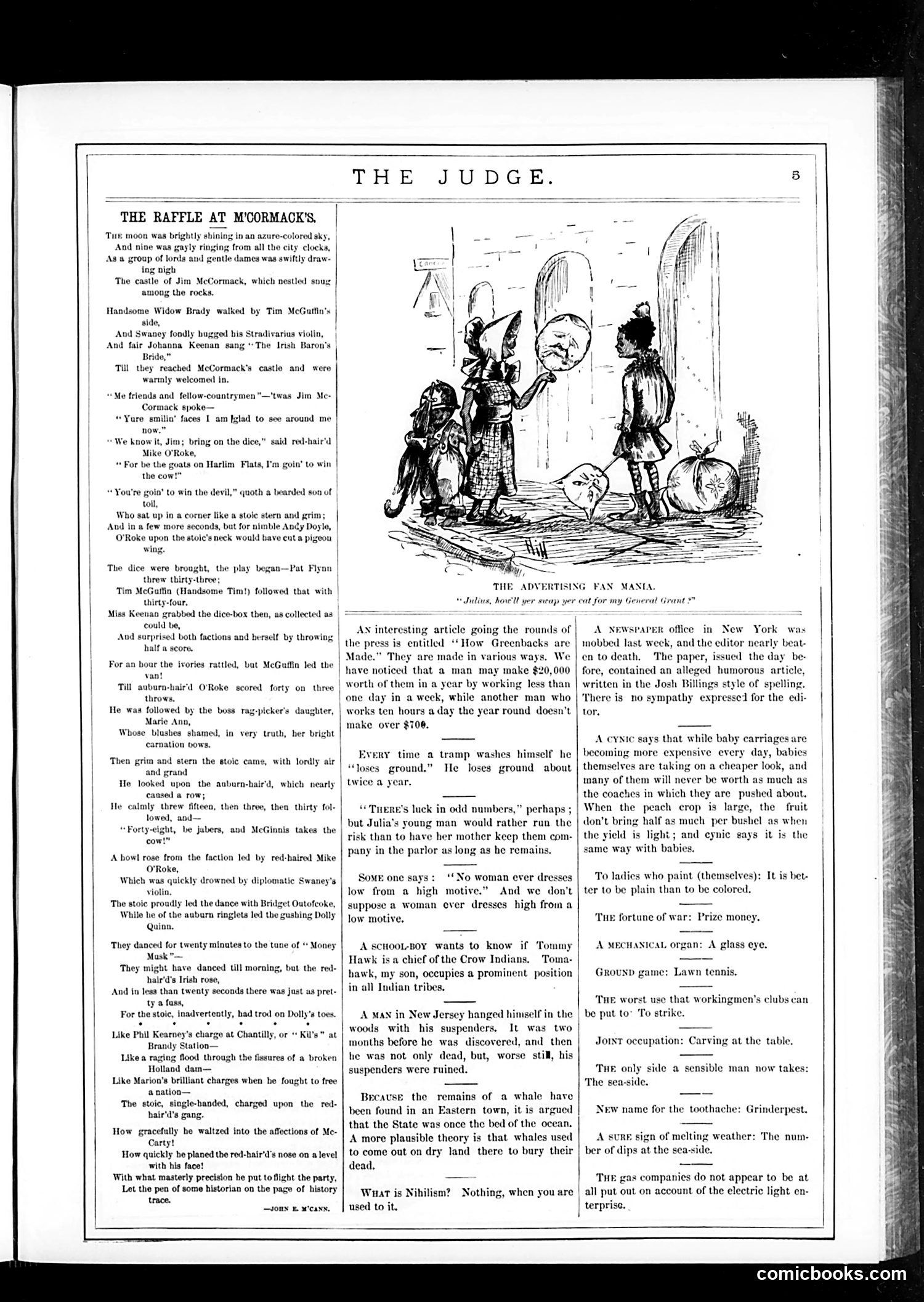
This is primarily a humorous narrative poem about an Irish-American social gathering, not political satire. The poem tells of a raffle and dance at Jim McCormack's "castle" where Irish characters (with names like Tim McGuffin, Pat Flynn, and O'Roke) compete in dice games and dancing. The joke culminates when a stoic, stern man accidentally steps on a woman's toes during dancing, sparking a comical brawl. The poem compares his solo charge against O'Roke's gang to famous Civil War battles (Phil Kearney's charge, Marion's tactics), satirizing the melodramatic heroism of such comparisons through ridiculous domestic violence. The accompanying "short quips" section contains light social commentary on topics like counterfeiting, tramps, romance, and women's fashion—typical filler humor of the era. The cartoon illustration shows children with toys, likely accompanying the advertising/humor content rather than the main poem.
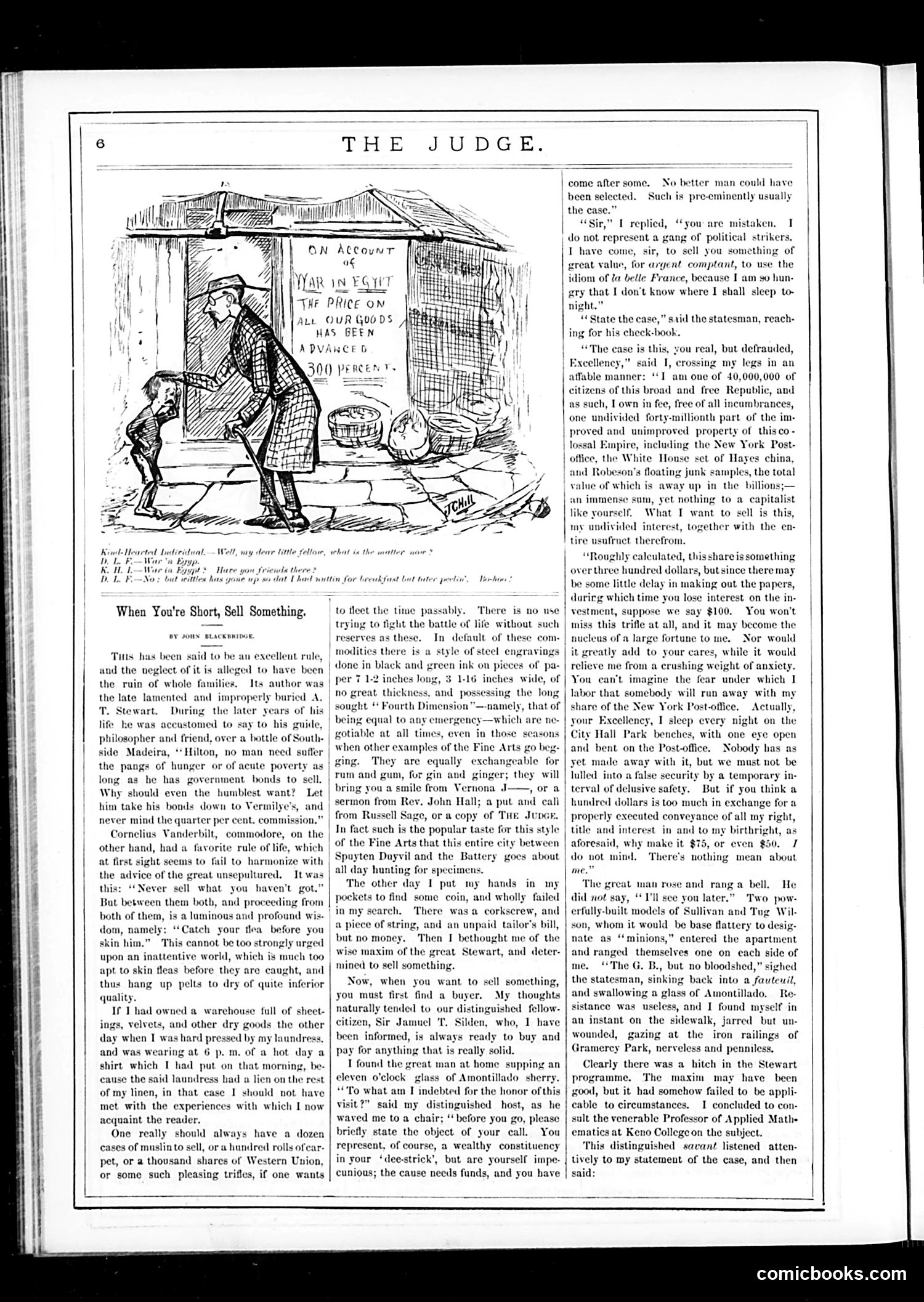
This page satirizes a common Gilded Age con scheme: selling fraudulent "securities" to gullible politicians and wealthy men. The main cartoon depicts a hustler pitching a statesman on buying his share of American government property—absurdly claiming to own a forty-millionth part of the U.S. government, including the New York Post-office, White House china, and naval equipment. The satire targets: - **Political corruption**: Government officials easily duped into questionable financial schemes - **Financial fraud**: Worthless "steel engravings" and dubious securities peddled as legitimate investments - **Greed**: Both the con-artist seller and the wealthy buyer willing to exploit citizens The accompanying article by John Blackridge advises "selling something" when short on funds—anything from government bonds to worthless art prints—mocking both con-artists and their marks. The joke assumes readers recognize this as common practice among both desperate poor and corrupt elites of the era.
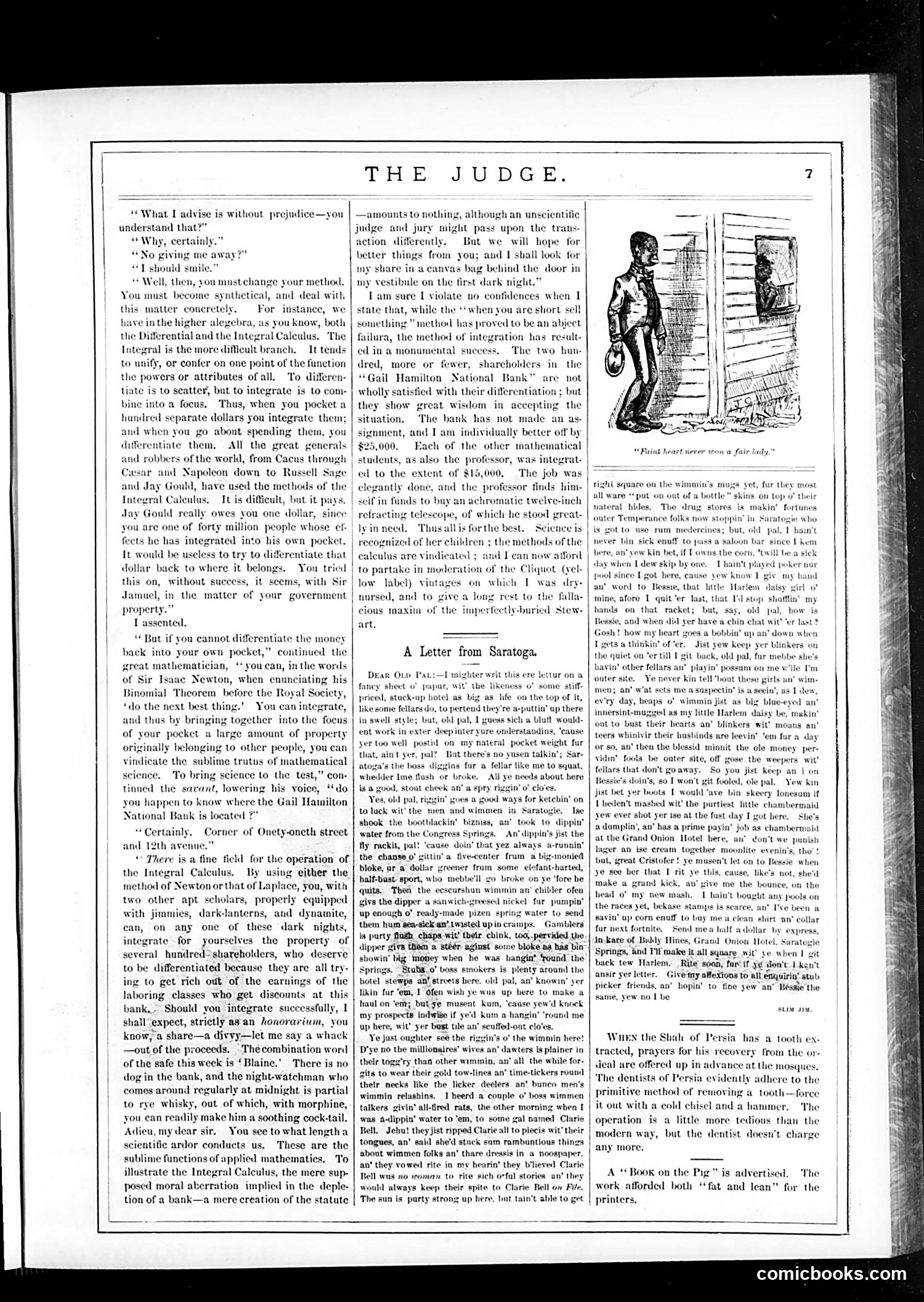
This page contains a satirical dialogue mocking both academic pretension and criminality. A "great mathematician" cynically lectures a student using calculus terminology as euphemism for bank robbery. He argues that just as mathematician Jay Gould "integrated" stolen wealth into his pocket through financial manipulation, the student should physically "integrate" bank deposits—meaning burglarize the Gail Hamilton National Bank at "Onety-oneth street and 12th avenue." The satire targets: (1) the moral equivalence between legal financial theft (monopoly capitalism) and literal crime, and (2) how sophisticated language obscures criminal intent. The phrase "integration" becomes darkly comic shorthand for consolidating stolen property. The accompanying illustration shows a figure at a window, likely depicting the proposed burglary. The piece argues that wealthy industrialists like Gould committed socially-sanctioned theft while ordinary criminals faced prosecution for identical acts—exposing the hypocrisy of Gilded Age economic power.
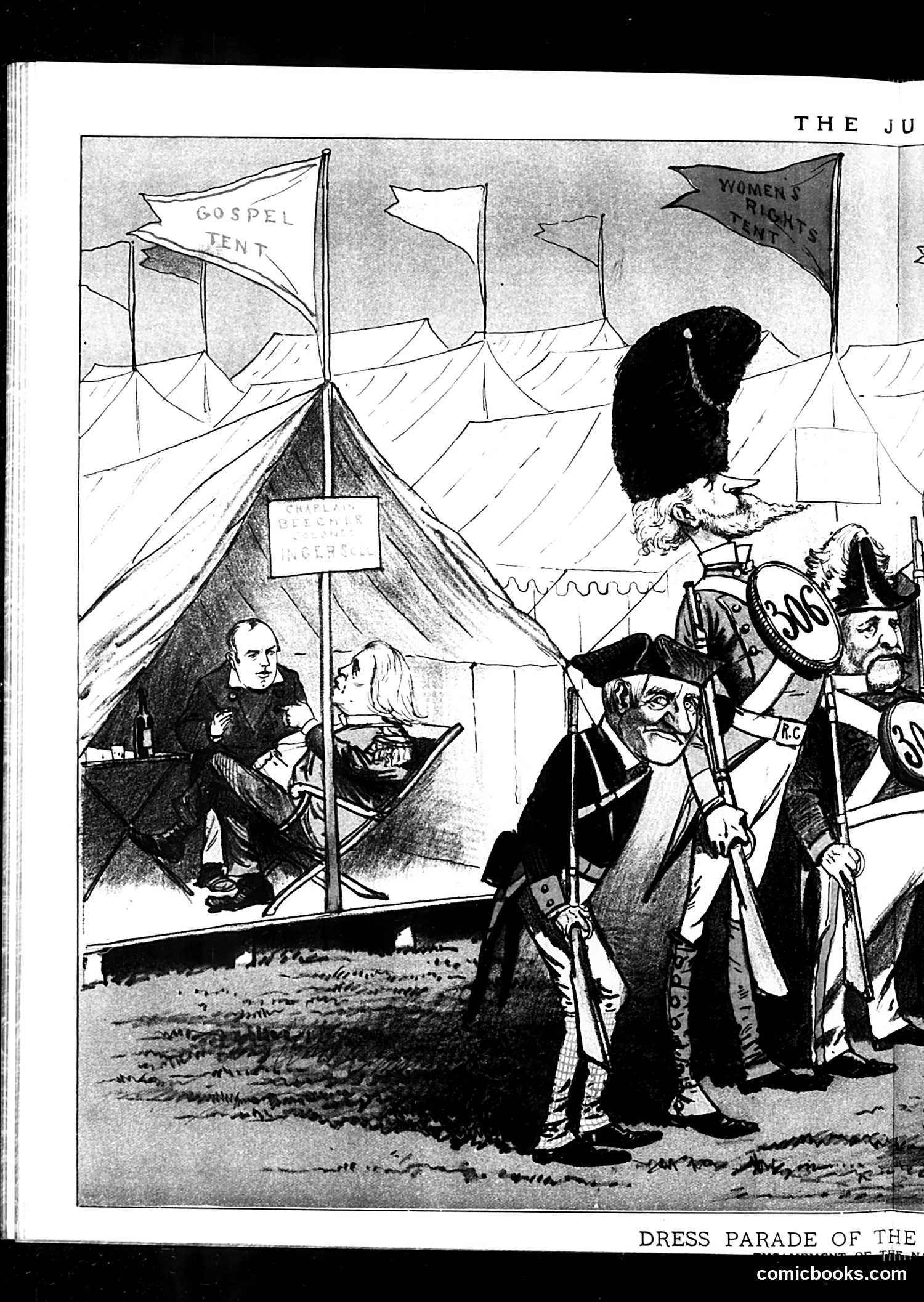
This political cartoon depicts a "dress parade" of religious and social reform movements, shown as a procession of figures in costume or ceremonial dress. Visible tents/banners include "Gospel Tent," "Chaplain's Lunch," and "Women's Rights." The satire appears to mock the proliferation of reform causes and evangelical movements of the era, presenting them as a theatrical parade or spectacle rather than serious endeavors. The caricatured figures—some wearing exaggerated costumes and expressions—suggest the cartoonist viewed these movements with skepticism or ridicule. The "Women's Rights" banner indicates this cartoon addresses the suffrage and women's equality movements. The overall tone suggests the cartoonist considered these various causes somewhat absurd or performative rather than substantive. Without a date visible, the specific historical moment remains unclear, though this style reflects late 19th or early 20th-century American satirical commentary on progressive movements.
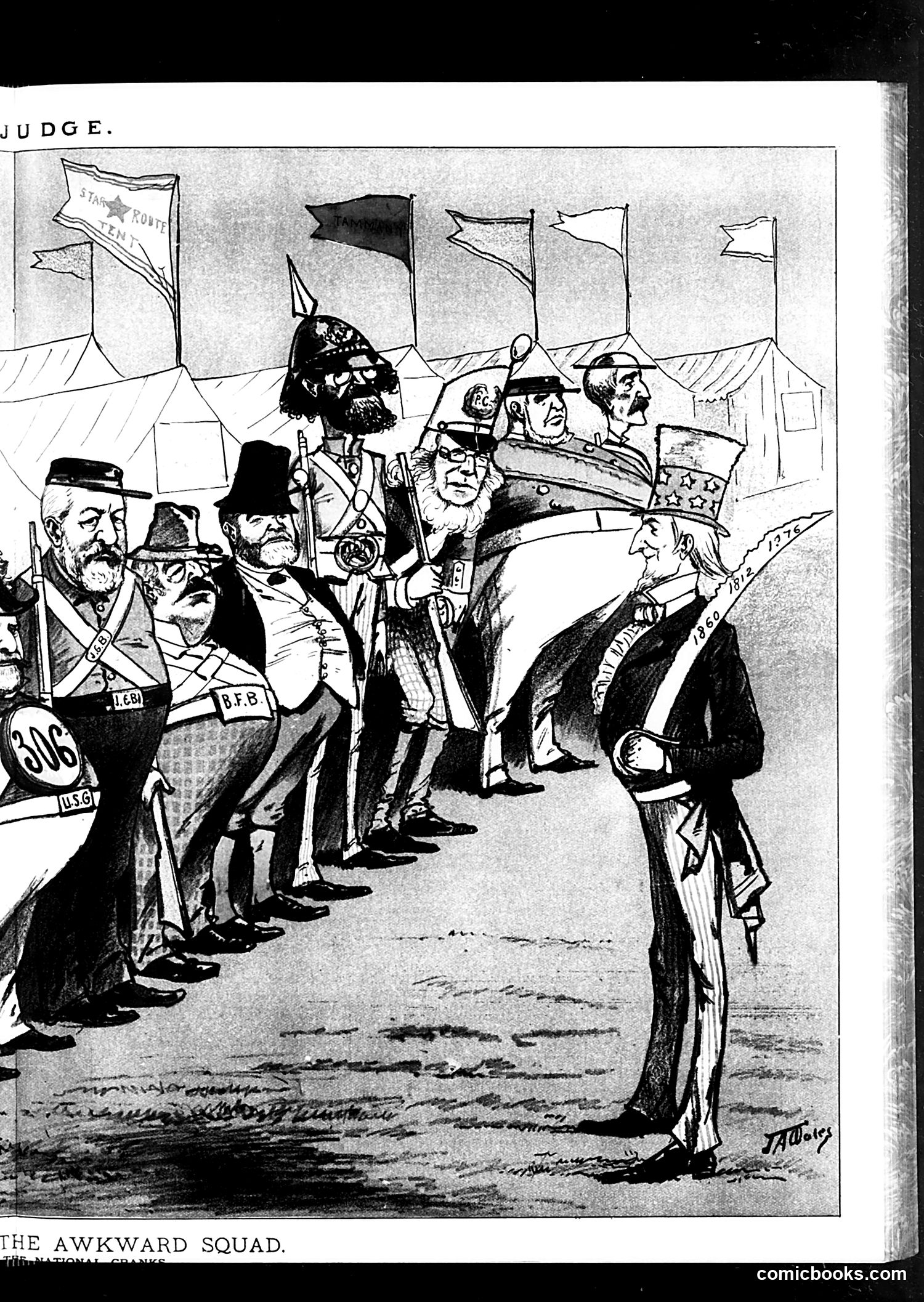
This political cartoon depicts a military or diplomatic inspection scene. A uniformed figure on the right (appearing to be a judge or authority figure, given the page header "JUDGE") observes a ragged line of soldiers or officials wearing various national uniforms and insignia marked with letters like "B.F.B." and "U.S.B." The figures are caricatured as incompetent or mismatched, with exaggerated facial features typical of early 20th-century satire. The "awkward squad" likely refers to an ill-coordinated military alliance or diplomatic group. The mixed uniforms, flags, and labels suggest different nations struggling to cooperate—possibly satirizing WWI-era Allied coordination or a similar international military effort where allied powers appeared disorganized or incompatible. The cartoon mocks their dysfunction through visual absurdity.
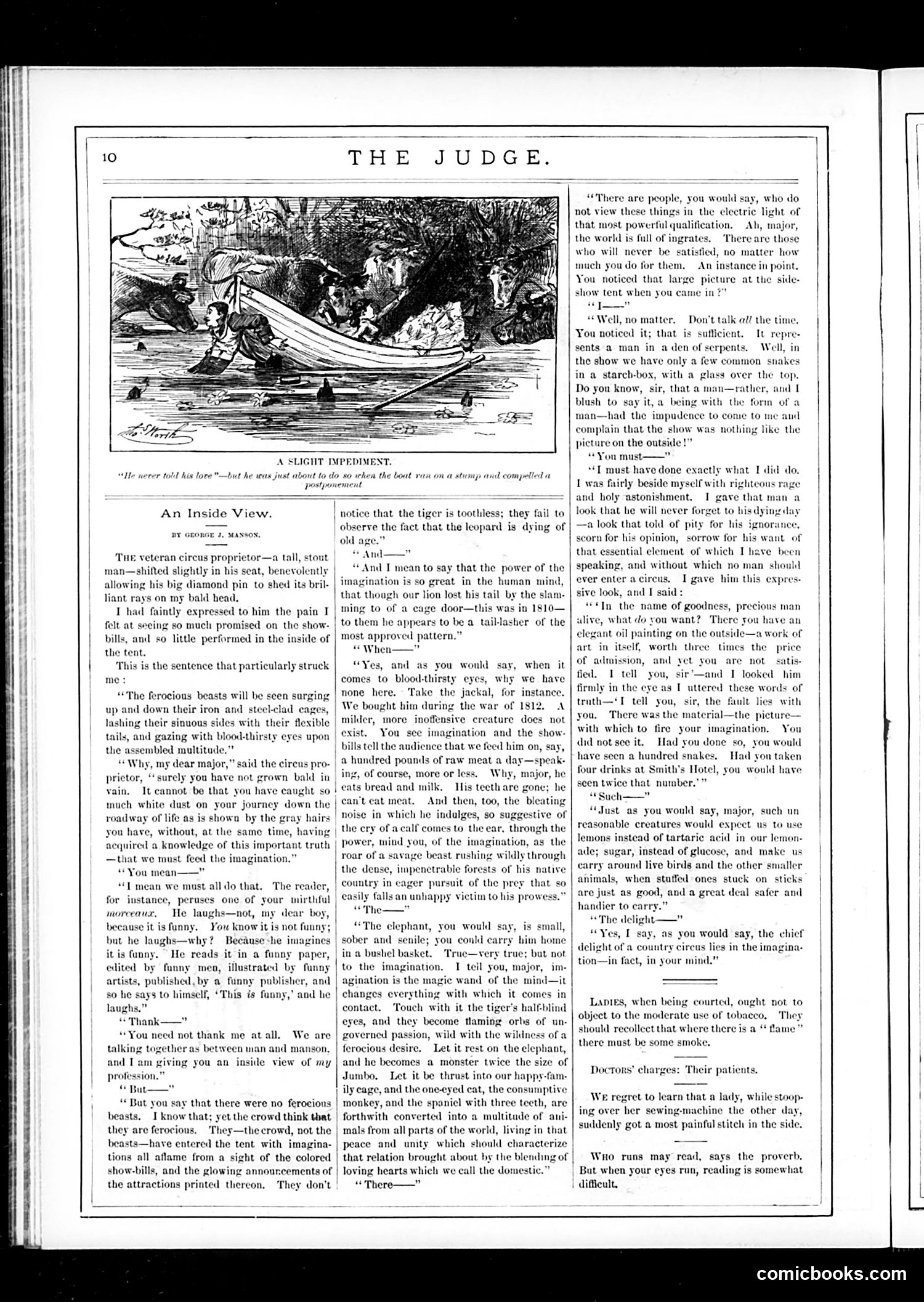
## "A Slight Impediment" The cartoon illustrates a man attempting to propose to a woman in a boat when the vessel runs aground on a stump, interrupting his romantic declaration. The title references the Thomas Moore poem "He Never Told His Love," satirizing how external obstacles can prevent romantic expression. ## "An Inside View" This longer piece is a dialogue between a circus proprietor and a visitor (addressed as "major"). The proprietor explains circus marketing strategy: audiences don't see actual reality—toothless tigers, dying leopards, and senile elephants—but rather what their *imaginations* project onto these creatures, fueled by colorful advertisements and promotional language. **The satire's point**: The proprietor explicitly reveals that circus success depends on manipulating audience imagination rather than delivering genuine spectacle. He boasts that imagination transforms worthless animals into thrilling attractions. This critiques both circuses' deceptive marketing practices and audiences' gullibility—a commentary on how entertainment industries exploit human credulity through skilled promotion.
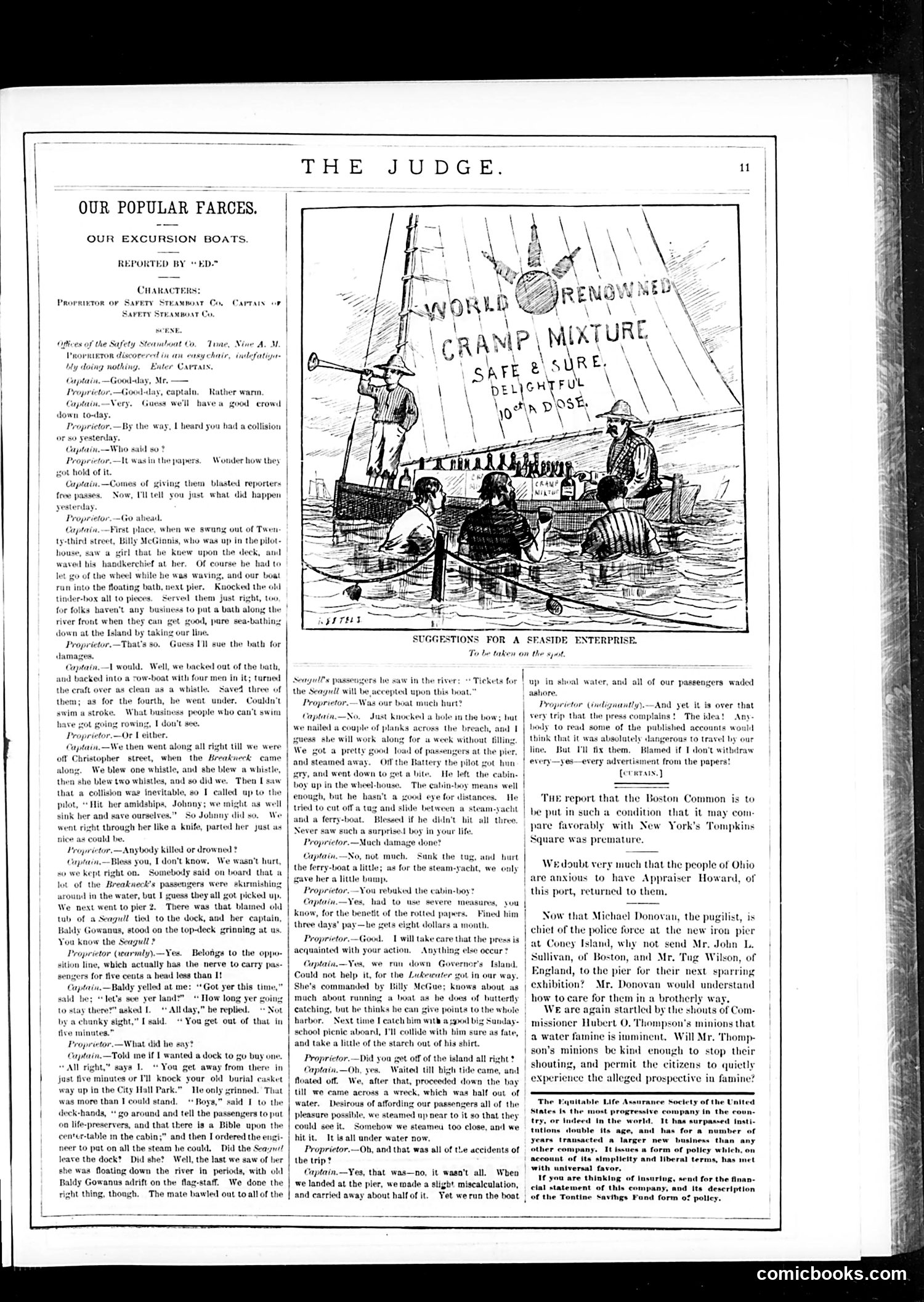
This is a satirical farce from *Judge* magazine depicting the incompetence and negligence of a steamboat safety company. The humor targets the absurdity of claiming safety while causing serial disasters. The plot: A steamboat captain cheerfully recounts a single excursion filled with collisions—hitting a floating bath, capsizing a rowboat (drowning one man), damaging a tugboat and ferry, and colliding with another steamship. Each accident stems from casual negligence: a pilot waving at a girl, poor navigation, miscommunication via whistles. **The satire:** The proprietor's response to this litany of disasters is not shock but indignation at newspaper coverage. He threatens to withdraw advertising from papers reporting the accidents, prioritizing PR over safety accountability. This exposes how corporate interests used advertising leverage to suppress critical journalism. The title "Suggestions for a Seaside Enterprise" sarcastically implies such reckless operators might as well be tourist attractions. The cartoon ridicules both corporate negligence and the media manipulation tactics used to hide it from the public.
This page contains **mostly advertising** interspersed with a political commentary section titled "Whiffs with Correspondents." The key political content appears in the main editorial text, which references **Senator Don Cameron of Pennsylvania** and Republican party politics. A Cameron lieutenant allegedly stated that no "half-breed Republican" will become Pennsylvania governor while Cameron controls politics, and that if General Beaver (the Republican candidate) cannot win, they'll support Democrat Pattison to prevent a rival Republican's success—revealing factional infighting within the party. The "Whiffs" section consists of brief, humorous reader submissions and editorial rejections—typical magazine filler content poking fun at submitted poems and correspondence. The remainder comprises period advertisements for patent medicines (hemorrhoid cure, tooth drops), cleaning products, and other goods—standard for 1880s magazines. The "Popular Songs Illustrated" shows a man in exaggerated posture, though the specific reference is unclear without additional context.
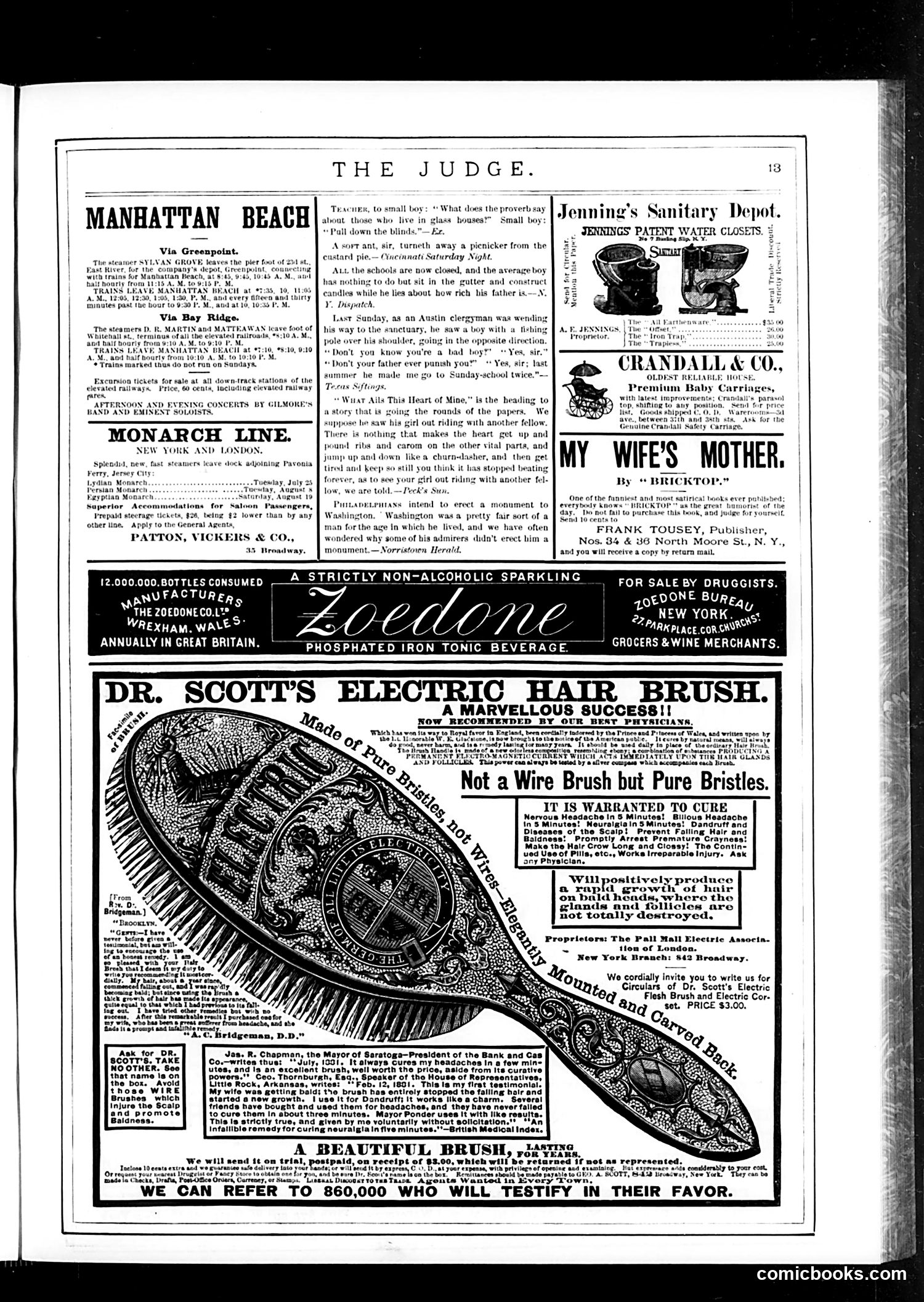
This page is primarily **advertising**, not political satire. It contains several commercial advertisements typical of late 19th-century publications. The main content includes: **Transportation ads**: Manhattan Beach steamship service and the Monarch Line (New York-London passage) **Product advertisements**: Zoedone (a non-alcoholic sparkling iron tonic), Dr. Scott's Electric Hair Brush (claimed to cure baldness and nervous headaches), Jennings' Patent Water Closets, and "My Wife's Mother" (a humorous book) **Small humorous anecdotes** (top right) include brief jokes about glass houses, picnickers, and a clergyman encountering a boy with a fishing pole—typical light humor of the era, but not political commentary. The Dr. Scott's Electric Hair Brush dominates the page with elaborate claims about curing baldness and headaches using electrical stimulation—reflecting period pseudoscience marketing common in Judge and similar publications.
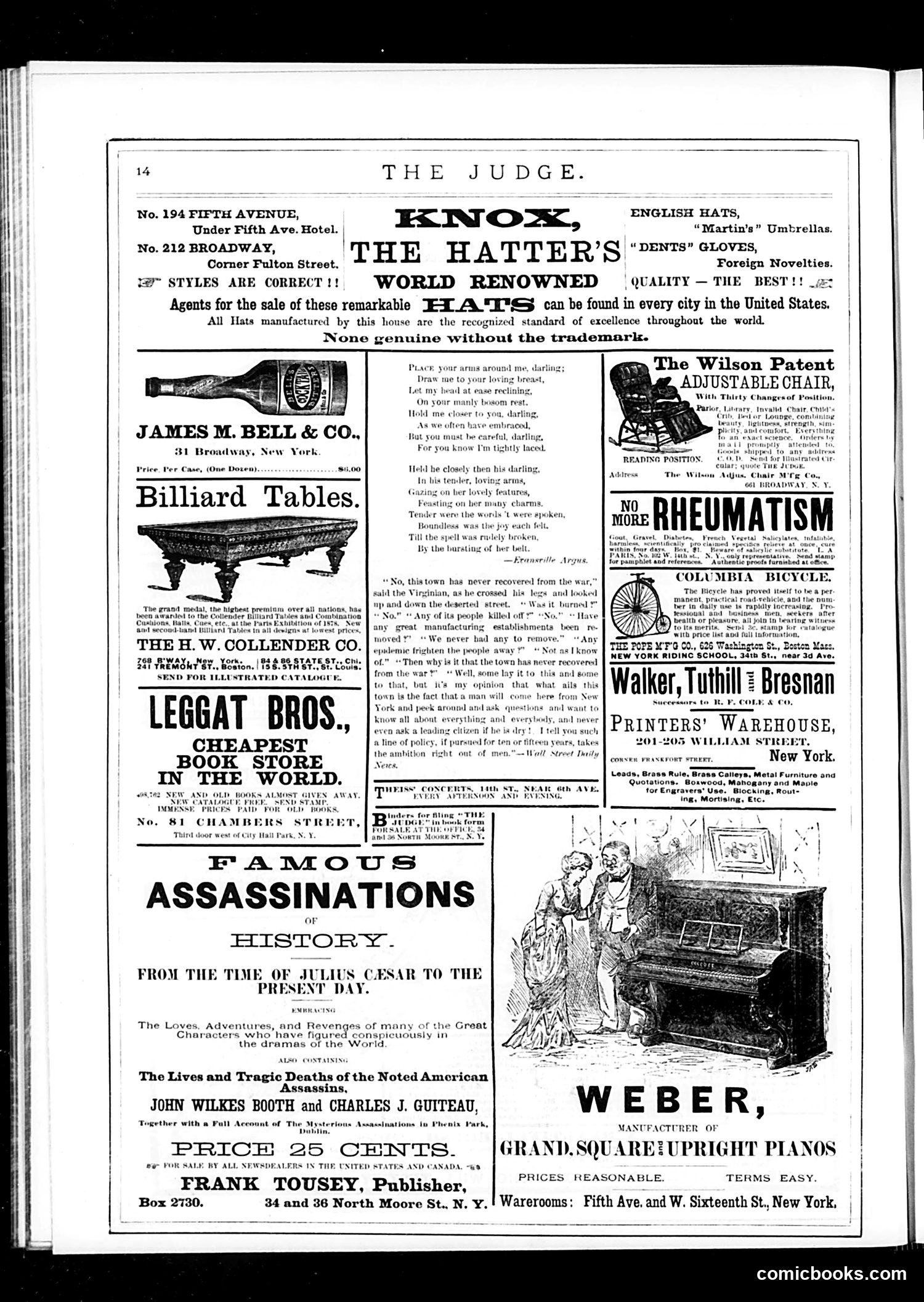
This page is primarily **advertising**, not editorial content. It showcases various commercial products typical of late 19th-century American businesses: Knox hats, billiard tables, James M. Bell & Co. liquor, the Wilson Patent adjustable chair, pianos, and a book store. The most notable advertisement is for a sensationalist 25-cent book titled **"Famous Assassinations History,"** featuring accounts of John Wilkes Booth and Charles J. Guiteau—both assassins of U.S. Presidents (Lincoln and Garfield, respectively). This reflects the era's appetite for true-crime narratives and reflects ongoing public fascination with these notorious historical murders. The small cartoon visible shows two figures examining a piano, likely making a mild joke about domestic life or consumerism, though details are unclear from this reproduction. The page reveals period advertising practices and public interests rather than political satire.
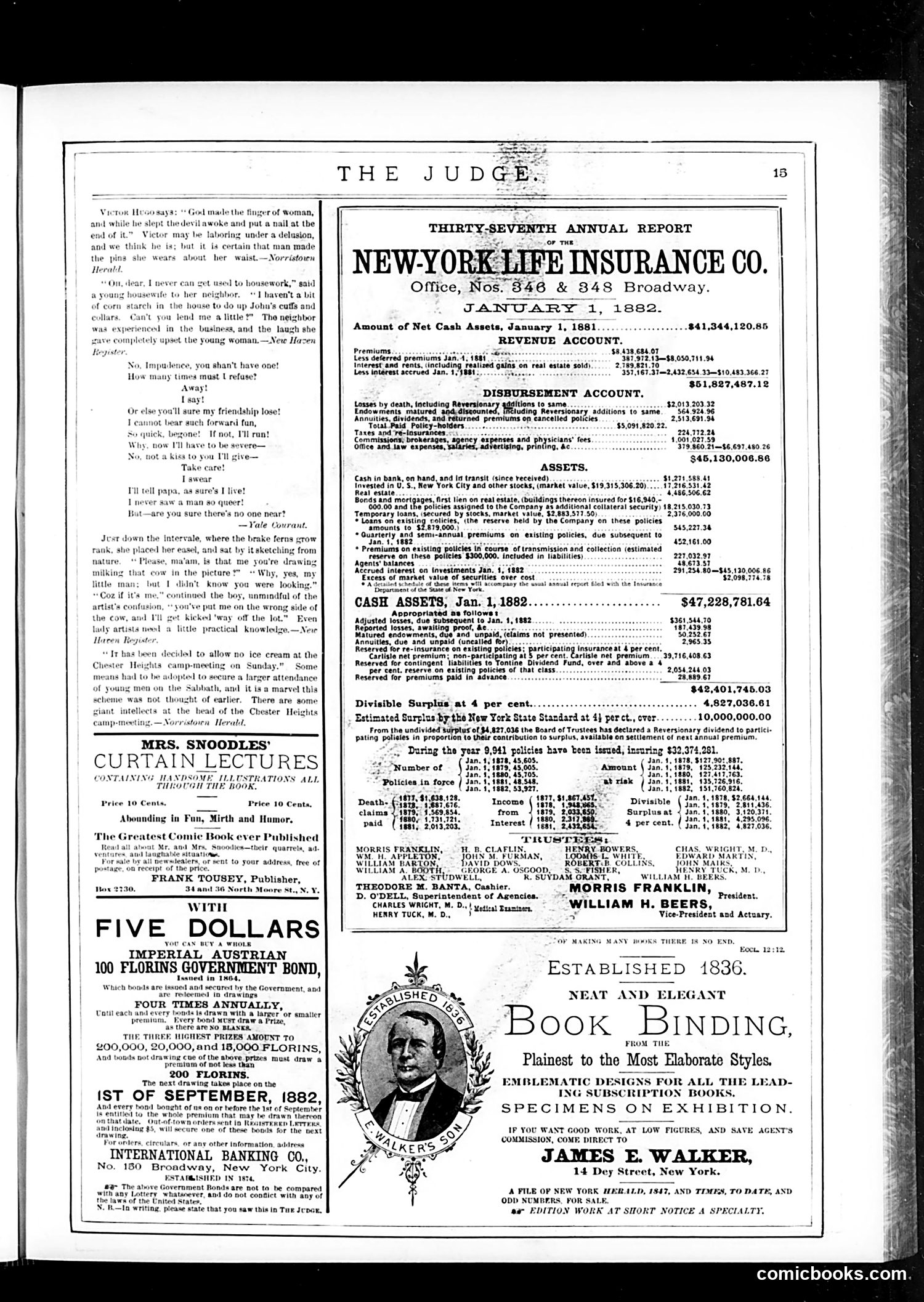
This page is primarily **advertisements and financial reports**, not political satire. The main content is the **New-York Life Insurance Company's 37th Annual Report** (January 1, 1882), displaying detailed financial statements, assets, and account information—standard corporate documentation. The page includes several minor **humorous anecdotes** in the upper left (about a housewife needing corn starch, friendship troubles, and a cow-milking artist), typical light social humor for the era, but these are filler content, not political cartoons. Below the insurance report are **advertisements** for Mrs. Snoodles' Curtain Lectures book, Imperial Austrian Government Bonds, and James E. Walker's book binding services—all commercial promotions. **There is no significant political satire or commentary on this page.** It's a mundane mixture of corporate financial information and period advertisements, representative of Judge's practice of filling pages with ads and light entertainment alongside its satirical content.
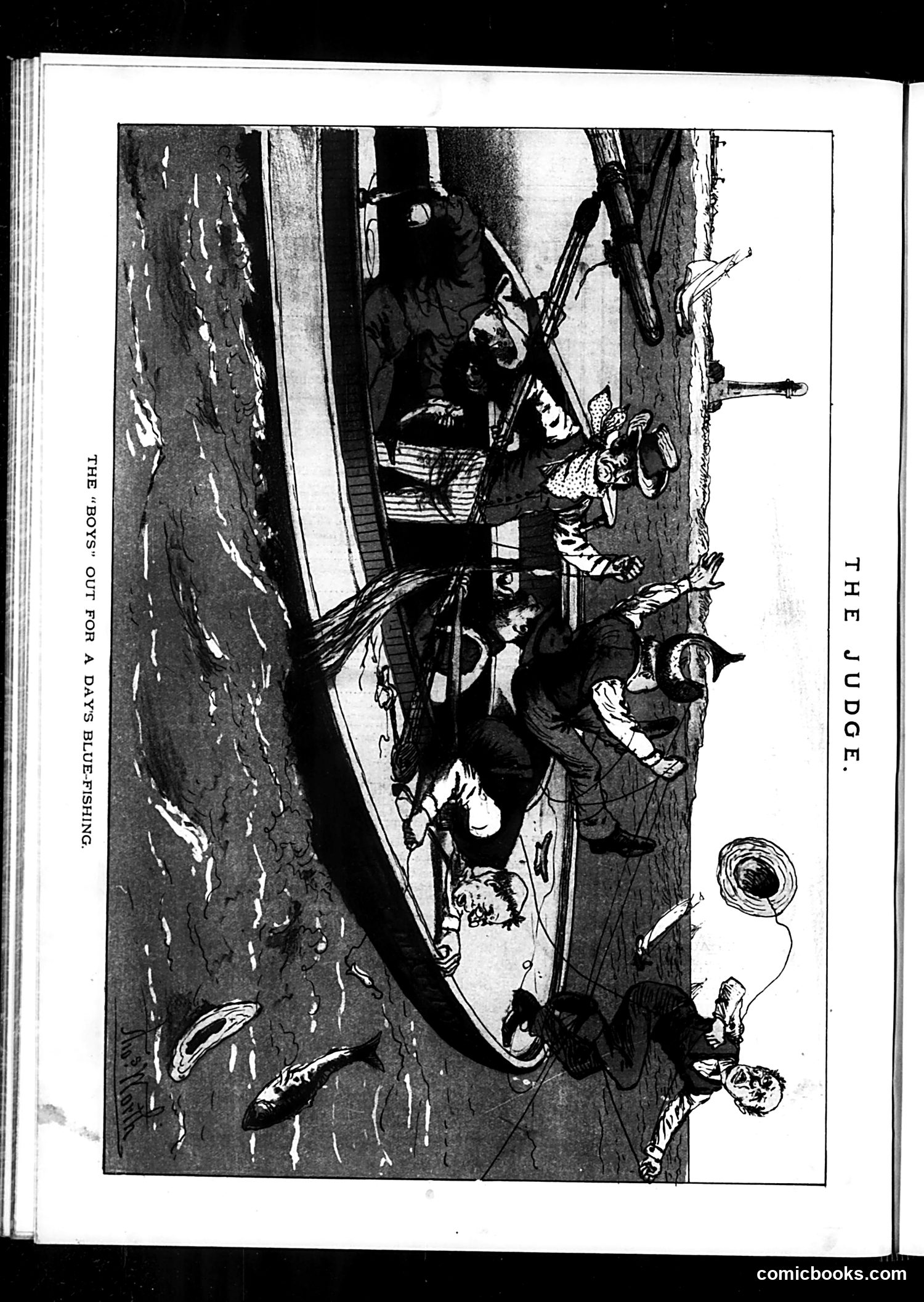
This appears to be a satirical illustration showing a boat scene labeled "For a Day's Blue-Fishing." The image depicts what seems to be a crowded, chaotic boat with multiple figures in period dress (likely late 19th century, given Judge magazine's era). "Blue-fishing" likely refers to catching bluefish, a popular sport. However, the crowded, disorganized composition and the presence of what appear to be caricatured figures suggest this is political satire—possibly mocking a specific political excursion, government expedition, or social group's outing that became notorious for incompetence or scandal. Without clearer identification of the figures or additional context about what specific event this references, the precise political target remains unclear, though the satirical intent is evident from Judge's characteristic comedic treatment.