
Judge, 1882-08-05 · page 4 of 16
Judge — August 5, 1882 — page 4: what you’re looking at
What you’re looking at
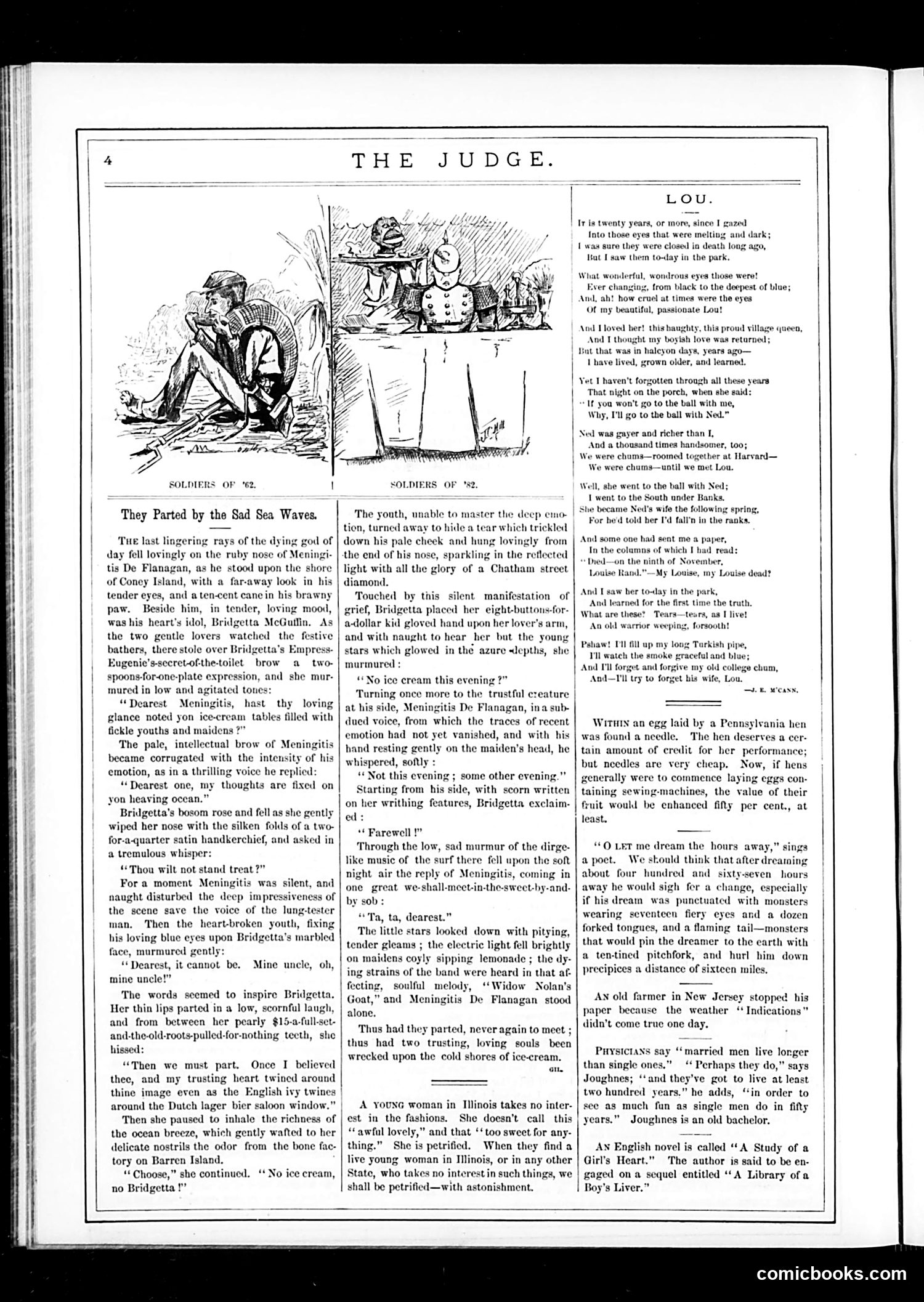
This page contains a lengthy satirical romance parody titled "They Parted by the Sad Sea Waves," mocking sentimental Victorian literature through deliberately absurd characterization and melodramatic language. **The satire works by:** - Creating ridiculous character names (Meningitis De Flanagan, Bridgetta McGuilin) and physical descriptions ("ruby nose," teeth valued at "$15-a-full-set") - Parodying flowery romantic prose with comic juxtapositions: lovers amid Coney Island bathers, Barren Island bone factories, cheap satin handkerchiefs - Escalating the melodrama absurdly—the central conflict is whether he'll buy her ice cream - Using mock-heroic language ("wrecked upon the cold shores of ice-cream") for trivial circumstances The title "Soldiers of '62" is unclear but may reference Civil War nostalgia or working-class humor. The overall effect ridicules both the overwrought sentimental literature popular in Judge's era and the penny-dreadfuls consumed by lower-class readers—making fun of bad writing and emotional excess simultaneously.
📄 Transcribed text from this page (OCR, searchable)
Machine-transcribed from the original scan — historical spelling and the odd misread are preserved.
SOLDIERS OF *62. They Parted by the Sad Sea Waves. ‘Tue last lingering rays of the dying god of day fell lovingly on the ruby nose of Meningi- tis De Flanagan, as he stood upon the shore of Coney Island, with a far-away look in his tender eyes, and aten-cent cancin his brawny paw. Beside him, in tender, loving mood, was his heart's idol, Bridgetta McGuilin. As the two gentle lovers watched the festive bathers, there stole over Bridgetta’s Empress- Eugenie’s-secret-of-the-toilet brow a two- spoons-for-one-plate expression, and she mur- mured in low and agitated ton “Dearest Meningitis, hast thy loving glance noted yon ice-cream tables filled with fickle youths and maidens ?” ‘The pale, intellectual brow of Meningiti became corrugated with the intensity of his emotion, as in a thrilling voice he replicd: “Dearest one, my thoughts are fixed on yon heaving ocean.” Bridgetta’s bosom rose and fell as she gently wiped her nose with the silken folds of a two- for-a-quarter satin handkerchief, and asked in a tremulous whisper: “Thou wilt not stand treat?” For a moment Meningitis was silent, and naught disturbed the deep impressivenes: the scene gave the voice of the lung-tester man, Then the heart-broken youth, fixing his loving blue eyes upon Bridgetta’s marbled face, murmured gently: ‘Dearest, it cannot be. mine uncle!” The words seemed to inspire Bridgetta, Her thin lips parted in a low, scornful laugh, and from between her pearly $15-a-full-set- and-the-old-roots-pulled-for-nothing teeth, she hissed: 3 of Mine uncle, oh, “Then we must part, Once I believed thee, and my trusting heart twined around thine image even as the English iv, around the Dutch lager bier Then she paused to inhale the richness of the ocean breeze, which gently wafted to her delicate nostrils the odor from the bone fac- tory on Barren Island. “‘Choose,” she continued. ‘‘ No ice cream, no Bridgetta !” twines | loon window.” | SOLDIERS OF ‘The youth, unable to master the deep cmo- tion, turned away to hide a tear which trickled down his pale cheek and hung lovingly from the end of his nose, sparkling in the reflected light with all the glory of a Chatham street diamond. Touched by this silent manifestation of grief, Bridgetta placed her eight-buttons-for- a-dollar kid gloved hand upon her lover's arm, and with naught to hear her but the young stars which glowed in thé azure «depths, she murmured : “No ice cream this evening 2” ‘Turning once more to the trustful creature at his side, Meningitis De Flanagan, ina sub- dued voice, from which the traces of recent emotion had not yet vanished, and with his nd resting gently on the maiden’s head, he whispered, soft! ‘Not this evening ; some other evening. Starting from his side, with scorn written on her writhing features, Bridgetta exclaim- ed: “ Farewell !” Through the low, sad murmur of the dirge- like music of the surf there fell upon the soft night air the reply of Meningitis, coming in one great we-shall-mect-in-the-sweet-by-and- by sob : , ta, dearest.” The little stars looked down with pitying, tender gleams ; the electric light fell brightly on maidens coyly sipping lemonade ; the dy- ing strains of the band were heard in that af | fecting, soulful melody, ‘Widow Nolan's Goat,” and Meningitis De Flanagan stood alone. Thus had they parted, never again to meet ; thus had two trusting, loving souls been | wrecked upon the cold shores of ice-cream. one A YOUNG woman in Illinois takes no inter- est in the fashions. She doesn’t call this “awfal lovely,” and that ‘‘ too sweet for any- thing.” She is petrified. When they find a live young woman in Ilinois, or in any other State, who takes no interestin such things, we shall be petrified—with astonishment. | LOU. | Ir is twenty years, or more, since I gazed ting, and dark; 1 was ure they were closed in death long ago, Itat I saw them to-day in the park. ful, wondrous eyes those were! , trom black to the deepest of blue; how cruel at times were the eyes Of my beautiful, passionate Lou! And Hoved her! this haughty, this proud village queen, And [thought iny boyish love was retarned; Hut that was in haleyon days, years ago— Thave lived, grown older, and learned, Yet [haven't forgotten through all these years That night on the porch, when she sal “If you won't go to the ball with me, Why, I'll go to the ball with Ned.” Ned was gayer and richer than I, And a thousand times handsomer, too; We were chums—roomed together at Harvard— | We were chums—until we met Lou. Well, she went to the ball with Ned; I went to the South under Banks. became Ned's wife the following spring, For hed told ber I'd fall'n in the ranks. And some one had sent me a paper, In the columns of which I had read: Jon the ninth of 3 Louise Rand."—My Loui pvember, , iny Louise dead? And I saw her to-day in the park, And learned for the first time the truth, What are these? “urs—teora, as I live! An old warrior weeping, forsootht Pshaw! Pl fill up my long Tarkish pipe, Tl wateh the smoke graceful and blu And Pll forget and f my old colte; And—T'll try to forget bis wife, Lou, yee wreasn, chum, Witty an egg laid by a Pennsylvania hen was found a needle. The hen deserves a cer- tain amount of credit for her performance; but needles are very cheap. Now, if hens generally were to commence laying eggs con- taining sewing-machines, the value of their ruit would be enhanced fity per cent., at j least. ‘O Ler me dream the hours away,” sin apoet. We skould think that after dreaming about four hundred and sixty-seven hours away he would sigh fer a change, especially if his dream was punctuated with monsters wearing seventeen fiery eyes and a dozen forked tongues, and a flaming tail—monsters that would pin the dreamer to the earth with a ten-tined pitchfork, and hurl him down precipices a distance of sixteen miles, AN old farmer in New Jersey stopped his paper because the weather ‘ Indications” didn’t come true one day. Puysictans say ‘married men live lorger than single one: “ Perhaps they do,” says Joughnes; ‘‘and they’ve got to live at least two hundred years.” he adds, “in order to see as much fun as single men do in fifty years.” Joughnes is an old bachelor. AN English novel is called ‘A Study of a Girl’s Heart.” The author is said to be en- | gaged ona sequel entitled “A Library of a Boy's Liver.” comicbooks.com