
A complete issue · 16 pages · 1882
Judge — July 1, 1882
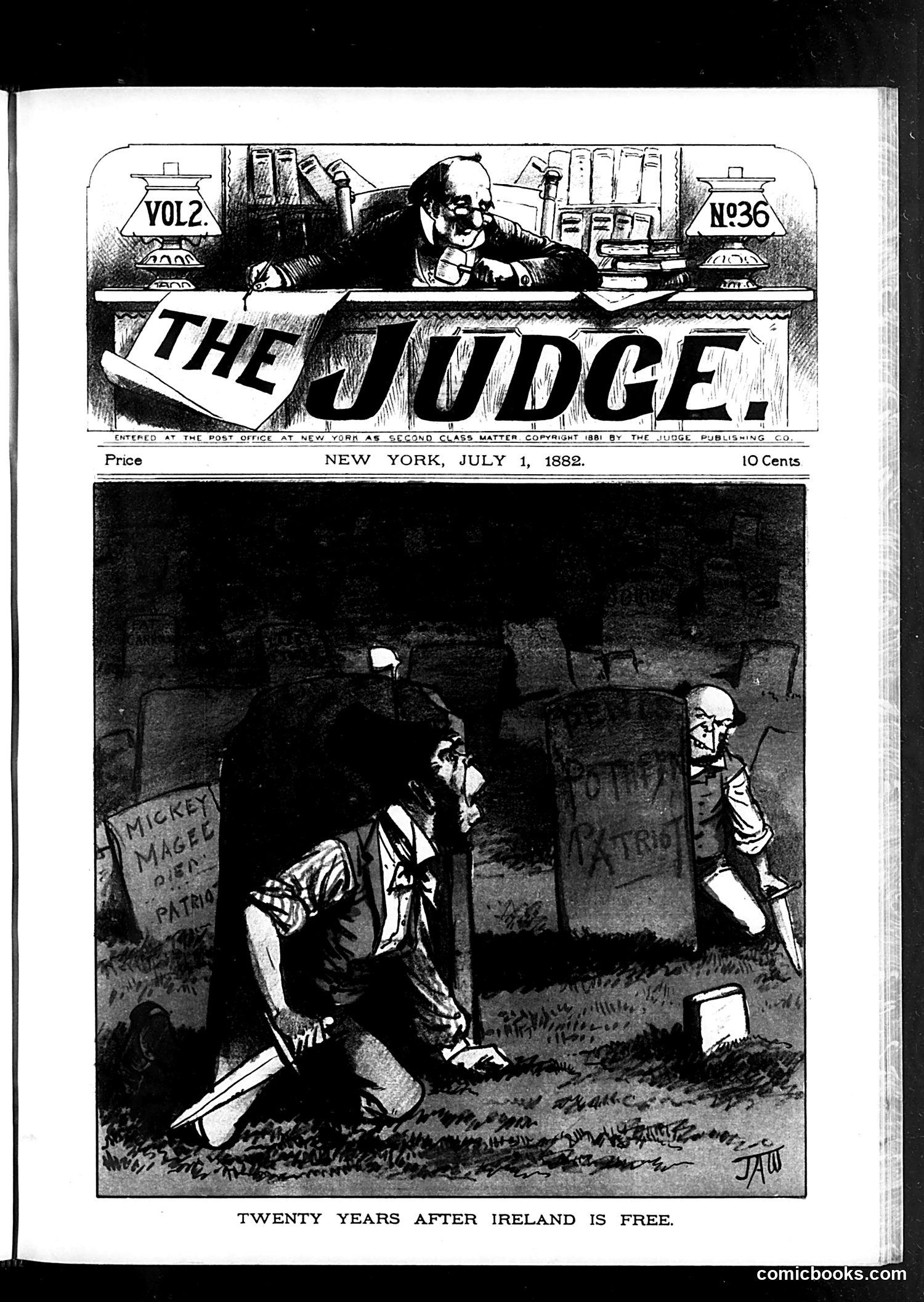
This 1882 *Judge* cartoon depicts a dystopian future scenario imagined twenty years after Irish independence. The image shows a graveyard with skeletal figures and gravestones labeled with Irish names like "Mickey Magee" and "Patriot," suggesting mass death and suffering. The satire expresses skepticism about Irish independence movements popular at the time. Rather than celebrating freedom, the cartoon predicts catastrophic outcomes—implying that Irish self-governance would lead to chaos and death rather than prosperity. The contrasting header shows a judge or authority figure overseeing books and order, suggesting that continued British control represented stability and civilization, while independence represented anarchy. This reflects anti-Irish sentiment and anti-independence political views held by some Americans and British during this era of Irish nationalist agitation.
This page contains two main editorial cartoons/pieces satirizing American politics circa the 1880s. **"After Ireland is Free"** mocks Irish independence advocates by cynically predicting that free Irish citizens will spend their time fighting each other rather than governing productively. The piece also criticizes indolent Irish-Americans living comfortably in America while claiming to support Ireland's liberation—suggesting their political activism is hollow. **"Wake up and Adjourn"** attacks the U.S. Senate as dysfunctional and lazy, suggesting President Arthur should literally command them to adjourn. It contrasts this with the New York State Legislature, which at least maintains investigative committees, implying the Senate accomplishes nothing worthy of newspaper coverage. **"Puzzled Federal Employees"** (partially visible) addresses Republican party infighting over federal patronage—veterans demanding political assessments while threatening dismissal of employees who resist, referencing the contentious Civil Service Reform debates of the era. The cartoons reflect Judge's satirical stance criticizing political incompetence and corruption.
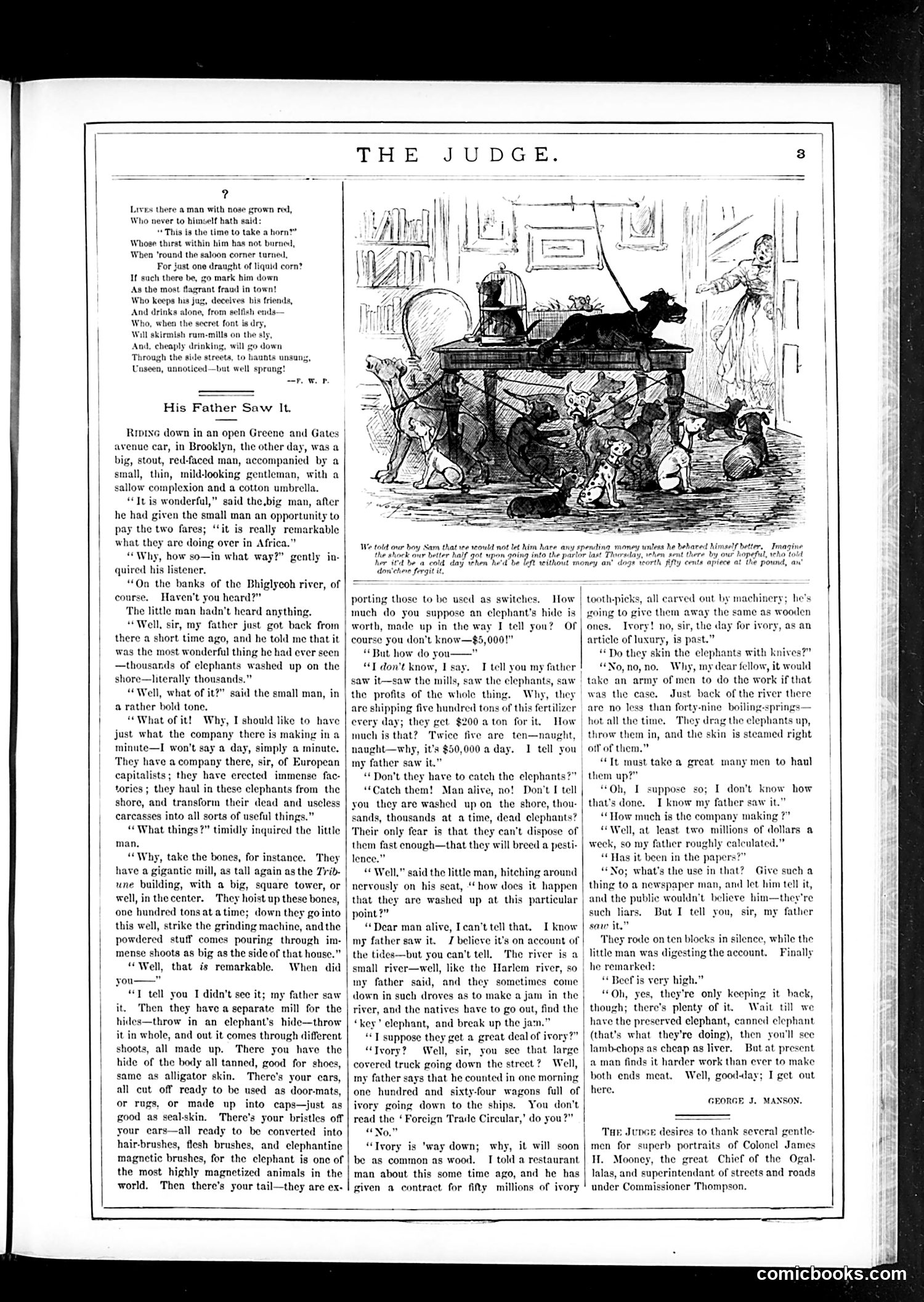
This story-cartoon mocks credulous listeners and tall tales. A bombastic red-faced man on a Brooklyn streetcar regales a skeptical small gentleman with an absurd fabrication: his father witnessed European factories in Africa processing thousands of dead elephants into profitable goods—grinding bones into powder, tanning hides for shoes, converting ears into doormats and hair-brushes, shipping 500 tons daily at $200/ton. The humor lies in the teller's evasive responses ("I didn't see it; *my father* saw it") when questioned, and the obviously fictional economics. The small man's repeated gentle skepticism ("Well, what of it?") underscores the yarn-spinner's obliviousness to his own absurdity. The satire targets turn-of-century American boastfulness and gullibility—men who believe or spread outlandish "business opportunity" stories, particularly regarding colonial Africa exploitation.
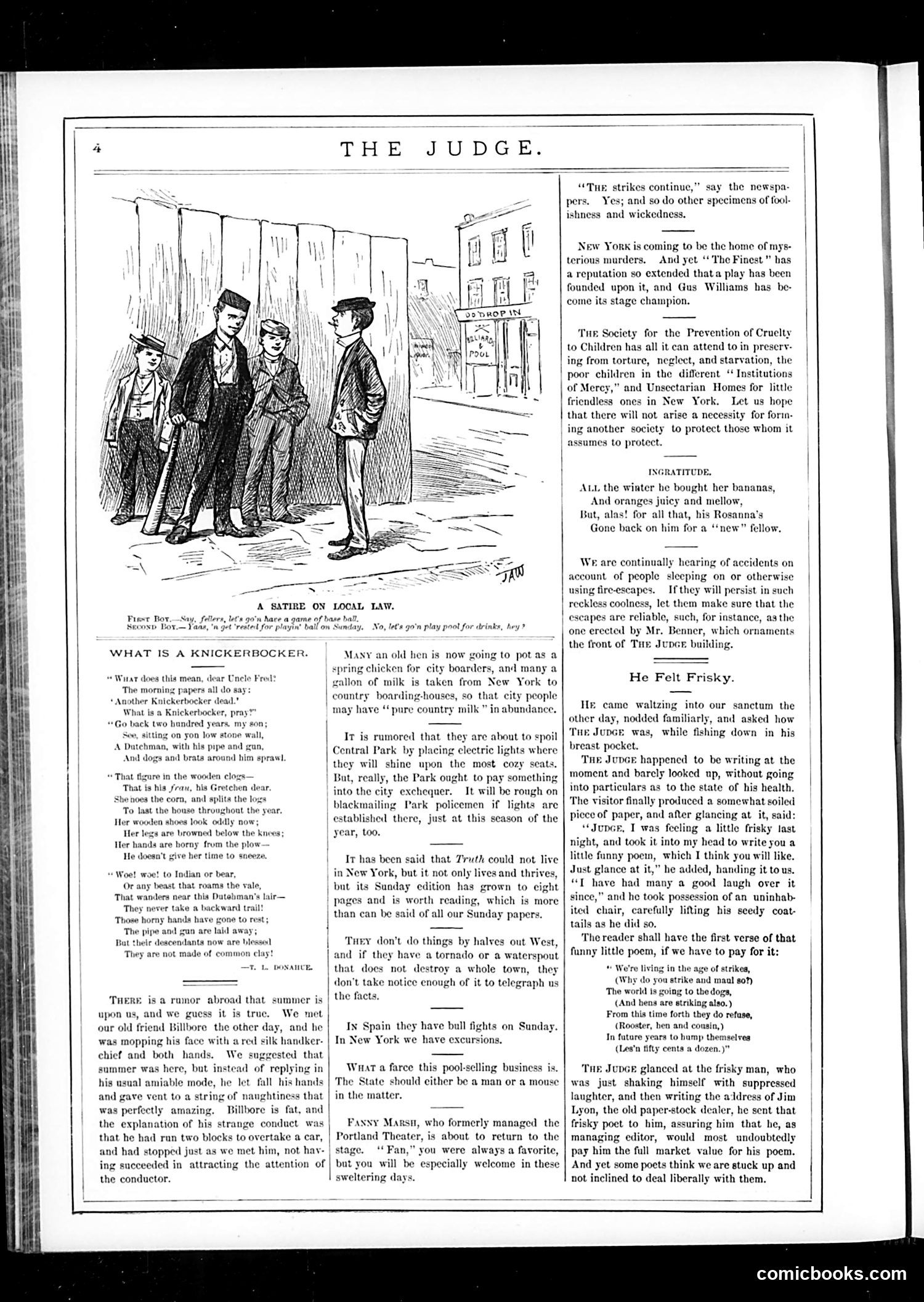
This cartoon satirizes New York's Sunday blue laws prohibiting ball games on the Sabbath. Two street boys discuss playing baseball, but one warns they'll be arrested; he suggests gambling ("pot for drinks") instead—apparently legal or overlooked by enforcers. The satire's point: the law is absurdly selective and poorly enforced. The accompanying text elaborates on local hypocrisy: Spanish bullfights happen Sundays (worse than baseball), yet New York permits Sunday excursions. The piece mocks inconsistent moral policing—authorities crack down on harmless recreation while ignoring or tolerating genuinely troublesome activities. "Knickerbocker" references old Dutch New York settlers, contrasting hardworking colonial ancestors with their pampered, law-breaking descendants—a common period critique of urban degeneration.
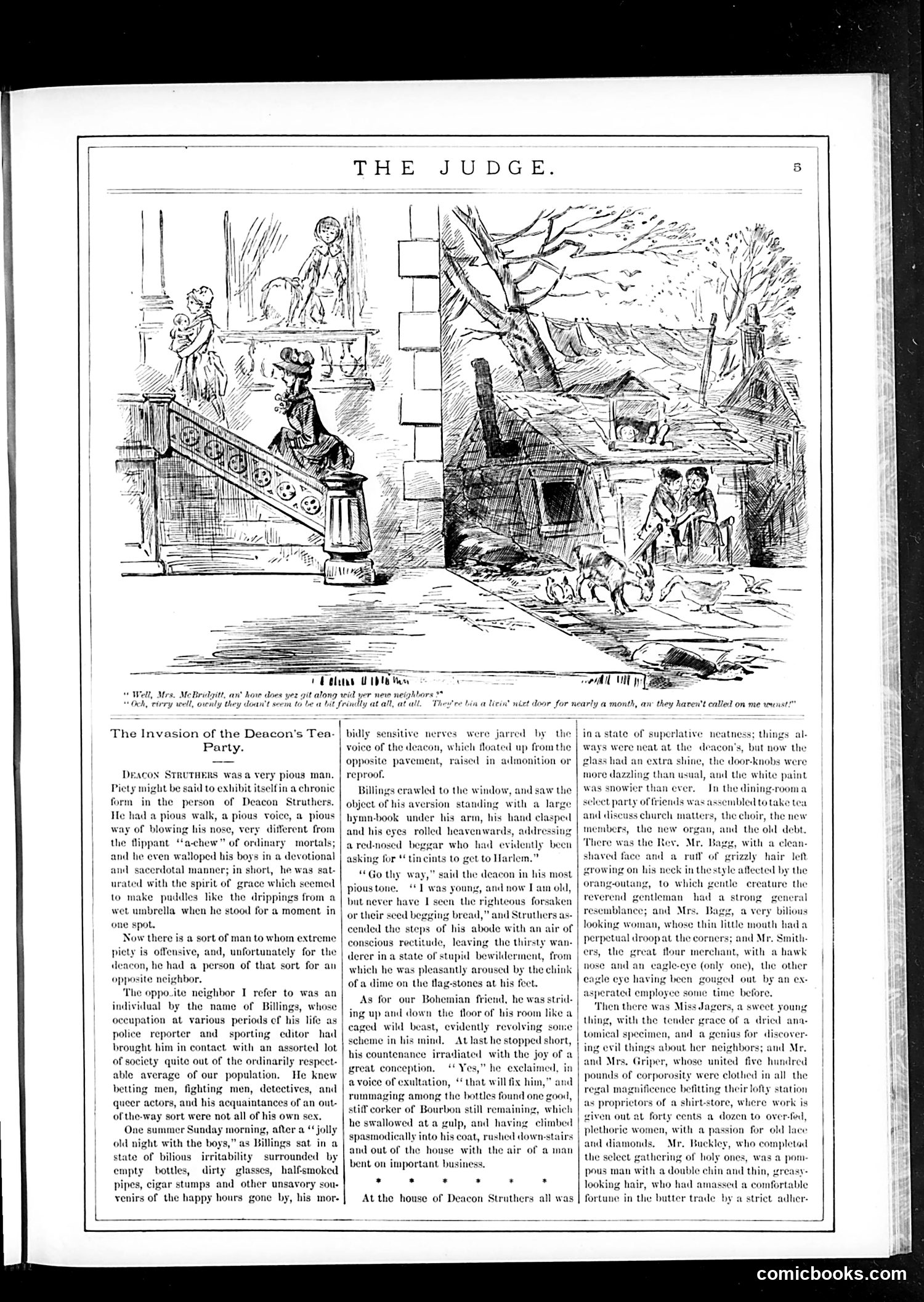
This satirical story mocks the hypocrisy of ostentatious piety. **Deacon Struthers** is portrayed as an exaggeratedly devout man whose chronic religiosity—his "pious walk," pious voice, and sanctimonious manner—makes him insufferable to his irreverent neighbor, **Billings**, a former police reporter and sporting editor who frequents disreputable company. The joke centers on class and moral pretension: the pious deacon represents respectable Victorian society, while Billings embodies bohemian excess. When the hungover Billings is irritated by the deacon's sanctimony, he apparently devises a scheme (the text is cut off) to disrupt the deacon's carefully orchestrated tea party—a genteel social gathering designed to showcase the household's moral and material refinement. The satire targets both characters: Struthers's self-righteous pomposity and Billings's crude rebellion against it. The dialogue opener suggests tension between old-money propriety and working-class irreverence in Gilded Age America.
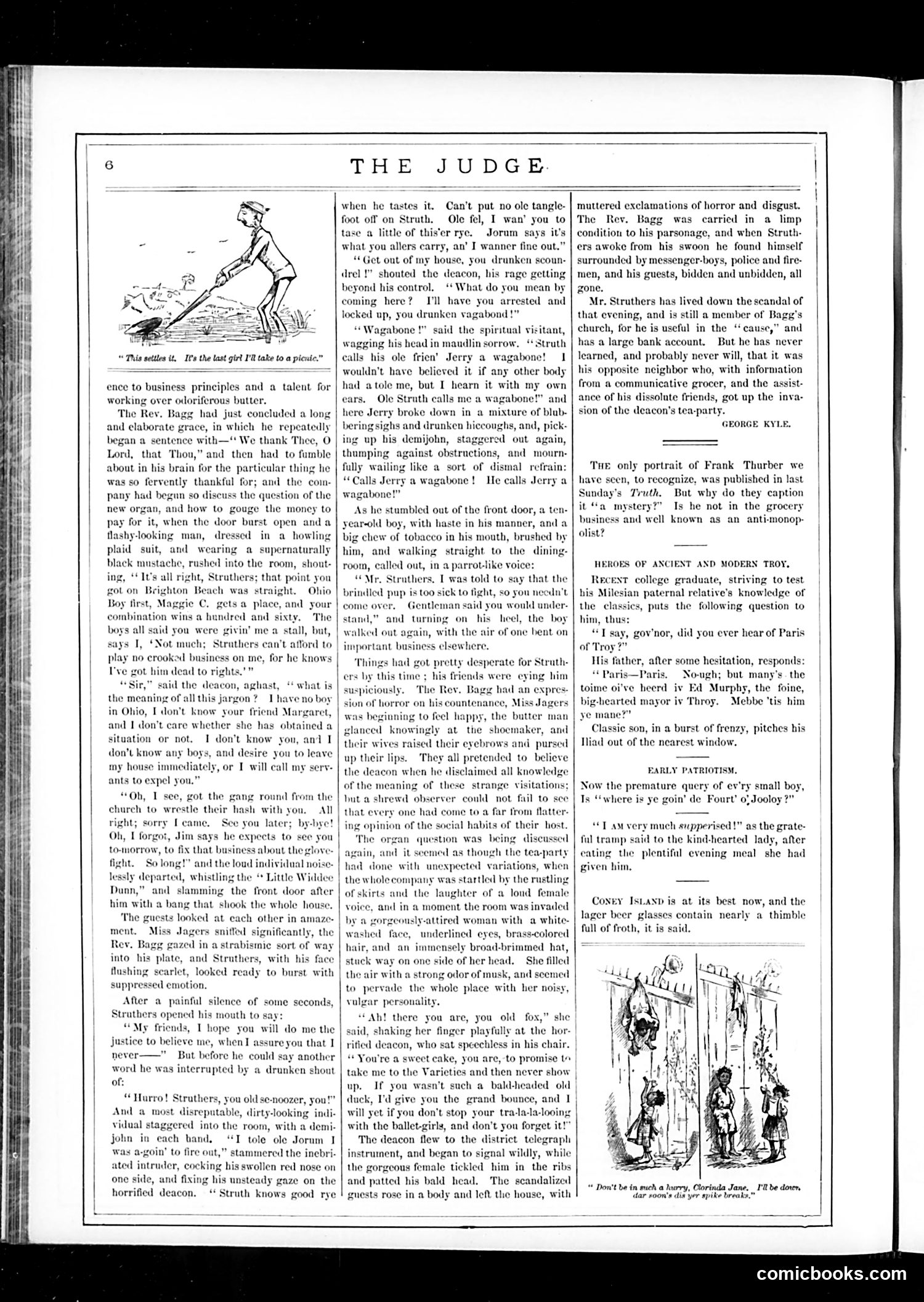
This page satirizes a respectable church deacon (Struthers) whose facade of propriety is demolished by unexpected visitors revealing his secret gambling and drinking connections. The setup: Struthers hosts a church dinner where the reverend discusses fundraising for a new organ—respectable, religious activity. Two successive interruptions shatter this image: first, a flashy tout arriving to discuss illegal horse racing and betting ("Brighton Beach," "Maggie C.," "hundred and sixty"), then a drunken gambler named Jerry demanding whiskey and calling Struthers by a familiar nickname. **The satire targets hypocrisy**: the ostensibly pious deacon is exposed as involved in gambling and consorting with disreputable characters. The humor comes from the contrast between Struthers' respectable church position and his actual associations with the criminal underworld of fixed horse races and illegal drinking. The cartoon ridicules the gap between public morality and private behavior among the seemingly "respectable" classes—a common Judge magazine theme.
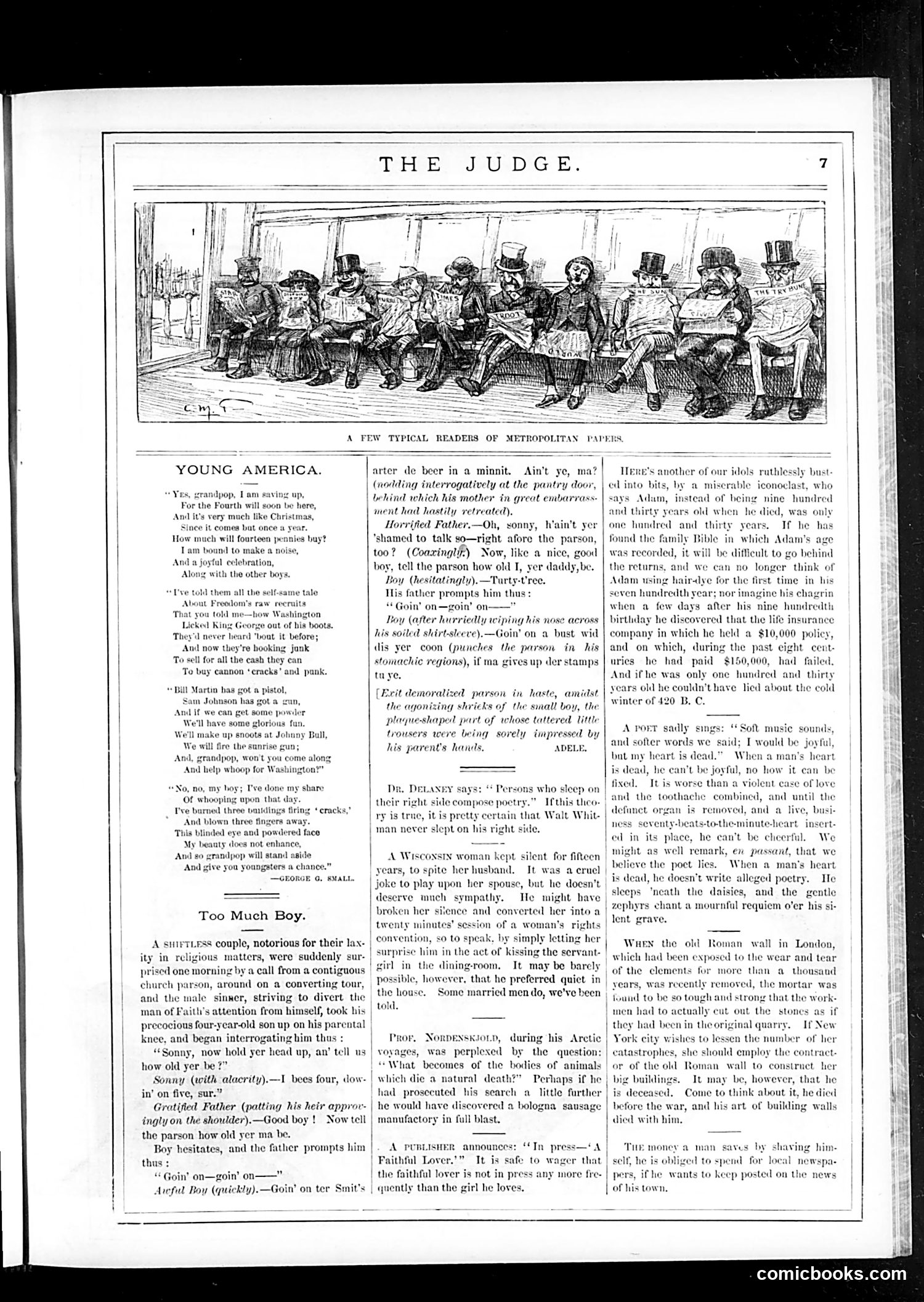
This *Judge* magazine page contains three satirical pieces typical of late 19th-century American humor: **"Young America"** (top): A poem mocking children's obsession with Independence Day celebrations—fireworks, noise-making, and destruction. The accompanying illustration shows rowdy urban children. The satire targets parental indulgence and children's recklessness (the speaker boasts of burning buildings and losing fingers). **"Too Much Boy"** (main story): A pastor visits a shiftless family to convert them. Their precocious four-year-old embarrasses everyone by bluntly revealing the family's poverty and the mother's drinking ("goin' on ter Smit's arter de beer"). The joke satirizes working-class dysfunction and how children innocently expose adult hypocrisy. **Shorter pieces** include commentary on Walt Whitman's poetry, a silent wife, Arctic explorer Nordenskiöld, and insurance companies—typical brief satirical jabs at contemporary figures and institutions. The overall tone reflects *Judge*'s target audience: educated, middle-class readers amused by mockery of both the poor and intellectual pretension.
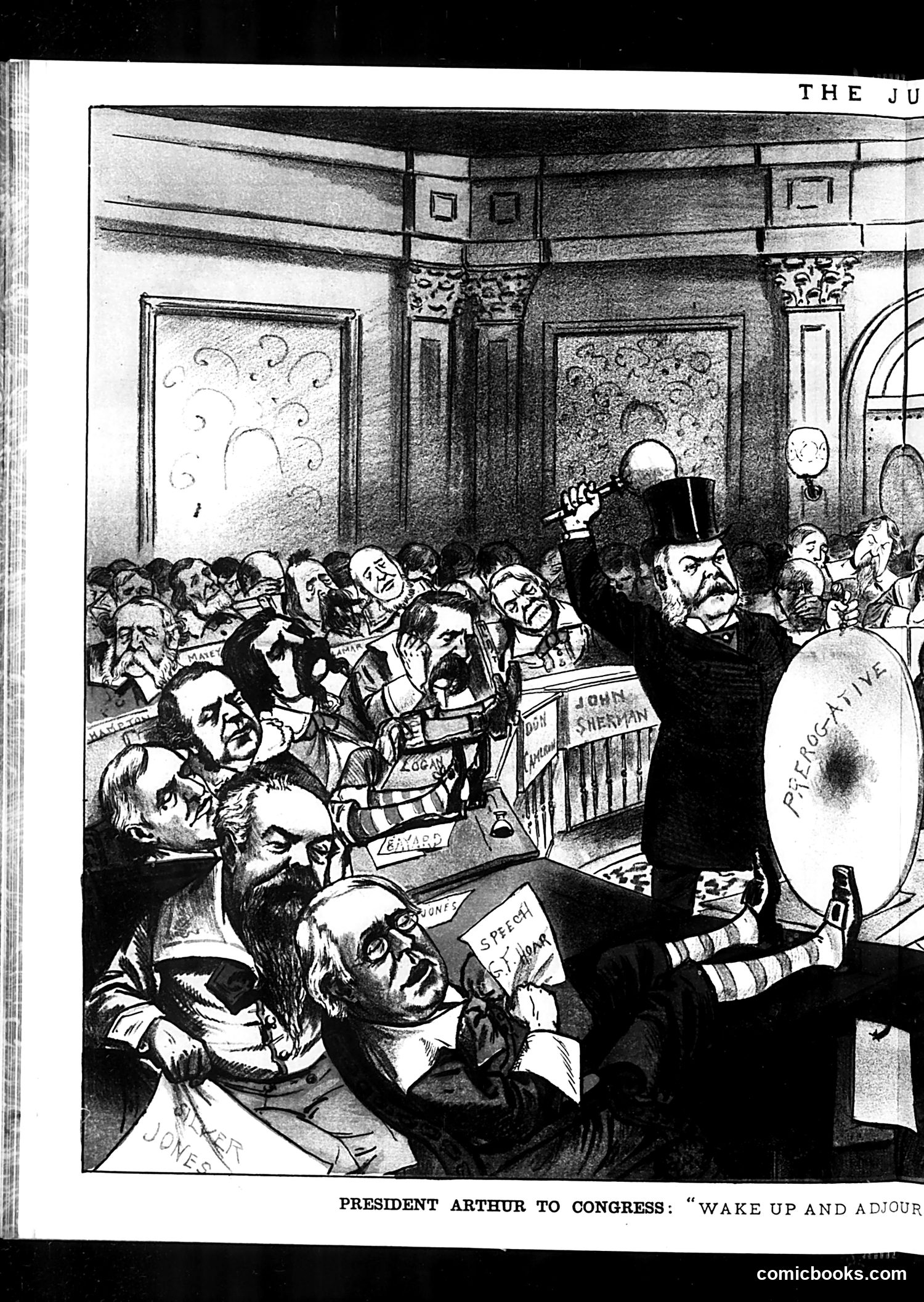
This Judge magazine cartoon depicts President **Chester Arthur** addressing Congress with the caption "Wake Up and Adjourn." The image shows Arthur as a conductor or showman, using a baton to direct a chaotic crowd of congressmen who appear drowsy, inattentive, or sleeping—their faces exaggerated in caricature style. The satire criticizes Congress for being ineffectual and lethargic, suggesting the body needed dramatic prodding to function. The "adjourn" reference likely mocks congressional inefficiency or the desire to end sessions without substantive work. Arthur, depicted as an energetic figure trying to impose order, represents the presidency attempting to manage an unruly, somnolent legislative body—a commentary on executive-legislative tensions during the Gilded Age.
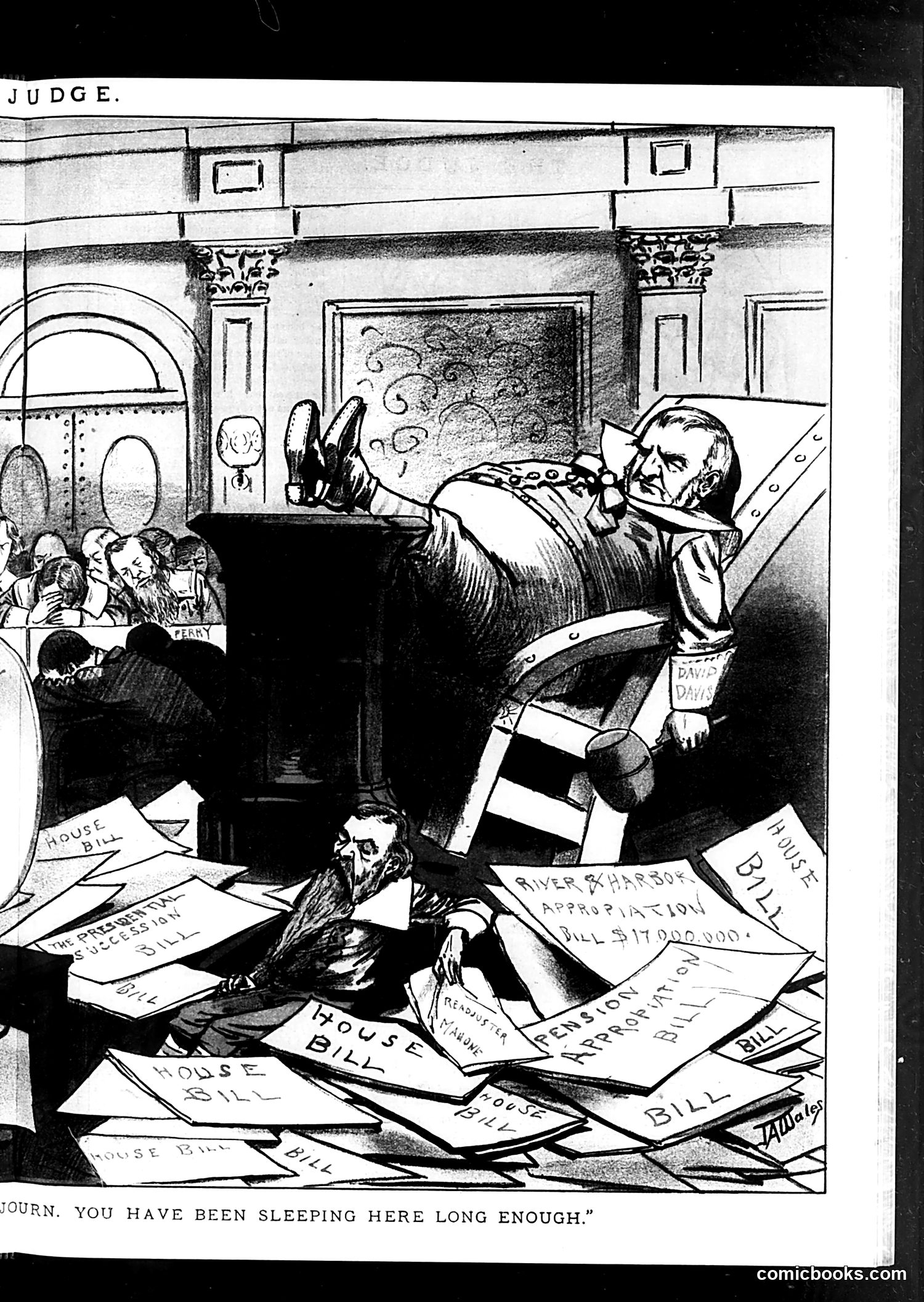
This political cartoon titled "Judge" satirizes legislative gridlock. A large, sleeping figure reclines in what appears to be a judge's chair or government seat, while papers labeled "HOUSE BILL," "RIVER & HARBOR APPROPRIATION," and other legislation litter the floor around him. The caption—"JOURN. YOU HAVE BEEN SLEEPING HERE LONG ENOUGH"—suggests the judicial or legislative branch has been inactive or negligent in processing pending bills. The accumulated paperwork emphasizes bureaucratic backlog and inaction. In the background, what appears to be a gallery of observers watches the scene, possibly representing the public or Congress. The cartoon criticizes governmental lethargy and the failure to address pressing legislative matters, likely from the late 19th or early 20th century based on Judge magazine's era and artistic style.
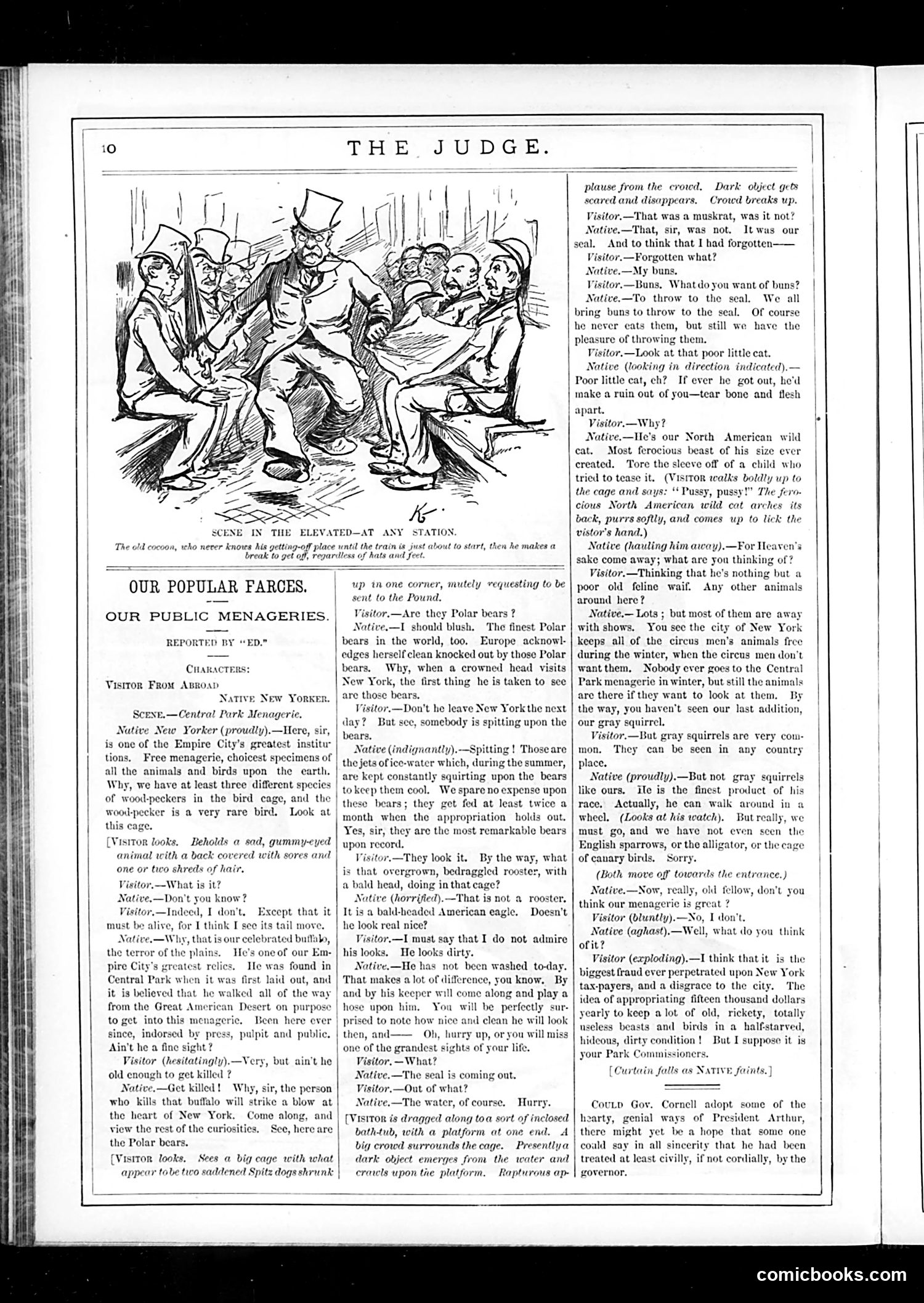
This satirical dialogue mocks New York City's Central Park menagerie and its incompetent management. A condescending Native New Yorker guides a naive Visitor through supposedly world-class exhibits that are actually pathetic: mangy, rare animals presented as magnificent attractions, deliberately misidentified or neglected. The satire targets civic pride and deception. The "celebrated buffalo" is ancient, the "polar bears" are sickly dogs, the "bald-headed American eagle" is a bedraggled rooster, and the "seal" emerging from water is revealed as a muskrat. Each exhibit showcases brazen fraud—the keeper squirts water to temporarily improve the animals' appearance before inspection. The joke undercuts both institutions claiming superiority (parks as cultural achievements) and the gullible tourists who accept obvious lies. The menagerie becomes a metaphor for municipal mismanagement and New York's false pretensions to cosmopolitan greatness.
This page satirizes exaggerated advertising claims by merchants of the 1870s-80s. The cartoon illustrates a merchant making implausible sales pitches—claiming to sell thousands of items at massive losses while somehow staying in business. The satire targets the absurdity of "loss-leader" advertising language: stores claiming goods cost them far more than selling price, that they're losing money daily, or that items are so scarce yet somehow available in huge quantities. The text parodies this by claiming $900,000 in silk inventory sold at 75% discount, parasols purchased for dollars sold for $2.50, and goods manufactured in 1872 suddenly being "latest style." The joke is that such obviously false claims ("We don't make money. We are losing thousands of dollars every day") were actually common in period advertisements. Judge mocks both the merchants' transparent dishonesty and readers' willingness to believe such nonsense. The illustration of the scheming merchant reinforces the message: caveat emptor (buyer beware).
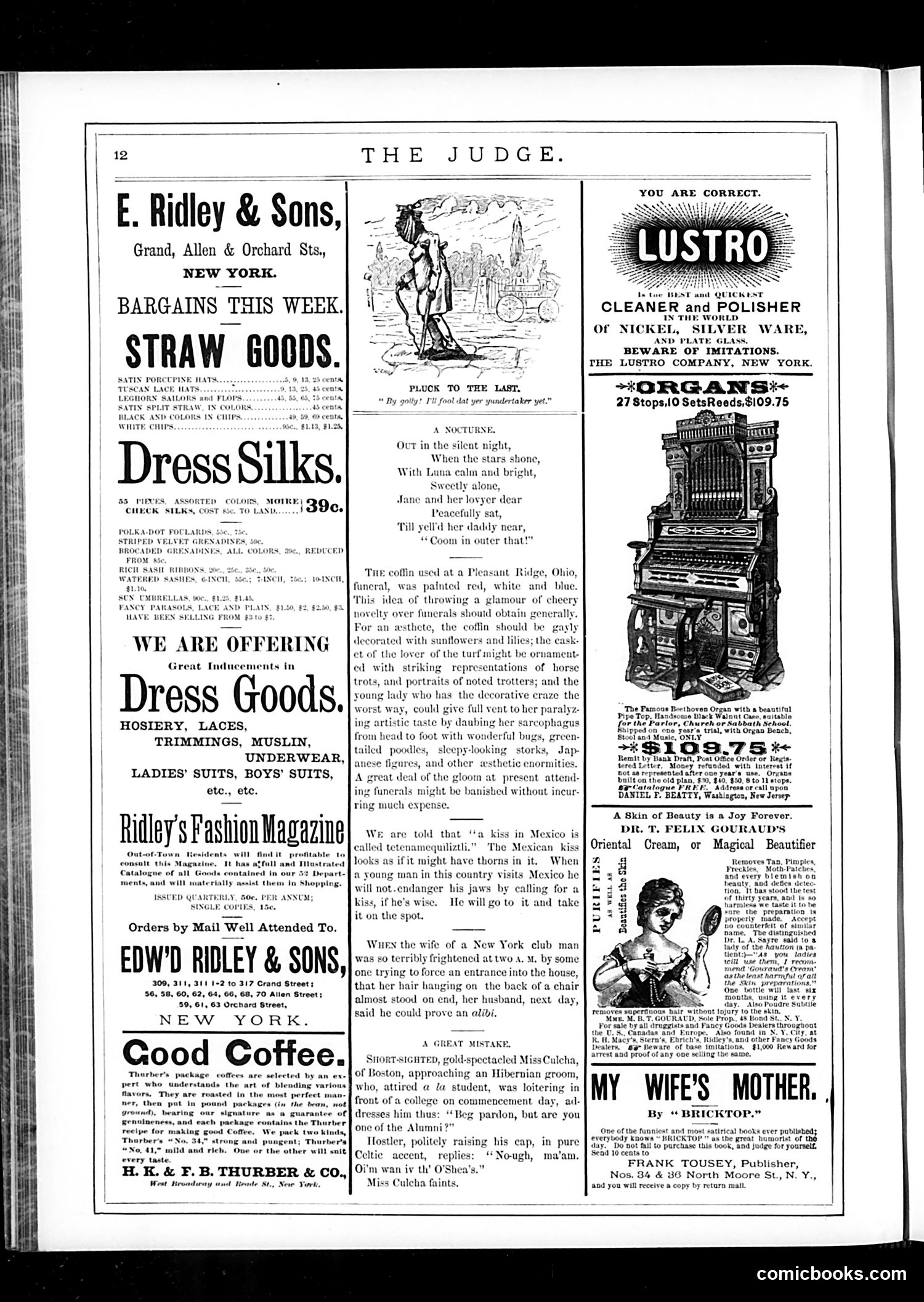
This page is primarily **advertisements** for New York retailers (E. Ridley & Sons dress goods, Thurber's coffee, organs, beauty products), with several brief **humorous anecdotes** scattered between ads. The main satirical content includes: **"Pluck to the Last"**: A joke about a dying man's final concern—ensuring his undertaker gets paid. **"A Nocturne"**: Mocking romantic poetry's melodrama, with lovers in "outer that" (unclear phrasing, possibly satirizing flowery verse). **"A Great Mistake"**: The page's sharpest satire. A Boston woman ("short-sighted, gold-spectacled Miss Culcha") asks an Irish stable worker if he's an "Alumni," apparently confusing "alumnus" with something else. His reply—"No-ugh, ma'am. Oi'm wan iv th' O'She's"—suggests she's mistaken his Irish ethnicity/working-class status for college affiliation. Her fainting mocks both her snobbery and obtuseness. These brief jokes target **class pretension** and **ethnic stereotyping** common to late-19th-century American humor. The page demonstrates Judge's mix of consumer advertising with genteel satirical content.
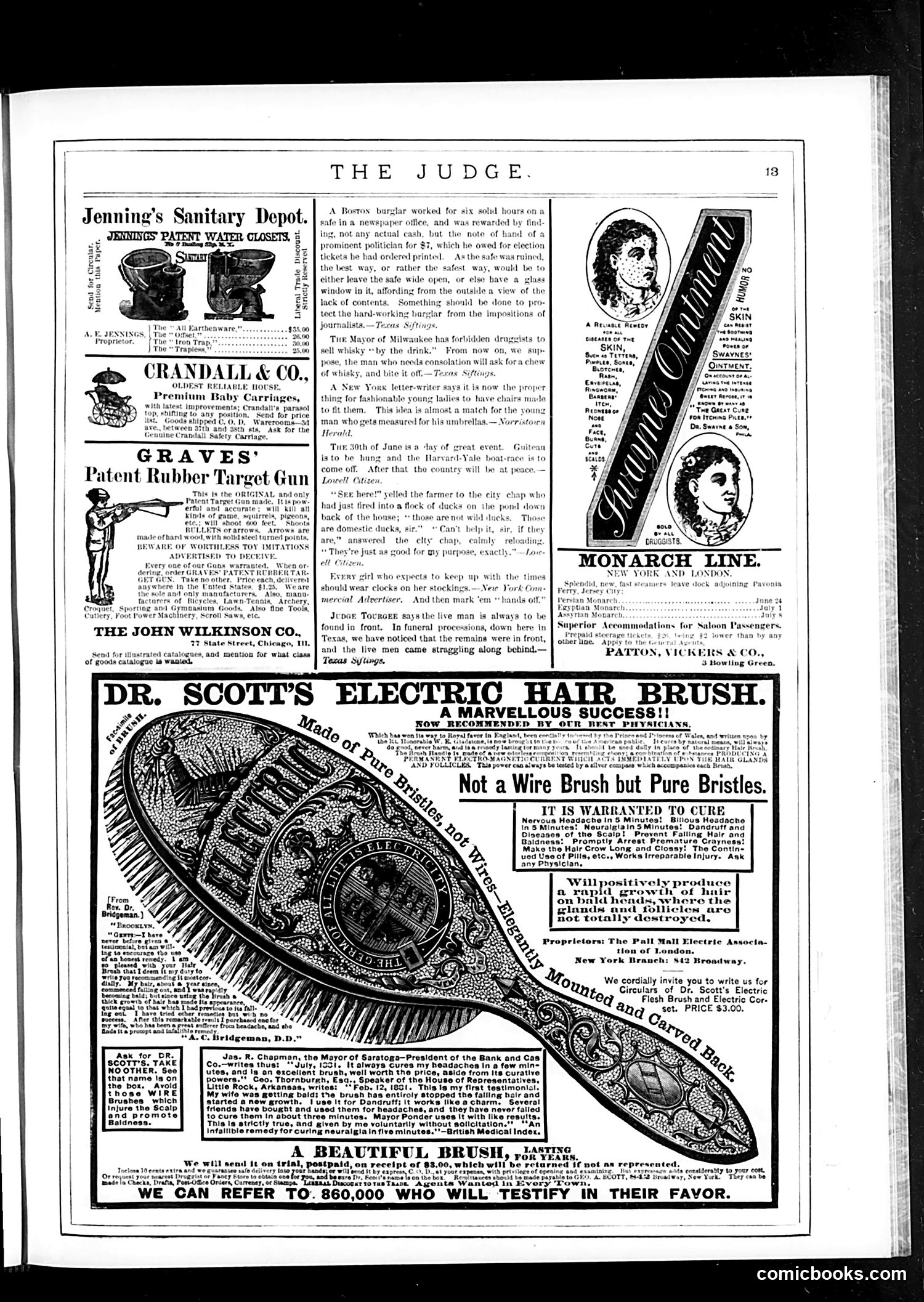
This page is primarily **advertisements** rather than political satire, though it includes several humorous editorial snippets. The brief jokes scattered among ads mock contemporary figures and situations: - A **politician's financial dishonesty** is referenced—someone who worked in a newspaper office and owes money ("the note of hand of a prominent politician") rather than actual cash. - The **Mayor of Milwaukee** is mentioned regarding whisky sales regulations. - A joke about **Guiteau** (likely Charles J. Guiteau, President Garfield's assassin, executed 1882) references the upcoming June 30th execution. - **Social commentary** on fashion, etiquette, and gender appears in brief quips about women wearing clocks on stockings and proper funeral procession order. The dominant content is **patent medicine and product advertising**—Jennings' Sanitary Depot, Graves' Target Gun, and most prominently, Dr. Scott's Electric Hair Brush, which claims miraculous cures for headaches, neuralgia, baldness, and hair loss. These ads were typical of Judge's era and reveal period attitudes toward medical remedies and marketing.
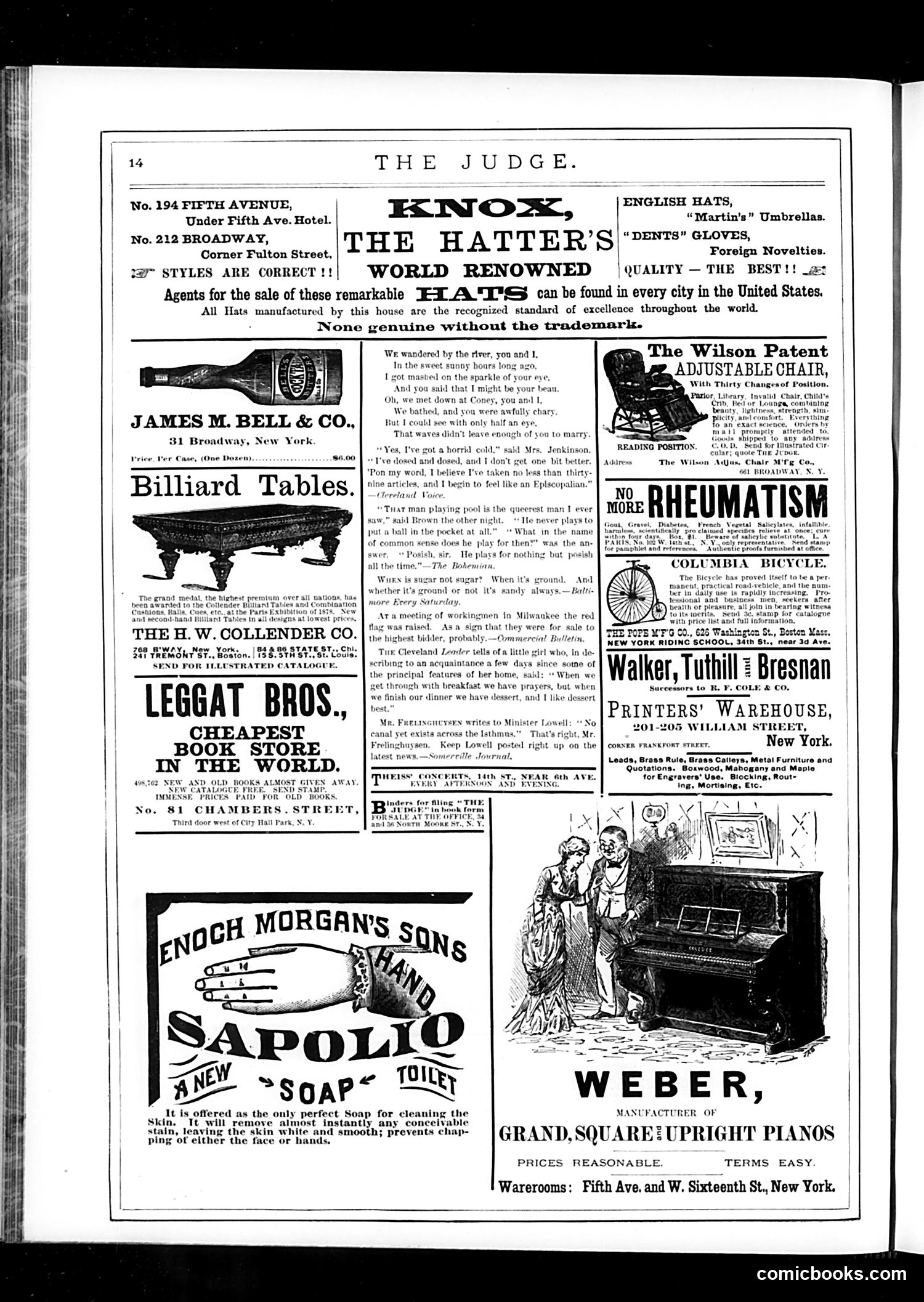
This page is **primarily advertising** with minimal editorial cartoon content. The visible satirical material consists of brief prose humor pieces rather than illustrated political cartoons. The text snippets show conversational jokes typical of 1880s-90s humor magazines: - One piece mocks hypochondriac Mrs. Jenkinson, who obsessively medicates herself and fears becoming "Episcopal" (unclear reference, possibly religious or medical) - Another references a river romance and failed courtship - A third quotes a correspondent writing to "Minister Lowell" about the Isthmus—likely referring to diplomatic correspondence about the proposed canal, treated as fodder for casual gossip The bulk of the page showcases **late 19th-century advertisements**: Knox hats, billiard tables, Sapolio soap (with a period illustration of a hand), pianos, bicycles, and books. These ads reveal contemporary consumer culture and manufacturing concerns. No clearly identifiable political figures appear. The satire is gentle, social rather than political—typical of Judge's lighter content balancing with harder editorial commentary elsewhere.
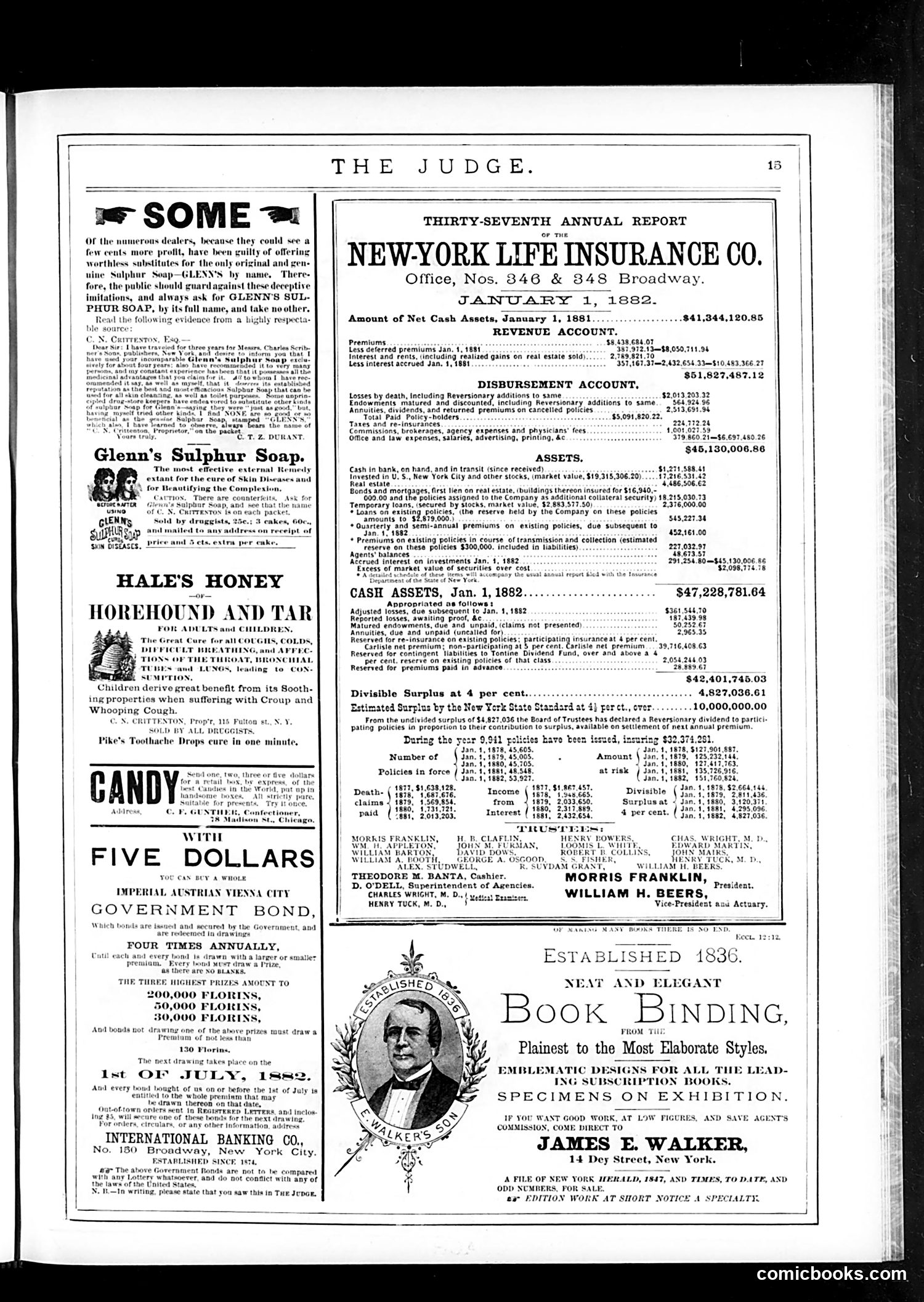
This page is **primarily advertising and financial reporting**, not satire or political commentary. The main content is the **37th Annual Report of the New York Life Insurance Company**, presenting detailed financial statements—assets, revenue, disbursements, and cash reserves as of January 1, 1882. The surrounding advertisements are typical period promotions: Glenn's Sulphur Soap (with endorsements), Hale's Honey and Horehound Tar cough remedy, Pike's toothbrushes, candy, and government bonds. There's also an advertisement for James Walker's bookbinding services (established 1836). **No recognizable political cartoon or satirical content is visible** on this page. The "Judge" masthead indicates this is from the satirical magazine, but this particular page appears to be filler or sponsored content—common in 19th-century publications where advertising subsidized editorial costs. The financial tables and product advertisements would have been of practical interest to Judge's middle-class readership.
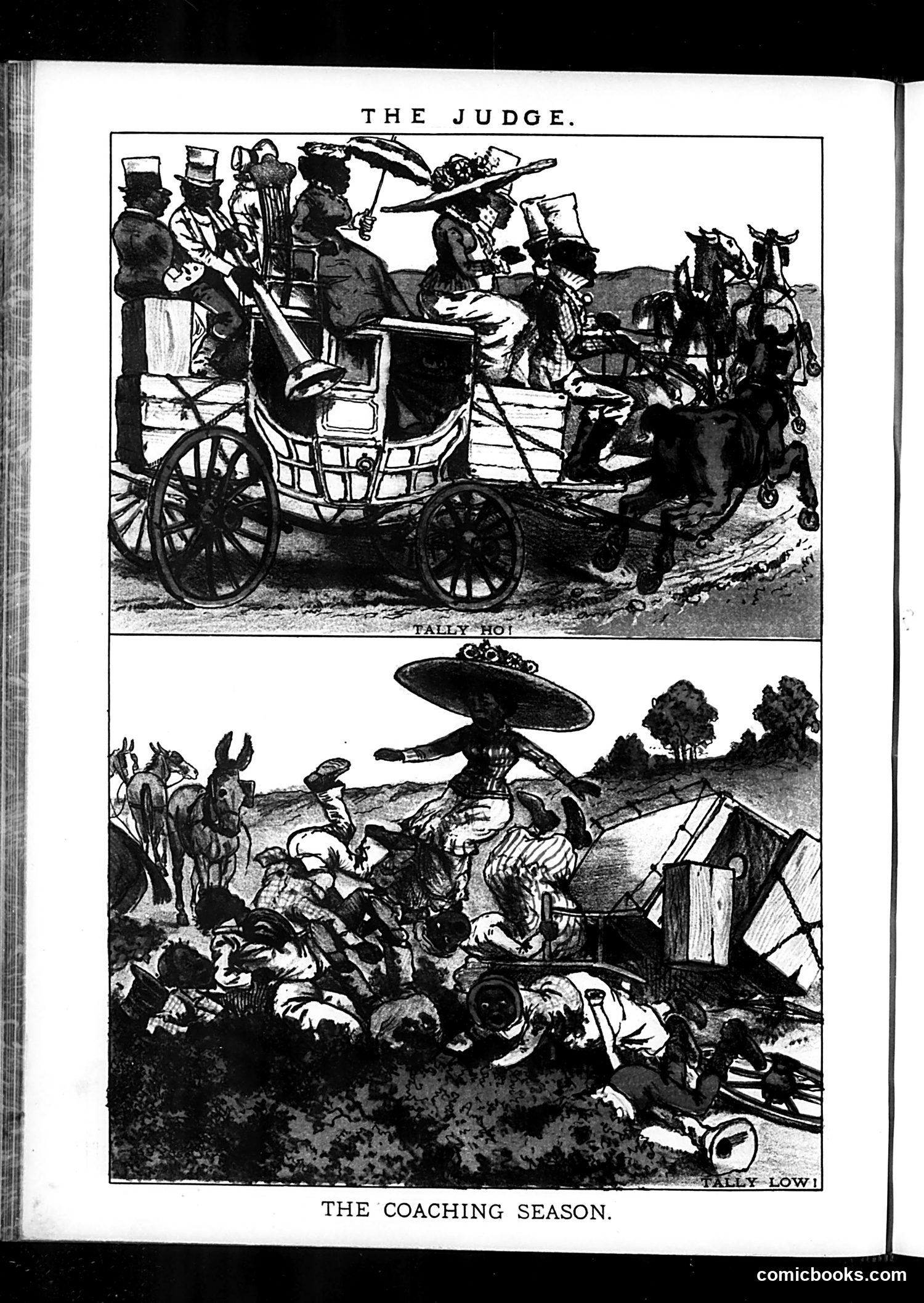
This two-panel satirical cartoon from *Judge* uses the "coaching season" (the summer social period of wealthy Americans traveling in coaches/carriages) as its subject. **Top panel ("Tally-Ho"):** Shows an elegant, orderly coaching party—the ideal version of upper-class leisure travel, with well-dressed passengers in a proper carriage. **Bottom panel ("Tally-Low"):** Depicts the chaotic reality: the same scene has devolved into disaster. The carriage is overturned, passengers are scattered and disheveled, and the whole enterprise is in shambles. The satire mocks the gap between how wealthy Americans imagine their genteel pastimes and the actual disastrous outcomes—likely commenting on incompetence, recklessness, or the inherent absurdity of such pretentious activities. The contrast between "Tally-Ho" (fox-hunting cry) and "Tally-Low" reinforces the fall from aspiration to failure.