
Judge, 1882-07-01 · page 3 of 16
Judge — July 1, 1882 — page 3: what you’re looking at
What you’re looking at
This story-cartoon mocks credulous listeners and tall tales. A bombastic red-faced man on a Brooklyn streetcar regales a skeptical small gentleman with an absurd fabrication: his father witnessed European factories in Africa processing thousands of dead elephants into profitable goods—grinding bones into powder, tanning hides for shoes, converting ears into doormats and hair-brushes, shipping 500 tons daily at $200/ton. The humor lies in the teller's evasive responses ("I didn't see it; *my father* saw it") when questioned, and the obviously fictional economics. The small man's repeated gentle skepticism ("Well, what of it?") underscores the yarn-spinner's obliviousness to his own absurdity. The satire targets turn-of-century American boastfulness and gullibility—men who believe or spread outlandish "business opportunity" stories, particularly regarding colonial Africa exploitation.
📄 Transcribed text from this page (OCR, searchable)
Machine-transcribed from the original scan — historical spelling and the odd misread are preserved.
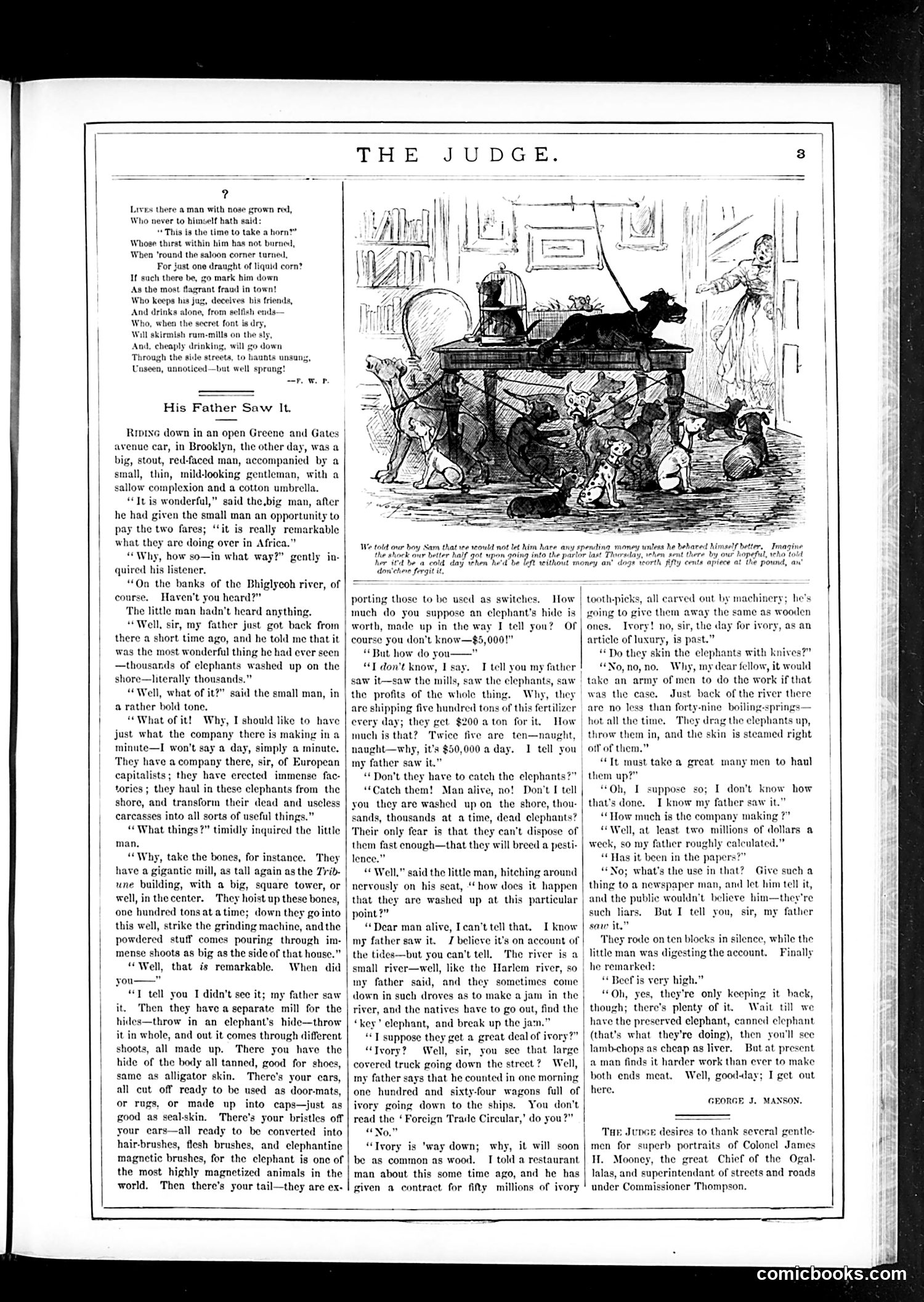
Lives there a man with nose grown red, Who never to himself hath said: This is the time to take a horn? Whose thirst within him has not burned, When ‘round the saloon corner turned, For just one draught of liquid corn? If such there be, go mark him down As the most flagrant fraud in town! Who keeps his jag, deceives bis friends, And drink: one, from selfish ends— Who, when ecret font is dry Will skirmish rum-mills on the sly And, cheaply drinking, Through the side str Unseen, unnoticed—but we an, sprang! Powe His Father Saw It. Rrptye down in an open Greene and Gat avenue car, in Brooklyn, the other day, was a big, stout, red-faced man, accompanied by a small, thin, mild-looking gentleman, with a sallow complexion and a cotton umbrella. “Iv is wonderful,” said the,big man, afer he had given the small man an opportunity to pay the two fares; “it is really remarkable | what they are doing over in Africa.” “Why, how so—in what way?” gently in- quired his listener. “On the banks of the Bhiglycoh river, of course, Haven't you heard?” ‘The little man hadn't heard anything. | “Well, sir, my father just got back from | there a short time ago, and he told me that it | was the most wonderful thing he had ever seen —thousands of elephants washed up on the shore—literally thousands.” “Well, what of it?” said the small man, in a rather bold tone. “What of it! Why, I should like to have just what the company there is making in a minute—I won't say a day, simply a minute, They have a company there, sir, of European capitalists; they have erected immense fac- tories ; they haul in these clephants from the shore, and transform their dead and uscless carcasses into all sorts of useful things.” “What things?” timidly inquired the little man. ow take the bones, for instance. They have a gigantic mill, as tall again as the Zvib- une building, with a big, square tower, or well, in thecenter. They hoist up these bones, ove hundred tons at atime; down they go into this well, strike the grinding machine, andthe powdered stuff comes pouring through im- mense shoots as big as the side of that house.” “Well, that is remarkable. When did you——" “T tell you I didn't see it; my father saw it. Then they have a separate mill for the hides—throw in an elephant’s hide—throw it in whole, and out it comes through different shoots, all made up. There you have the hide of the body all tanned, good for shoes, same as alligator skin. There's your cars, all cut off ready to be used as door-mats, or rugs, or made up into caps—just as good as seal-skin. There's your bristles off your ears—all ready to be converted into hair-brushes, flesh brushes, and clephantine magnetic brushes, for the elephant is one of the most highly magnetized animals in the world, Then there’s your tail—they are ex- We told our hoy Sam that ree could not let him hare any sp. the shock our better half got upon going into the pa her itd bea cold day then he'd be Left reithout money ¢ don'chore fergit it, porting those to be used as switches. How | much do you suppose an elephant’s hide worth, made up in the I tell you? course you don’t know—$5,000!" “But how do you——" “J don't know, 1 T tell you my fathe saw it—saw the mills, saw the elephants, saw the profits of the whole thing. Why, the! are shipping five hundred tons of this fert every day; they get $200 a ton for it. How much is that? Twice five are ten—naught, naught—why, it’s $50,000 a day. 1 tell you my father saw it.” ‘Don't they have to catch the elephants?” “Catch them! Man alive, no! Don't I tell you they are washed up on the shore, thou- sands, thousands at a time, dead clephants? Their only fear is that they can’t dispose of | them fast cnough—that they will breed a pesti- lence.” “ Well,” said the little man, hitching around nervously on his seat, “how does it happen | that they are washed up at this particular point?” | “Dear man alive, Tcan’t tell that. I know | my father saw it. J believe it’s on account of the tides—but you can't tell. The river is small river—well, like the Harlem river, so my father said, and they sometimes come down in such droves as to make a jam in the | river, and the natives have to go out, find the ‘key’ elephant, and break up the j ““T suppose they get a great deal of ivory?” “Ivory? Well, sir, you see that larg covered truck going down the street? Well, my father says that he counted in one morning one hundred and ty-four wagons full of ivory going down to the ships. You don't read the ‘Forcign Trade Circular,’ do you?” “No.” “Ivory is ‘way down; why, it will soon be as common as wood. I told a restaurant man about this some time ago, and he has given a contract for fifty millions of ivory or jared himself f there by ow cents apiece at ng. money unless he Thversilayy, 10h dog seful, rho to oorth fi pound, an’ tooth-picks, all carved out by machinery; he’s s wooden ones. Ivory article of luxu “Do they sl “No, no, no. in the elephants with knives?” Why, my dear fellow, it would take an army of men to do the work if that was the case. Just back of the river there are no less than forty-nine boiling-springs hot all the time, They drag the elephants up, throw them in, and the skin is steamed right tT of them,” “It must take a great many men to haul them up?” “Oh, I suppose so; I don't know how that’s done. I know my father saw it.” “How mneh is the company making ?” “Well, at least two millions of d week, so my father roughly ated. “Has it been in the pape “No; what's the use in that? Give such a thing to a newspaper man, and let him tell it, and the public wouldn't believe him—they're such 1 But I tell you, sir, my father saw it They rode on ten blocks in silence, while the little man was digesting the account, Finally he remarked: “ Beef is very high.” “Oh, yes, they're only keeping it hack, though; there's plenty of it. Wait till have the preserved elephant, canned elephant (that’s what they’re doing), then you'll see lamb-chops as cheap as liver. But at present aman finds it harder work than ever to make both ends meat. Well, good-lay; I get out here. rs a we GEORGE J, MANSON. Tae Juve res to thank several gentle- men for superb portraits of Colonel James If. Mooney, the great Chief of the Ogal- lalas, and superintendant of streets and roads under Commissioner Thompson. comicbooks.com