
A complete issue · 16 pages · 1882
Judge — May 27, 1882
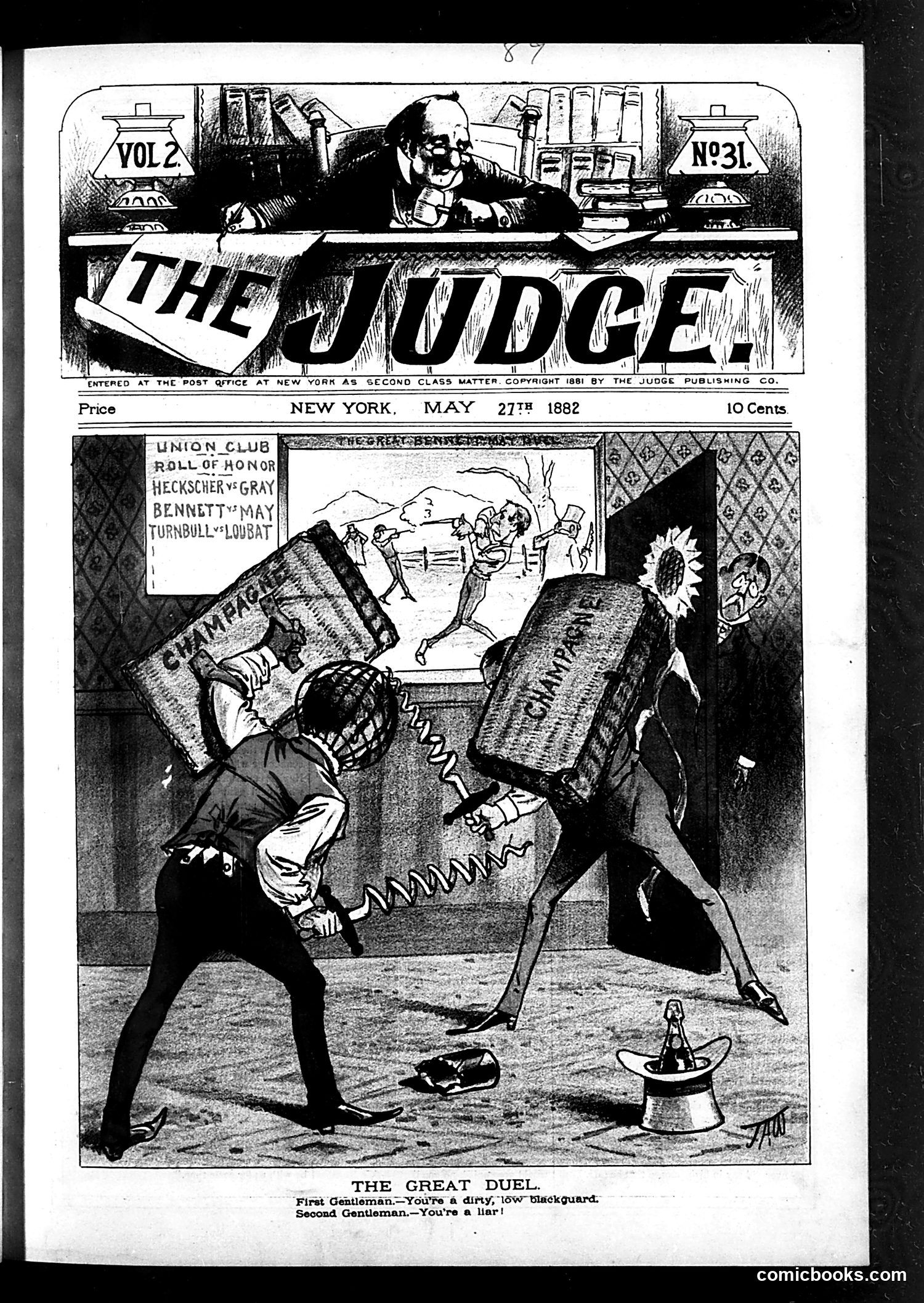
This cartoon satirizes a confrontation between two gentlemen, likely political or social figures of 1882, depicted as antagonists in a formal duel scenario. The figures wear "Champion" labeled containers as heads—a visual metaphor suggesting their arguments are hollow or trivial. The absurd weaponry and theatrical posing mock the ritualized nature of gentlemen's honor disputes of the era. The exchange—one calling the other a "dirty, low blackguard," the other responding "You're a liar!"—represents pointless name-calling rather than substantive debate. The inset showing a Union Club gathering suggests this may reference a specific social or political dispute within elite New York circles. The satire critiques both the participants' pettiness and the anachronistic tradition of dueling to defend honor, treating serious conflict as comedic theater.
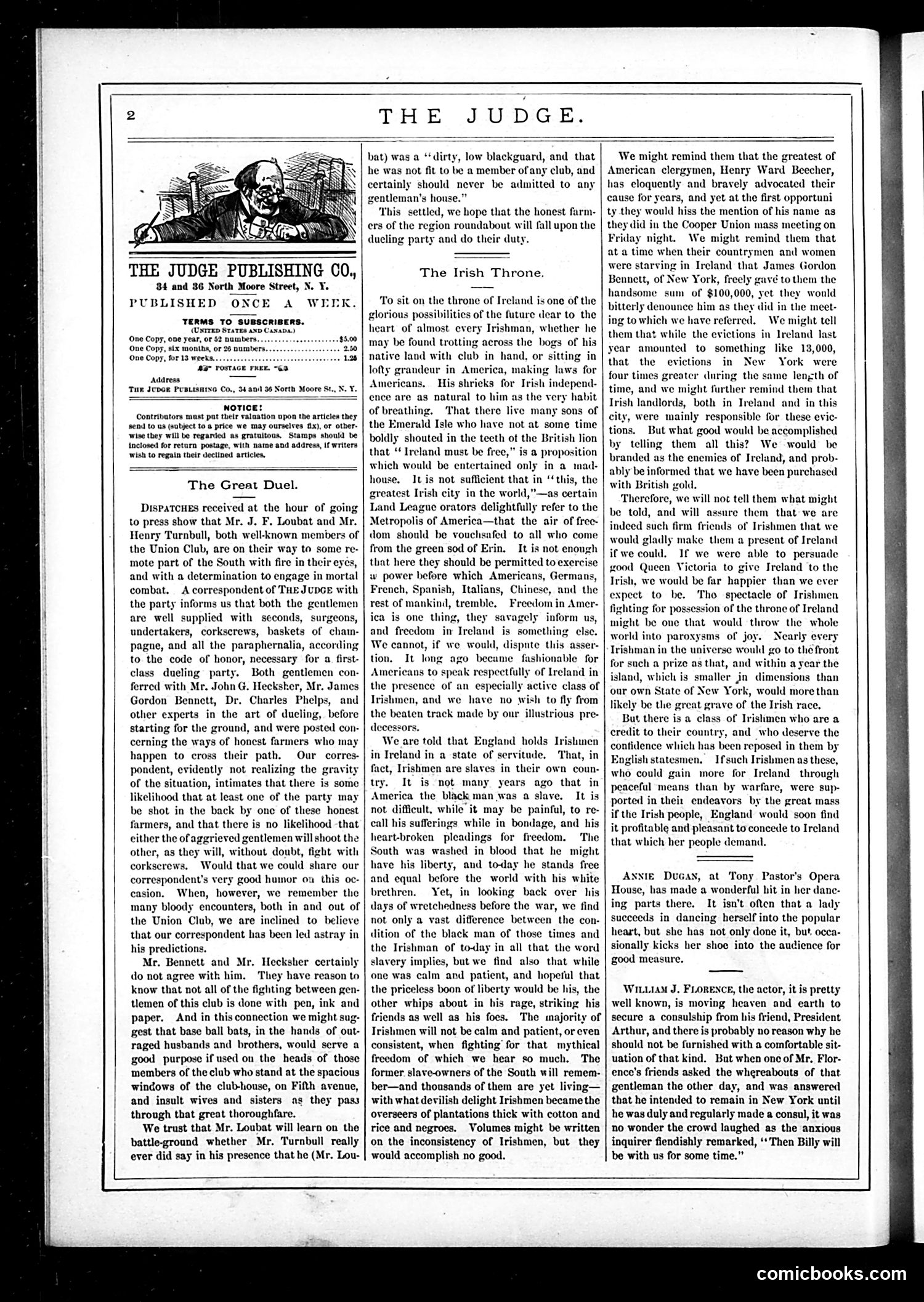
This page contains two distinct pieces of satire: **"The Great Duel"** mocks a literal duel between two Union Club members (Loubat and Turnbull) over an insult. Judge treats it with mock-serious tone, detailing their preparations with "seconds, surgeons, undertakers, corkscrews, baskets of champagne." The satire targets the absurdity of gentlemen adhering to outdated honor codes while also critiquing the Union Club itself—suggesting members sexually harass women from club windows, proposing baseball bats as appropriate retaliation. **"The Irish Throne"** addresses Irish-American political sentiment. It satirizes Irish immigrants' passionate rhetoric about Irish independence ("Ireland must be free!"), characterizing their demands as performative bombast whether spoken "across the bogs" or from America while "making laws for Americans." The piece implies hypocrisy in Irish-Americans' nationalist fervor while safely residing abroad. Both pieces exemplify *Judge's* style: mocking upper-class pretension, masculine violence, and immigrant political rhetoric through exaggeration and ironic understatement.
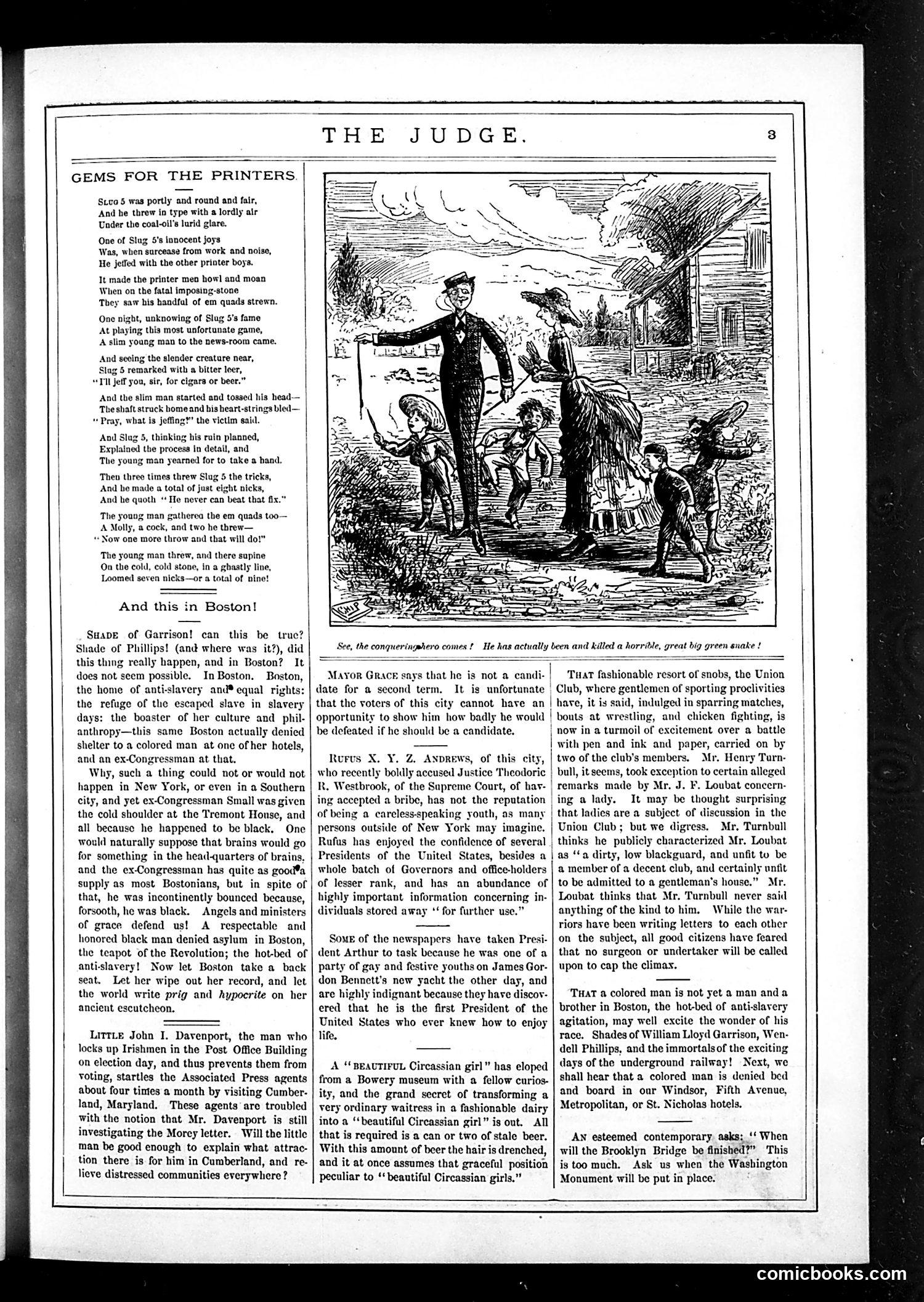
This page contains two main satirical pieces: **"Gems for the Printers"** (left): A humorous narrative poem about printer's pranks—specifically "jeffing" (throwing metal type quads on an imposing stone). The joke is a young man outperforms the experienced printers at this game, humbling the cocky "Slug 5." **Political Commentary (right)**: The main satire targets **Boston's hypocrisy**. An ex-Congressman (likely Samuel J. Small, who was Black) was denied shelter at the prestigious Tremont House hotel despite Boston's abolitionist reputation. The piece sarcastically mocks Boston's claim to moral superiority while it discriminates against a respected Black politician. The accompanying cartoon shows a man presenting a dead snake as a great conquest—likely mocking Mayor Grace or another politician's inflated self-importance. Additional items briefly lampoon **John I. Davenport** (election official accused of suppressing Irish-American voters) and **Rufus Andrews** (who publicly accused a Supreme Court justice of bribery). The overarching theme: exposing hypocrisy among Boston's and New York's political establishment.
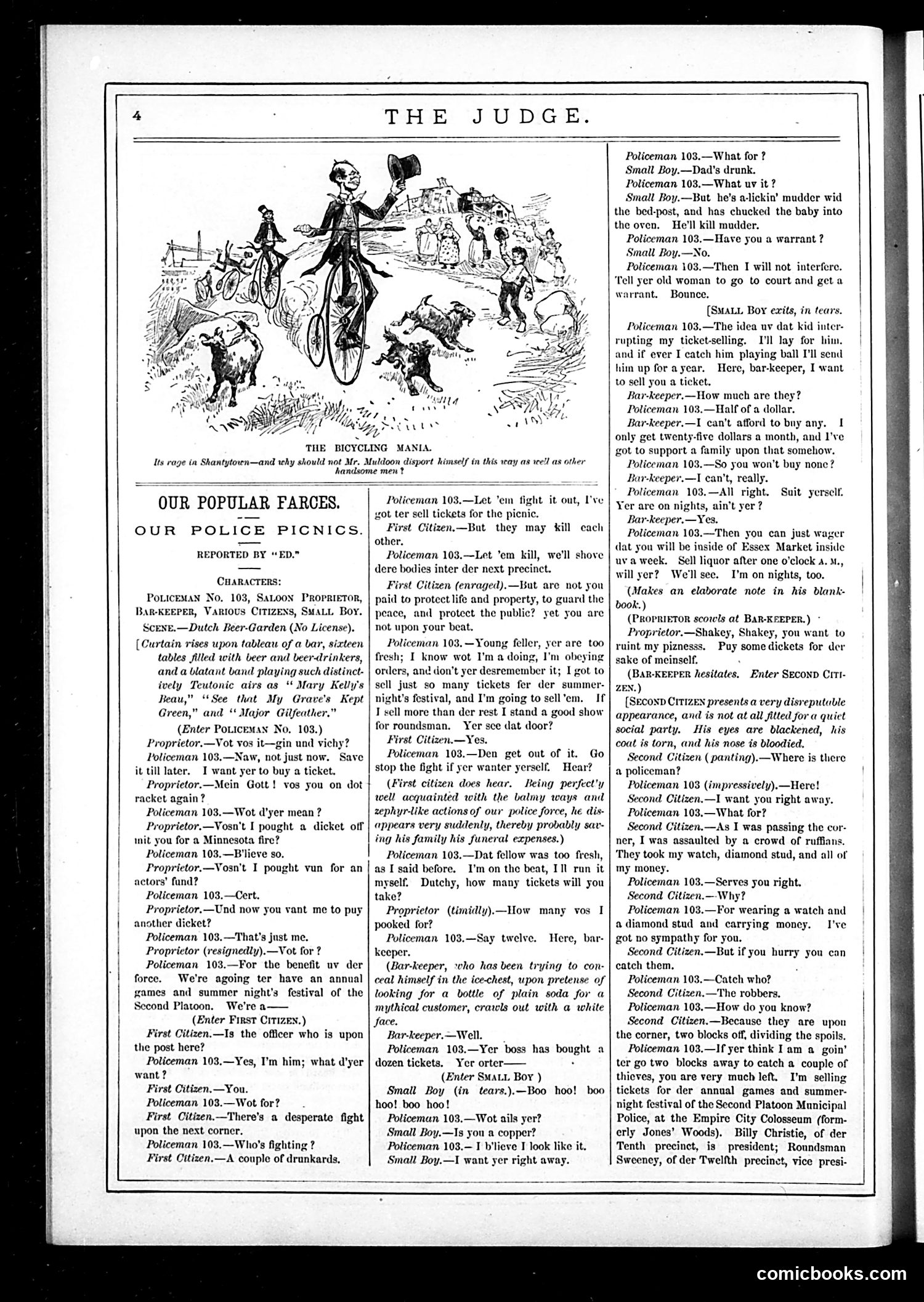
This sketch satirizes New York police corruption and neglect of duty in the late 19th century. Policeman No. 103 abandons his beat to sell tickets for the Police Department's summer festival picnic—a fundraising scheme ostensibly for the Second Platoon. The satire escalates through three interruptions: a saloon proprietor repeatedly coerced into buying tickets, a citizen reporting a violent fight on the corner (which the officer ignores), and finally a child seeking help because his father is beating his mother and endangering the baby. The officer refuses each request, prioritizing ticket sales over protecting life and property—his actual job. His callous dismissals ("Let 'em kill, we'll shove dere bodies inter der next precinct") expose how police fundraising schemes incentivized officers to neglect public safety duties. The joke's bitter point: corrupt police had perverted their protective role into personal profit-seeking, leaving citizens unprotected.
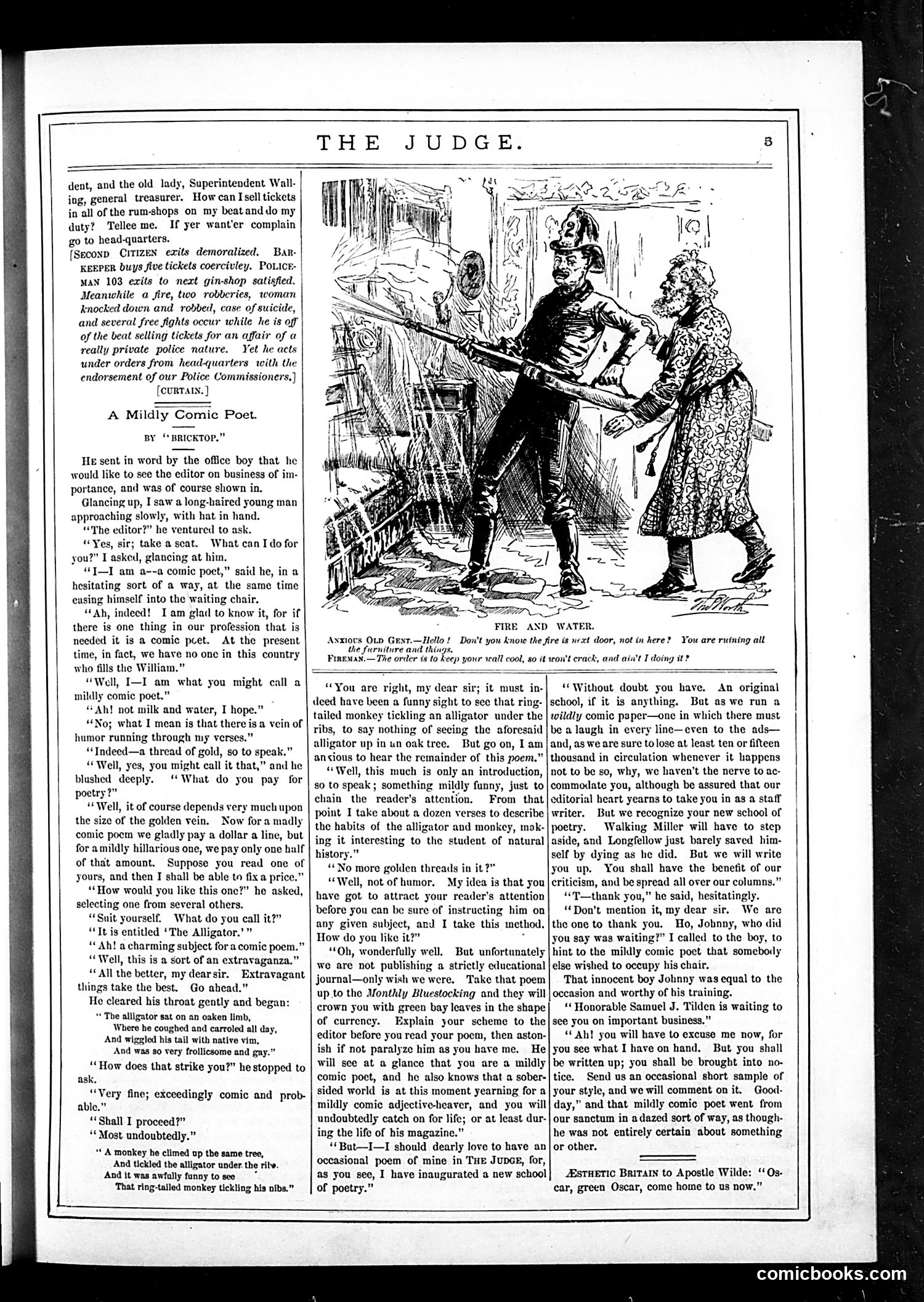
This page from *Judge* magazine contains two distinct pieces of satire: **"Fire and Water"** (the cartoon): A firefighter sprays water on the wrong building during a fire, destroying a neighbor's interior. The humor satirizes bureaucratic inefficiency and workers following orders literally without common sense—the firefighter insists he's doing his job correctly despite obvious absurdity. **"A Mildly Comic Poet"** (the story): An editor interviews an aspiring "comic poet" who recites terrible, forced verse about an alligator and monkey in a tree. The satire mocks pretentious bad poetry and self-deluded artists who believe their mediocre work is profound. The absurd subject matter and awkward phrasing ("ring-tailed monkey tickling his nibs") exemplify the low quality the poet presents with unearned confidence. Both pieces ridicule incompetence masked by earnestness—whether bureaucratic bumbling or artistic delusion.
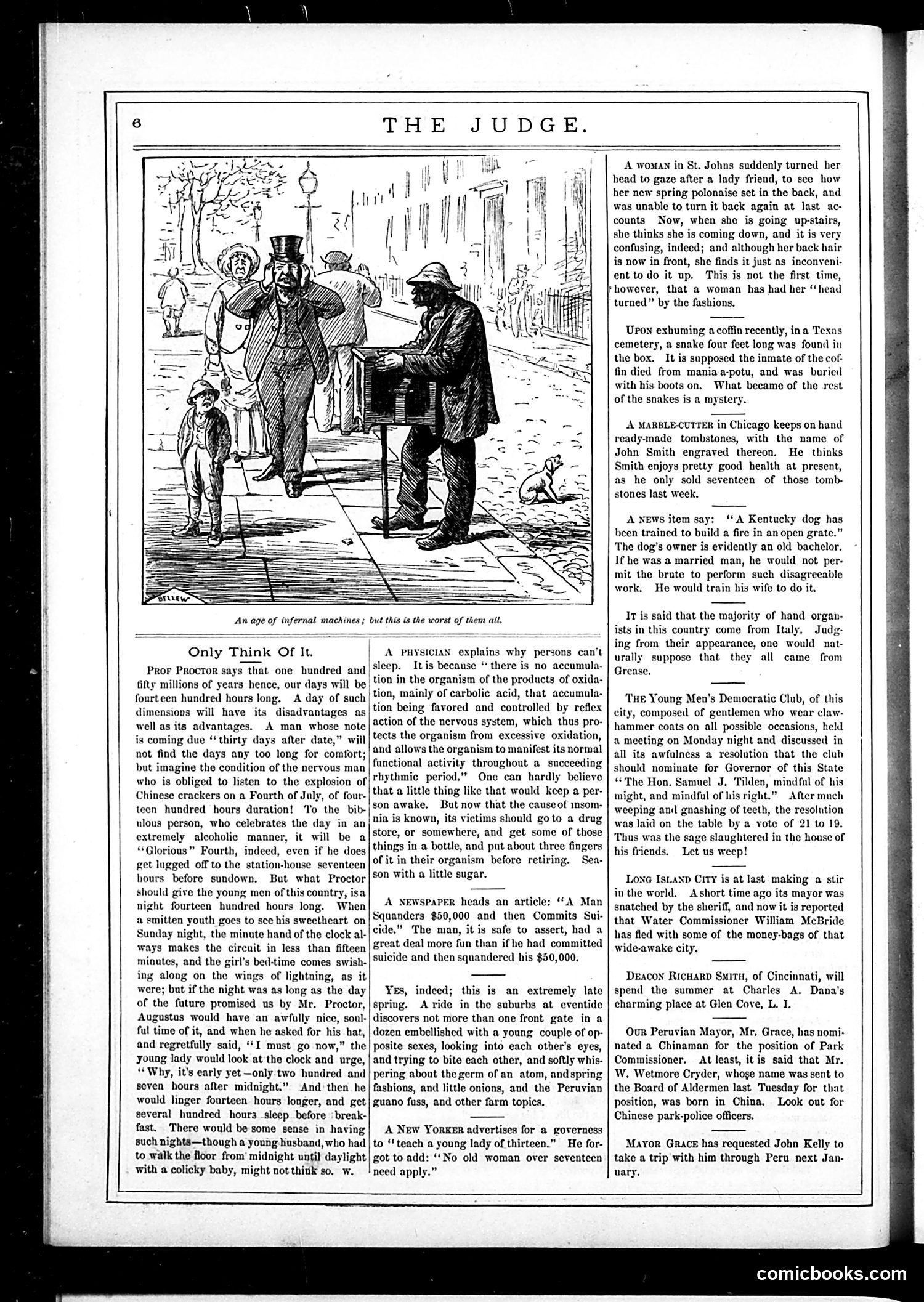
The main cartoon depicts a street scene with figures examining what appears to be a coffin or box, captioned "An age of infernal machines; but this is the scent of them all." The page is primarily **humorous commentary rather than political satire**. The "Only Think Of It" section mocks Professor Proctor's astronomical prediction that future days will be 1,400 hours long. The satire targets: 1. **Young courting couples** — if nights were proportionally longer, lovestruck men could extend their visits without wives complaining about the time 2. **Sleep deprivation pseudoscience** — a physician's absurdly complex explanation for insomnia (carbolic acid accumulation) 3. **Romantic clichés** — couples discussing atoms, fashion, and guano instead of anything substantial The scattered anecdotes mock Victorian social conventions: a woman unable to turn her head after admiring a dress, a New Yorker seeking a young governess while excluding "old women over seventeen." **The cartoon's meaning is unclear from the image alone** — it may reference contemporary concerns about mechanical devices or urban dangers, but lacks sufficient context for certain identification.
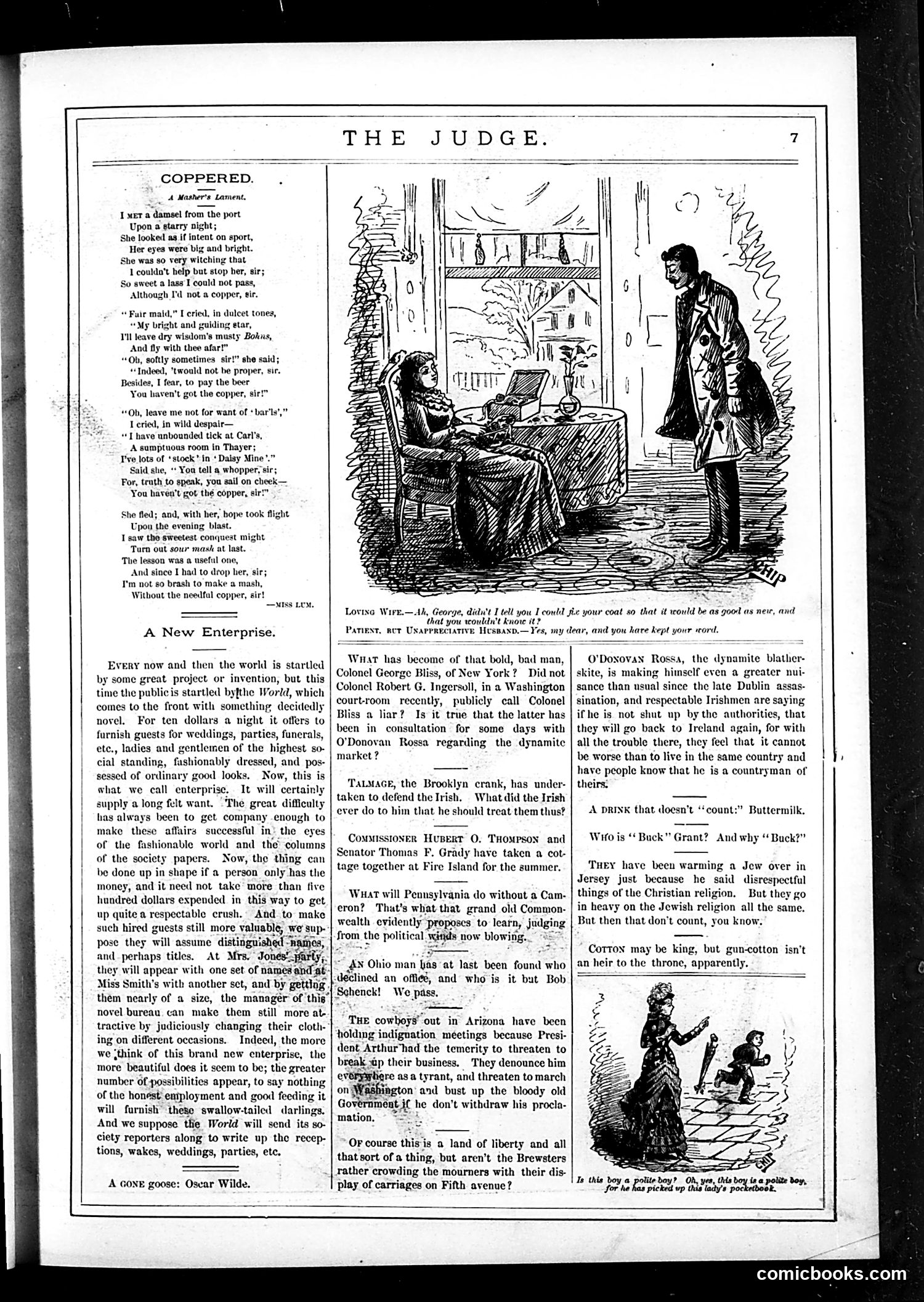
This Judge magazine page contains two main satirical pieces: **"Coppered"** (poem with illustration): A young man attempts to seduce a woman he meets, but she repeatedly rebuffs him by noting he lacks money ("copper" = coins). The satire mocks shallow romance motivated by financial status—the "masher" (aggressive flirt) has no actual funds despite boasting of credit and stock investments. The joke's bitterness suggests frustration with class barriers to courtship. **"A New Enterprise"**: Judge mocks the World newspaper's new service: renting well-dressed "guests" of high social standing for weddings and parties. The satire exposes the phoniness of Gilded Age society—wealthy hosts purchasing the *appearance* of a prestigious social circle rather than earning genuine status. By suggesting these hired guests could wear different names and clothing at different events, the writer ridicules how interchangeable and artificial fashionable society actually is. Both pieces target late-19th-century American class anxiety and social pretension.
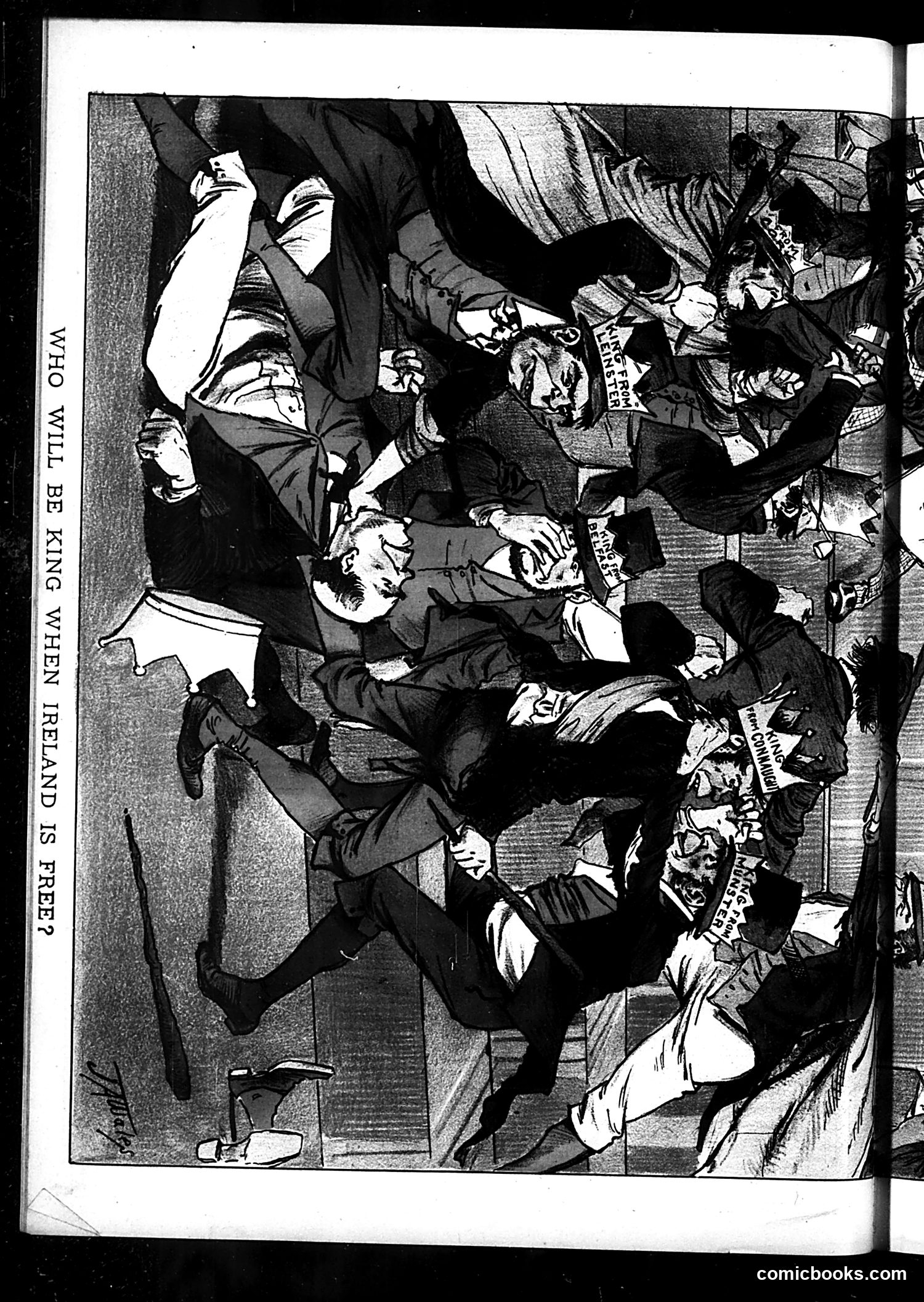
The OCR text is too corrupted to read clearly. However, the image shows a satirical cartoon depicting what appears to be a chaotic political scene. Multiple figures in formal dress are shown in disarray—some upside-down or falling—suggesting political tumult or collapse. The caption reads: "WHO WILL BE KING WHEN IRELAND IS FREED?" This references Irish independence debates, likely from the early 20th century when Ireland's political future was contested. The cartoon satirizes the disorder and competing factions within Irish politics, suggesting that freedom from British rule would not automatically resolve internal disputes about governance structure or leadership. The chaotic composition—with figures tumbling and overlapping—emphasizes the anticipated confusion and instability of Irish self-governance among rival political groups.
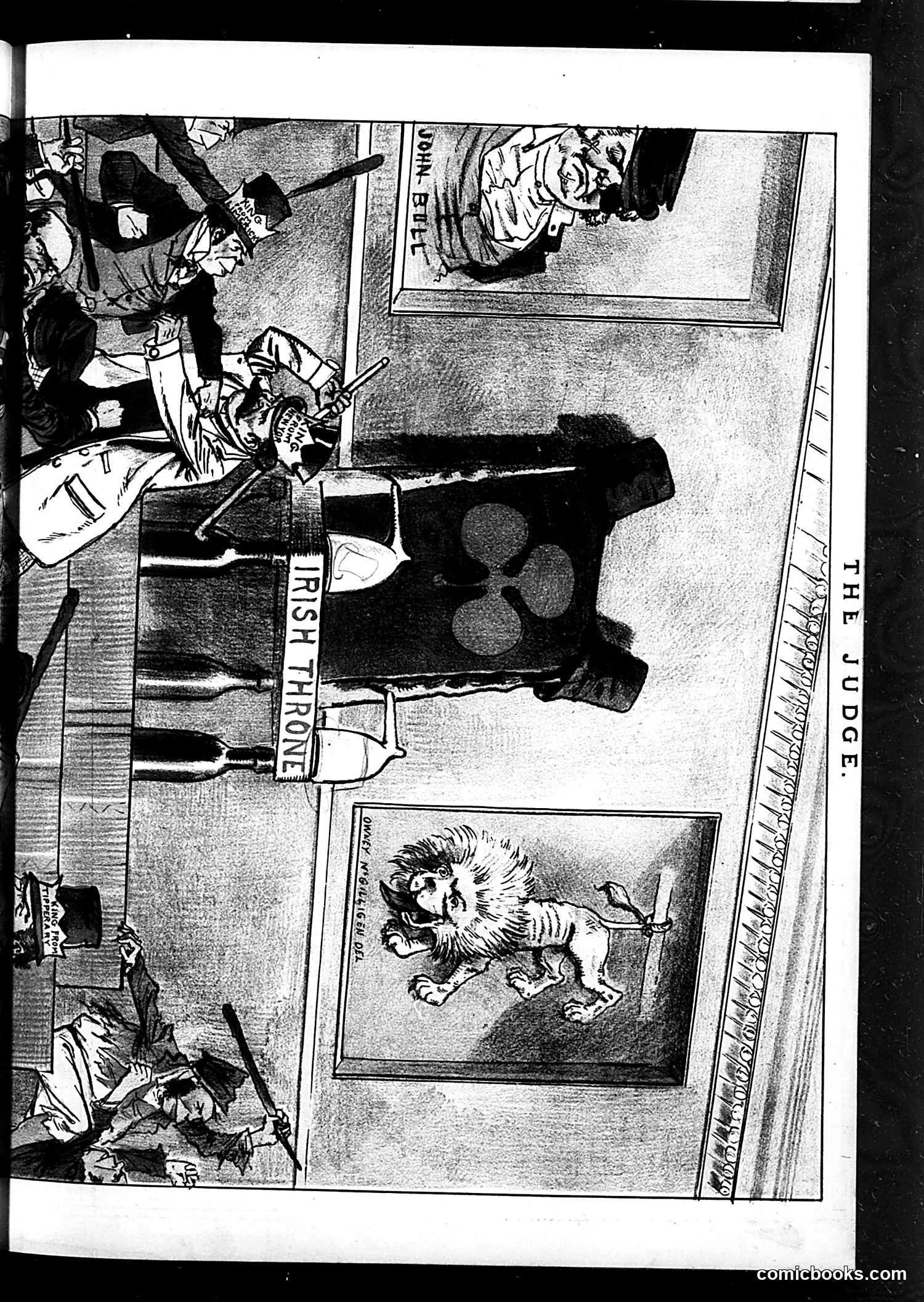
This appears to be a political cartoon titled "The Judge" featuring three panels. The central image shows a figure labeled "FIRST THRONE" seated on what appears to be a judicial or authoritative seat, with "THE JUDGE" text visible on the right margin. The surrounding panels contain caricatured figures and what appears to be a dog or animal illustration. The cartoon likely satirizes judicial authority or a specific judge/court decision of its era. However, without clearer visibility of all character labels and the publication date, I cannot definitively identify which specific political figure or court case this references. The style and composition suggest early-to-mid 20th century American political satire, but specific context remains unclear from this image alone.
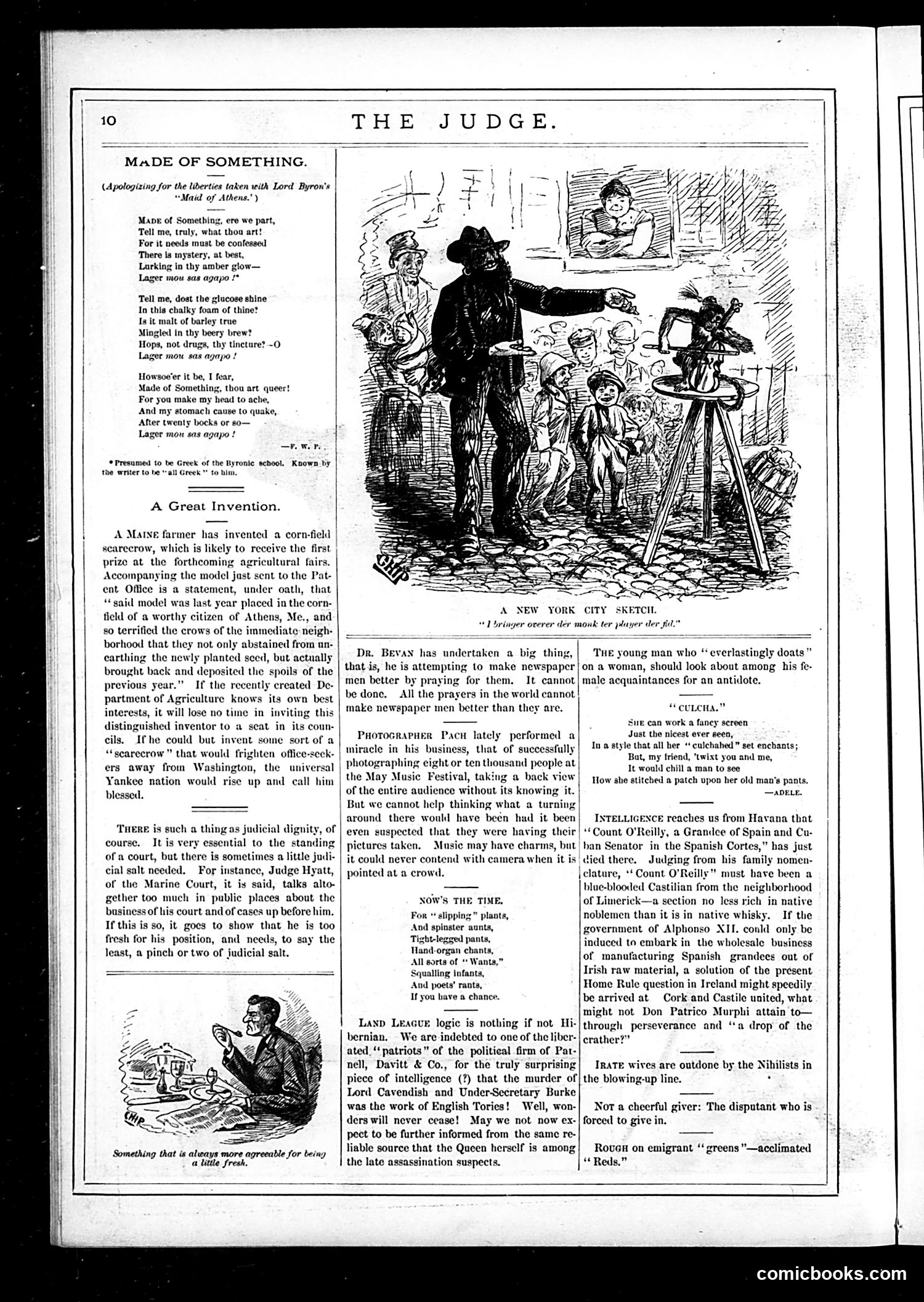
This page from *Judge* magazine contains several distinct satirical pieces: **"Made of Something"** parodies Lord Byron's "Maid of Athens," replacing romantic longing with complaints about beer quality. The poem mocks cheap lager beer—questioning whether it contains actual malt and hops or mysterious adulterants—and jokes about its stomach-upsetting effects. This likely satirizes concerns about beer adulteration, a common public health worry in 19th-century America. **The main cartoon** depicts a man (labeled "Dr. Bevan") attempting to "make newspaper men better by praying for them," which the text dismisses as impossible. This ridicules both religious reformism and newspaper journalists' perceived moral failings. **Other brief items** mock: a Maine farmer's scarecrow invention, Judge Hyatt's excessive public courtroom gossip, photographer Pach's achievement, and—most pointedly—Irish Land League logic, sarcastically suggesting they blame English Tories for assassinations (likely referencing the 1882 Phoenix Park murders). The satire throughout targets social incompetence, dubious reforms, and Irish political violence—characteristic *Judge* magazine concerns.
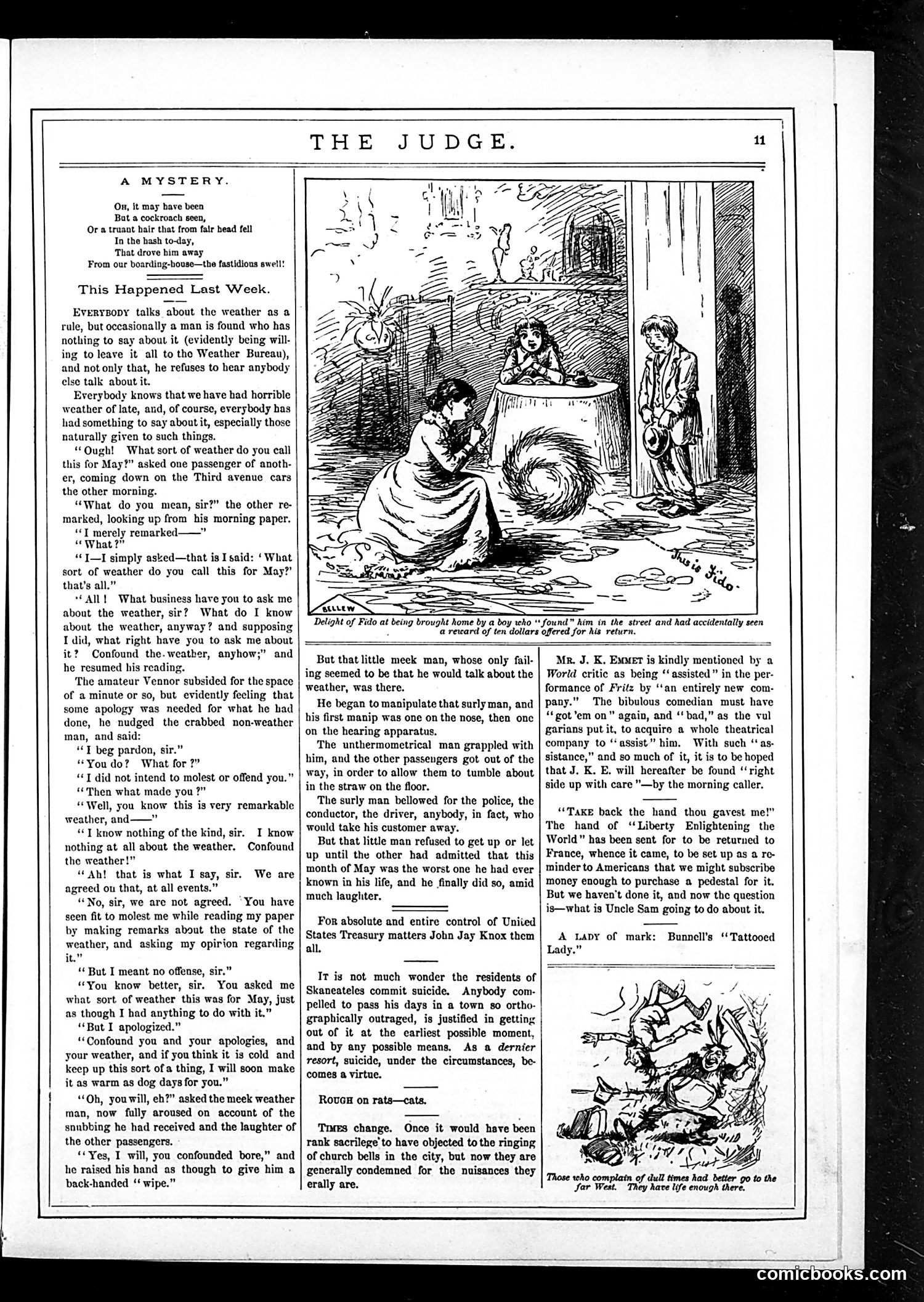
This page contains two separate satirical pieces from *Judge* magazine: **"A Mystery"** (main story): A humorous anecdote about a fastidious boarder who abandons his meal after finding a hair or cockroach in the hash—poking fun at overly particular lodgers. **"This Happened Last Week"** (longer narrative): Satirizes a particular social type: the man who refuses to discuss weather, yet gets violently angry when others do. When a meek passenger mentions the poor May weather on a Third Avenue trolley, the surly reader assaults him. They fight in the straw on the car floor until the passenger forces the man to admit May was indeed terrible weather. The satire mocks two targets: the irritating bore who pedantically refuses weather talk while ironically being obsessed with it, and the absurd physicality of urban disputes. The humor relies on the contrast between the meek passenger's politeness and his unexpected fighting prowess. The illustrations show a mugging at street level and people fighting in a street scene.
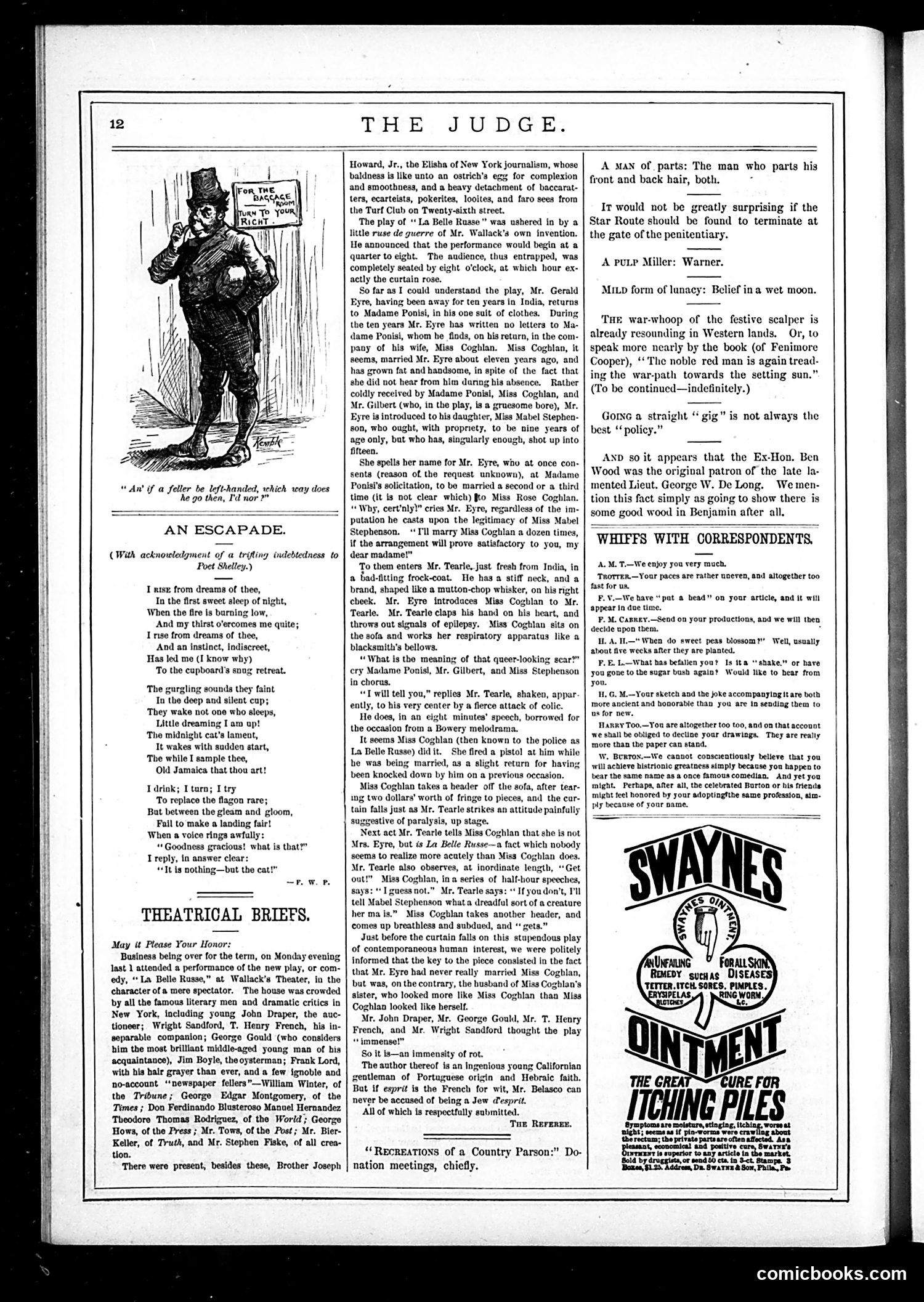
This page contains two main pieces of satirical content for *Judge* magazine: **"An Escapade"** is a humorous poem (credited to Shelley) about someone sneaking downstairs at midnight to drink rum from the liquor cabinet, only to get caught by a family member who mistakes the noise for the cat. It's gentle domestic comedy about guilty pleasures and failed cover-ups. **"Theatrical Briefs"** is a scathing review of the play *"La Belle Russe"* at Wallack's Theater. The reviewer (listed as "F.W.P.") mocks the absurd plot: a man returns from India after ten years to find his wife (whom he never contacted) has borne him a daughter—who's mysteriously already fifteen years old. The reviewer satirizes both the implausible plot mechanics and the society figures attending the premiere, listing prominent New York journalists, critics, and wealthy men (including gamblers) present. The satire targets theatrical absurdity and the pretension of New York's cultural elite.
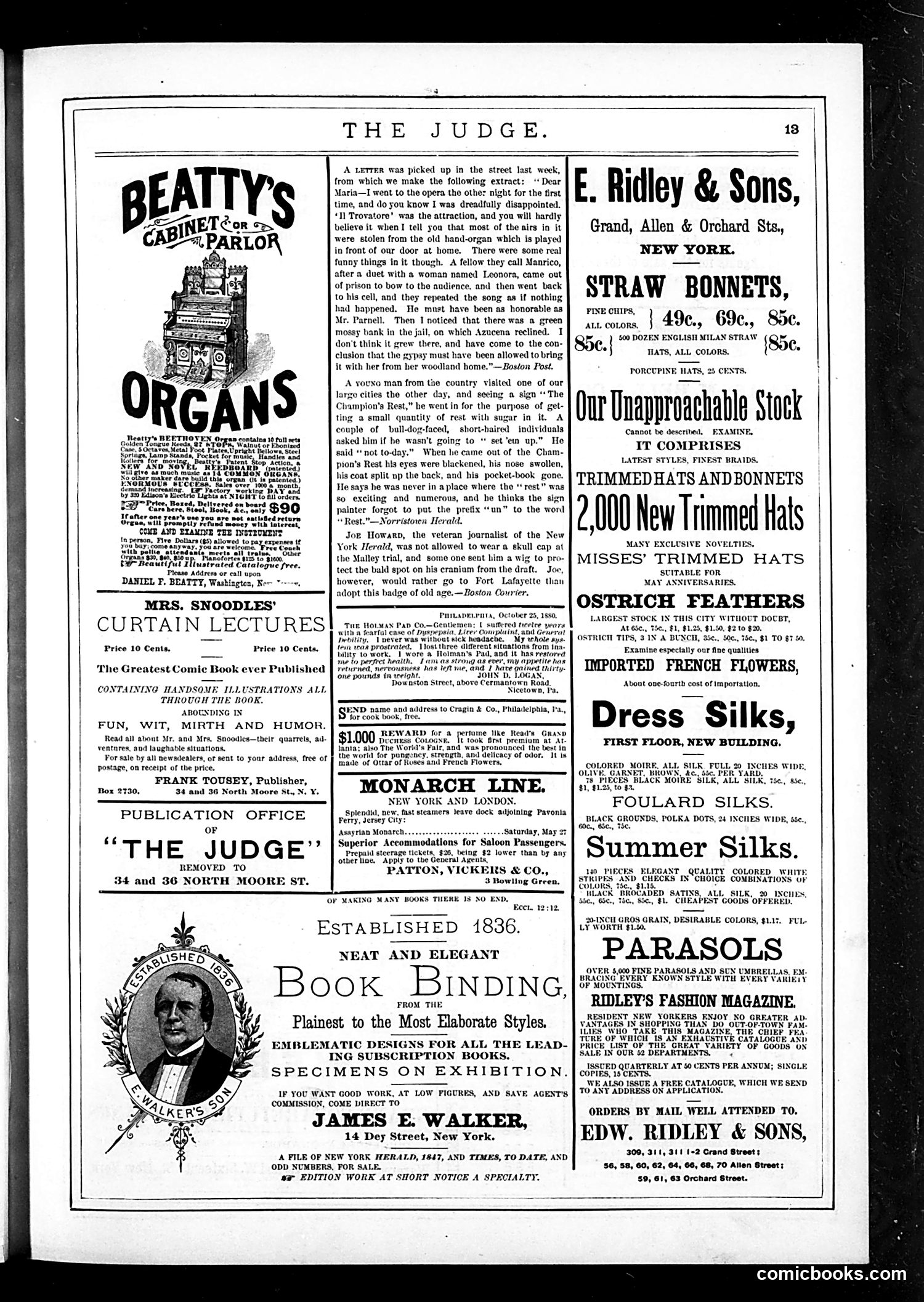
This is primarily an **advertising page** from Judge magazine, not a political cartoon. The page contains commercial notices for products and services popular in the 1880s: Beatty's Cabinet Organs, Mrs. Snoodles' comic book, book binding services, straw bonnets, trimmed hats, dress silks, parasols, and shipping lines. Interspersed are brief **humorous anecdotes** rather than satire: - A letter mocking an opera-goer who found *Il Trovatore* derivative of street organ music - A country visitor's misadventure at "The Champion's Rest" (a bar/saloon where "set 'em up" means buying drinks), beaten and robbed - A note about journalist Joe Howard refusing to wear a wig despite baldness These are light, social humor pieces poking fun at unsophisticated visitors and pretentious theatergoers—typical filler content for a satirical magazine. **No significant political or social commentary is evident** on this particular page.
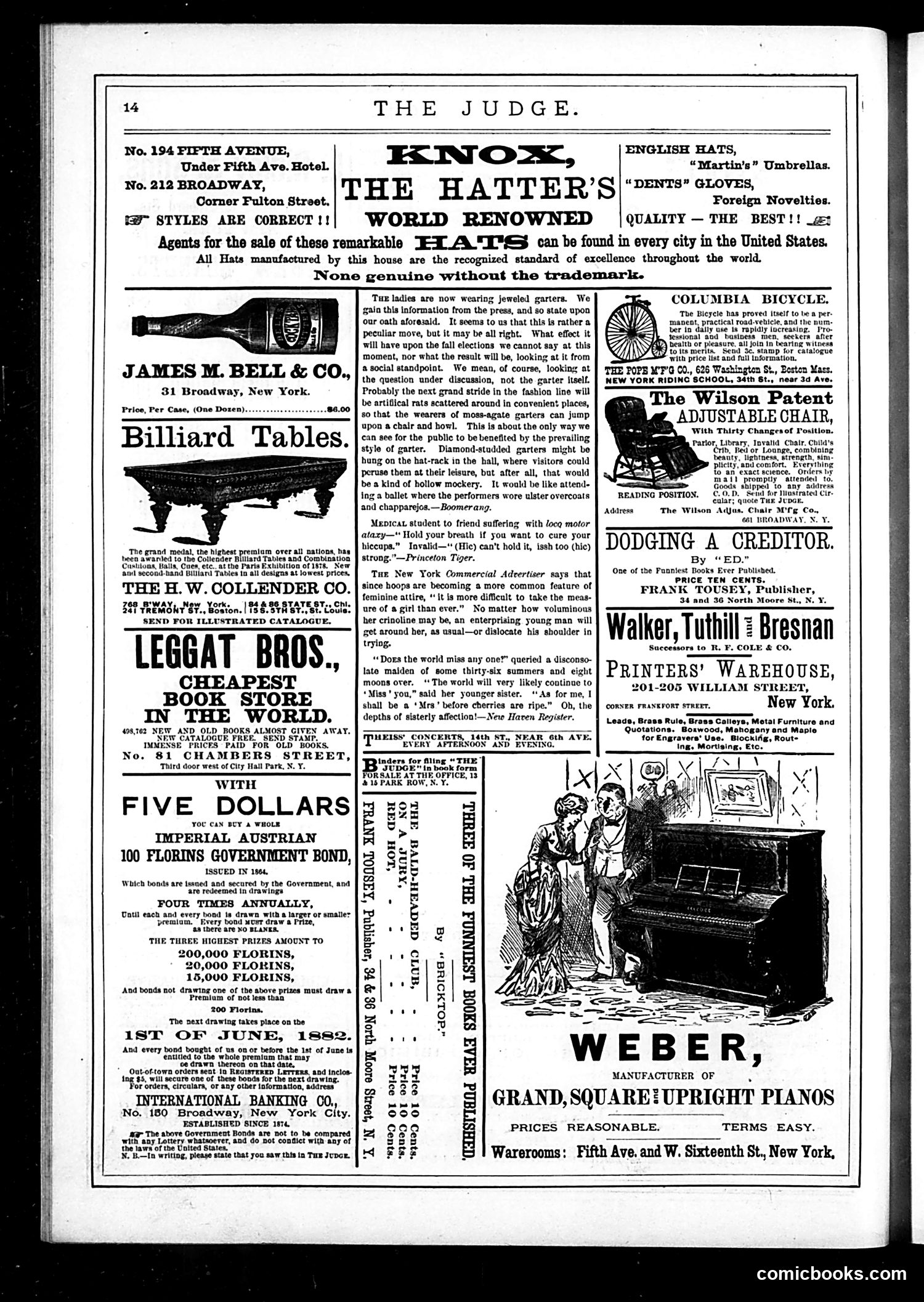
This page is primarily **advertising with minimal editorial content**. The bulk consists of product advertisements for hats, billiard tables, books, Austrian government bonds, bicycles, and pianos—typical of Judge magazine's revenue model. The small editorial content includes: 1. **"Jeweled Garters" commentary**: A satirical note mocking the fashion trend of women wearing jeweled garters, questioning its social impact and suggesting absurd alternatives (artificial rats to justify jumping on chairs). This is lighthearted social satire on women's fashion trends. 2. **Medical/Student Humor**: Brief joke about a medical student and a patient with hiccups—simple wordplay requiring no historical context. The page contains **no identifiable political cartoons or caricatures**. It represents Judge as a humor and advertising publication from approximately 1882 (based on the Austrian bond drawing date mentioned), focused on commercial revenue alongside genteel social satire about fashion and manners.
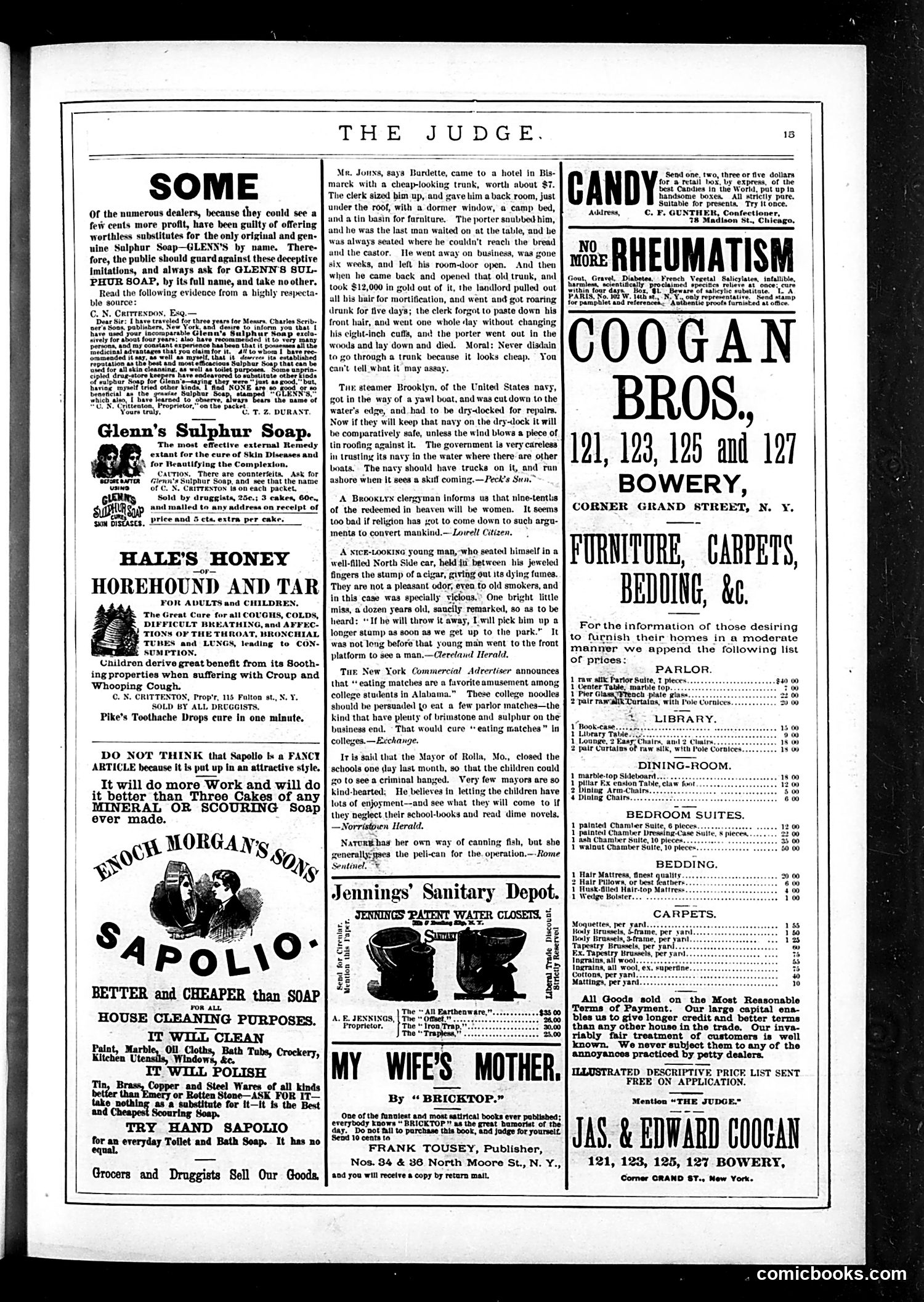
This page is **primarily advertisements** for patent medicines and household products (Glenn's Sulphur Soap, Hale's Honey, Sapolio) rather than editorial cartoons. The **content** consists of brief humorous anecdotes interspersed among ads. The clearest example: A story by humorist Robert Burdette about a man with a cheap-looking trunk containing $12,000 in gold. A hotel clerk dismisses him, seats him poorly, and treats him rudely. When the guest leaves and returns to retrieve the money, the embarrassed staff suffer comical consequences (the clerk loses his composure, the porter "goes and dies"). **The satire**: This lampoons class prejudice and snap judgments based on appearances. The joke warns against underestimating people by their outward presentation—a common 19th-century morality lesson. The naval joke criticizing the navy's practices is mild social commentary typical of Judge's satirical voice, but the page is overwhelmingly commercial rather than politically significant.
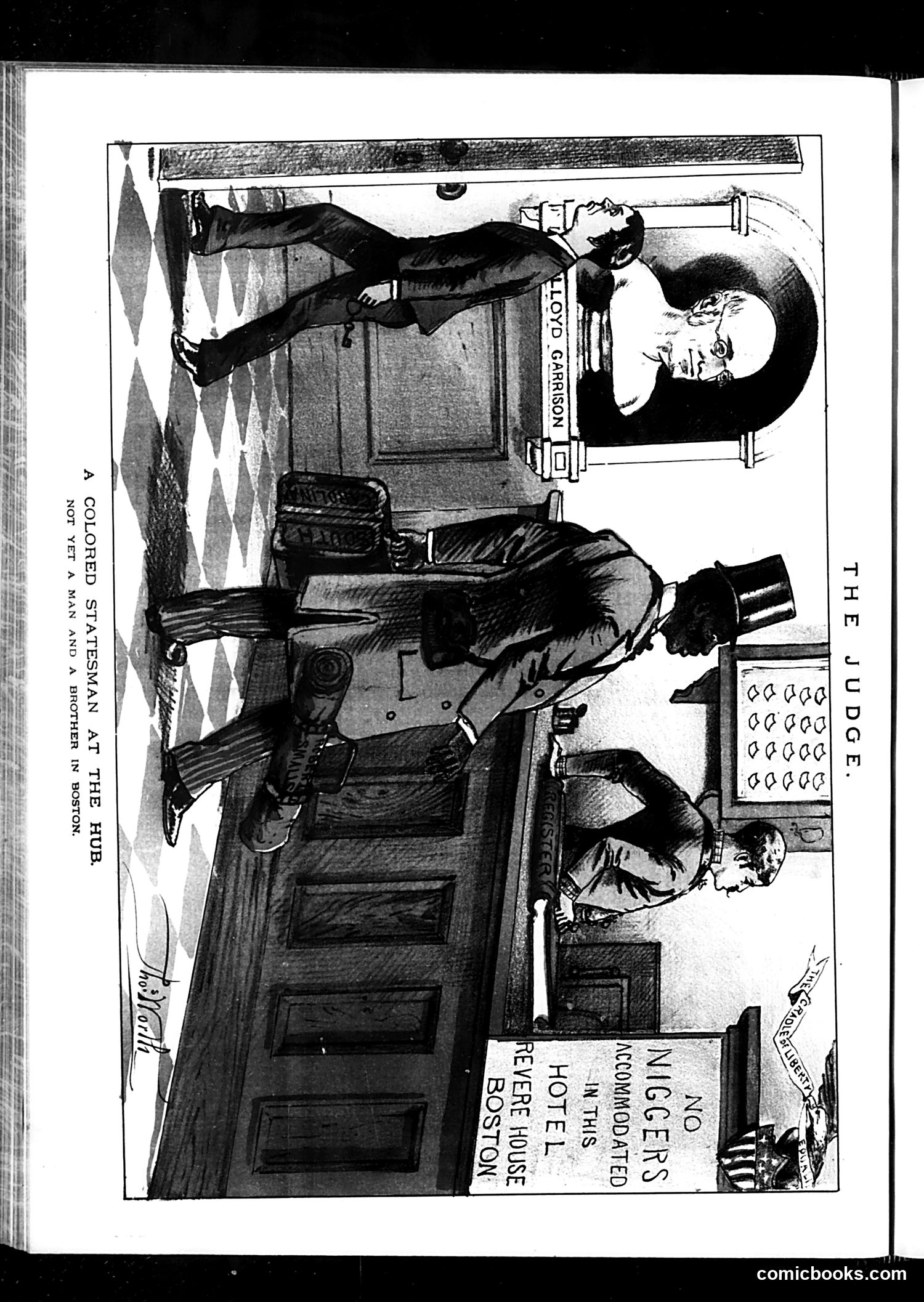
This appears to be a late 19th-century satirical cartoon mocking racial discrimination in Boston. The scene depicts a Black man (identified as "a colored statesman") being refused accommodation at a hotel, with a sign reading "NO NIGGERS ACCOMMODATED IN THIS HOTEL BOSTON." The cartoon's title contains contradictory phrases—"A Colored Statesman at the Hub" versus "Not Yet a Man and a Brother"—highlighting the hypocrisy of treating Black individuals as political equals while denying them basic human dignity and services. The satire targets Boston's failure to practice the racial equality it nominally championed, particularly regarding a Black political figure. This reflects broader post-Reconstruction tensions over civil rights and racial integration in Northern cities.