
Judge, 1882-05-27 · page 2 of 16
Judge — May 27, 1882 — page 2: what you’re looking at
What you’re looking at
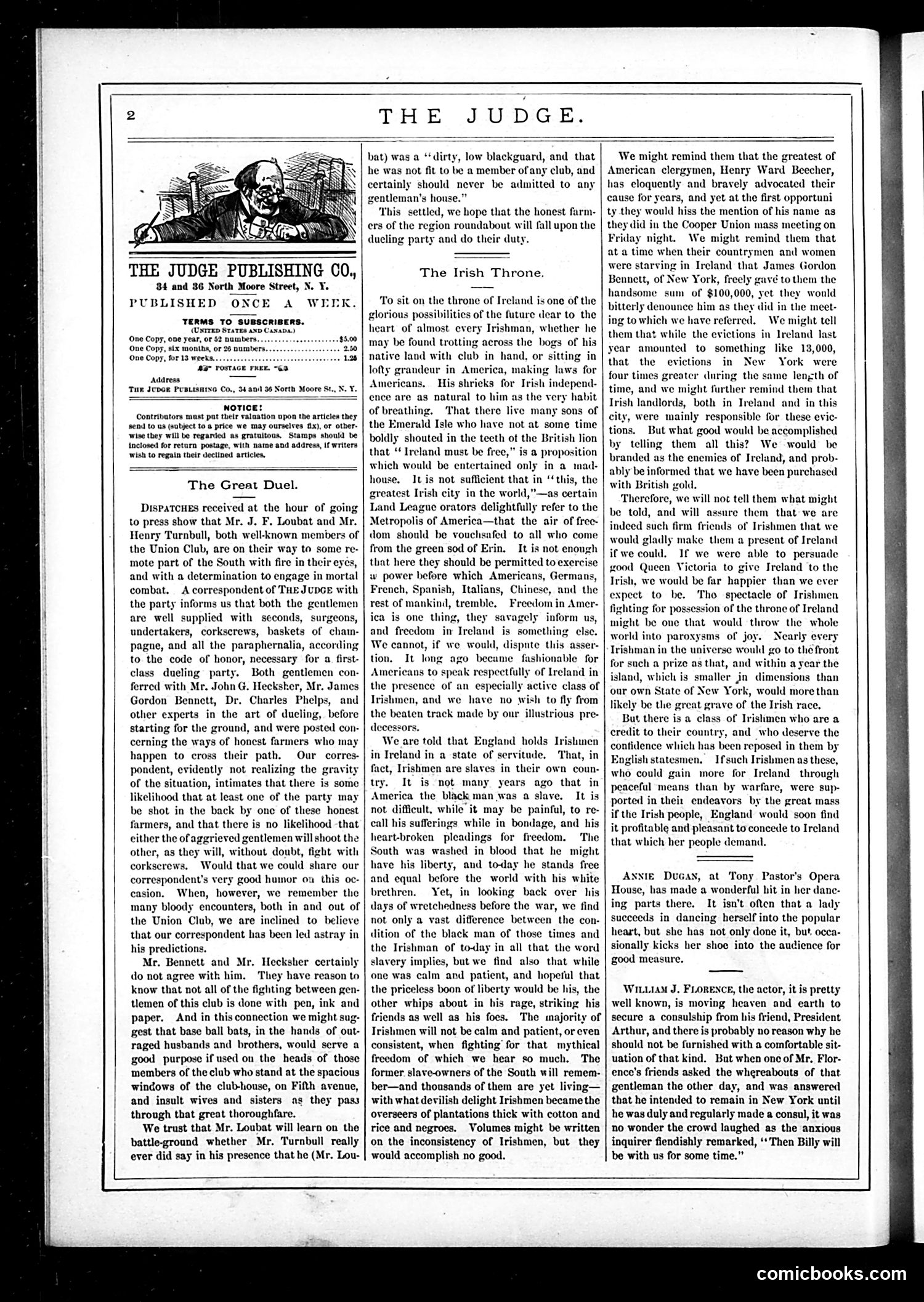
This page contains two distinct pieces of satire: **"The Great Duel"** mocks a literal duel between two Union Club members (Loubat and Turnbull) over an insult. Judge treats it with mock-serious tone, detailing their preparations with "seconds, surgeons, undertakers, corkscrews, baskets of champagne." The satire targets the absurdity of gentlemen adhering to outdated honor codes while also critiquing the Union Club itself—suggesting members sexually harass women from club windows, proposing baseball bats as appropriate retaliation. **"The Irish Throne"** addresses Irish-American political sentiment. It satirizes Irish immigrants' passionate rhetoric about Irish independence ("Ireland must be free!"), characterizing their demands as performative bombast whether spoken "across the bogs" or from America while "making laws for Americans." The piece implies hypocrisy in Irish-Americans' nationalist fervor while safely residing abroad. Both pieces exemplify *Judge's* style: mocking upper-class pretension, masculine violence, and immigrant political rhetoric through exaggeration and ironic understatement.
📄 Transcribed text from this page (OCR, searchable)
Machine-transcribed from the original scan — historical spelling and the odd misread are preserved.
THE JUDGE. THE JUDGE PUBLISHING CO., 84 and 36 North Moore Street, N. Y. PUBLISHED ONCE A WEEK. TERMS TO SUBSCRIBERS. (Usrrep States axp Cas! One Copy, one year, o $2 numbers. ‘One Cops, six months, or 26 number ‘One Copy, for 13 weeks. Contributors must pat thelr valuation upon the articles they send to us (subject to a price we may ourselves fix), or other- wise they will be regarded as gratuitous, Stamps should be inclosed for return postage, with name and address, If writers wish to regain their declined articles, The Great Duel. Dispatcues received at the hour of going to press show that Mr. J. F, Loubat and Mr. Henry Turnbull, both well-known members of the Union Club, are on their way to some re- mote part of the South with fire in their eyes, and with a determination to engage in mortal combat. A correspondent of THE Jupce with the party informs us that both the gentlemen are well supplied with seconds, surgeons, undertakers, corkscrews, baskets of cham- pagne, and all the paraphernalia, according to the code of honor, necessary for a first- class dueling party, Both gentlemen con- ferred with Mr. John G. Hecksher, Mr. James Gordon Bennett, Dr. Charles Phelps, and other experts in the art of ducling, before starting for the ground, and were posted con- cerning the ways of honest farmers who may happen to cross their path. Our corres- pondent, evidently not realizing the gravity of the situation, intimates that there is some likelihood that at least one of the party may be shot in the back by one of these honest farmers, and that there is no likelihood -that either the ofaggrieved gentlemen will shoot the other, as they will, without doubt, fight with corkser Would that we could share our correspondent’s very good humor on this oc- casion. When, however, we remember the many bloody encounters, both in and out of the Union Club, we are inclined to believe that our correspondent has been led astray in his predictions. Mr. Bennett and Mr. Hecksher certainly do not agree with him. They have reason to know that not all of the fighting between gen- tlemen of this club is done with pen, ink and paper. And in this connection we might sug- gest that base ball bats, in the hands of out- raged husbands and brothers, would serve a good purpose if used on the heads of those members of the club who stand at the spacious windows of the club-house, on Fifth avenue, and insult wives and sisters as they pass through that great thoroughfare. We trust that Mr. Loubat will learn on the battle-ground whether Mr. Turnbull really ever did say in his presence that he (Mr. Lou- bat) was a ‘dirty, low blackguard, and that he was not fit to be a member ofany club, and certainly should never be admitted to any gentleman's house.” This settled, we hope that the honest farm- ers of the region roundabout will fall upon the dueling party and do their duty. The Irish Throne. To sit on the throne of Ireland is one of the glorious possibilities of the future dear to the heart of almost every Irishman, whether he may be found trotting across the bogs of his native land with club in hand, or sitting in lofty grandeur in America, making laws for Americans. His shrieks for Irish independ- ence are as natural to him as the very habit of breathing. That there live many s of the Emerald Isle who have not at some time boldly shouted in the teeth ot the British lion that “Ireland must be free,” is a proposition which would be entertained only in a mad- house, It is not sufficient that in ‘this, the greatest h city in the world,”—as certain Land League orators delightfully refer to the Metropolis of America—that the air of free- dom should be vouchsafed to all who come from the green sod of Erin. It is not enough that here they should be permitted to exercise w power before which Americans, Germans, French, Spanish, Italians, Chinese, and the rest of mankind, tremble, Freedom in Amer- ica is one thing, they savagely inform us, and freedom in Ircland is something else. We cannot, if we would, dispute this assei tion. It long ago became fashionable for Americans to speak respectfully of Ireland in the presence of an especially active class of Irishmen, and we have no wish to fly from the beaten track made by our illustrious pre- deceszors. We are told that England holds Irishinen in Ireland in a state of servitude. That, in fact, Irishmen are slaves in their own coun- try. It is not many years ago that in America the black man was a slave. It is not difficult, while’ it may be painful, to re- call his sufferings while in bondage, and his heart-broken pleadings for freedom. ‘The South washed in blood that he might have his liberty, and today he stands free and equal before the world with his white brethren. Yet, in looking back over his days of wretchedness before the war, we find not only a vast difference between the con- dition of the black man of those times and the Irishman of to-lay in all that the word slavery implies, but we find also that while one was calm and patient, and hopeful that the priceless boon of liberty would be his, the other whips about in his rage, striking his friends as well as his foes. The majority of Irishmen will not be calm and patient, or even consistent, when fighting’ for that mythical freedom of which we hear so much, The former. slave-owners of the South will remem- ber—and thonsands of them are yet living— with what devilish delight Irishmen became the overseers of plantations thick with cotton and rice and negroes. Volumes might be written on the inconsistency of Irishmen, but they would accomplish no good. We might remind them that the greatest of American clergymen, Henry Ward Beecher, has eloquently and bravely advocated their cause for years, and yet at the first opportuni. ty they would hiss the mention of his name a3 id in the Cooper Union mass meeting on Friday night. We might remind them that ata time when their countrymen and women were starving in Ireland that James Gordon Bennett, of New York, freely gavé to them the handsome sum of $100,000, yet they would bitterly denounce him as they did in the meet- ing towhich we have referred. We might tell them that while the evictions in Ireland last year amounted to something like 13,000, that the evictions in New York were four times greater during the same length of time, and we might further remind them that Trish landlords, both in Ireland and in thi: city, were mainly responsible for these ev tions. But what good would be accomplished by telling them all this? We would be branded as the enemies of Ireland, and prob- ably be informed that we have been purchased with British gold. ‘Therefore, we will not tell them what might be told, and will assure them that we are indced such firm friends of Irishmen that we would gladly make them a present of Ireland ifwe could. If we were able to persuade good Queen Victoria to give Ireland to the Irish, we would be far happier than we ever expect to be. Tho spectacle of Irishmen fighting for possession of the throne of Ireland might be one that would throw the whole world into paroxysms of joy. Nearly every Irishman in the universe would go to the front for such a prize as that, and within a year the island, which is smaller jin dimensions than our own State of New York, would more than likely be the great grave of the Irish race. But there is a class of Irishmen who are a credit to their country, and who deserve the contidence which has been reposed in them by English statesmen, If such Irishmen as these, who could gain more for Ireland through peaceful means than by warfare, were sup- ported in thei: endeavors by the great mass if the Irish people, England would soon find it profitable and pleasant to concede to Ircland that which her people demand, ANNIE Duc. at Tony Pastor's Opera House, has made a wonderful hit in her danc- ing parts there. It isn’t often that a lady succeeds in dancing herself into the popular heart, but she has not only done it, but, occa- sionally kicks her shoe into the audience for good measure, WILuiaM J. FLORENCE, the actor, it is pretty well known, is moving heaven and earth to secure a consulship from his friend, President Arthur, and there is probably no reason why he should not be furnished with a comfortable sit- uation of that kind. But when one of Mr. Flor- ence's friends asked the whereabouts of that gentleman the other day, and was answered that he intended to remain in New York until he was duly and regularly made a consul, it was, no wonder the crowd laughed as the anxious inquirer fiendishly remarked, ‘Then Billy will be with us for some time.” comicbooks.com