
Judge, 1882-05-27 · page 12 of 16
Judge — May 27, 1882 — page 12: what you’re looking at
What you’re looking at
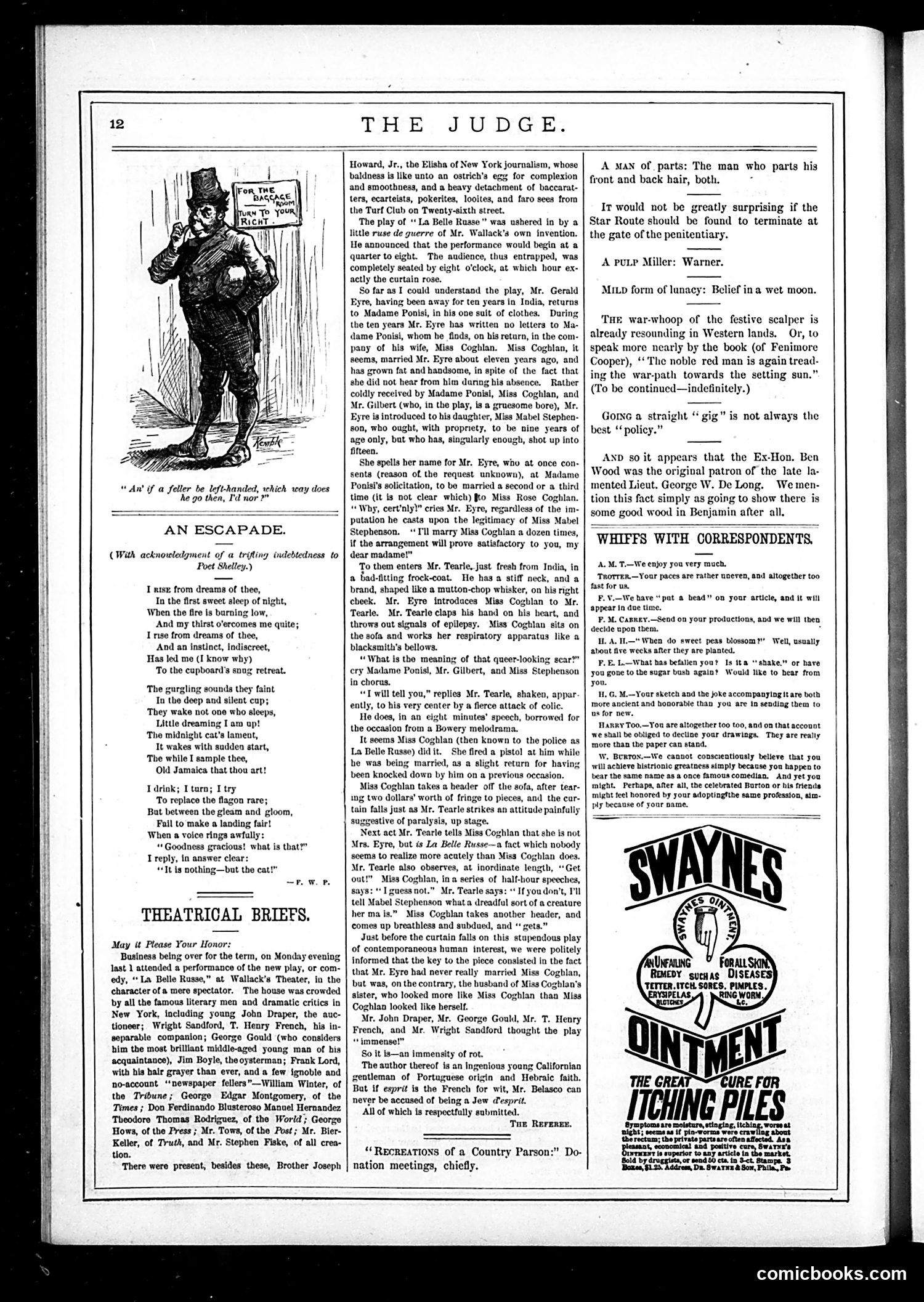
This page contains two main pieces of satirical content for *Judge* magazine: **"An Escapade"** is a humorous poem (credited to Shelley) about someone sneaking downstairs at midnight to drink rum from the liquor cabinet, only to get caught by a family member who mistakes the noise for the cat. It's gentle domestic comedy about guilty pleasures and failed cover-ups. **"Theatrical Briefs"** is a scathing review of the play *"La Belle Russe"* at Wallack's Theater. The reviewer (listed as "F.W.P.") mocks the absurd plot: a man returns from India after ten years to find his wife (whom he never contacted) has borne him a daughter—who's mysteriously already fifteen years old. The reviewer satirizes both the implausible plot mechanics and the society figures attending the premiere, listing prominent New York journalists, critics, and wealthy men (including gamblers) present. The satire targets theatrical absurdity and the pretension of New York's cultural elite.
📄 Transcribed text from this page (OCR, searchable)
Machine-transcribed from the original scan — historical spelling and the odd misread are preserved.
THE JUDGE. “ An’ if a feller be left-hanted, which way does Yee We hon Pd nor AN ESCAPADE. (With acknowledgment of a trifling indebtedness to Poet Shelley.) I rise from dreams of thee, In the first sweet sleep of night, When the fire is burning low, And my thirst o'ercomes me quite; I nse from dreams of thee, And an instinct, indiscreet, Has led me (I know why) To the cupboanl’s sung retreat. The gurgling sounds they faint In the deep and silent cup; They wake not one who sleeps, Little dreaming I am up! Tho midnight cat’s lament, Tt wakes with sudden start, The while I sample thee, Old Jamaica that thou art! Tdrink; Tturn; I try To replace the flagon rare; Bat between the gleam and gloom, Fail to make a landing fair! When a voice rings awfully: Goodness gracious! what is that?” T reply, in answer clear: “Teis nothing—but the cat!” rower THEATRICAL BRIEFS. May it Please Your Honor: Business being over for the term, on Monday evening last 1 attended a performance of the new play, or com- edy, ‘La Belle Russe,” at Wallack’s Theater, in the character of a mere spectator. The house was crowded by all the famous literary men and dramatic critics in New York, including young John Draper, the auc- tioneer; Wright Sandford, T. Henry French, his in- separable companion; George Gould (who considers him the most brilliant middle-aged young man of bis acquaintance), Jim Boyle, the oysterman; Frank Lord, with his hair grayer than ever, and a few ignoble and no-account ‘newspaper fellers”"—William Winter, of the Tribune; George Edgar Montgomery, of the Times ; Don Ferdinando Blusteroso Manuel Hernandez Theodore Thomas Rodriguez, of the World; George Hows, of the Press ; Mr. Tows, of the Post; Mr. Bier- Keller, of Truth, and Mr. Stophen Fiske, of all crea- tion. ‘There were present, besides these, Brother Joseph Howard, Jr., the Elisha of New York journalism, whose baldness is like unto an ostrich’s egy for complexion and smoothness, and a heavy detachment of baccarat ters, ecarteists, pokerites, looites, and faro sees from the Turf Clab on Twenty-sixth street, The play of “La Belle Russe” was ushered in by a little ruse de guerre of Mr. Wallack’s own invention. He announced that the performance would begin at a quarter to eight. The audience, thus entrapped, was completely seated by eight o'clock, at which hour ex- actly the curtain rose. So far as I could understand the play, Mr. Gerald Eyre, having been away for ten years in India, returns to Madame Ponisi, in his one suit of clothes. During the ten years Mr, Eyre has written no letters to Ma- dame Ponisi, whom he finds, on his return, in the com- pany of his wife, Miss Coghlan. Miss Coghlan, it seems, married Mr. Eyre about eleven years ago, and has grown fat and handsome, in spite of the fact that ehe did not hear from him danng bis absence. Rather coldly received by Madame Ponisi, Miss Coghlan, and Mr. Gilbert (who, in the play, is a gruesome bore), Mr. Eyre is introduced to his daughter, Miss Mabel Stephen- son, who ought, with propriety, to be nine years of age only, but who has, singularly enough, shot up into fifteen. She spells her name for Mr. Eyre, who at once con- sents (reason of the request unknown), at Madame Ponisi’s solicitation, to be married a second or a third timo (it is not clear which) fto Miss Rose Coghlan. “Why, cert’nly!” cries Mr. Eyre, regardless of the im- putation he casts upon the legitimacy of Miss Mabel Stephenson. “I'll marry Miss Coghlan a dozen times, if the arrangement will prove satisfactory to you, my dear madame!” To them enters Mr. Tearle. jast fresh from India, in a bad-fitting frock-coat. He has a stiff neck, and a brand, shaped like a mutton-chop whisker, on his right check. Mr. Eyre introdaces Miss Coghlan to Mr. Tearle. Mr. Tearle claps his hand on his heart, and throws out signals of epilepsy. Miss Coghlan sits on the sofa and works her respiratory apparatus like a blacksmith’s bellows. “What is tho meaning of that queer-looking scar?” cry Madame Ponisi, Mr. Gilbert, and Miss Stephenson in chorus. “I will tell you,” replies Mr. Tearle, shaken, appar ently, to his very center by a fierce attack of colic. He does, in an eight minutes’ speech, borrowed for the occasion from a Bowery melodrama, It seems Miss Coghlan (then known to the police as La Belle Russe) did it, She fired a pistol at him while he was being married, as a slight return for having been knocked down by him on a previons occasion. Miss Coghlan takes a header off the sofa, after tear- ing two dollars’ worth of fringe to pieces, and the cur- tain falls just as Mr. Tearle strikes an attitude painfully suggestive of paralysis, up stage. Next act Mr. Tearle tells Miss Coghlan that she is not Mrs. Eyre, but is La Belle Russe~a fact which nobody scems to realize more acutely than Miss Coghlan does. Mr, Tearle also observes, at inordinate length, “Get out!” Miss Coghlan, ina series of half-hour speeches, says: “I guess not.” Mr, Tearle says: If youdon't, I'l tell Mabel Stephenson whata dreadful sort of a creature her mais.” Miss Coghlan takes another header, and comes up breathless and subdued, and “ gets.” Just before the curtain falls on this stapendous play of contemporaneous human interest, we were politely informed that the key to the piece consisted in the fact that Mr, Eyre had never really married Miss Coghlan, but was, on the contrary, the husband of Miss Cogblan's sister, who looked more like Miss Coghlan than Miss Coghlan looked like herself. Mr. John Draper, Mr. George Gould, Mr. T. Henry French, and Mr. Wright Sandford thought the play “immense!” So it is—an immensity of rot. ‘The author thereof is an ingenious young Californian gentleman of Portuguese origin and Hebraic faith. Bat if esprit is the French for wit, Mr. Belasco can never be accused of being a Jew @esprit. All of which is respectfully submitted. ‘Tue Rerenze. “*RECREATIONS of a Country Parsot nation meetings, chiefly. A MAN of parts: The man who parts his front and back hair, both. Ir would not be greatly surprising if the Star Route should be found to terminate at the gate of the penitentiary. A PULP Miller: Warner. MILD form of lunacy: Belief ina wet moon. THE war-whoop of the festive scalper is already resounding in Western lands. Or, to speak more nearly by the book (of Fenimore Cooper), ‘The noble red man is again tread- ing the war-path towards the setting sun.” (To be continued—indefinitely.) Gore a straight “ gig” best ‘ policy.” is not always the ND so it appears that the Ex-Hon. Ben Wood was the original patron of the late la- mented Lieut. George W. De Long. Wemen- tion this fact simply as going to show there is some good wood in Benjamin after all. WHIFFS WITH CORRESPONDENTS, A.M. T.—We enjoy you very much, ‘Trorrer—Your paces are rather uneven, and altogether too fast for us, P.V.—We have “pat a bead” on your article, and it will appear in due time. P. M. Canney.—Send on your productions, and we will thea decide upon them, H. A. TL—" When do sweet peas blossom?” Well, usually about five wecks after they are planted. F.E. L.—What has befallen yout Is ta ‘shake. or have you gone to the sugar bush again? Would like to bear from you. 11, G, M.—Your sketch and the joke accompanying it are both more ancient and honorable than you are in sending them to us for new. HanryToo.—You are altogether too too, and on that account ‘we shall be obliged to decline your drawings. They are really more than the paper can stand, W. Brrrox.—We cannot conscientiously belleve that you will achieve histriontc greatness simply because you happen to bear the same name asa once famous comedian. And yet you might. Perhaps, after al, the celebrated Barton or bis frien: might feel honored by your adoptingfthe same profession, aim- ny becante of your name, ue PILES Symptomsare molstare, etingin aizbtt ecems tai plorworme were crawtlag comicbooks.com