
A complete issue · 16 pages · 1882
Judge — January 14, 1882
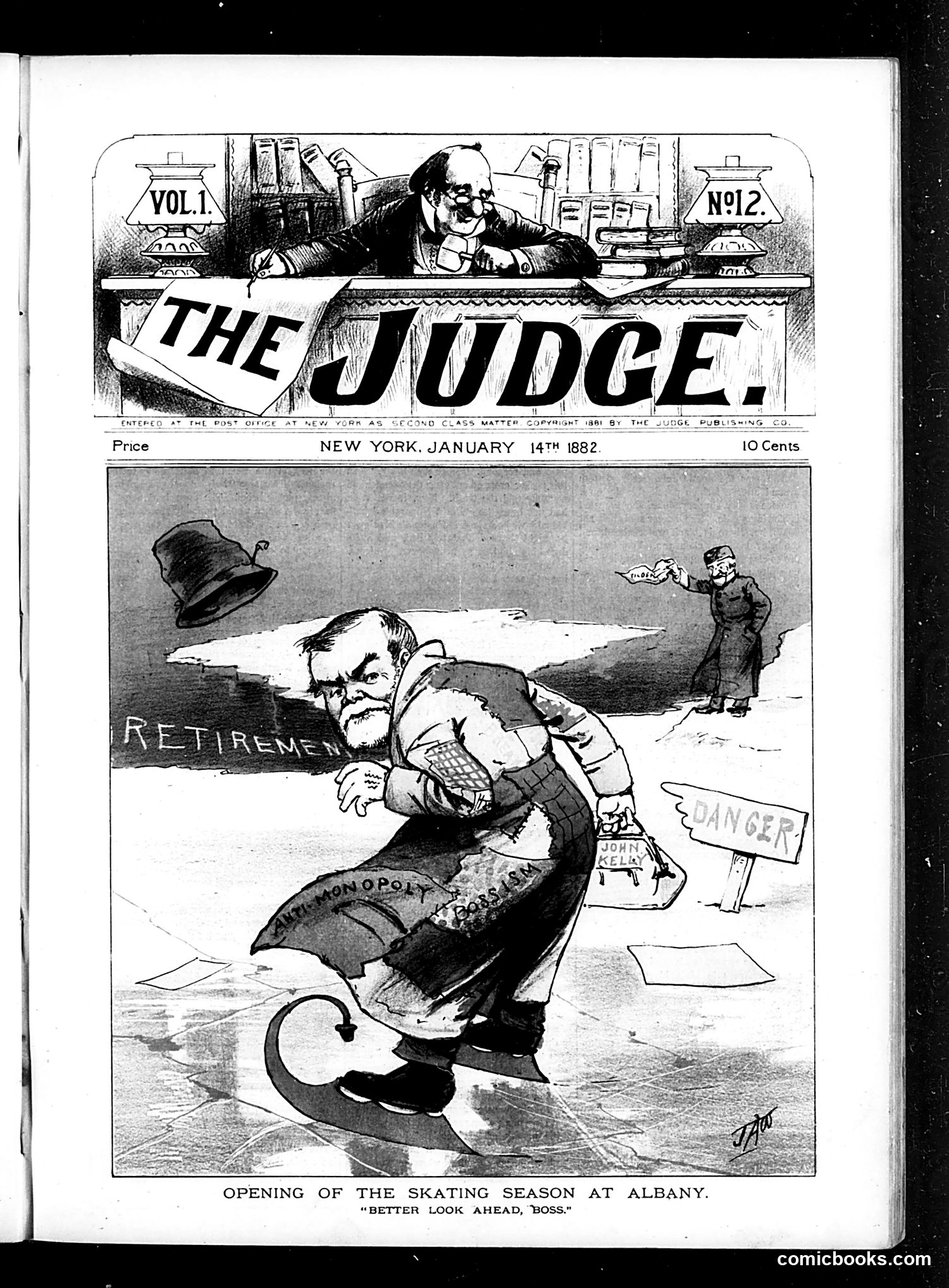
This political cartoon satirizes the "opening of the skating season at Albany," likely referencing New York state politics. A caricatured figure (possibly a political boss or corrupt official) is depicted skating blindfolded on thin ice labeled "ANTI-MONOPOLY" and "SPECIAL INTERESTS." A warning figure shouts "DANGER—JOHN KELLY," suggesting Kelly (likely Democratic politician John Kelly) poses a threat. The "RETIREMENT" sign and hazardous conditions represent political peril ahead. The figure's prominent facial features suggest ethnic caricature—common in 1882 satire. The cartoon warns corrupt Albany politicians that reform movements and political rivals threaten their precarious positions. The skating metaphor emphasizes how dangerous their situation has become.
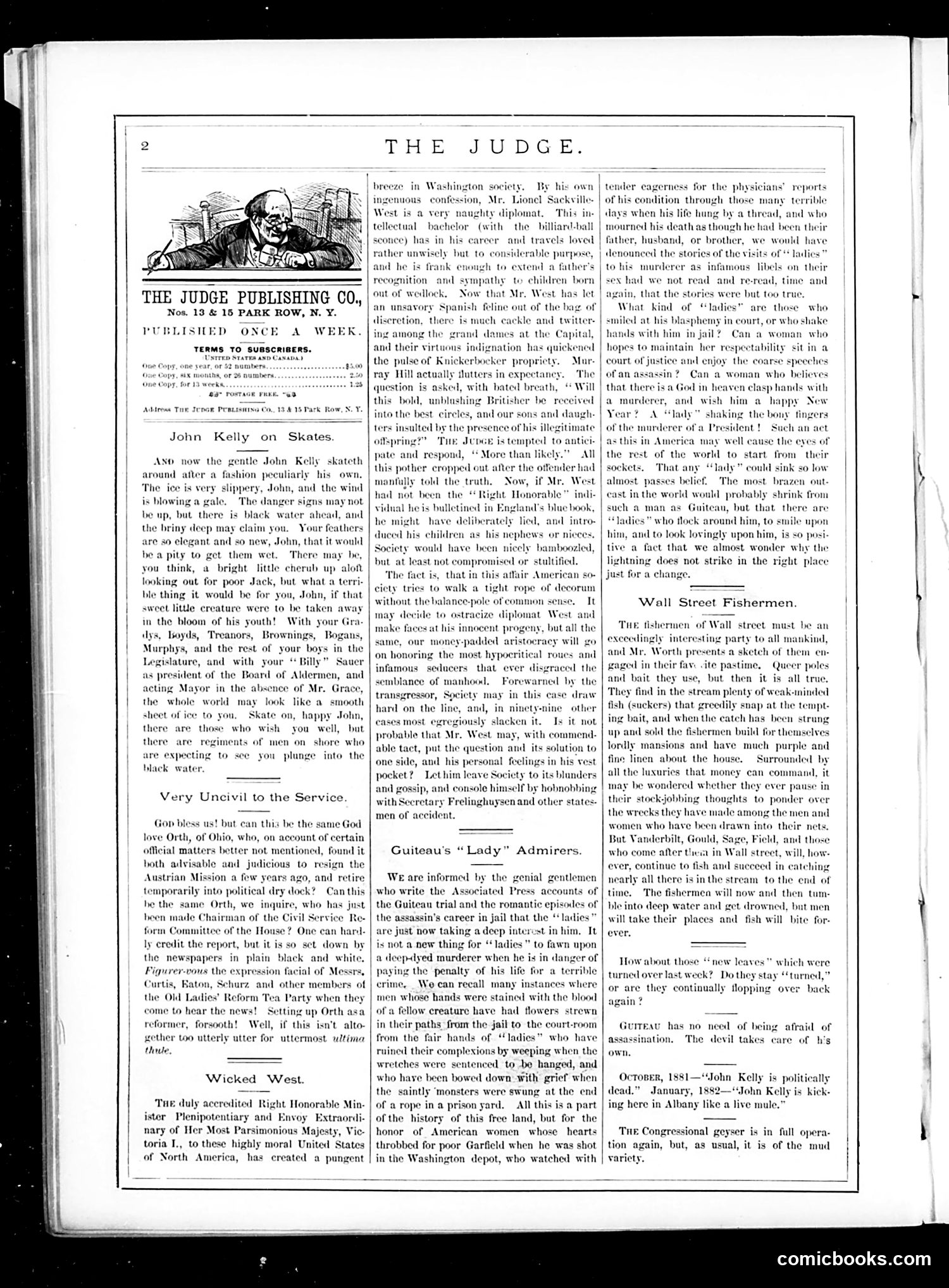
This page from *Judge* contains several satirical pieces mocking contemporary figures and social hypocrisy: **"John Kelly on Skates"** appears to caricature John Kelly, a prominent New York Democratic politician, skating dangerously on thin ice—a metaphor for his precarious political position amid corruption charges and factional struggles within New York's Democratic machine. **"Very Uncivil to the Service"** criticizes William Maxwell Evarts (likely "Orth"), a former diplomat recently appointed to a Civil Service Reform Committee. The satire mocks the irony of placing someone with questionable ethical credentials in charge of government reform. **"Wicked West"** targets Lionel Sackville-West, the British Minister, for his illegitimate children. The piece satirizes American society's selective moral outrage—condemning his personal conduct while overlooking similar scandals among American elites, exposing class-based hypocrisy about respectability. All pieces ridicule the gap between public morality and private behavior among the powerful.
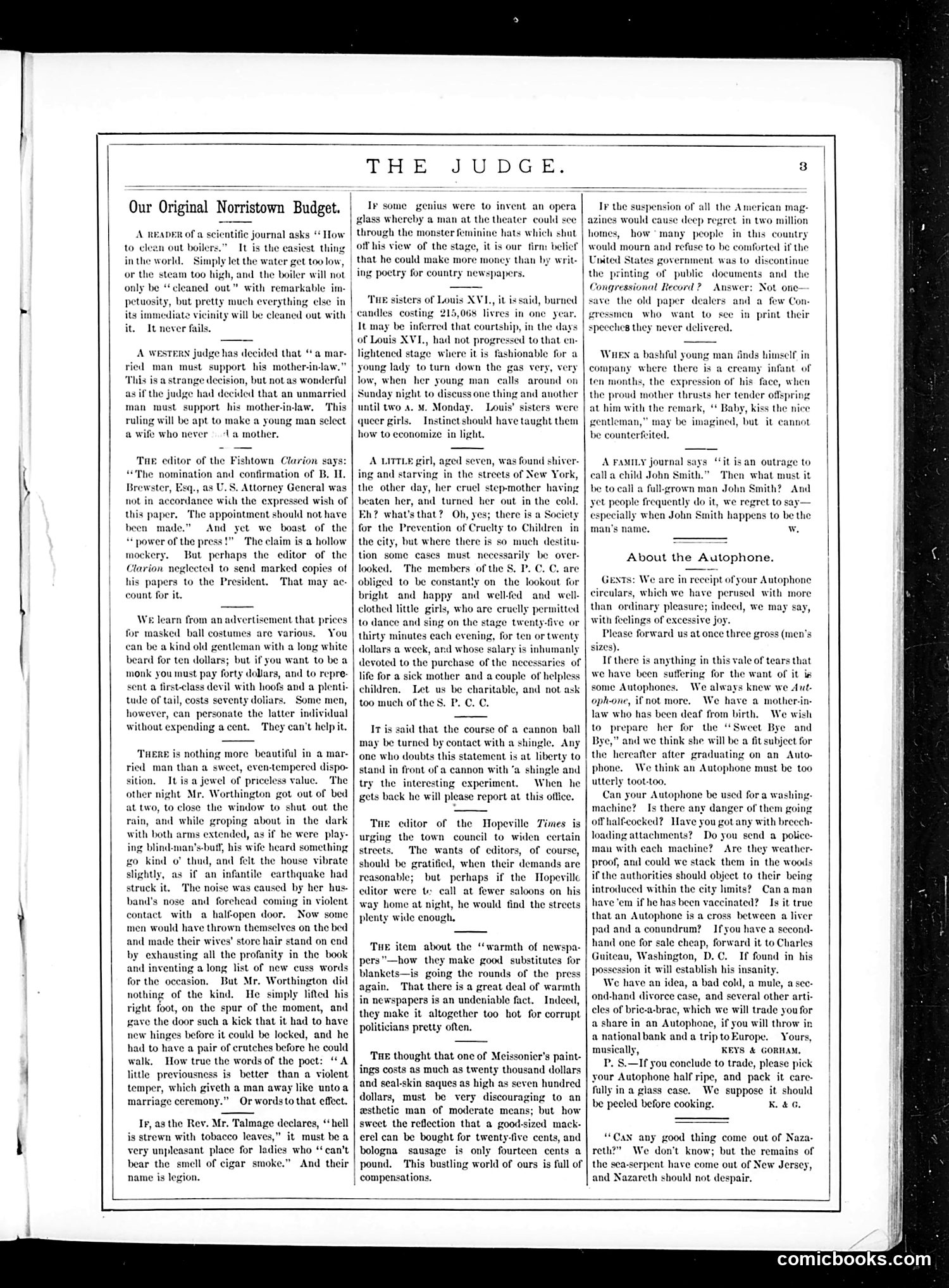
This satirical column contains brief, disconnected humorous observations typical of Judge magazine's format—short jokes and social commentary rather than illustrated cartoons. **Key items:** 1. **Norristown Budget**: Local satire mocking practical "advice" (cleaning boilers by letting them explode). 2. **Marriage laws joke**: Absurdist humor about a judge ruling married men must support mothers-in-law—pointing out the illogic of legal decisions. 3. **Press power mockery**: Criticizes the Fishertown *Clarion* editor's boast about "power of the press" when his opposition to B.H. Brewster's appointment as U.S. Attorney General was ignored. The joke: editors claim influence they don't possess. 4. **Costume prices satire**: Notes masked ball costumes cost differently ($10 for "kind gentleman," $40 for monk, $70 for devil)—implying some men need no costume to appear devilish. 5. **Worthington anecdote**: Gentle domestic humor about a patient husband who calmly handles mishaps rather than cursing. The page emphasizes Judge's satirical approach: deflating pretension, mocking social hypocrisy, and finding humor in everyday absurdities.
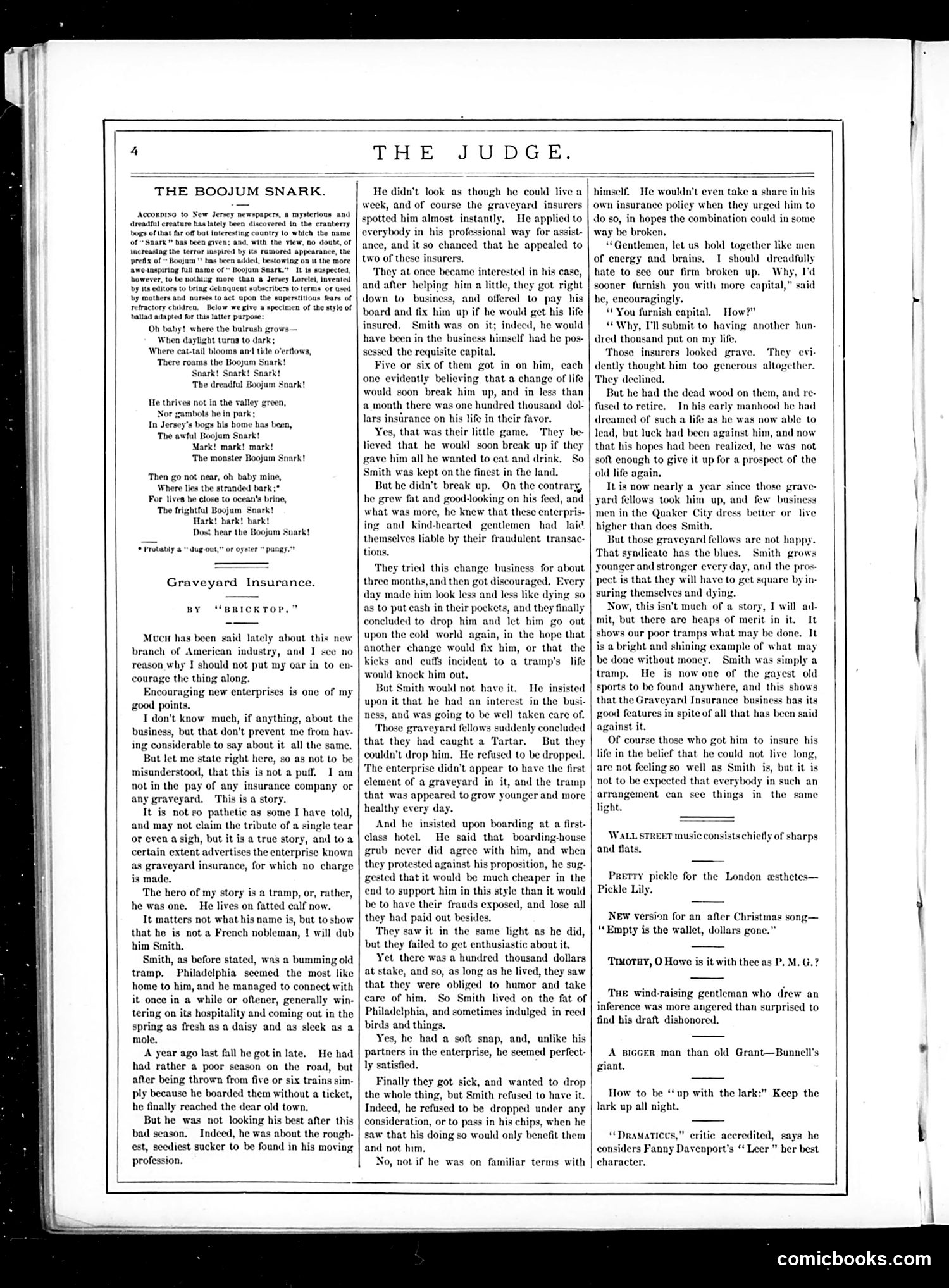
This page contains two distinct pieces of satire from Judge magazine. **"The Boojum Snark"** mocks New Jersey newspapers for inventing a fictional creature—a "mysterious and dreadful" swamp monster—to frighten readers and boost circulation. Judge presents it as obvious journalistic fabrication, likely inspired by Lewis Carroll's literary nonsense (referenced in the title), used either to scare subscribers or frighten disobedient children. **"Graveyard Insurance"** satirizes a real but macabre 19th-century practice: unscrupulous insurance agents insuring destitute people's lives for minimal premiums, then essentially betting on their early deaths. The story describes how insurers target a dying tramp named Smith, offering him food and shelter in exchange for life insurance policies—a parasitic scheme exploiting extreme poverty. The satire criticizes both the industry and the predatory moral logic that treats the poor as profitable death-bets. Both pieces attack fraud and exploitation: one journalistic, one financial.
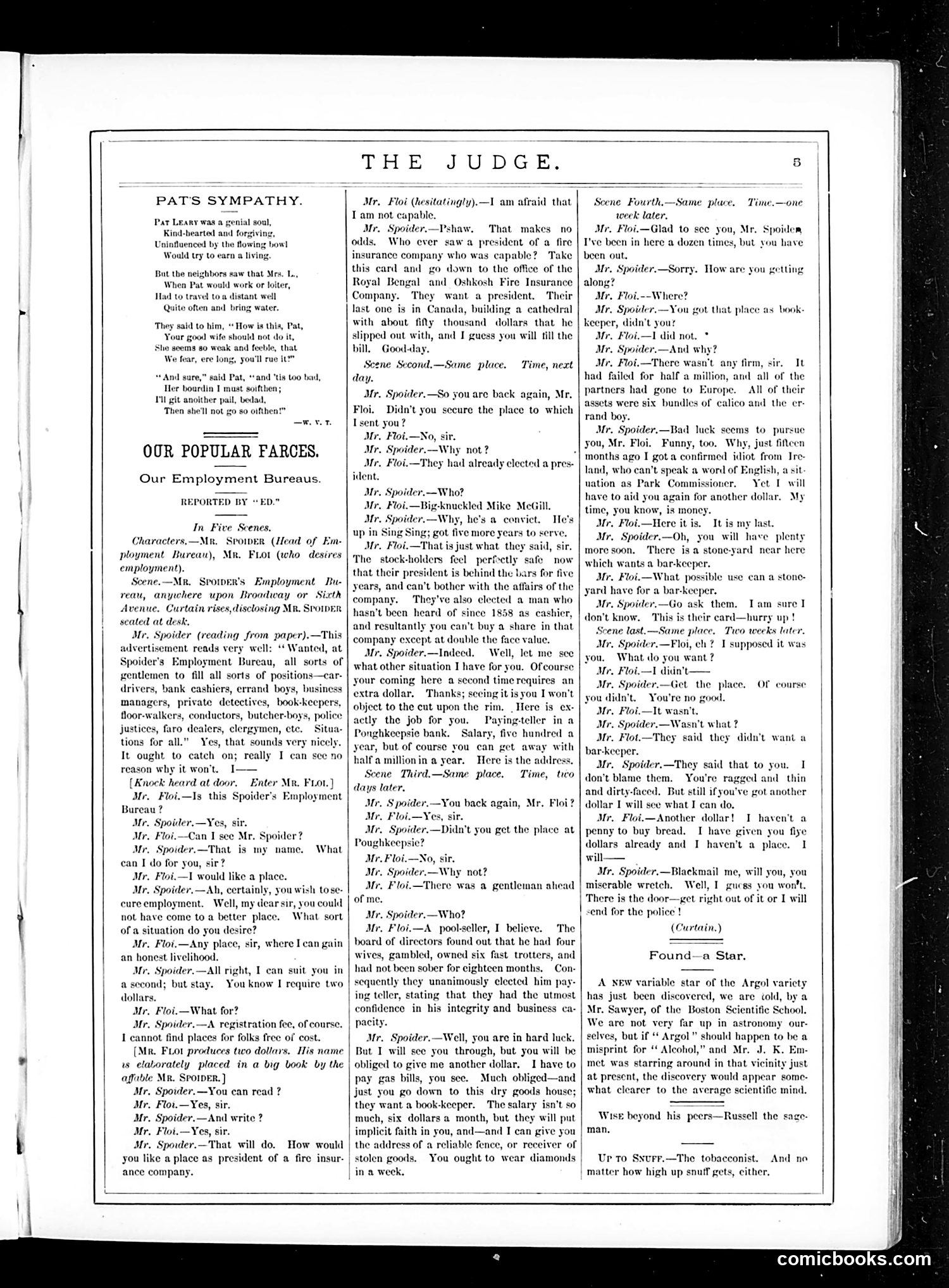
This satirical sketch mocks the fraudulent employment agencies that proliferated in late 19th-century America. Mr. Spoider runs a bureau that preys on desperate job-seekers like Mr. Floi, extracting two-dollar fees (substantial for the era) for worthless placements. The satire targets: 1. **Corrupt employment brokers** who care only for fees, not actual job placement 2. **Absurd "qualifications"** — Spoider places Floi as a fire insurance company president despite his admitted incompetence, joking that competence is irrelevant 3. **Institutional fraud** — the Royal Bengal and Oshkosh company's president allegedly absconded to Canada with stolen funds 4. **Repeating victims** — Floi returns multiple times, each rejection met with another dubious job offer and another fee The sketch exposes how these agencies exploited vulnerable workers through false promises and impossible placements, reflecting genuine Progressive-era concerns about labor market exploitation.
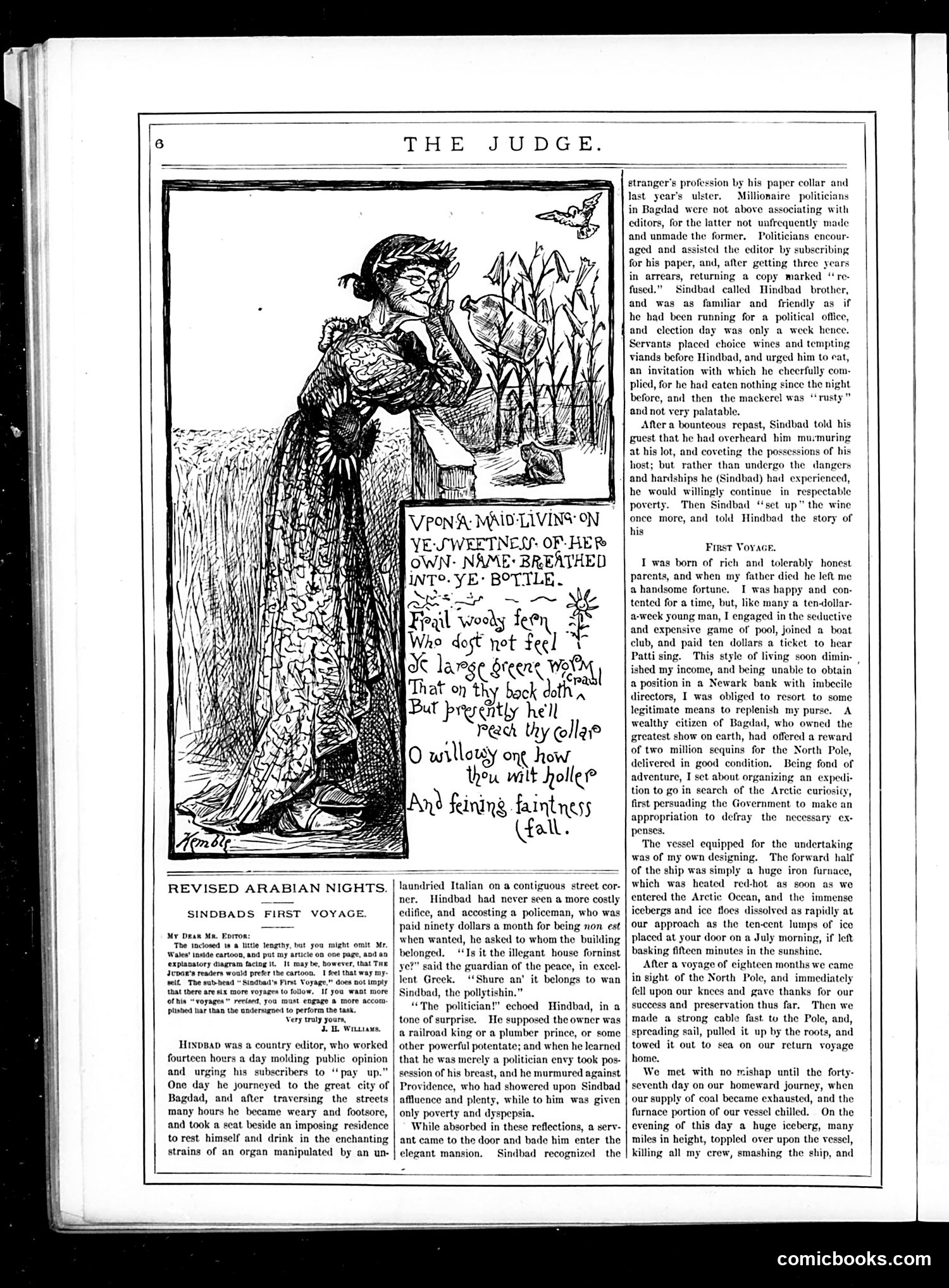
This page parodies Arabian Nights tales to satirize American politics and the relationship between editors and politicians. The protagonist Hindbad, a struggling country newspaper editor, envies a wealthy politician named Sindbad in Bagdad. The satire reveals that Sindbad's fortune comes not from legitimate enterprise but from political corruption—a common theme in Gilded Age critiques. The joke targets how politicians and newspaper editors were mutually dependent: politicians subscribed to papers (then stopped paying), while editors promoted politicians. The elaborate illustration and accompanying poem mock Sindbad's pretensions and expose the hypocrisy of corrupt politicians living lavishly while claiming respectability. Judge uses this fantastical frame to critique real American political corruption of the era.
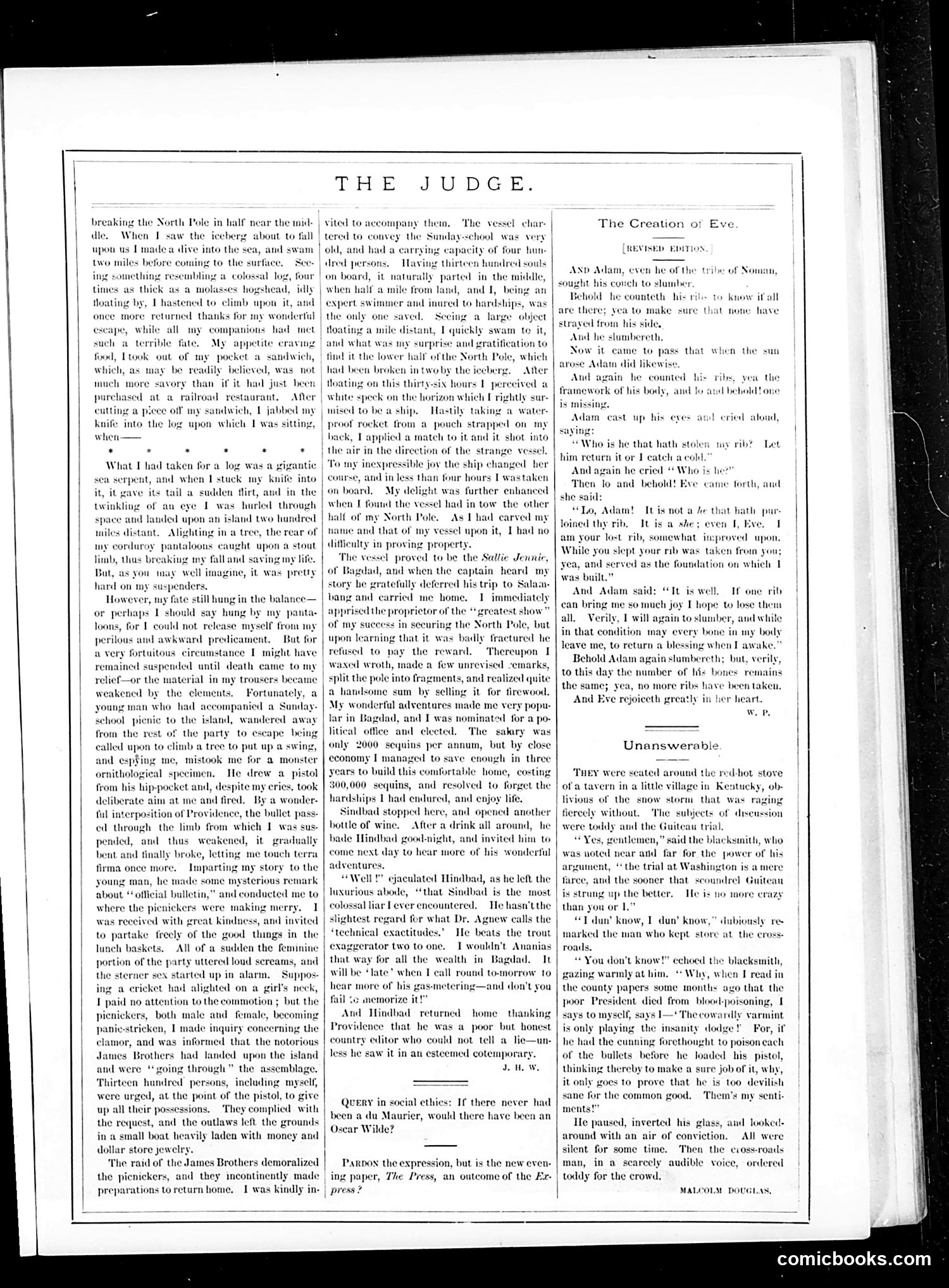
This page from **Judge** (a 19th-century American satirical magazine) contains no political cartoon but rather a serialized humorous adventure story titled "The Judge" by W.P. (likely a pseudonym). The narrative is a tall tale featuring an unnamed narrator recounting absurd expeditions: breaking the North Pole in half, being attacked by a sea serpent, surviving via a fortuitous bullet through a tree limb, and encountering the **James Brothers** (famous outlaws) robbing a picnic party at gunpoint. The satire operates through **exaggeration and absurdist humor** rather than political commentary—typical of Judge's light entertainment content. The James Brothers reference adds topicality (they were notorious 1880s-90s outlaws), but the story uses them merely as comedic plot devices rather than social critique. The right column contains unrelated pieces including "The Creation of Eve" (Biblical parody) and "Unanswerable" (a social vignette about a blacksmith and Washington D.C.). This reflects Judge's miscellaneous content format.
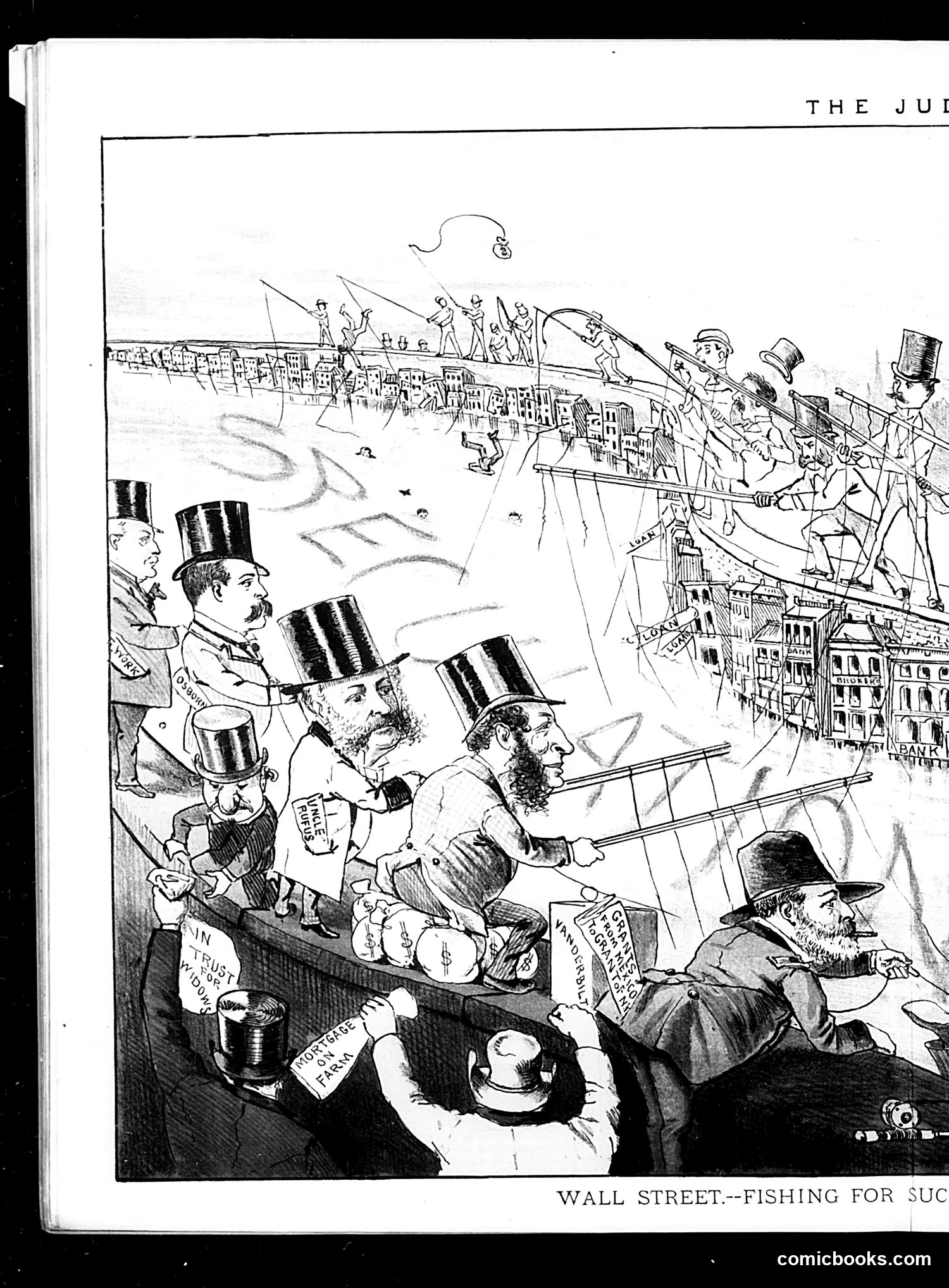
This Judge magazine cartoon satirizes wealthy Wall Street financiers as greedy "fishermen" casting lines into a cityscape below. The men in top hats represent wealthy speculators and bankers of the Gilded Age. They're fishing with dollar signs and labeled hooks, suggesting they're trying to catch profits from the urban masses living in the crowded buildings below. The cartoon critiques how Wall Street elites exploit ordinary working people and city residents for financial gain. The contrast between the well-dressed, leisurely financiers above and the densely packed tenements below emphasizes wealth inequality. The phrase "fishing for success" implies their methods are predatory rather than legitimate enterprise—they're not creating wealth but extracting it from those below.
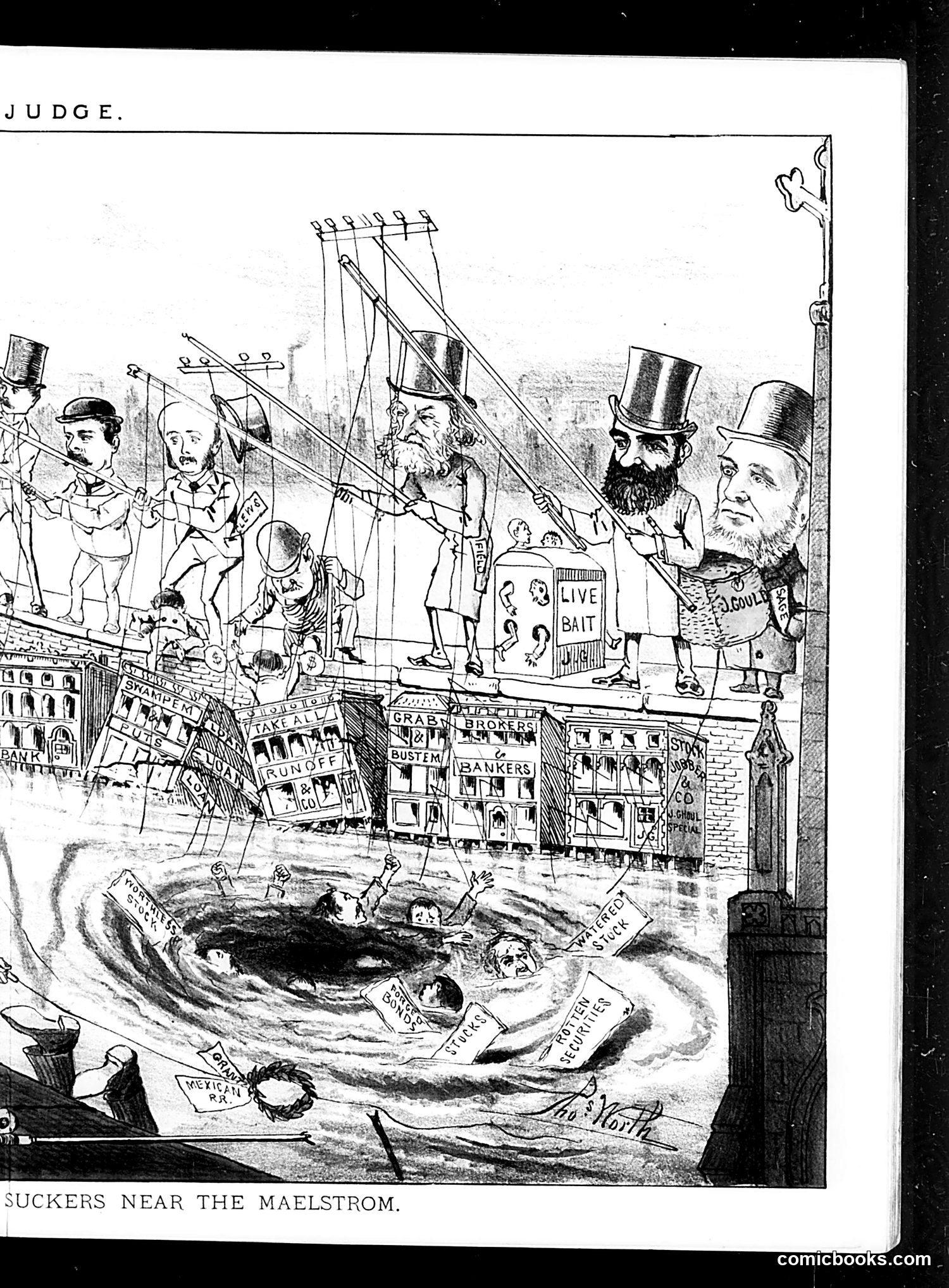
This political cartoon depicts financial disaster, likely referencing a banking or market crisis. Caricatured figures in top hats stand on a platform labeled with business names ("BANKERS," "LIVE BAIT") above a whirlpool where small figures labeled "SUCKERS" are drowning. The "Live Bait" sign suggests ordinary citizens are being used as fodder. The cartoon satirizes how wealthy financiers and bankers profit from or exploit economic turmoil while ordinary people ("suckers") are caught in financial catastrophe. The maelstrom metaphor emphasizes chaos and danger, while the elevated bankers appear callous and removed from victims' suffering below. Without a visible date, the specific crisis remains unclear—this could reference various late 19th or early 20th-century panics or market crashes when such imagery was common in American satire.
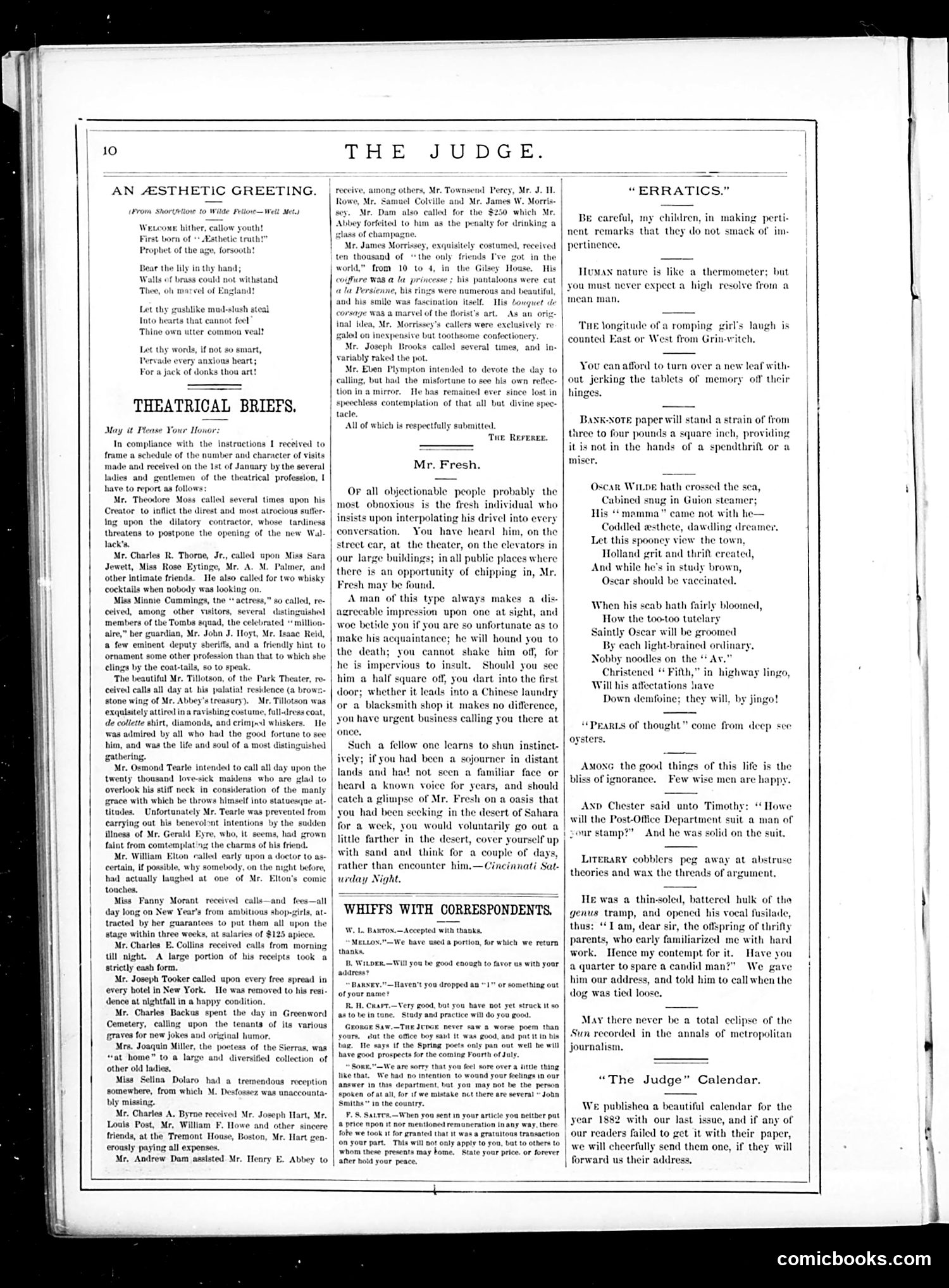
This page satirizes the theatrical and arts world of the 1880s, focusing on fashionable pretension and social climbers. **"An Aesthetic Greeting"** mocks the "Aesthetic Movement" — a late-19th-century artistic philosophy emphasizing "art for art's sake" that Judge viewed as affected and empty. The poem ridicules devotees who adopt aesthetic poses ("wear the lily") without genuine substance, calling them intellectual frauds ("jack of donks"). **"Theatrical Briefs"** offers humorous "visitor logs" for famous actors and theater figures. The satire targets both the theatrical profession's vanity and the absurdity of tracking social calls as marks of importance. Notable targets include Charles Backus (mocked for grave-robbing ideas) and Fanny Morant (criticized for unrealistic promises to aspiring actresses). The overall thrust: Judge attacks the shallow pretension of those claiming artistic sophistication while engaging in gossip, self-promotion, and fraud. The page lampoons how New York's cultural elite performed status through social visiting and aesthetic affectation rather than genuine talent or substance.
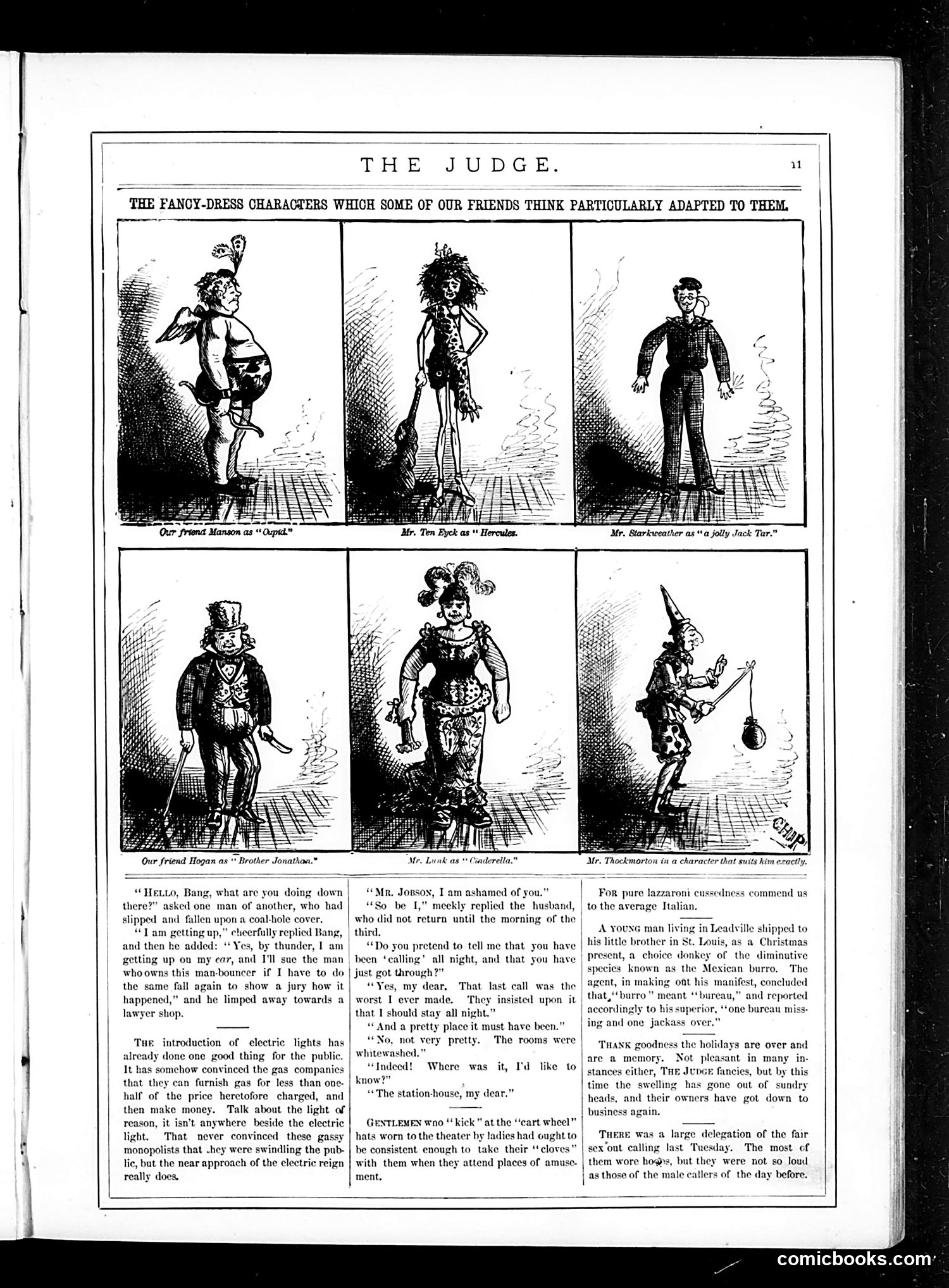
This page from *Judge* magazine presents six cartoon costume suggestions for fancy-dress parties, accompanied by humorous anecdotes. The top row features: a cherub labeled "Cupid," a thin woman as "Hercules," and a man as "a jolly Jack Tar" (sailor). The bottom row shows a man as "Thunder Jonathan," a large woman as "Cinderella," and a thin figure as an unspecified character. The satire works through ironic mismatching—suggesting costumes hilariously unsuited to the wearer's appearance (thin people as strongmen, heavy people as delicate fairy-tale figures). This was typical Victorian-era visual humor. The accompanying text contains unrelated anecdotes about social mishaps: a man falling into a coal-hole, marital discord over late-night "calling" (social visiting), and confusion over shipping a Mexican burro mislabeled as a "bureau." The humor relies on puns, misunderstandings, and period-specific social customs now largely obsolete.
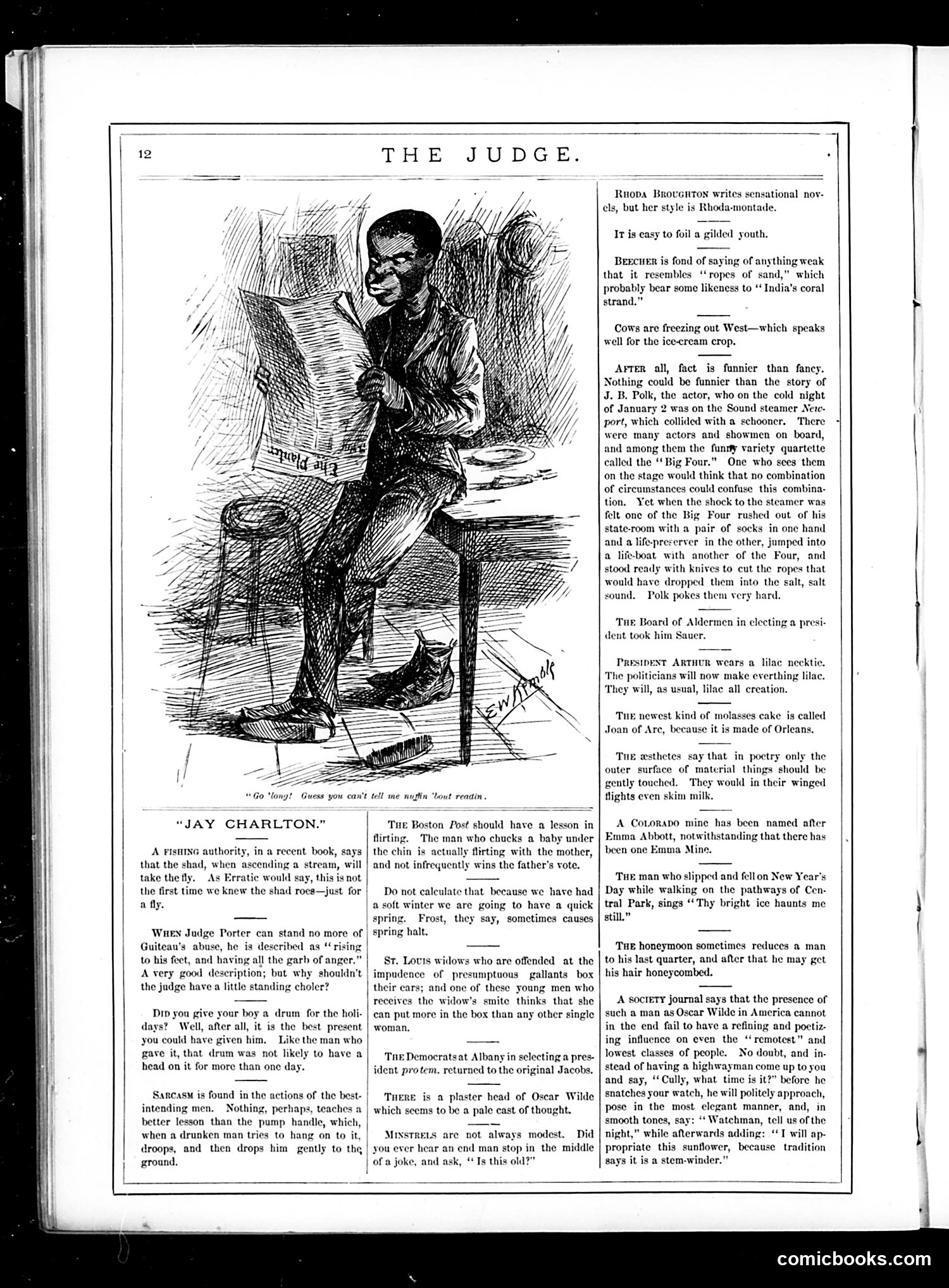
The main cartoon depicts a young man reading a newspaper while seated, labeled "Jay Charlton." The accompanying text explains the joke through various witty observations about current events and social figures. Key references include: - **Judge Porter and Guiteau**: References the trial of Charles J. Guiteau, President Garfield's assassin (1881-1882), where Judge Porter presided - **Oscar Wilde**: The mention of "a plaster head of Oscar Wilde" likely references Wilde's 1882 American lecture tour, which generated satirical commentary - **Arthur**: References President Chester Arthur, newly in office - **J.B. Polk and the "Big Four"**: References an actual 1883 collision of the steamer Newport with a schooner, where the theatrical "Big Four" variety act performed The page is primarily a collection of brief satirical observations on contemporary politics, social customs, and recent events, rather than a single coherent cartoon narrative. The humor relies on readers' familiarity with these specific recent incidents and notable figures.
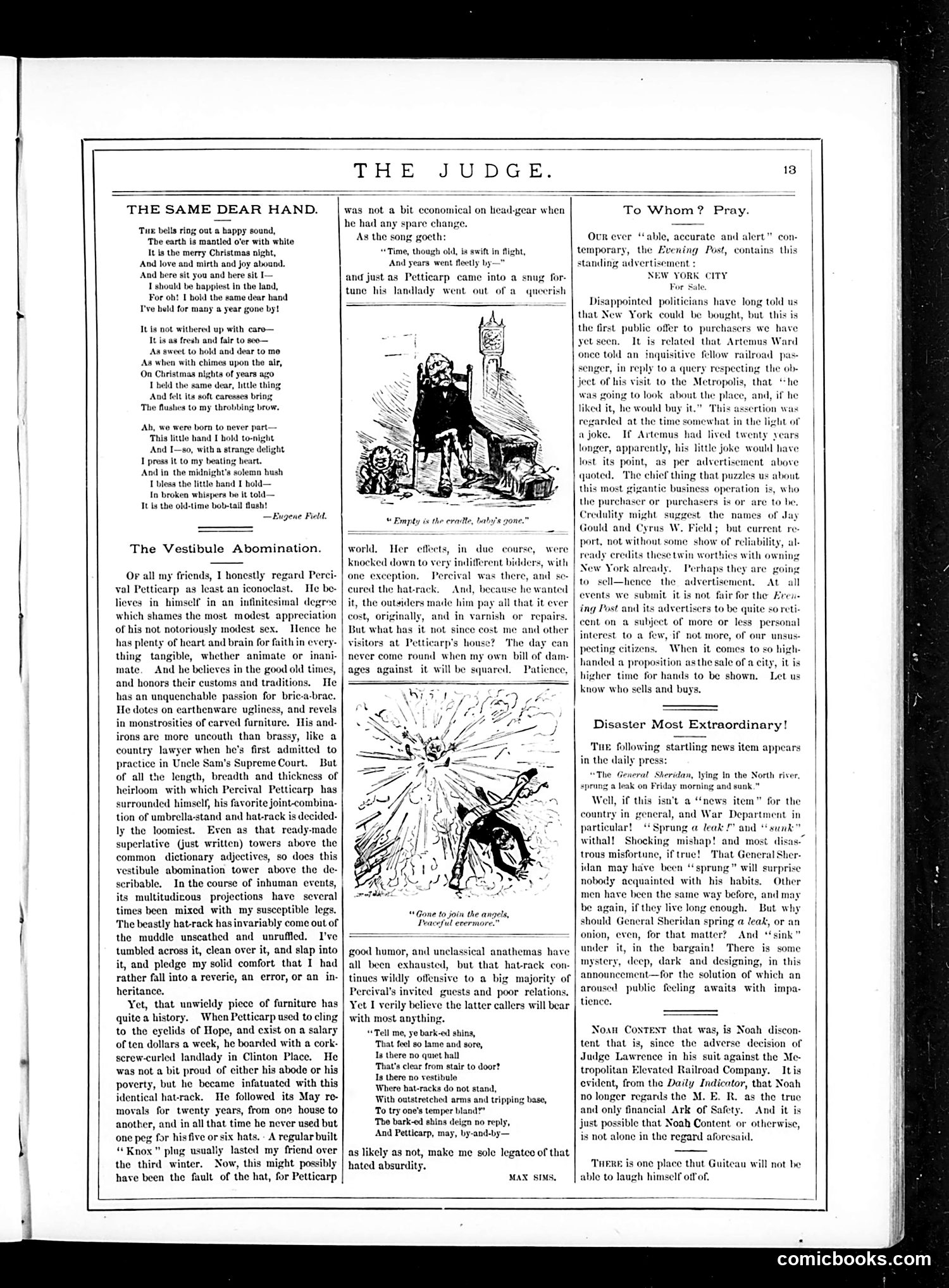
This page contains two satirical pieces from *Judge* magazine: **"The Same Dear Hand"** is a sentimental poem that appears to romanticize holding a beloved's hand on Christmas night—until the final reveal: the "old-time bob-tail flush" is a poker hand, not a person's hand. The joke mocks overly sentimental Christmas literature by disguising gambling/card-playing language as romance. **"The Vestibule Abomination"** mocks a character named Percival Petticarp, who obsessively collects antique furniture and bric-a-brac. The narrator describes Petticarp's prized umbrella stand/hat-rack combination as ugly and dangerous (he keeps tripping over it). The satire targets the Gilded Age fashion for collecting old, impractical items as status symbols—Petticarp followed this hat-rack through twenty years of moves and paid inflated prices for it purely because he wanted it. The piece ridicules both excessive sentimentalism toward "good old times" and wasteful conspicuous consumption among the wealthy.
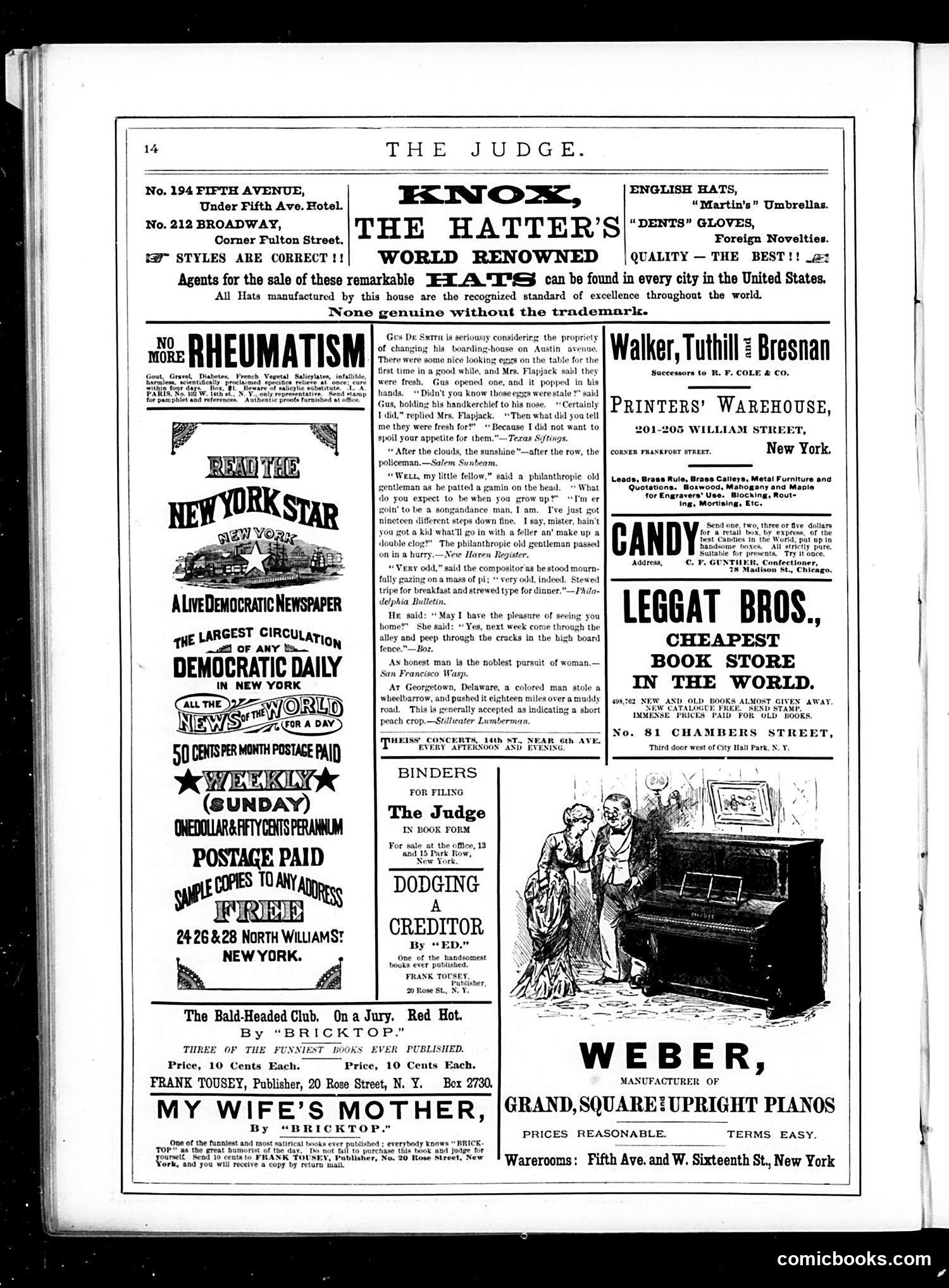
This page is primarily **advertising**, not editorial content or political satire. It contains numerous commercial advertisements for late 19th-century New York businesses: Knox hats, the New York Star newspaper, rheumatism remedies, the Printers' Warehouse, candy, a book store, pianos, and publications like "The Judge" itself in book-binding form. The small text snippets scattered throughout appear to be humorous anecdotes or jokes typical of Judge magazine's satirical humor—brief, often absurdist observations about everyday life (eggs popping, philanthropists meeting street children, a man pushing a wheelbarrow). These lack clear political content. The page serves primarily as a revenue-generating advertisement section rather than as satirical commentary. To understand any specific political or social satire from this issue, one would need to examine other pages featuring actual editorial cartoons or longer satirical pieces.
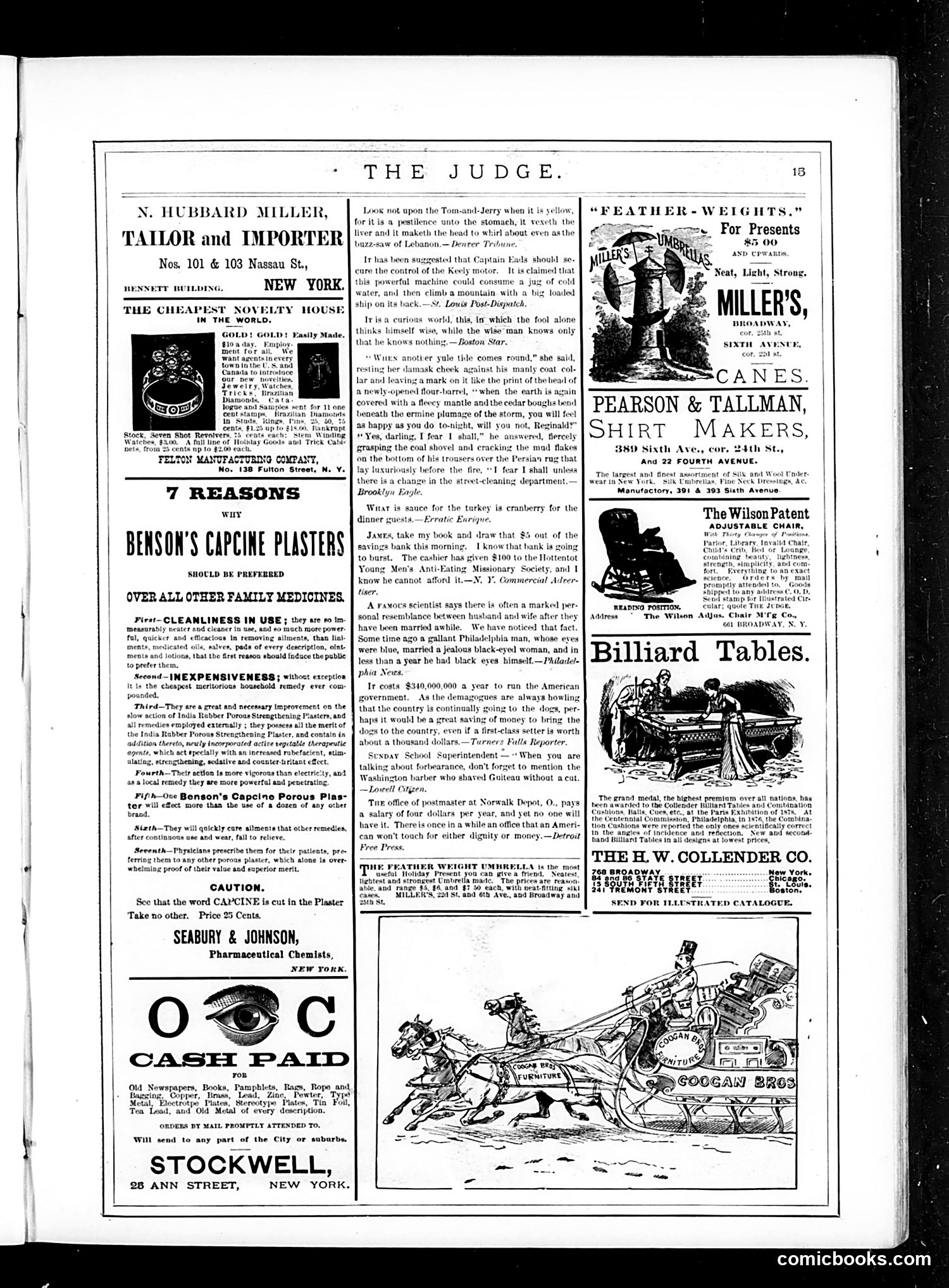
This page is primarily **advertising**, with small satirical snippets interspersed. The main cartoon (bottom right) depicts a horse-drawn coach labeled "Cooggan Bros" with multiple horses and passengers—an illustration for a transport or delivery service. The satirical content consists of brief, humorous quotations and anecdotes scattered throughout: - A joke about a foolish man who thinks his wife is being romantic about winter scenery, but she's actually commenting on his need to shovel coal and clean streets - A scientist's observation that married couples grow to resemble each other physically—illustrated with a joke about a blue-eyed man who married a jealous black-eyed woman and now has black eyes (from her hitting him) - Various other brief witticisms about banking failures, turkey dinners, and postal appointments The page reflects *Judge*'s characteristic style: **light domestic humor and social observation** rather than political satire. The dominant purpose is advertising patent medicines (Benson's Capsine Plasters), tailoring services, and other commercial products to the magazine's readers.
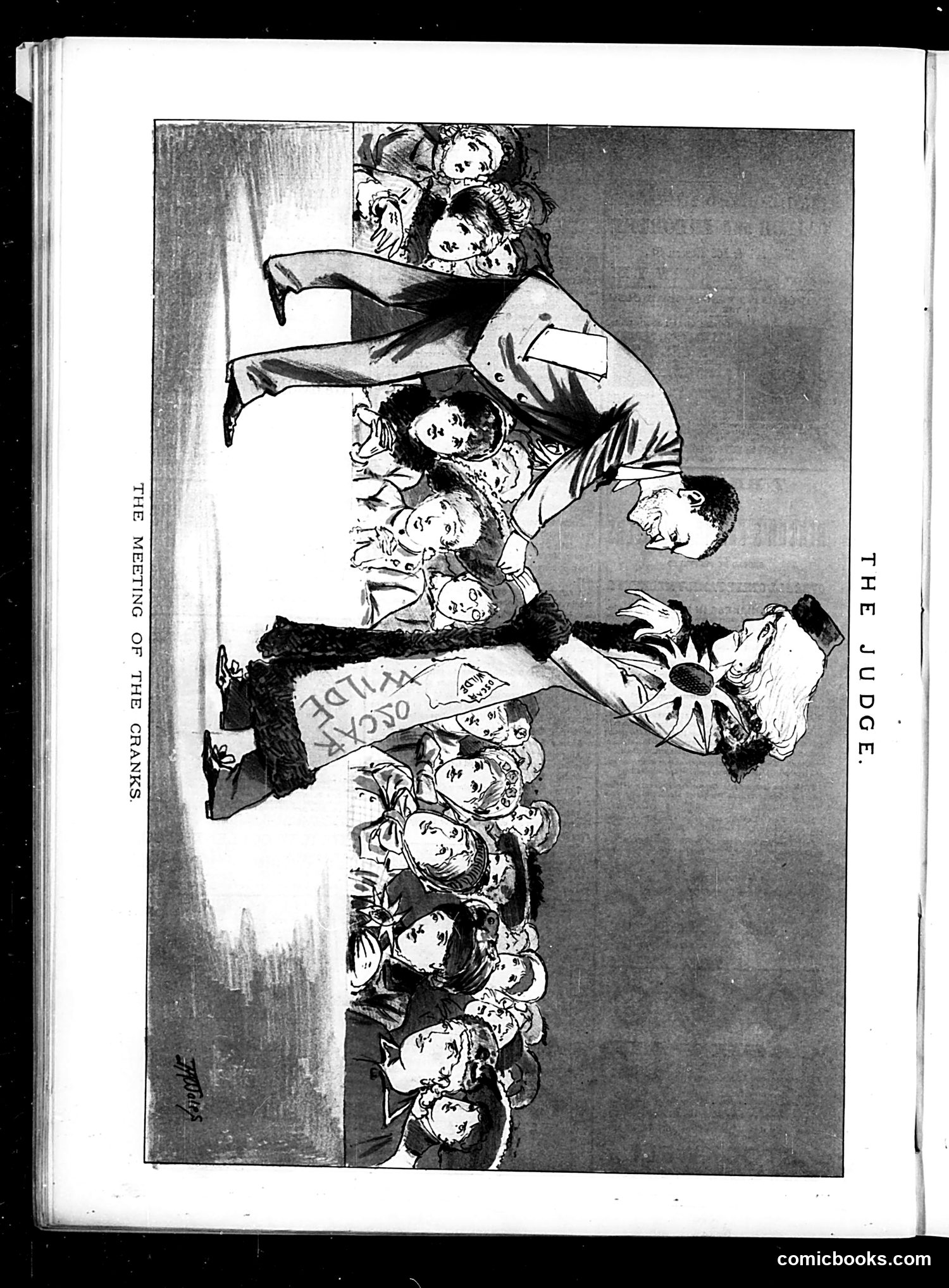
I can see this is a political cartoon from Judge magazine, but the image is rotated 90 degrees, making it difficult to read clearly. The OCR text appears corrupted or reversed ("SHL AO ONILSAW AHL"). From what's visible when rotated: the cartoon depicts a man in formal attire surrounded by numerous children's faces. There appears to be text on his clothing or near him, though it's not entirely legible in this orientation. The title references "THE JUDGE" and "THE MEETING OF THE GRANDS," suggesting this is satirizing a political or social figure dealing with multiple constituencies or dependents. Without clearer text or knowing the publication date, I cannot definitively identify the specific figure or political context being satirized. A properly oriented version would be necessary for accurate interpretation.