
Judge, 1882-01-14 · page 4 of 16
Judge — January 14, 1882 — page 4: what you’re looking at
What you’re looking at
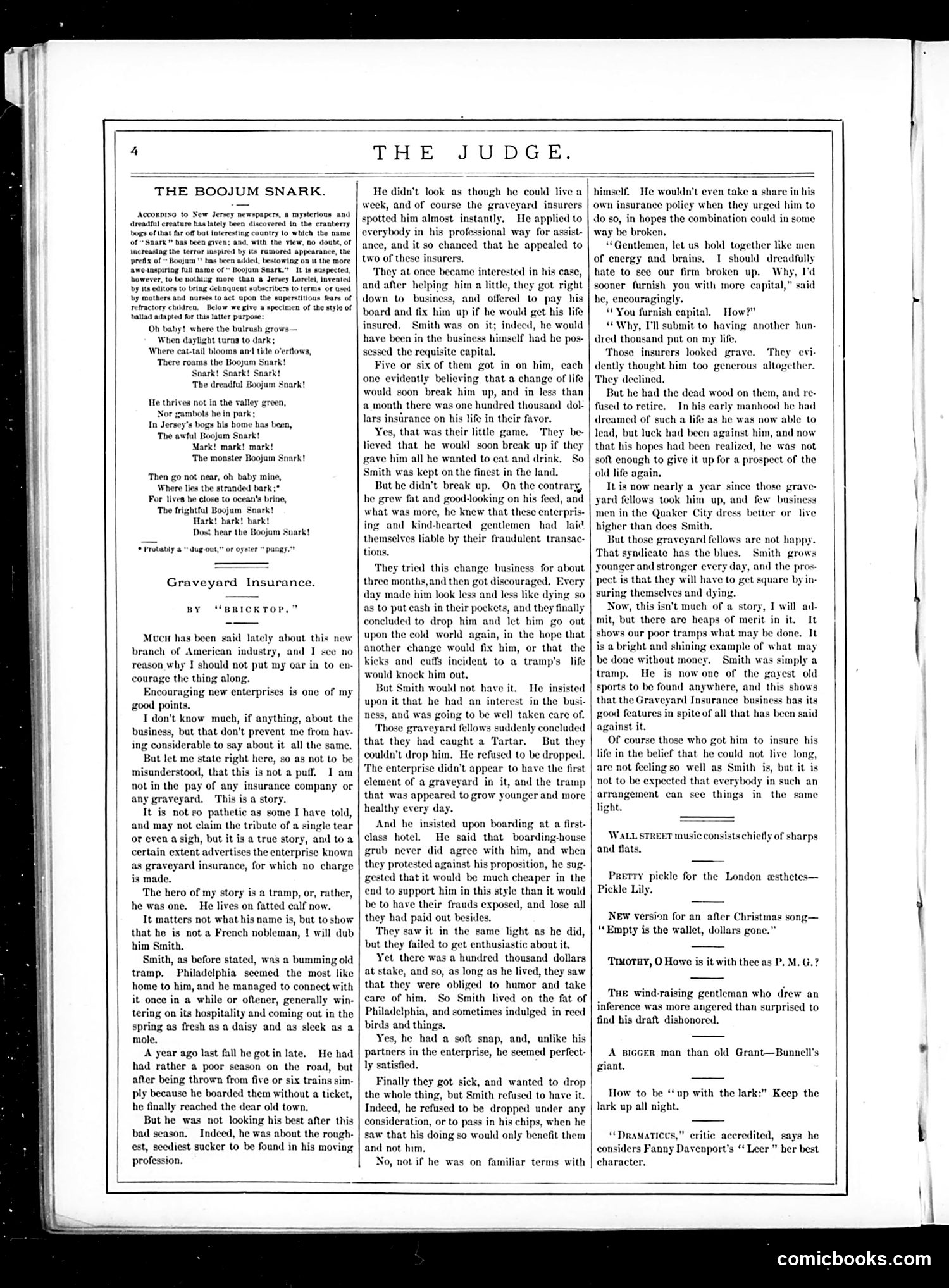
This page contains two distinct pieces of satire from Judge magazine. **"The Boojum Snark"** mocks New Jersey newspapers for inventing a fictional creature—a "mysterious and dreadful" swamp monster—to frighten readers and boost circulation. Judge presents it as obvious journalistic fabrication, likely inspired by Lewis Carroll's literary nonsense (referenced in the title), used either to scare subscribers or frighten disobedient children. **"Graveyard Insurance"** satirizes a real but macabre 19th-century practice: unscrupulous insurance agents insuring destitute people's lives for minimal premiums, then essentially betting on their early deaths. The story describes how insurers target a dying tramp named Smith, offering him food and shelter in exchange for life insurance policies—a parasitic scheme exploiting extreme poverty. The satire criticizes both the industry and the predatory moral logic that treats the poor as profitable death-bets. Both pieces attack fraud and exploitation: one journalistic, one financial.
📄 Transcribed text from this page (OCR, searchable)
Machine-transcribed from the original scan — historical spelling and the odd misread are preserved.
THE JUDGE. | THE BOOJUM SNARK. Acconntxa to New Jersey newspapers, @ mysterious and reatful creature has lately been discovered tn the cranterry bogs of that far off bat nteresting country to which the name of" Snark” bas been given; and, with the view, no doubt, of increasing the terror inspired by Its rumored appearance, tbe prefix of * Hoojam "has been added, bestowing on it the more inspiring fall name of Boojam Snark."’ It ts suspected, wever, to be nothing more than & Jersey Lorelei, invented by its editors to bring Gelinqueot subscribes to terms oF used by mothers and nurses to act upon the superstitious fears of refractory children. Below we give a specimen of the style of hallad adapted for this latter purpose: Oh baby! where the bulrush grows— wi ight turns to dark ‘Where cat-tail blooms an‘ tide 0 There roams the Boojam Snark! Snark! Snark! Snarl The dreadful Boojun en day Snark! He thrives not in the valley green, Nor gambols he in par In Jersey's bogs his home has been, The awful Boojum Snark! Mark! mark! mark! ‘The monster Boojumn Snark! Then go not near, oh baby mine, Where lies the stranded bark ; For lives he close to ocean's brine, The frightful Boojam Snark! Hark! bark! bark! Dost hear the Boojam Snark! ‘¢Protably a *dug-oet,” or oyster * pangs." Graveyard Insurance. BY ‘BRICKTOP. Mucu has been said lately about this new branch of American industry, and I see no reason why I should not put my oar in to en- courage the thing along. Encouraging new enterpri good points, I don’t know much, if anything, about the business, but that don’t prevent me from hav- ing considerable to say about it all the same. But let me state right here, so as not to be misunderstood, that this is not a puff. I am not in the pay of any insurance company or any graveyard. This is a story. It is not co pathetic as some I have told, | and may not claim the tribute of a single tear or even a sigh, but it is a true story, and toa certain extent advertises the enterprise known as graveyard insurance, for which no charge is made. The hero of my story is a tramp, or, rather, | he was one. He lives on fatted calf now. It matters not what his name is, but to show | that he is not a French nobleman, 1 will dub him Smith. Smith, as before stated, was a bumming old | tramp. Philadelphia scemed the most like home to him, and he managed to connect with it once in a while or oftener, generally win- tering on its hospitality and coming out in the spring as fresh asa daisy and as sleck as a | mole. A year ago last fall he got in late. He had had rather a poor season on the road, but after being thrown from five or six trains sim- | ply because he boarded them without a ticket, he finally reached the dear old town. But he was not looking his best after this bad season. Indeed, he was about the rough- est, seediest sucker to be found in his moving profession. 3 is one of my He didn't look as though he could live a week, and of course the graveyard insurers spotted him almost instantly. He applied to everybody in his professional way for assist ance, and it so chanced that he appealed to two of these insurers, ‘They at once became interested in his case, and after helping him a little, they got right down to business, and offered to pay his board and fix him up if he would get his life insured. Smith was on it; indecd, he would have been in the business himself had he pos- sessed the requisite capital. Five or six of them got in on him, cach one evidently believing that a change of life would soon break him up, and in less than a month there was one hundred thousand dol- lars insurance on his life in their favor. Yes, that was their little game. They be- lieved that he would soon break up if they gave him all he wanted to cat and drink, So Smith was kept on the finest in the land. But he didn’t break up. On the contrary, he grew fat and good-looking on his feed, and what was more, he knew that these enterpri: ing and kind-hearted gentlemen had lai themselves liable by their fraudulent transac- ti ns. ‘They tried this change busi three months,and then got discour: day made him look less and less like dy as to put cash in their pockets, and they final concluded to drop him and Iet him go out upon the cold world again, in the hope that another change would fix him, or that the kicks and cuffs incident to a tramp’s life would knock him out. But Smith would not have it. He insisted upon it that he had an interest in the busi- ness, and was going to be well taken care of. ‘Those graveyard fellows suddenly concluded that they had caught a Tartar. But they couldn't drop him. He refused to be droppe ‘The enterprise didn't appear to have the first element of a graveyard in it, and the tramp that was appeared to grow younger and more healthy every da; And he insisted upon boarding at a first- class hotel. He said that boarding-house grub never did agree with him, and when they protested against his proposition, he sug- gested that it would be much cheaper in the end to support him in this style than it would be to have their frauds exposed, and lose all they had paid out besides. They saw it in the same light as he did, but they failed to get enthusiastic about it. Yet there was a hundred thousand dollars at stake, and so, as long as he lived, they saw that they were obliged to humor and take care of him. So Smith lived on the fat of Philadelphia, and sometimes indulged in reed birds and things. Yes, he had a soft snap, and, unlike his partners in the enterprise, he seemed perfect- ly satisfied. Finally they got sick, and wanted to drop | the whole thing, but Smith refused to have Indeed, he refused to be dropped under any consideration, or to pass in his chips, when he saw that his doing so would only benefit them and not him. », hot if he was on fam jar terms with himself, He wouldn't even take a share in his own insurance policy when they urged him to do so, in hopes the combination could in way be broken, “Gentlemen, let us hold together like men of energy and brains, I should dreadfully hate to see our firm broken up. Why sooner furnish you with more capital,” s he, encouraging): “You furnish capital. How? “Why, I'll submit to having another hun- dred thousand put on my life. Those insurers looked grave. They evi- dently thought him too generous al ‘They declined. But he had the dead wood on them, and re- fused to retire. In his early manhood he had dreamed of such a life as he was now able to lead, but luck had been against him, and now that his hopes had been realized, he was not soft enough to give it up for a prospect of the old life again. It is now nearly a year since those yard fellows took him up, and few men in the Quaker City dress better or live higher than does Smith. But those graveyard fellows are not happ; ‘That syndicate has the blues. Smith grows younger and stronger every day, and the pros pect is that they will have to get square by in- suring themselves and dying. Now, this isn't much of a story, I will ad- mit, but there are heaps of merit in it. It shows our poor tramps what may be done. It is a bright and shining example of what may be done without money. Smith simply a tramp. He is now one of the gayest old sports to be found anywhere, and this shows that the Graveyard Insurance business has its good features in spite of all that has been said against it. Of course those who got him to insure his life in the belief that he could not live long, are not feeling so well as Smith is, but it is not to be expected that everybody in such an arrangement can see things in the light. ne ether. craves bnsiness same WaLL street music consists chietly of sharps and flat Pretty pickle for the London asthetes Pickle Lily. New version for an after Christinas song “Empty is the wallet, dollars gone.” Trmotuy, O Howe is it with thee as P. M. G.? Tue wind-raising gentleman who drew an inference was more angered than surprised to find his draft dishonored. R man than old Grant—Bunnell’s Tlow to be ‘‘up with the lark:” Keep the lark up all night. “Dramatics,” critic accredited, says he considers Fanny Davenport's “ Leer " her best character. comicbooks.com