
A complete issue · 18 pages · 1882
Judge — January 7, 1882
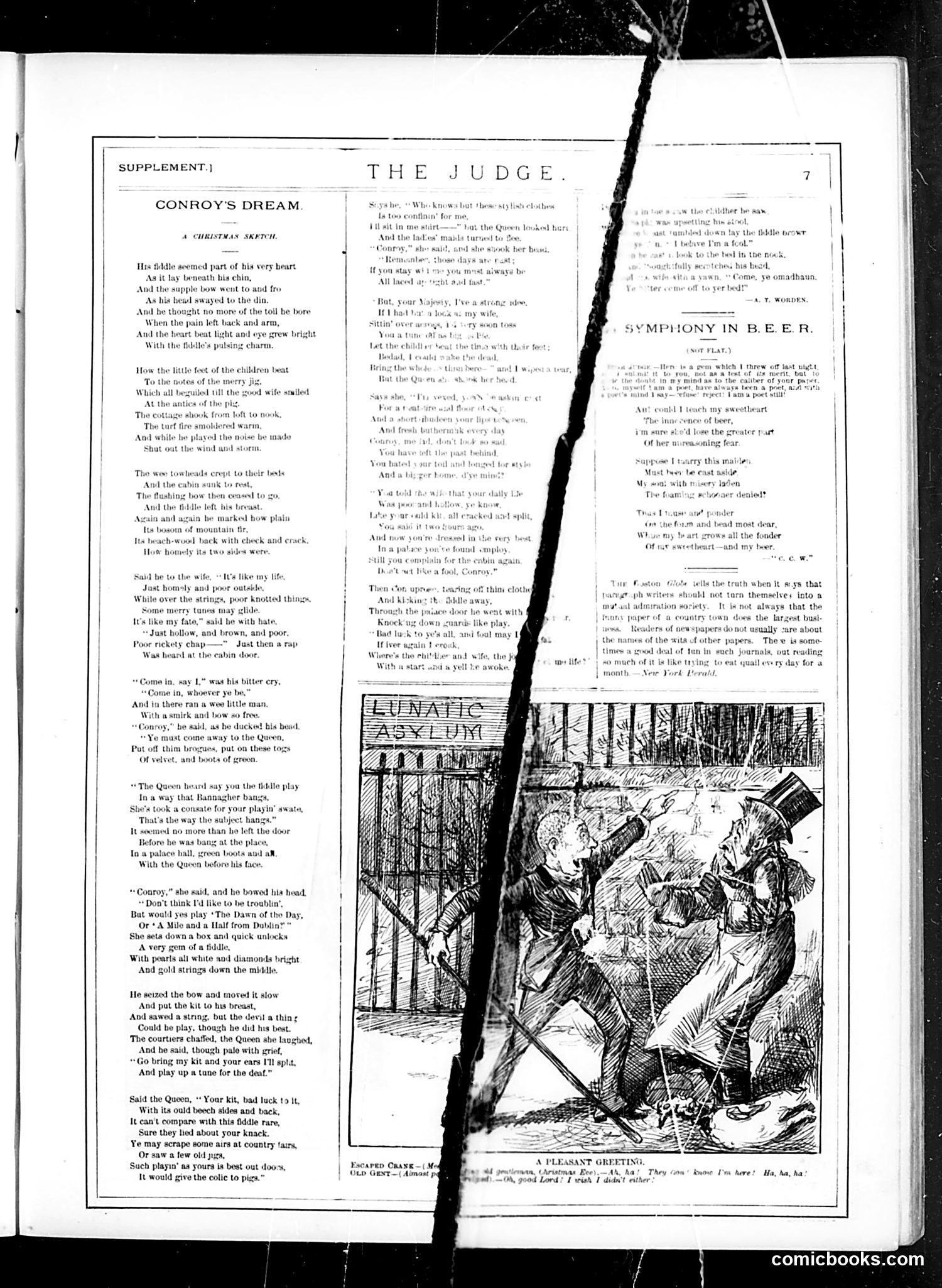
This Christmas sketch satirizes Irish immigrant aspirations and class pretension. "Conroy," likely an Irish character (suggested by the dialect and name), dreams of playing fiddle for the Queen. The narrative contrasts his humble reality—a poor fiddler in a cabin—with his fantasy of royal performance. The satire operates on multiple levels: Conroy's delusion that his crude playing could impress nobility, the Queen's mockery when he fails spectacularly, and his defensive retreat to his original fiddle. The moral appears to be about knowing one's station; when he attempts to play the Queen's ornate instrument (pearls, diamonds, gold), he produces nothing but discord. The accompanying "Symphony in B.E.E.R." cartoon reinforces themes of working-class humor and social boundaries. This reflects 19th-century Judge magazine's tendency to mock Irish immigrants while simultaneously entertaining them—a complex editorial stance blending condescension with populist appeal.
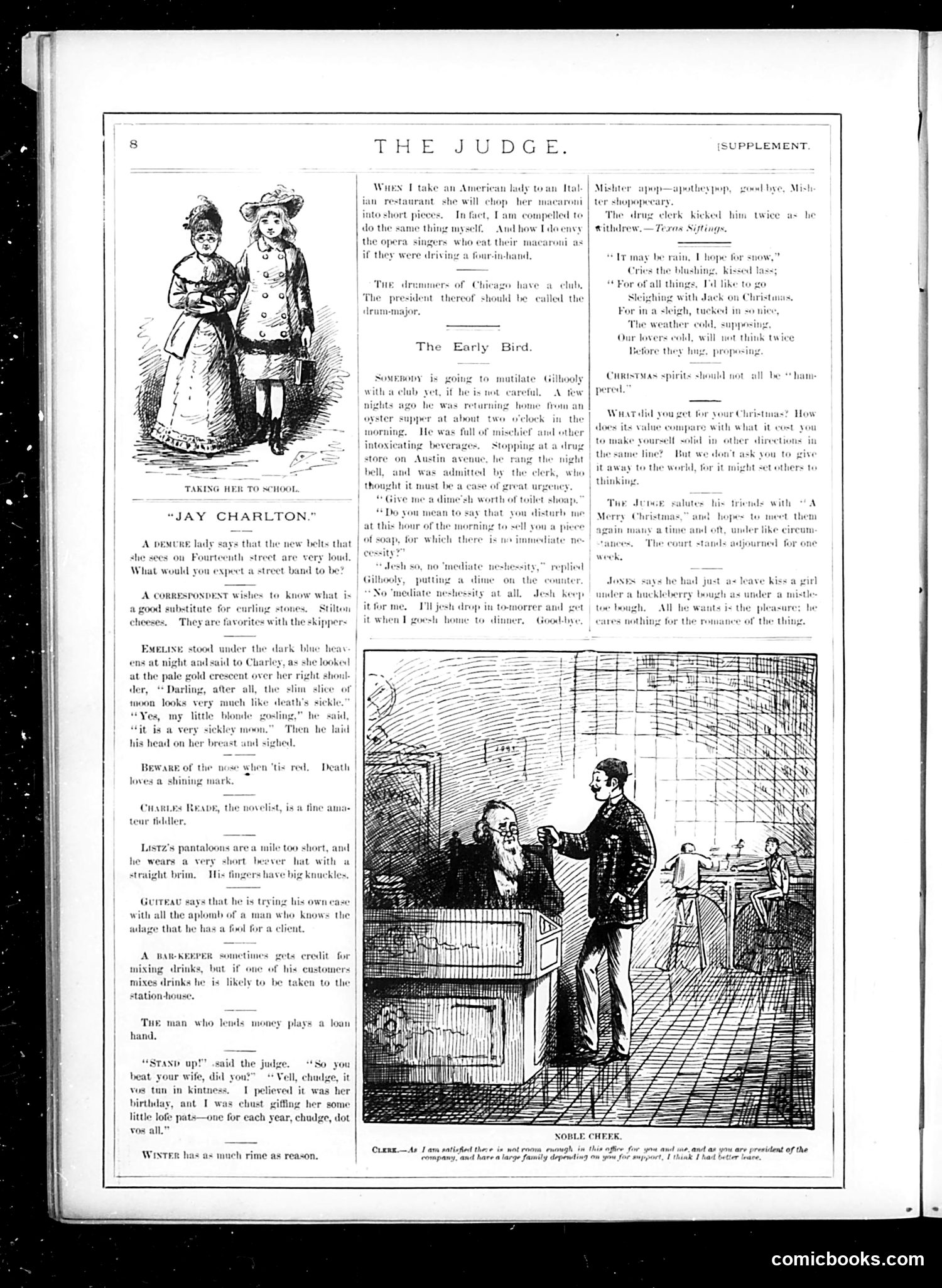
This page from *Judge* magazine contains several brief satirical items and two illustrations mocking contemporary manners and social pretension. **"Taking Her to School"** depicts a fashionable woman and child—likely satirizing how wealthy urbanites dressed children in elaborate clothing for even mundane outings. **"Jay Charlton"** and the surrounding quips ridicule various social types: pretentious diners who eat macaroni "as if driving a four-in-hand" (overdramatic), Chicago's "drum-major" society, and romantic clichés. **"Noble Cheek"** (bottom illustration) shows a clerk confronting an older gentleman about office finances—likely satirizing workplace audacity or class presumption. The scattered one-liners mock specific targets: Liszt's fashion sense, a bar-keeper mixing drinks poorly, and a judge's immigrant accent. The humor relies on observational comedy about urban American life, Victorian social climbing, and ethnic stereotyping typical of 1880s-90s American satire.
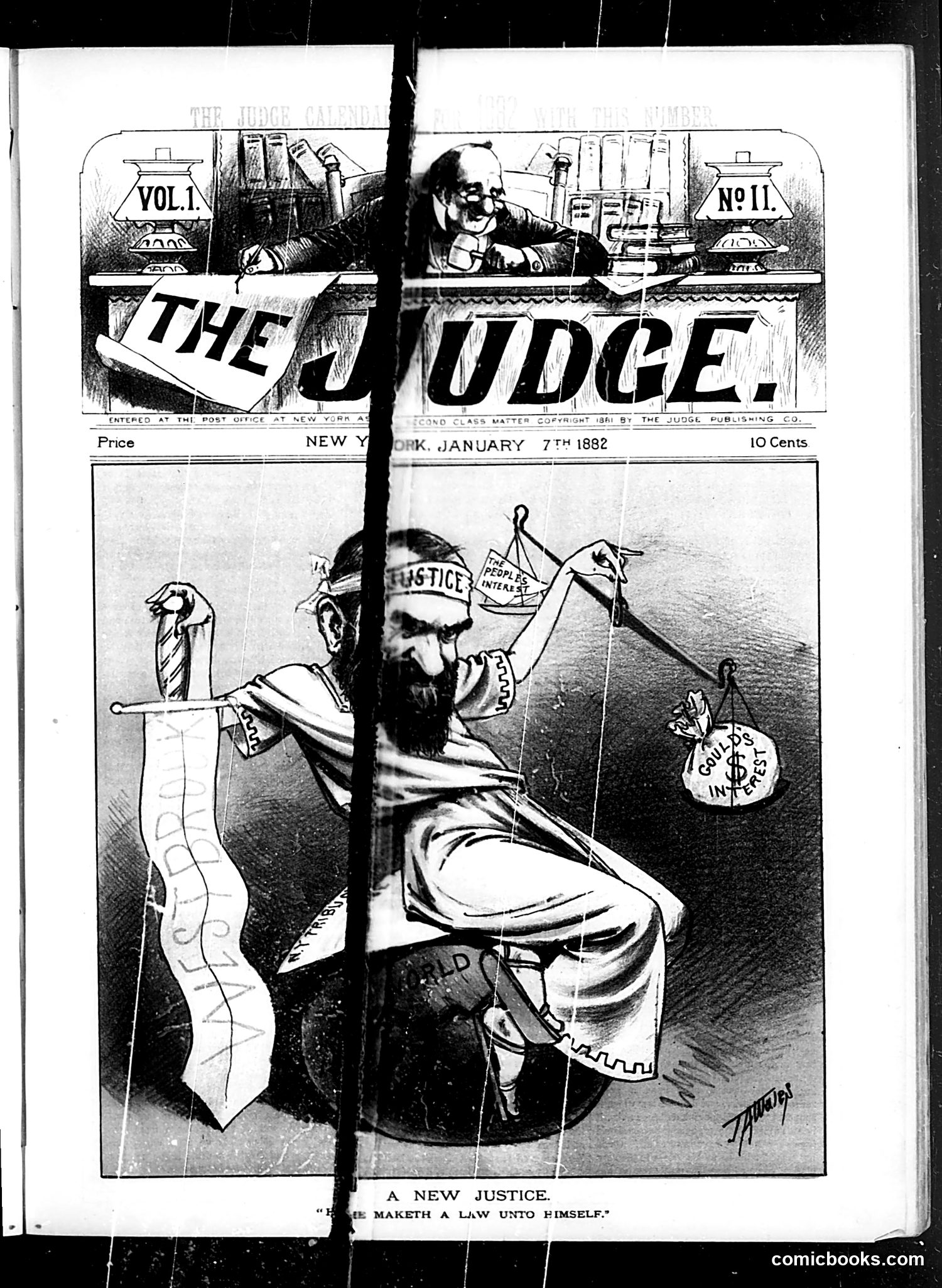
The main cartoon depicts Lady Justice as a bearded man wearing a headband labeled "JUSTICE" and holding scales. Rather than balancing fairly, he manipulates the scales with one hand while the other holds a bag labeled "CORRUPT INTERESTS." A scroll unfurls showing an unequal weighing. The caption quotes scripture: "He maketh a law unto himself"—suggesting a judge or justice system that ignores impartiality and instead serves corrupt financial interests. The image satirizes judicial corruption, implying that those administering justice are illegally enriching themselves rather than upholding law fairly. The figure at top right (possibly an editor or publisher) observes this corruption, suggesting Judge magazine's role as a watchdog exposing institutional decay in the Gilded Age.
This editorial cartoon and accompanying article attack **Jay Gould**, the notorious robber baron and Wall Street manipulator, for his corruption of the Manhattan Elevated Railroad. The piece condemns Gould's use of bribery and political connections—specifically judges like Theodoric Westbrook and Attorney-General Hamilton Ward—to escape legal consequences for what the editor calls "the most glaring piece of rascality." The cartoon's central figure appears to be Gould himself, depicted as a criminal deserving prosecution. The article references Gould's earlier association with Boss Tweed's corruption ring and argues that despite the *New York Times* exposing his crimes, he continues operating with impunity through a corrupt judiciary. Judge magazine demands he finally face criminal indictment and imprisonment—hence "Put Jay Gould to the Bar" (meaning trial, not social gathering).
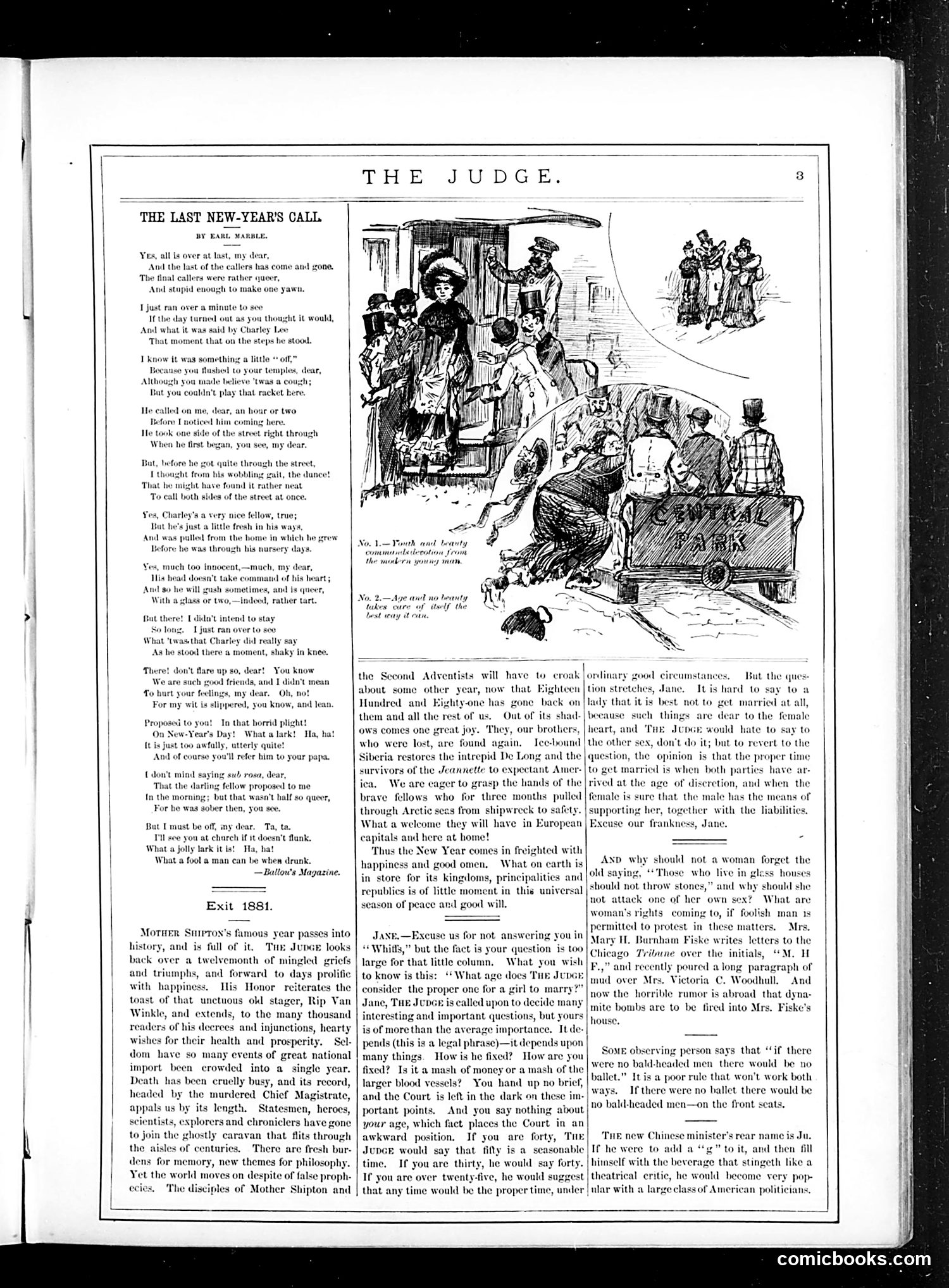
This page contains a poem by Earl Warble satirizing New Year's social conventions (particularly the Victorian custom of making courtesy calls). The verses mock the tedious ritual of visiting acquaintances, with a speaker complaining about an unexpected drunk visitor who showed up unannounced. The accompanying illustrations show chaotic New Year's scenes—crowded domestic spaces with well-dressed visitors in various states of disarray, capturing the social mayhem of obligatory holiday calling. The editorial content discusses the approaching 1882, optimistically welcoming news that Arctic explorers De Long and the Jeannette crew were rescued. It also addresses readers' questions about proper marriage age, expressing the era's conventional view that women should marry when financially secure and "of discretion." A final item references Victoria C. Woodhull (a controversial women's rights advocate and spiritualist) being publicly attacked in the Chicago Tribune, which Judge treats with bemused detachment—typical of the magazine's satirical stance toward contemporary social controversies.
This page contains **humorous letters and anecdotes** rather than political cartoons. The satire targets everyday absurdities: 1. **"Our Original Norristown Budget"**: A reader complains about being directed to a "sensible, instructive" library book with an unpronounceable foreign title (likely Dutch or German). The joke mocks pretentious literary recommendations—the book may be worthwhile, but life's too short to learn a new language for it. He settles for Zola instead. 2. **School for Choosing Mates**: Mock outrage that a New York man is teaching boys and girls how to select romantic partners. An Irish character dismisses this as unnecessary; those ignorant of mate-selection deserve nothing better than dry bread. 3. **Patent Medicine Testimonial**: A doctor receives a "testimonial" praising his pills because his wife attended church after taking them—but the real cause was a new sealskin coat he'd given her. The satire mocks both dubious medical claims and women's materialism. The page's humor is genteel, domestic, and character-driven rather than overtly political.
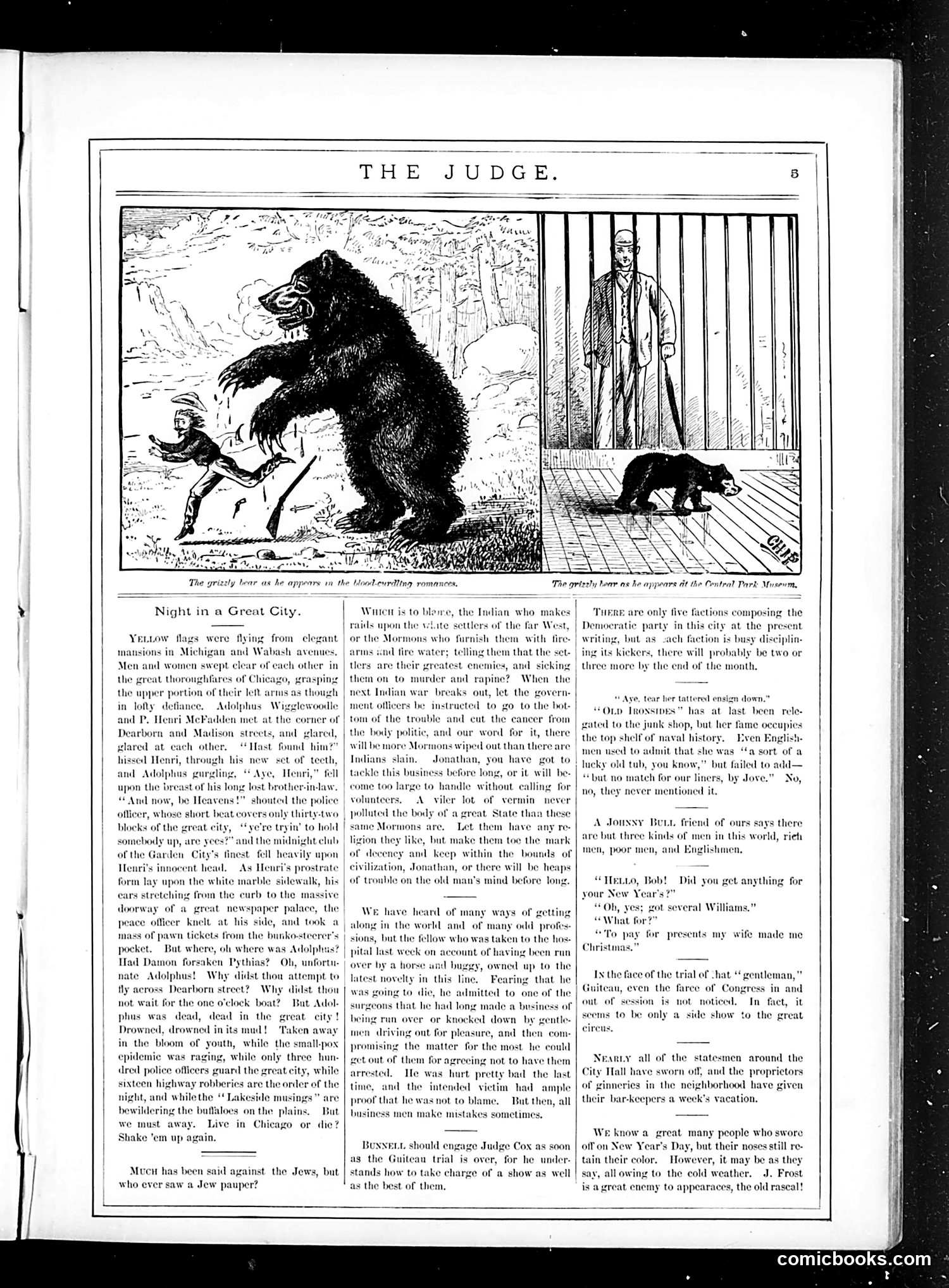
This page contains two distinct cartoon panels satirizing American life circa the 1880s. **Left panel**: Depicts a grizzly bear wrestling a frontiersman, captioned as "the grizzly bear as he appears in the Dime-novel romances." This mocks the exaggerated Wild West adventure narratives popular in dime novels—contrasting their romanticized depiction with reality. **Right panel**: Shows a menacing dog confronting a well-dressed man (appears to be a judge, given the page title). The caption references "The grizzly bear as he appears at the Federal Park, Wasatch," suggesting ironic contrast between fictional and real danger. **Text content**: Articles discuss anti-Mormon sentiment, criticizing Mormon settlers and calling them "vermin." One piece sarcastically defends Jewish people against stereotyping ("Much has been said against the Jews, but who ever saw a Jew pauper?"). Another references the Guiteau trial (likely Charles Guiteau, President Garfield's assassin, 1881). The satire targets dime-novel fantasies, Western religious tensions, and contemporary judicial proceedings, while making pointed social commentary about prejudice.
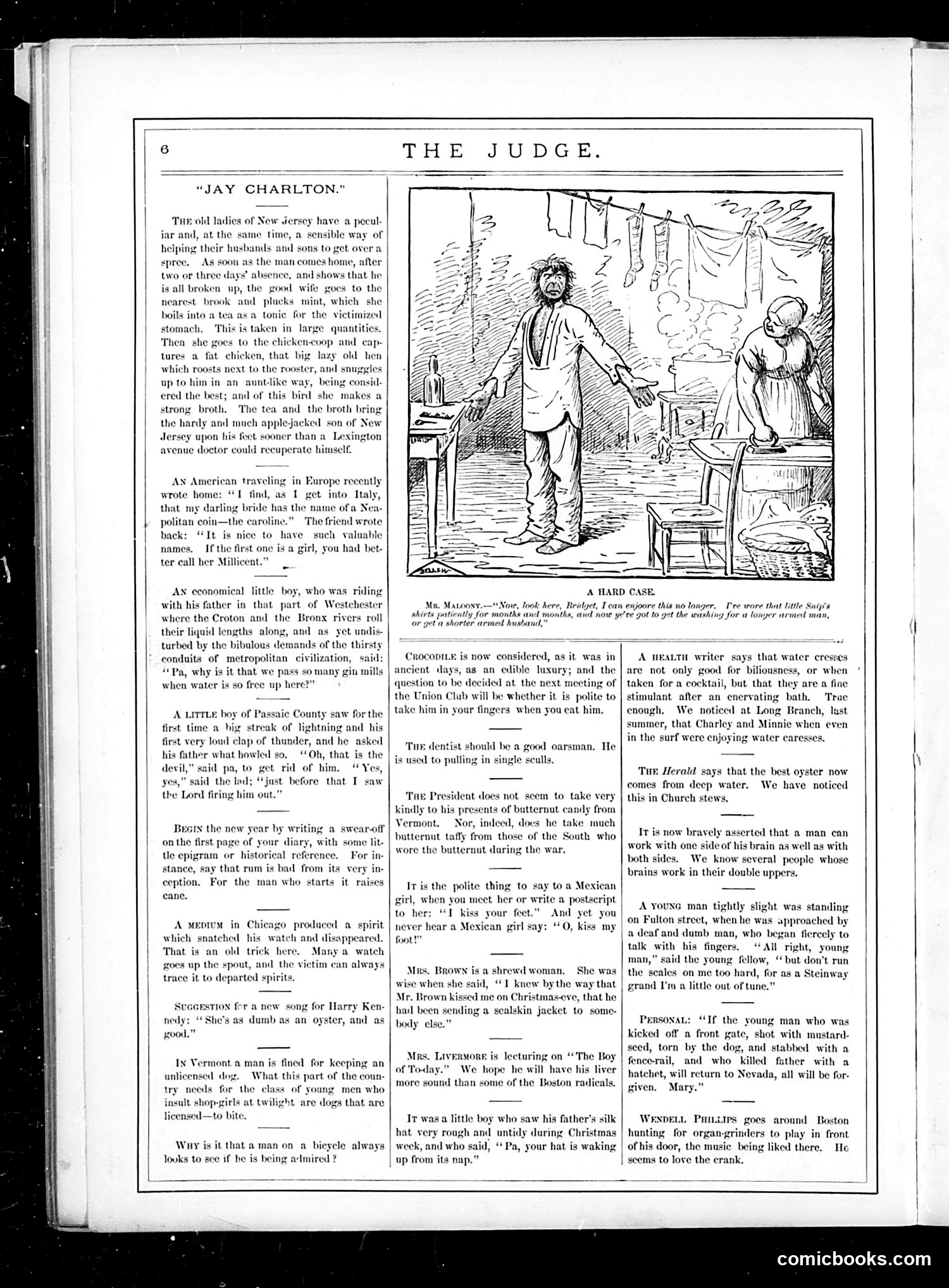
This page from Judge magazine is a collection of brief satirical commentaries and jokes typical of late 19th-century American humor. The main cartoon depicts "A Hard Case"—a domestic dispute where a woman (likely Irish, suggested by the name "Bridget") complains to a man about laundry work, sarcastically wishing for "a longer armed man" to do the washing. The surrounding text consists of short, punchy observations mocking various targets: wealthy New Yorkers, ineffectual politicians (the President's indifference to butternut candy gifts), pretentious travelers, spiritualist mediums, Mexican customs, and Irish domestic workers. References to "butternut" (Confederate uniforms) suggest Civil War-era tensions lingering in Reconstruction-era America. The humor relies on period stereotypes—Irish servants, Mexican girls, incompetent dentists—and social commentary on class, gender relations, and Gilded Age absurdities. The overall tone is lighthearted mockery of contemporary American society.
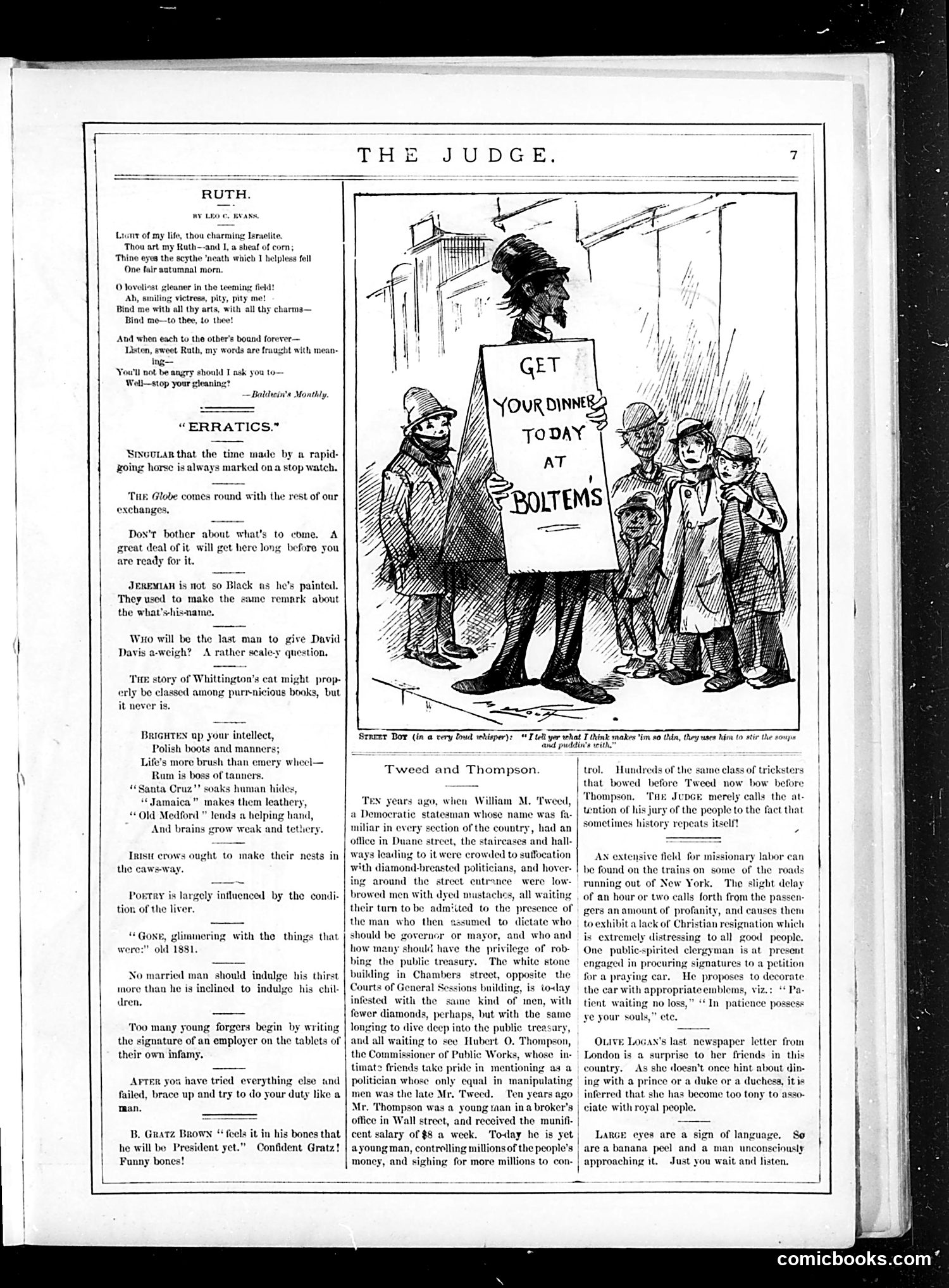
This page contains multiple satirical pieces typical of 1880s American humor: **The Main Cartoon** depicts a tall figure (appearing to be a wealthy man or politician) holding a sign advertising "Boltem's" restaurant to street children. The caption suggests the figure is cynically promoting cheap food to the poor, likely satirizing either a particular businessman's exploitation or general class hypocrisy. **"Tweed and Thompson"** is the substantive piece: it compares Commissioner of Public Works Hubert O. Thompson to the notorious Boss William M. Tweed (imprisoned for corruption). The article suggests Thompson, like Tweed years earlier, attracts corrupt politicians and manipulators seeking access to public money. Judge is warning readers that Thompson represents the same pattern of governmental corruption and self-enrichment that Tweed exemplified—"sometimes history repeats itself." The remaining content includes minor jokes, poetry, and brief satirical observations on contemporary topics, typical of the magazine's format.
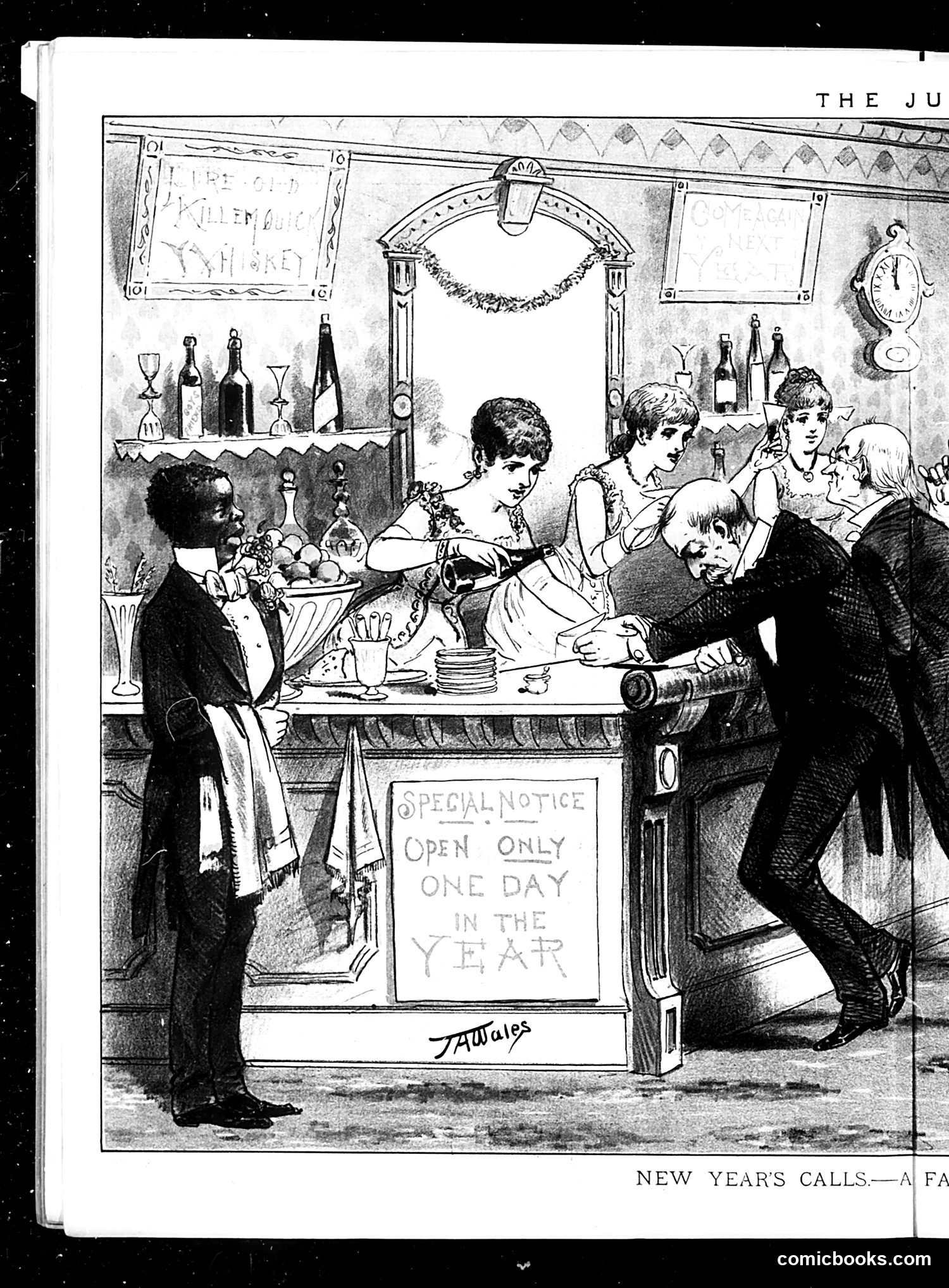
This cartoon satirizes the tradition of New Year's social calls—formal visits made on January 1st. The storefront bears a sign reading "SPECIAL NOTICE: OPEN ONLY ONE DAY IN THE YEAR," suggesting this establishment (likely a bar or refreshment parlor) capitalizes on the annual custom. The scene depicts well-dressed men in formal attire making obligatory New Year's visits to women, who serve drinks and refreshments. The satire targets the artificiality and commercial exploitation of this social ritual—the business operates solely to service these obligatory calls, and participants engage in the formalized but insincere social performance. The cartoon mocks both the hollow nature of the tradition itself and how businesses profited from it.
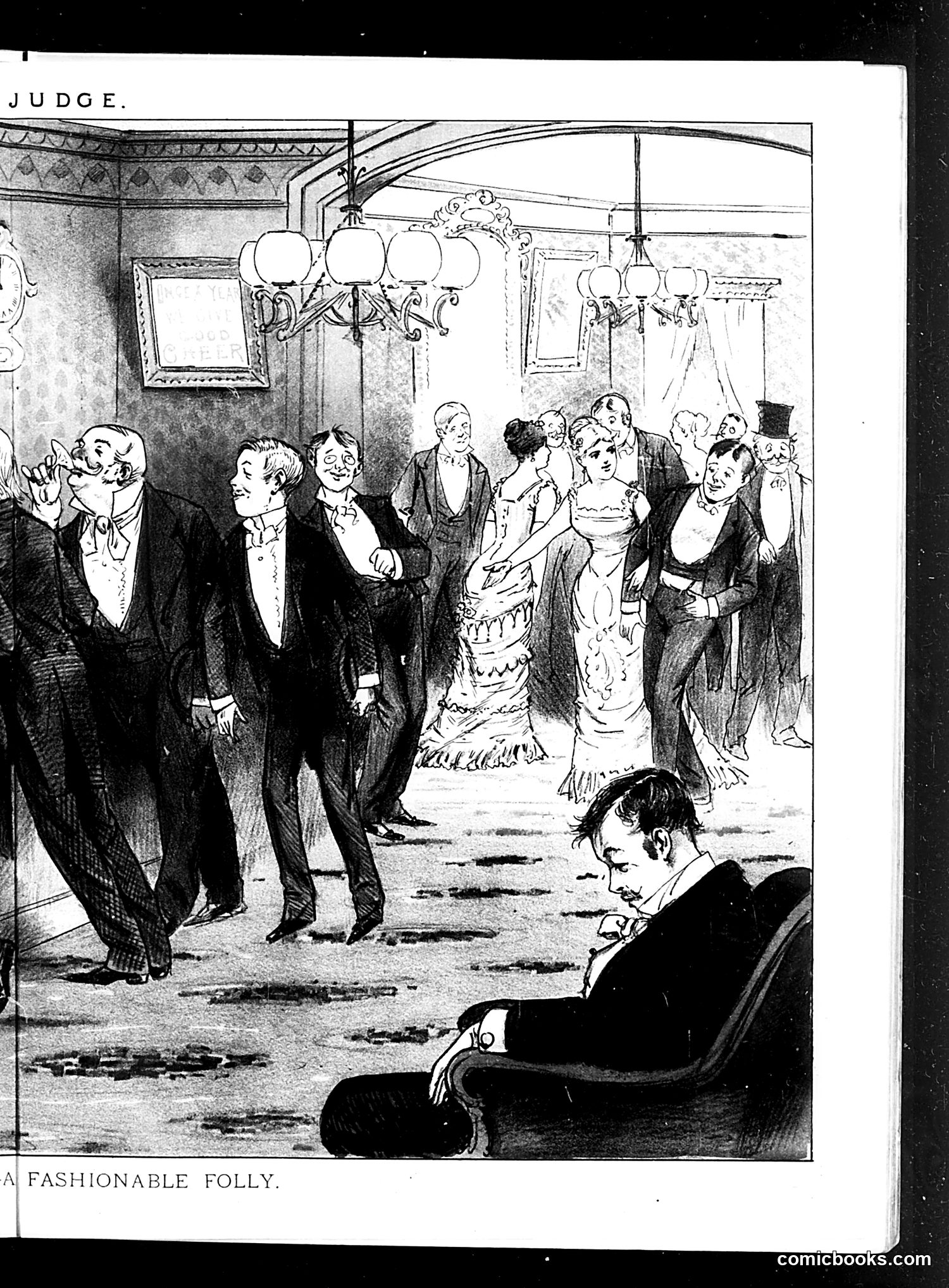
This Judge cartoon satirizes high-society social behavior, likely from the Gilded Age era. The scene depicts an elegant ballroom where well-dressed gentlemen in formal attire observe fashionably-dressed women. A man sits alone in the foreground, apparently dejected or bored, while the crowd mingles beneath ornate chandeliers. The satire targets the superficiality and pretension of fashionable society—the "folly" of the title. The isolated figure suggests social awkwardness or exclusion amid the glittering crowd, implying that fashionable gatherings prioritize appearance and status over genuine connection or substance. The cartoon mocks both the elaborate dress codes and the shallow social dynamics of wealthy urbanites concerned primarily with maintaining fashionable appearances.
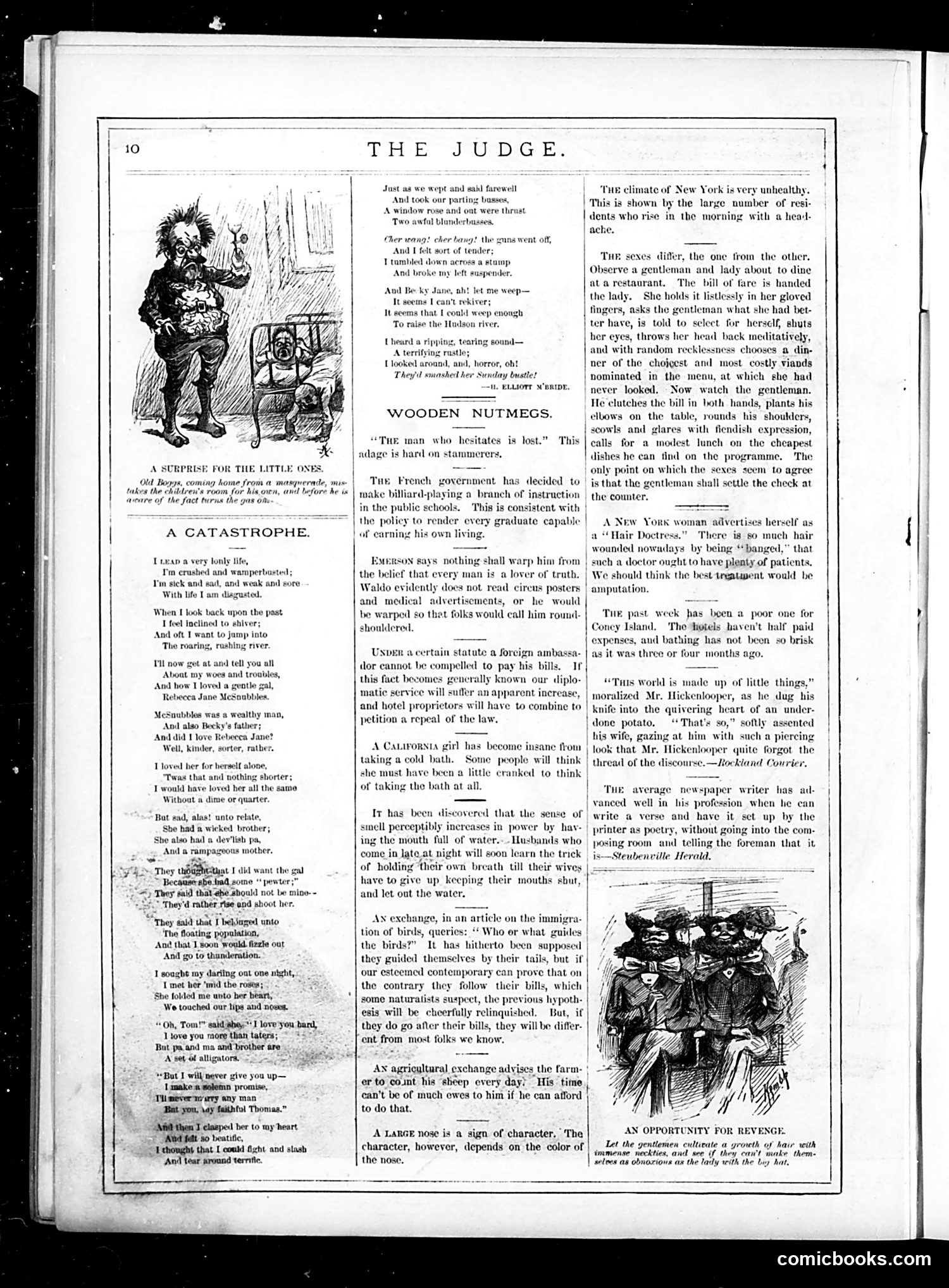
This page contains **two main pieces of satirical content**: ## "A Catastrophe" (Poem with Illustration) A melodramatic narrative poem about a spurned lover named Tom whose romance with Rebecca Jane is violently interrupted when her family shoots at them through a window with blunderbusses. The satire mocks overly dramatic, sentimental Victorian poetry and romance conventions—the narrator's histrionics about heartbreak are deliberately excessive and absurd. The crude illustration shows the violent domestic interference, poking fun at both romantic clichés and family opposition to unsuitable matches (Tom appears to be working-class, while Rebecca is wealthy). ## "Wooden Nutmegs" (Brief Satirical Observations) Short quips on contemporary life: French billiard-playing in schools, Emerson's naive idealism about truth, diplomatic immunity, bathing dangers, and bird migration. These mock various social pretensions, scientific claims, and public figures—typical Judge fare that offered light social commentary on current events and absurd modern trends. The page exemplifies Judge's style: visual and textual satire targeting Victorian sentimentality, class pretension, and contemporary foolishness.
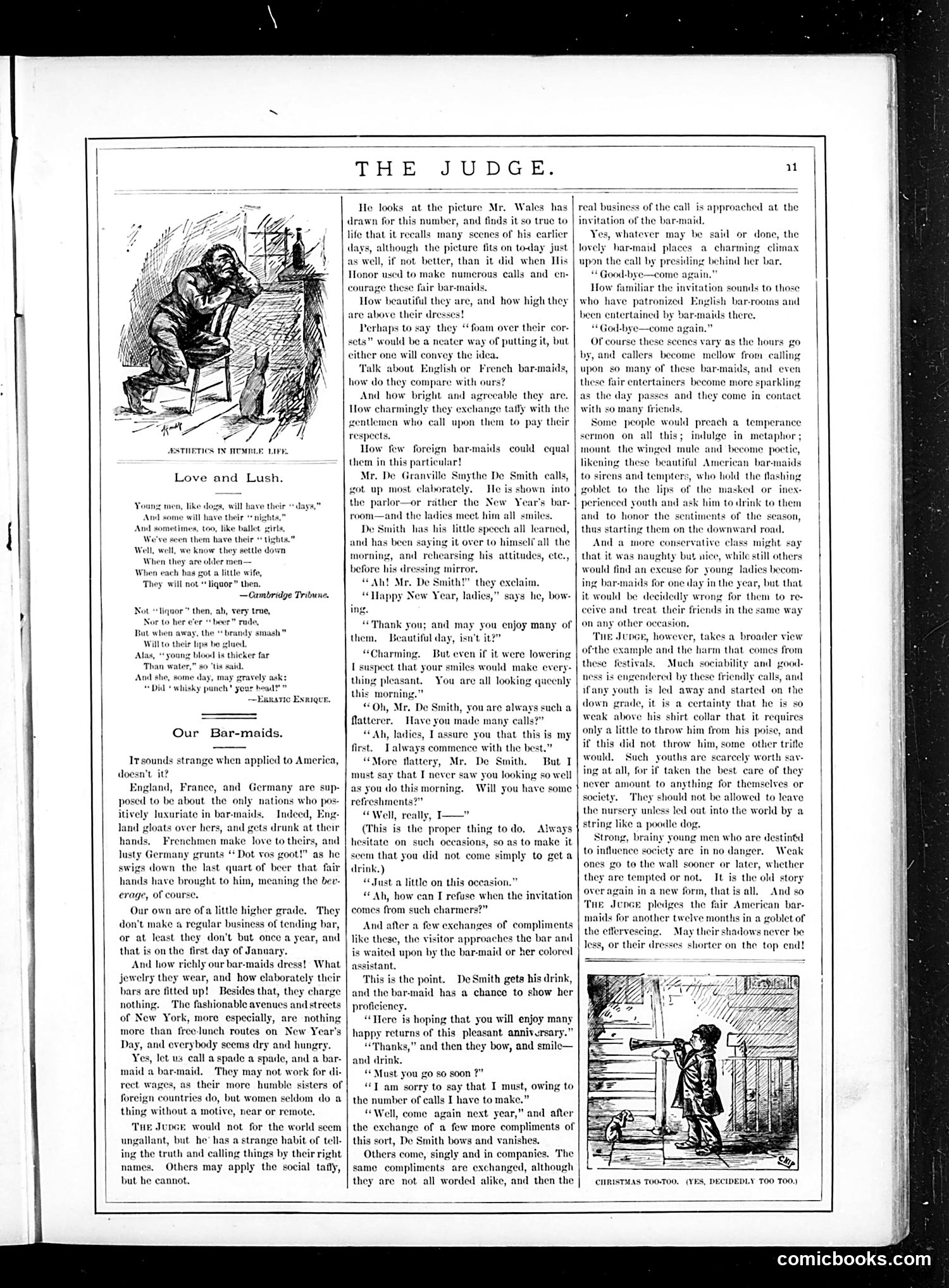
This page satirizes American hypocrisy regarding "bar-maids"—women who serve drinks, particularly on New Year's Day. The artist (credited to "Wales") depicts an elaborately dressed gentleman, Mr. De Granville Smythe De Smith, making social calls to bars with flattering compliments. **The satire's point:** Judge contrasts European bar-maids (who work professionally year-round in England, France, and Germany) with American ones, who only "work" on New Year's Day when fashionable women serve free drinks at bars along New York's avenues. Judge mocks this pretense: these aren't genuine bar-maids but society women engaging in a ritualized annual performance, yet they're treated as such. The accompanying poem "Love and Lush" further mocks how young men and women claim to reform after marriage, though habits persist. Judge's irreverent tone—calling things by their "right names" rather than polite euphemisms—is the magazine's signature approach to social commentary.
This is a satirical theatrical sketch mocking the New York upper-class tradition of New Year's Day social calls. The humor centers on the pretension and tedium of the custom. Three wealthy bachelors—St. James Passaic, Adolphus Hackensack, and Fitznoodle Cohoes—must make formal calls to maintain their social standing, despite having only three legitimate visits planned. To appear respectable (St. James told his landlady he'd make 100 calls), they scheme to crash an uninvited reception at the McGuire mansion, hoping to get their names mentioned in newspaper society pages. The satire targets both the absurdity of the calling ritual itself—requiring full dress, consuming entire days with manufactured visits—and the social climbing desperation it reveals. The ladies receiving calls similarly treat it as obligatory performance rather than genuine social engagement. The sketch ridicules Gilded Age conventions where appearance and social standing mattered more than authenticity.
This page from *Judge* magazine consists primarily of **theatrical brief reviews** and advertisement-style notices about actors and performers. Rather than a political cartoon, it's a humor column mocking stage actors of the era. The "Theatrical Briefs" section satirizes various actors by listing dubious "gifts" they supposedly received—insulting mock-awards highlighting their perceived flaws. For example, one actor receives "a new idea of humor," another gets "some proper consideration," and another receives criticism about their accent or acting ability. The page also includes a short story or poem titled **"There is a Time"**—a sentimental narrative about a young man's life trajectory through romantic disappointment and eventual artistic fulfillment, contrasting youthful idealism with mature realization. The bottom section, "Whiffs with Correspondent," contains brief reader letters and responses. This represents *Judge*'s satirical approach: theatrical gossip and actor mockery aimed at contemporary entertainment audiences familiar with these performers' work.
This page is primarily **advertising and notices**, not editorial content. The dominant features are commercial advertisements for businesses like Knox Hats, a Democratic newspaper, printers' warehouses, piano manufacturers, and book publishers. The only apparent editorial/satirical content is a small section titled **"DODGING A CREDITOR"** (bylined "ED."), which appears to be a humorous short story or sketch—a common Judge feature. The text references someone trying to avoid debts, a relatable comedic theme for readers. Below that are advertisements for Frank Tousey's published works, including titles like *The Bald-Headed Club* and *My Wife's Mother*—apparently humorous books priced at 10 cents. There is **one cartoon illustration** showing two figures at a piano (Weber brand), likely accompanying one of the advertised stories, though its specific satirical point is unclear from this image alone. Overall, this is a typical mixed page combining commercial advertising with light entertainment content typical of 19th-century American magazines.
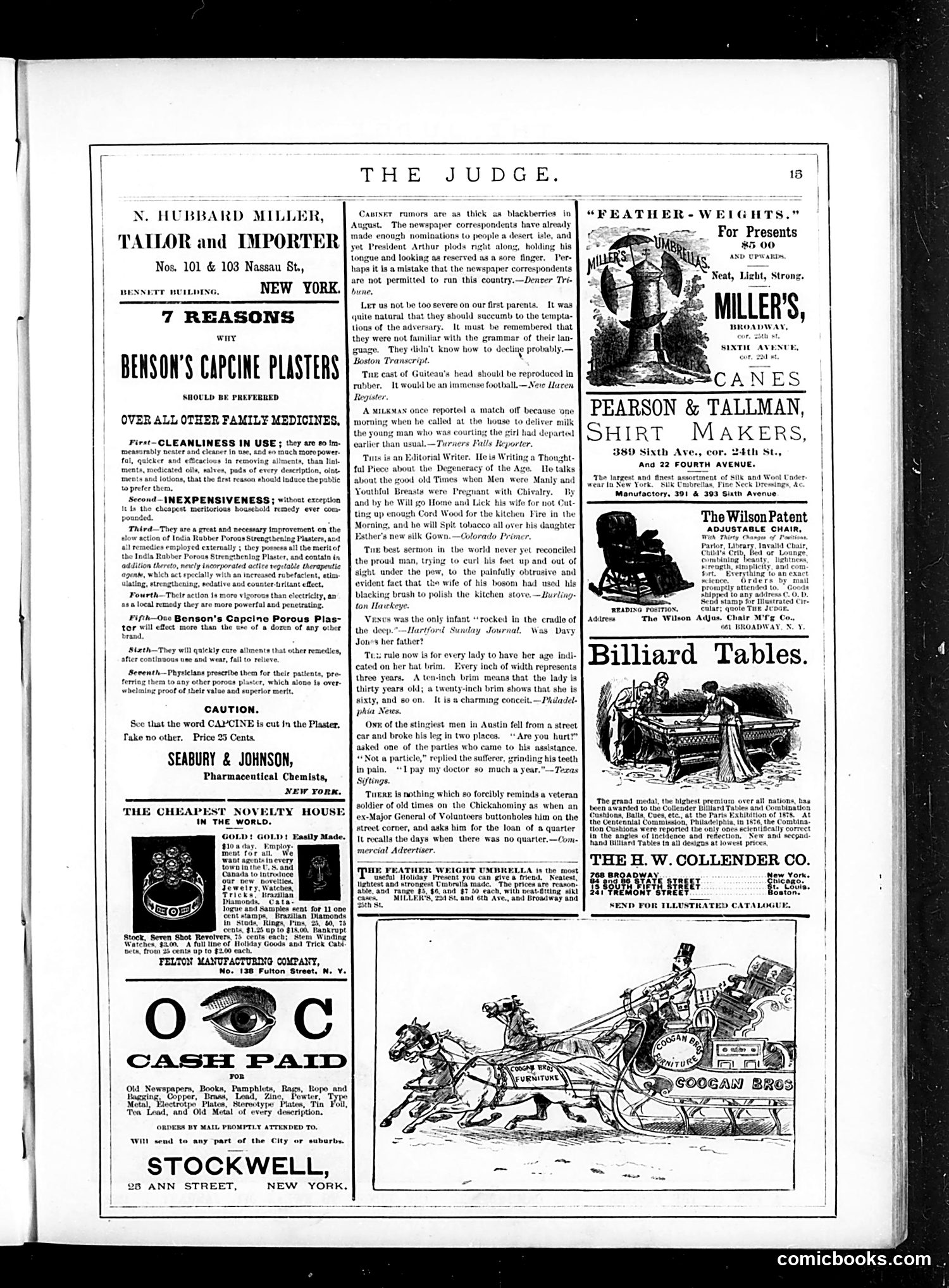
This page is primarily **advertisements** interspersed with brief satirical editorial snippets rather than a full cartoon. The visible satirical content includes: **Editorial Jokes:** - A jab at **newspaper correspondents** controlling politics ("It is a mistake that the newspaper correspondents are not permitted to run this country") - A reference to **Guiteau's head** (Charles J. Guiteau, who assassinated President Garfield in 1881), suggesting his cast should be reproduced as a football—dark gallows humor about a recent national tragedy - Commentary on a man asking for a quarter at a street corner, implying panhandling or economic hardship - Mockery of an aging man complaining about "degeneracy of the age" who then goes home to beat his wife—satirizing hypocritical nostalgia for "better times" **Context:** This appears to be from the 1880s (post-Garfield assassination). The satire targets journalism, poverty, male hypocrisy, and domestic violence with Judge's characteristically cynical humor. Most of the page, however, consists of commercial advertisements for various goods and services.
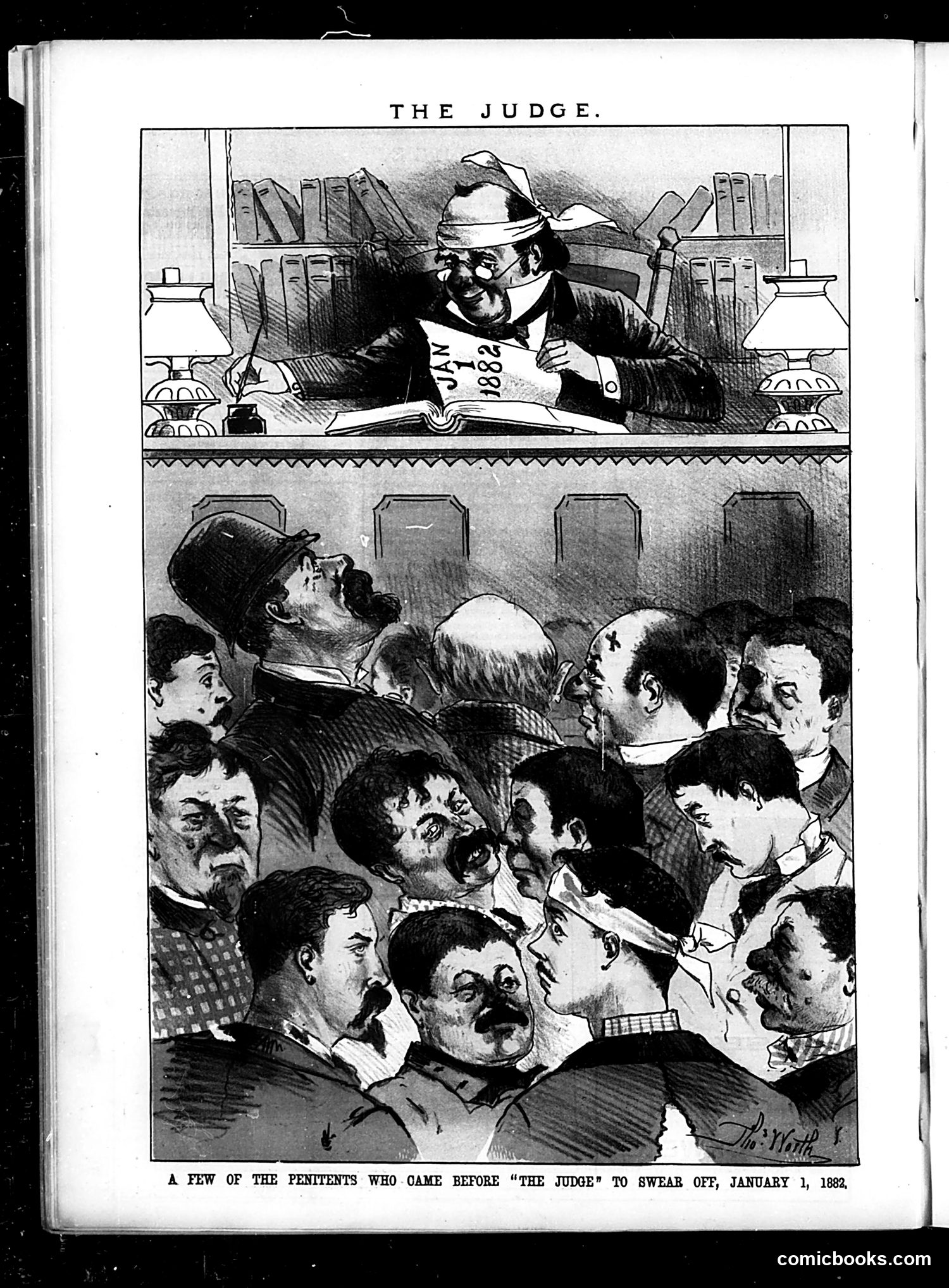
This *Judge* magazine cartoon satirizes New Year's resolutions from January 1, 1882. The image shows two panels: a judge presiding at a desk in a library above, and below, a crowd of rough-looking men—"penitents"—appearing before him to publicly swear off their vices on New Year's Day. The satire mocks the annual tradition of making grand resolutions. These men's disheveled appearances and expressions suggest they're habitual offenders (likely drinkers or troublemakers) who return yearly with the same promises they've broken before. The judge's stern supervision implies the resolutions require official oversight to have any chance of success. The cartoon cynically comments on human nature: that people repeatedly fail at self-improvement, returning to the same destructive habits despite solemn pledges.