
Judge, 1882-01-07 · page 5 of 18
Judge — January 7, 1882 — page 5: what you’re looking at
What you’re looking at
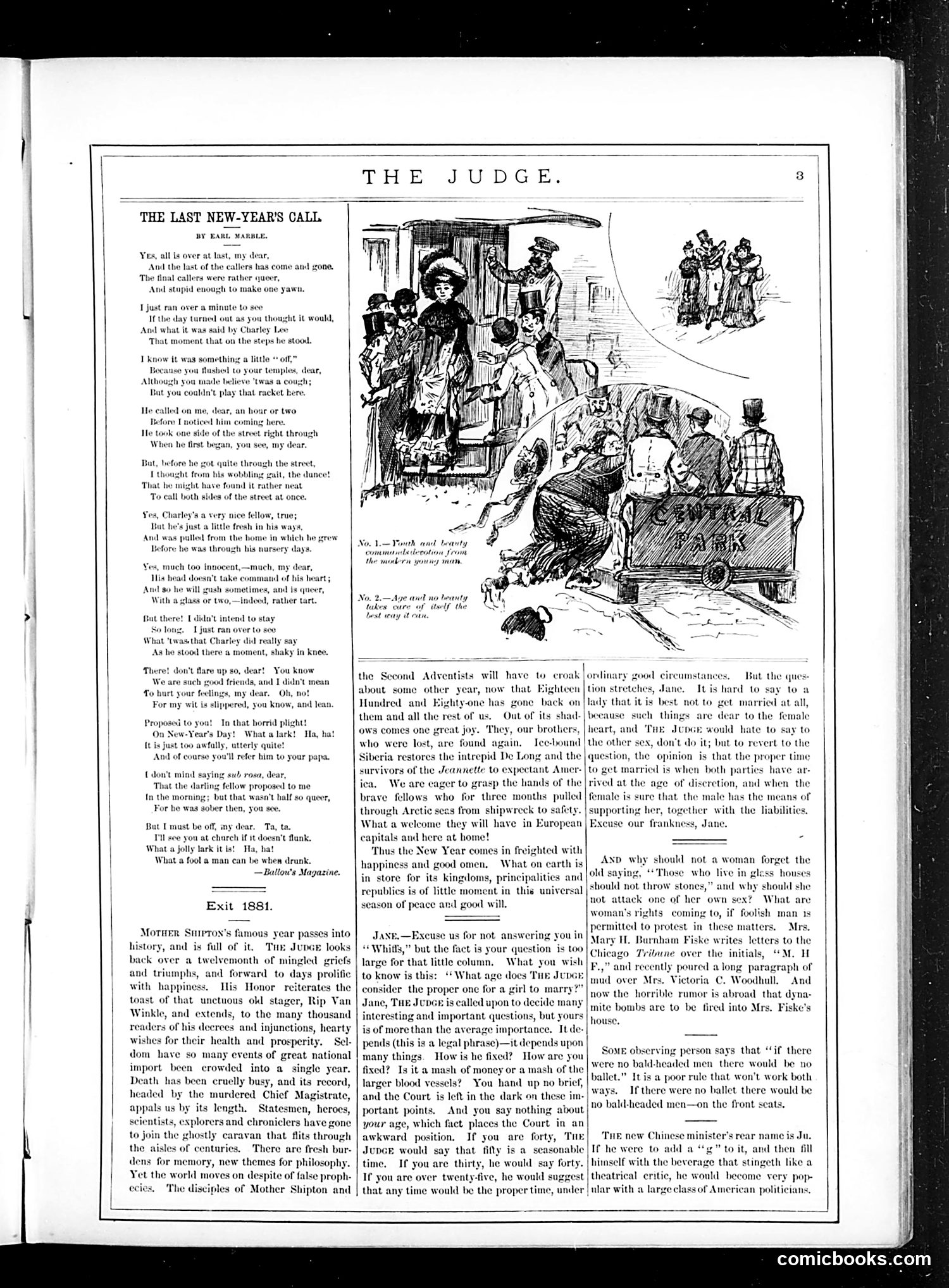
This page contains a poem by Earl Warble satirizing New Year's social conventions (particularly the Victorian custom of making courtesy calls). The verses mock the tedious ritual of visiting acquaintances, with a speaker complaining about an unexpected drunk visitor who showed up unannounced. The accompanying illustrations show chaotic New Year's scenes—crowded domestic spaces with well-dressed visitors in various states of disarray, capturing the social mayhem of obligatory holiday calling. The editorial content discusses the approaching 1882, optimistically welcoming news that Arctic explorers De Long and the Jeannette crew were rescued. It also addresses readers' questions about proper marriage age, expressing the era's conventional view that women should marry when financially secure and "of discretion." A final item references Victoria C. Woodhull (a controversial women's rights advocate and spiritualist) being publicly attacked in the Chicago Tribune, which Judge treats with bemused detachment—typical of the magazine's satirical stance toward contemporary social controversies.
📄 Transcribed text from this page (OCR, searchable)
Machine-transcribed from the original scan — historical spelling and the odd misread are preserved.
| THE JUDGE. a | THE LAST NEW-YEAR'S CALL. BY EARL MAR dear, 8 has come and gone. play that racket he ar, an hour or twa Beforw T noticed hi here. side through ny dear. the street, m his wobblin found it of the And was pulled from the b Before he was thr his nursery days. the modern youny mun, Yes, much too innocent,—much, my dear, | His head doesn’t take ow | Ani 80 he will gush som With a glass or two, cout no teanty takes cure of itself the . > But there! didn’t int est leay Ae creme le 1 just ra ‘Wwasthat Chi As he stood the | roe a Ty a Ae eae on ROW ig [the Sceond Adventists will ha ry good circumstances, — But the ques ‘To hart sour feelings, my dear. Obi bi about some other year, now that Eighteen | tion stretches, Jane. It is hard to say to a | For my wit is slippered, you know, and le Hundred and Kighty-one has gi k on |lady that it is best not to get marrie¢ atall, them and all the rest of us. Out of its shad- | bee: : ¢ such things are dear to the Proposed to yout In that horrid plight! 1 ay | Poe ets Dect Wet e wekt ta, hat | OWS comes one great joy. They, our brothers, |heart, and ‘THe JvpcE would hate to say to | {tis just too awfally, utterly quitet who were lost, are found a; Ice-bound | the other sex, don't do it; but to revert to the And of ¢ u'll refer him to your papa. 1 restores the intrepid De Long and the |question, the opinion is that the proper time ‘ors of the Jeannette to expectant Amer: | to get married is when both parti We are cager to grasp the hands of the | rived at the age of discretion, and when the fellows who for three months pulled | female is sure that the male has the means of through Aretic seas from shipwreck to safety. | supporting her, together with the liabilities. Bat | must be off, my dear. pme they will have in European | Excuse our frankness, Jane. Til eee you at church if it do capitals and here at home! — - What a jolly lark it ist Ha, hat Thus the New Year comes in freighted with What a fool a ma nd good omer r its kingdoms, principaliti is of little moment in this univ dl good will. have {don't min x sub rosa, de That the darlin fn the mos How proposed to me but wasn't half so queer, can be when drunk. —Ballou's Magazine. AND why should not a woman forget the i ose who live in gles he ones,” and why should shi of her own sex? 13 coming to, if for “ 5 @ . {permitted to protest in these matte Excuse us for not answering you in) \tary 1], Burnham Fiske writes letters to the ion is too cago Tribune over the initials, ““M. H h and recently poured along paragraph of mud over Mrs. Victoria C. Woodhull, And now the ho rumor is abroad that dyna- } mite bombs are to be fired into Mrs. Fi house, happine: in store Exit 1881. wom: Morier Siiptoy’s famous year passes into | history, and is full of it, ‘Tue Jupce looks | + Whitts, | back over a twelvemonth of mingled: griefs | Jarge for that little | and triumphs, and forward to days prolific | to know is this: “What age does | with happiness, His Honor reiterates the | consider the proper one for a girl to marry? toast of that unctuous okl stager, Rip Van | Jane, Tae Jupce is called upon to decide many Winkle, and extends, to the many thousand | interesting and important questions, but yours s and injunctions, hearty | is of more than the average importance. Itde- wishes for their health and prosperity, Sel- | pends (this is a legal phrase)—it depends upon | dom have so many events of great national | many things. How is he fixed? How are you xed? Is it a mash of money or a mash of the h has been cruelly busy, and its record, | larger blood js? You hand up no bricf, 1 by the murdered Chief Magistrate, | and the Court is left in the dark on th im-| uls us by its length, Statesmen, heroes, | portant points. And you say nothing about} jentists, explorers and chroniclers have gone | your age, which fact places the Court in an the ghostly caravan that flits through | awkward position, If you are forty, Tue] THE new Chinese minister's rear name is Ju. the aisles of centuries. There are fresh bur- | Jupce would say that fifty is a scasonable|If he were to add a “g” to it, and then fill | dens for memory, new themes for philosophy. | time. If you are thirty, he would say forty. | himself with the beverage that stingeth like a Yet the world moves on despite of false proph- | If you are over twenty-five, he would suggest | theatrical critic, he would become very pop- ‘The disciples of Mother Shipton and | that any time would be the proper time, under | ular with a largeclassof American politicians. Some observing person says that “if there were no bald-headed men there would be no allet.” It is a poor rule that won't work both If there were no ballet there would be no bald-headed men—on the front s m