
Judge, 1882-01-07 · page 13 of 18
Judge — January 7, 1882 — page 13: what you’re looking at
What you’re looking at
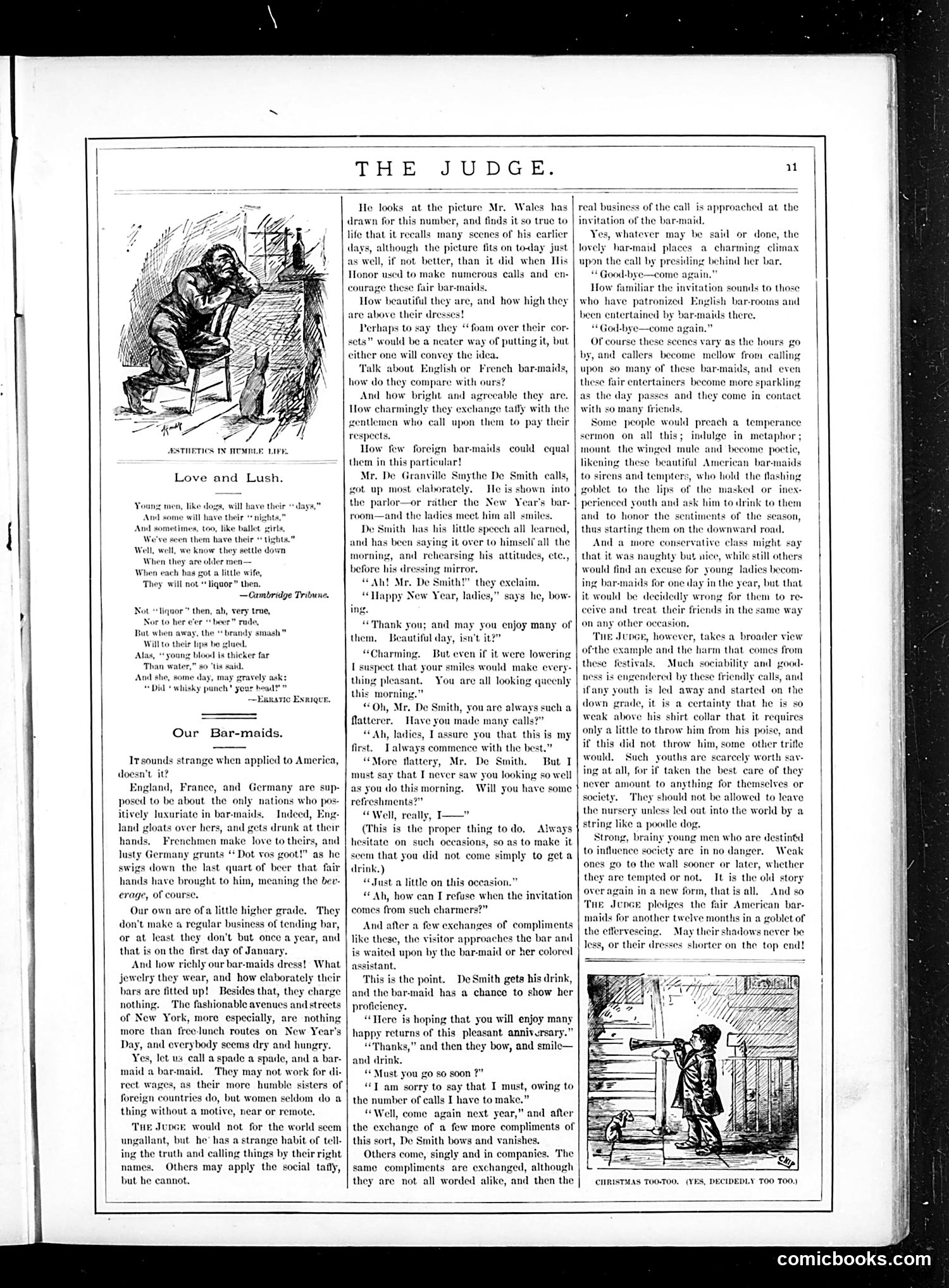
This page satirizes American hypocrisy regarding "bar-maids"—women who serve drinks, particularly on New Year's Day. The artist (credited to "Wales") depicts an elaborately dressed gentleman, Mr. De Granville Smythe De Smith, making social calls to bars with flattering compliments. **The satire's point:** Judge contrasts European bar-maids (who work professionally year-round in England, France, and Germany) with American ones, who only "work" on New Year's Day when fashionable women serve free drinks at bars along New York's avenues. Judge mocks this pretense: these aren't genuine bar-maids but society women engaging in a ritualized annual performance, yet they're treated as such. The accompanying poem "Love and Lush" further mocks how young men and women claim to reform after marriage, though habits persist. Judge's irreverent tone—calling things by their "right names" rather than polite euphemisms—is the magazine's signature approach to social commentary.
📄 Transcribed text from this page (OCR, searchable)
Machine-transcribed from the original scan — historical spelling and the odd misread are preserved.
ASTHETICS IN TUMBLE LIFE. Love and Lush. ‘oung men, like dogs, will b i Awd And some We've « ve the » will have their ** nights, mea, too, like ballet girls, n them have their « tights.” Well, well, we know they settle down When they are older men Wh h has got a little wife, ‘They will not * liquor” then. Cambridge Tribune, + days “liquor” then, ah, very trae, F to her cer * beer But whe dy smash” Will to their hips be glued. Alas, blood is thicker far Than water,” 80 ‘tis said. And she, 4¢ rude, away, the you “Did * whisky pul Our Bar-maids. Irsounds strange when applied to America, doesn’t it? England, France, and Germany posed to be about the only nations who pos- itively luxuriate in bar-maids. Indeed, Eng- land gloats over hers, and gets drunk at their hands. Frenchmen make love to theirs, and lusty Germany grunts “Dot vo: * as he swigs down the last quart of beer that fair hands have brought to him, meaning the bev- erage, of course. re sup. Our own are ofa little higher grade. ‘They don't make a regular business of tending bar, or at least they don’t but once a year, and that is on the first day of January. And how richly our bar-maids dress!’ What jewelry they wear, and how elaborately their bars are fitted up! Besides that, they charge nothing. ‘The fashionable avenues and streets of New York, more especially, are nothing more than free-lunch routes on New Year's Day, and everybody seems dry and hungry. Yes, let us call a spade a spade, and a bar- maid a barmaid. They may not work for di- rect w their more humble sisters of foreign countries do, but women seldom do a thing without a motive, near or remote. Tue Jupce would not for the world seem ungallant, but he’ has a strange habit of tell- ing the truth and calling things by their right names. Others may apply the social tafly, but he cannot. He looks at the picture Mr. Wales has drawn for this number, and finds it so true to life that it recalls many seenes of his earlier days, although the picture fits on today just as well, if not better, than it did) when His Honor used to make numerous calls and en- courage these fair bar-maids. How beautiful they are, and how high they are above their dresses! Perhaps to say they “foam over their ec sets” would be a neater way of putting it, but cither one will convey the idea, Talk about French bar-maids, how do they compare with ours? And how bright and agreeable th rmingly they e: 1 who call up ish or are. change tatly with the nm them to pay their ew foreign bar-amaids could equal them in this particular! Mr. De Granville Smythe De Smith cal He is sbi or rather the New got up most elaborately. the re room De arsing his attitudes, ete., ng inirror. “Ah! Mr. De Smith!” they ex “Happy New Year, ladies, ing im. says he, bow- ‘Thank you; and may you enjoy many of them, Beautiful day, isn't it?” “Charming. But even if it were lowering I suspect that your smiles would make ever thing pleasant, this morning.” “Oh, Mr. De Smith, you are always such a flatterer. Have you made many calls?” “Ah, ladies, Fassure you that this first. I always commence with the best.” “More flattery, Mr. De Smith, But I must say that T never saw you looking so well as you do this morning. Will you have some refreshments?” “Well, really, I—" (This is the proper thing to do, hesitate on such occasion You are all looking quceniy my Always , SO as to make em that you did not come simply to get a drink.) “Just a little on this occasion “ Ah, how can I refuse when the invitation comes from such charmers?” And after a few exchanges of compliments like these, the visitor approaches the bar and is waited upon by the barmaid or her colored sistant. ‘This is the point. De Smith gets his drink, and the bar-maid has a chance to show her proficiency. “Tere is hoping that you will enjoy many happy returns of this pleasant anniversary.” anks,” and then they bow, and smile— and drink. “ Must you go so soon ?” “T am sorry to say that I must, owing to the number of calls I have to make.” “Well, come again next year,” and afer the exchange of a few more compliments of this sort, De Smith bows and vanishes, Others come, singly and in companies. The same compliments are exchanged, although they are not all worded alike, and then the ess of the jon of the b: , Whatever may be said or done, the har-maid places a charming climax upon the call by presiding behind her bar. « Good-bye all is approel maid, ome again,” How familiar the invit who have patronized KE been entertained by bart “ God-bye—come again. Of course these scenes vary as the hours go by, and callers become mellow from calling upon so many of these ba and even these fair entertainers become more sparkling as the day passes and th with so many friends. Some people would p ion sounds to those sh bar-rooms and ids there, -maid -y come in contact ach a temperance sermon on all this; indulge in metaphor; mount the winged mule and become poctie, likening these beautiful American baranaids to sirens and tempters, who hold the flashing goblet to the lips of the masked or inex- perienced youth and ask him to drink to them to honor the sentiments of the thus starting them on the downward road. And a more conservative class might say that it was naughty but nice, while still others would find an excuse for young ladies becom- ing bar-maids for one day in the year, but that it would be decidedly wrong for them to re- ceive and treat their friends in the same way on any other oceasion, THE JUDGE, however, takes a broader ofthe example and the harm that comes these festivals. Much sociability and s engendered by these friendly calls, and ifany youth is led away and started on the down grade, it is a certainty that he is so weak above his shirt collar that it requires only a little to throw him from his poise, and if this did not throw him, some other trifle would. Such youths are scarcely worth sav- ing at all, for if taken the best care of they hever amount to anything for themselves or societ, They should not be allowed to leave the nursery unless led out into the world by a string like a poodle dog. Strong, brainy young men who are destined to influence society are in no danger. Weak ones go to the wall sooner or later, whethe they are tempted or not, It is the old story over again in a new form, thatis all, And so Tue Jen pledges the fair American bar- maids for another twelve months in a goblet of the eflervescin and pason, CHRISTMAS TOO-TOO, (YES, DECIDEDLY TOO T00,) comicbooks.com