
A complete issue · 16 pages · 1881
Judge — November 12, 1881
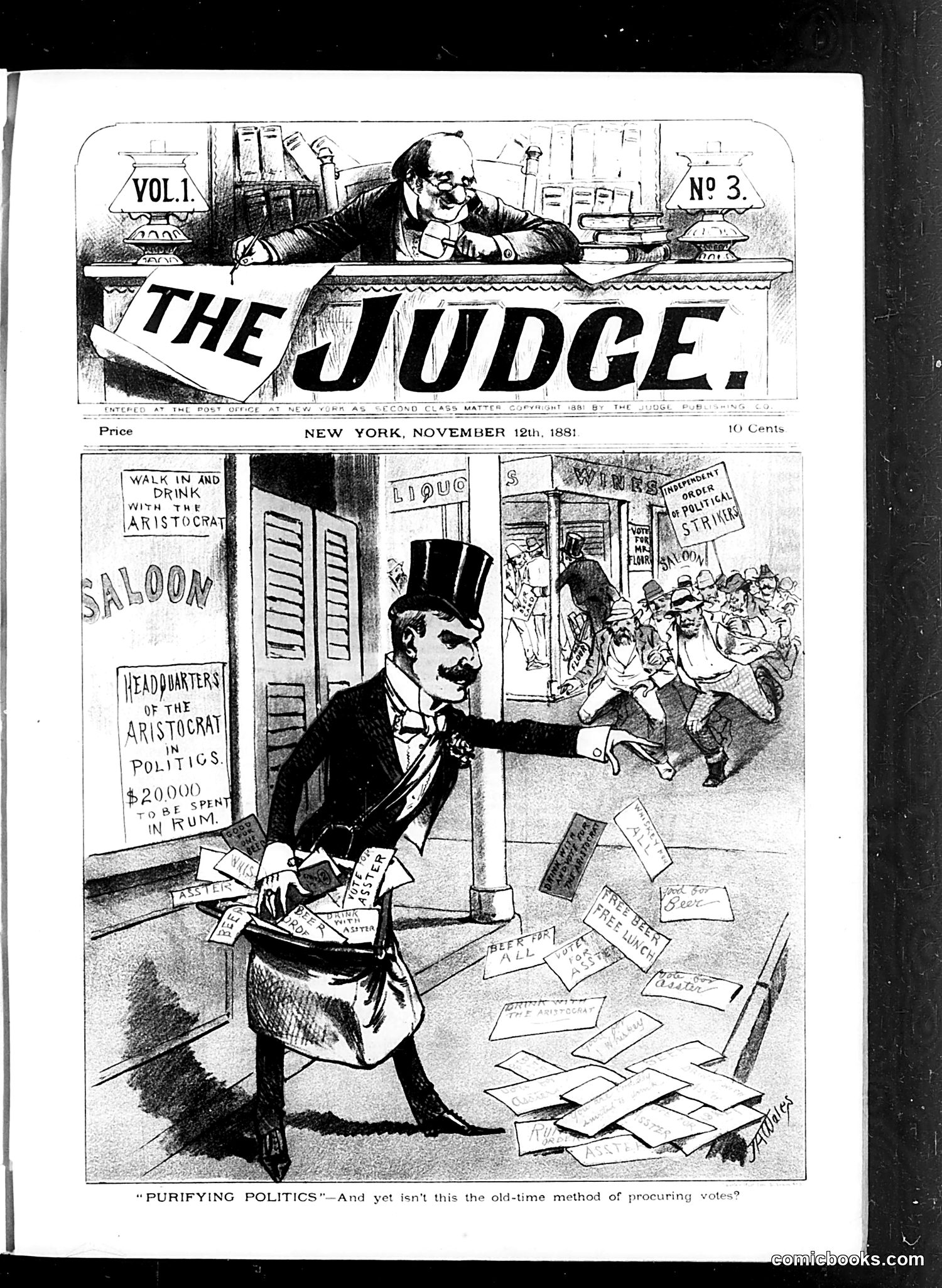
This political cartoon satirizes vote-buying and corruption in American politics. A well-dressed man with a top hat stands outside a saloon marked "Headquarters of the Aristocrat in Politics" ($20,000 to be spent in rum), distributing money to working-class men emerging from the establishment. Papers labeled with various vote-related terms scatter on the ground. The cartoon's title, "Purifying Politics," is ironic—it mocks reformers' claims to be cleaning up politics while illustrating the actual mechanism: buying votes with alcohol and cash at aristocratic saloons. The caption's rhetorical question emphasizes that despite reform rhetoric, corrupt vote-purchasing remains standard practice. This reflects 1881 concerns about political machine corruption and the influence of wealthy elites on democratic elections.
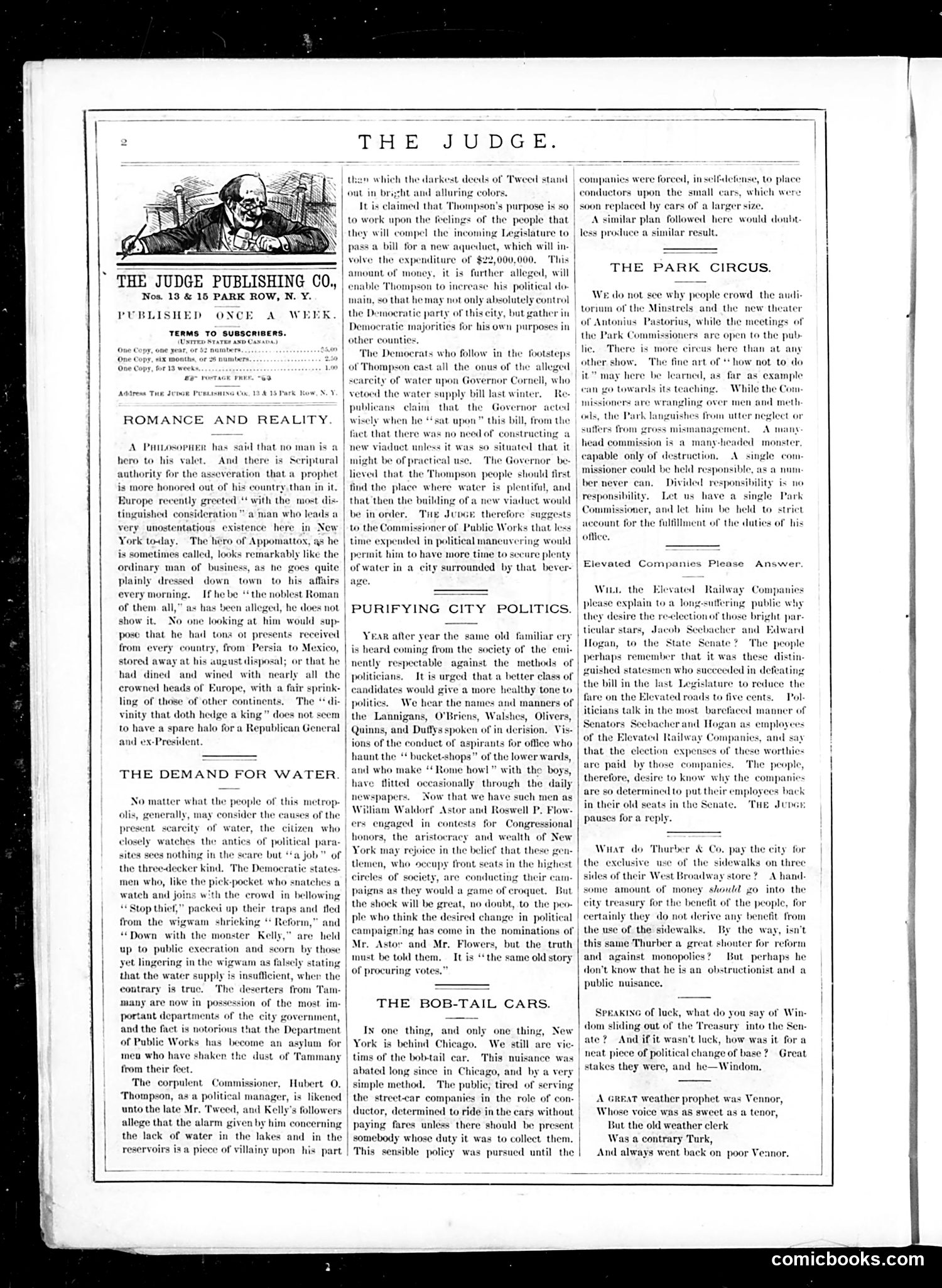
The main cartoon (top left) depicts **The Judge Publishing Co.** editorial voice—a stern figure overseeing political affairs. The page satirizes **New York City politics**, particularly attacking **Hubert O. Thompson** (a Democratic political manager) over the water crisis. The text alleges Thompson manufactured alarm about insufficient water to justify a $22 million aqueduct project, using it to consolidate Democratic power and control. Critics claim this was political manipulation echoing **Tammany Hall's corrupt methods** (referenced via "Tweed"). A secondary piece mocks the **Park Commissioners** for ineffectual management—comparing their circus-like incompetence to actual entertainment venues. The satire suggests the commissioners waste resources and create "destructive" policy through divided responsibility and poor oversight. Overall: Judge attacks Democratic machine politics and bureaucratic incompetence in Gilded Age New York, using water infrastructure and parks as examples of how politicians exploit public services for power.
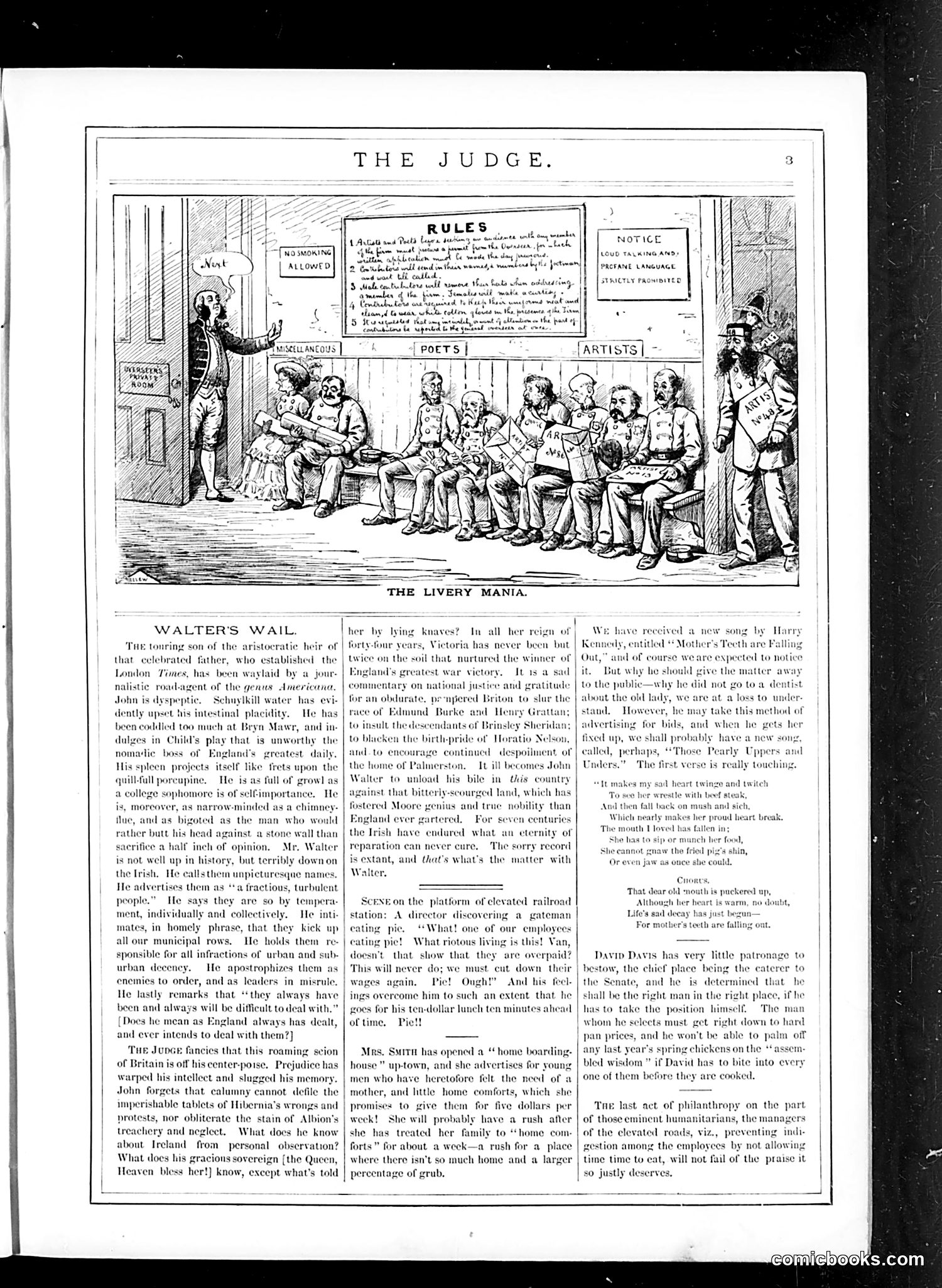
The main cartoon depicts a courtroom scene labeled "The Livery Mania," showing a judge presiding over what appears to be poets and artists being disciplined or processed. The "Rules" posted on the wall establish strict conduct regulations—no smoking, no loud talking, no profane language—suggesting satirical commentary on rigid institutional control of creative people. The accompanying article "Walter's Wail" criticizes John Walter (likely of the *London Times*), attacking his Irish prejudices and dyspeptic temperament. The piece mocks Walter for condemning Irish people while knowing little of Ireland firsthand, and accuses him of hypocrisy—allowing himself luxuries (expensive lunches) while lecturing others about restraint. The satire targets both institutional rigidity stifling artists and a pompous British journalist's sanctimonious moralizing about people he despises yet poorly understands. The "rules" cartoon visually reinforces the article's theme of excessive control and judgment.
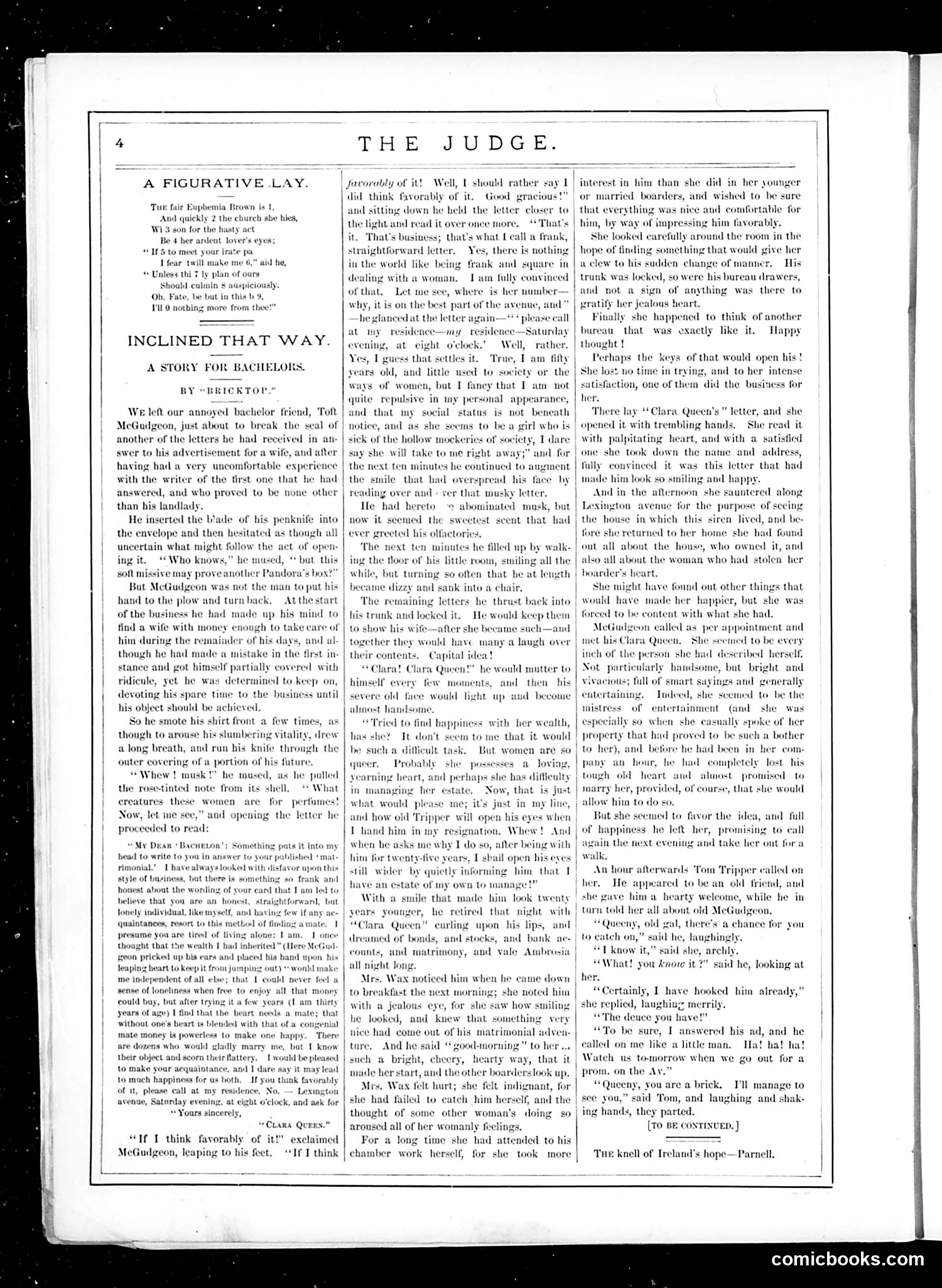
This page contains two pieces of satirical content about marriage and courtship: **"A Figurative Lay"** appears to be light verse using numbered blanks—a word-puzzle format popular in period humor magazines. **"Inclined That Way: A Story for Bachelors"** is the main satire. It mocks a bachelor named McGudgeon who advertises for a wealthy wife. A woman named Clara Queen responds with a seemingly frank, business-like letter emphasizing her estate and inheritance. McGudgeon becomes excited, interpreting her directness as honest dealing—but the satire lies in his delusion: he's fallen for exactly what he sought (money), not recognizing that Clara Queen's letter is itself a calculated performance designed to appeal to his mercenary nature. The humor targets bachelor advertisements (a real Victorian practice), the pretense of "honest" matchmaking based on wealth, and male gullibility. The satire suggests that both parties are performing roles rather than seeking genuine connection. The closing "TO BE CONTINUED" indicates this is serialized fiction.
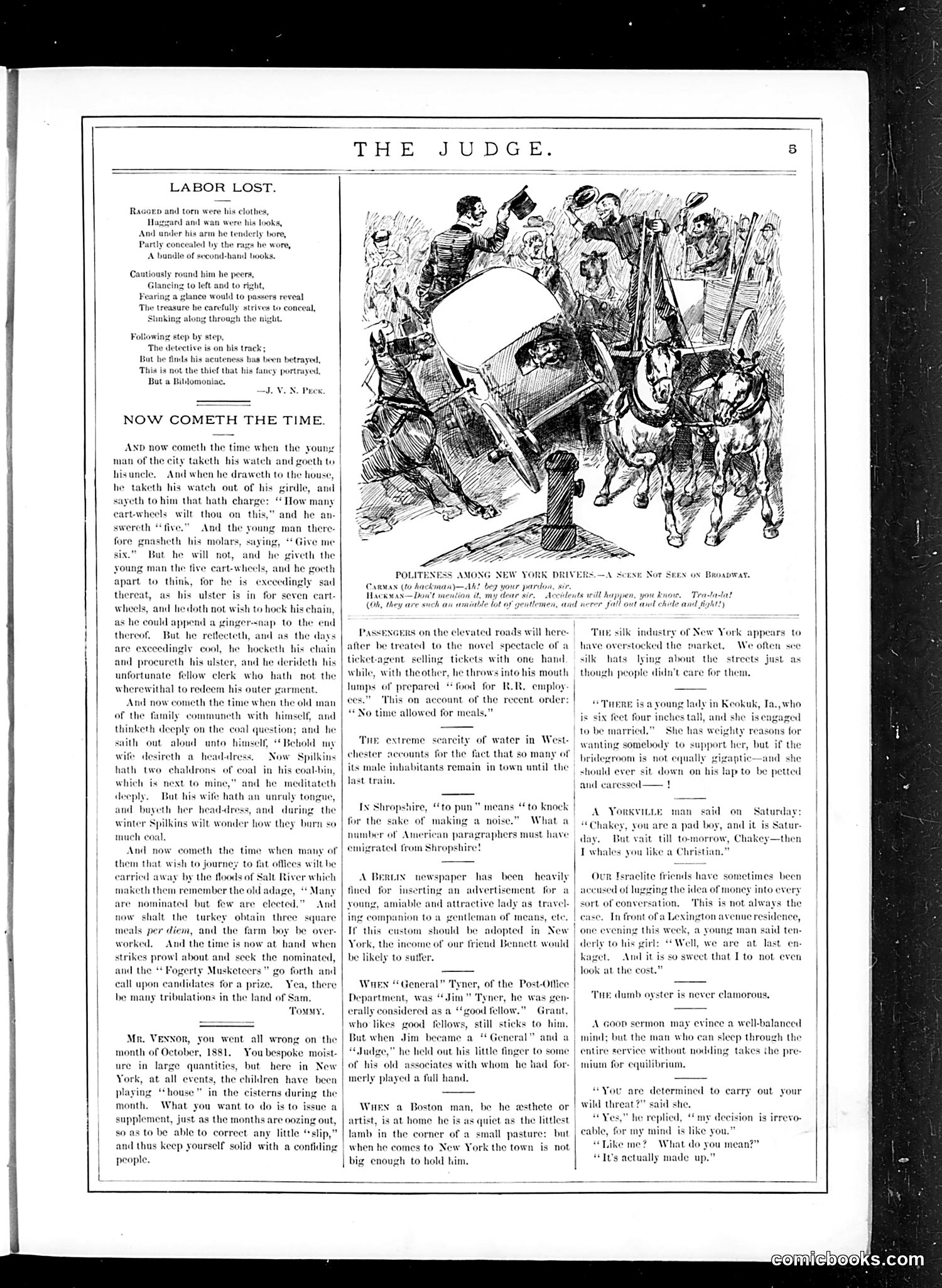
This **Judge** magazine page satirizes various aspects of late 19th-century American urban life. The main cartoon depicts chaotic street traffic in New York, captioned "Politeness Among New York Drivers"—ironic, as the scene shows collision and disorder, mocking the era's rapid urbanization and the crude behavior of cab drivers and cart operators. The text sections use mock-biblical language ("And now cometh the time") to humorously describe urban working-class struggles: young clerks pawning their watches and chains to survive financially; poor heating in tenements; political patronage and corrupt elections ("Fogerty Musketeers"). References include criticism of the Post Office Department's "General" Jim Tyner and satirical jabs at water scarcity in Westchester, Berlin's prudish journalism, and Boston's reserved temperament contrasting with New York's chaos. The humor relies on exaggerated social observation—depicting urban poverty, political corruption, and civic dysfunction through burlesque formality.
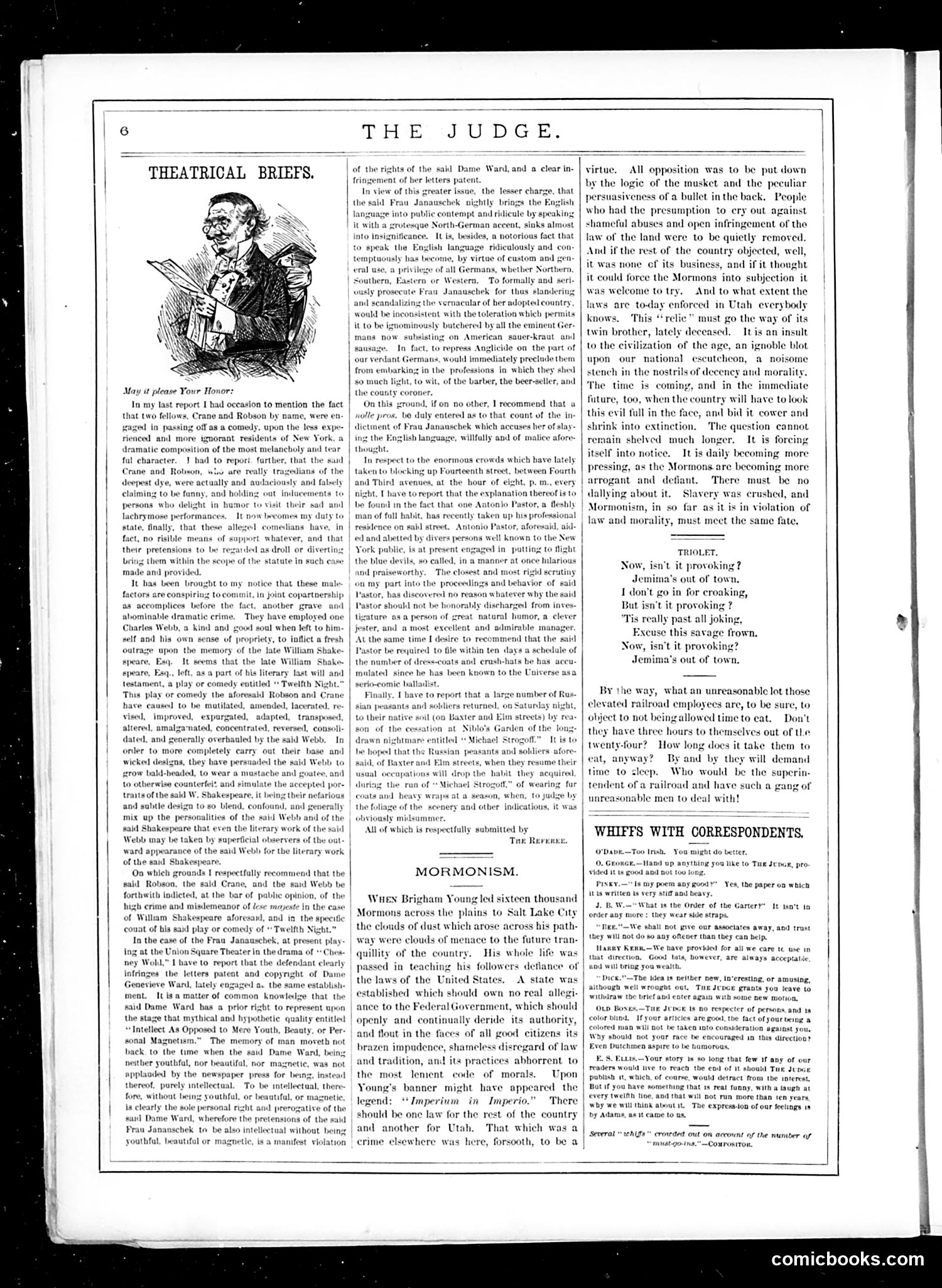
This page satirizes theatrical productions and performers of the era. The main cartoon (top left) depicts a grotesque male face, likely caricaturing an actor or playwright involved in the controversies discussed. The text humorously "prosecutes" several theatrical offenses: 1. **Crane and Robson** are mocked for staging a poor comedy version of Shakespeare's *Twelfth Night*, with collaborator Charles Webb accused of mangling the Bard's work. 2. **Fran Janauschek** (a German actress) is satirized for performing in a drama at Union Square Theater while speaking with a thick German accent, which the writer claims infringes on **Genevieve Ward's** supposed exclusive right to perform intellectual roles without youth or beauty. The satire mocks both theatrical mediocrity and the pretensions of actors claiming originality or exclusive artistic territory. It's essentially drama criticism weaponized as mock-legal proceedings, a common Judge magazine format for ridiculing public figures and cultural trends.
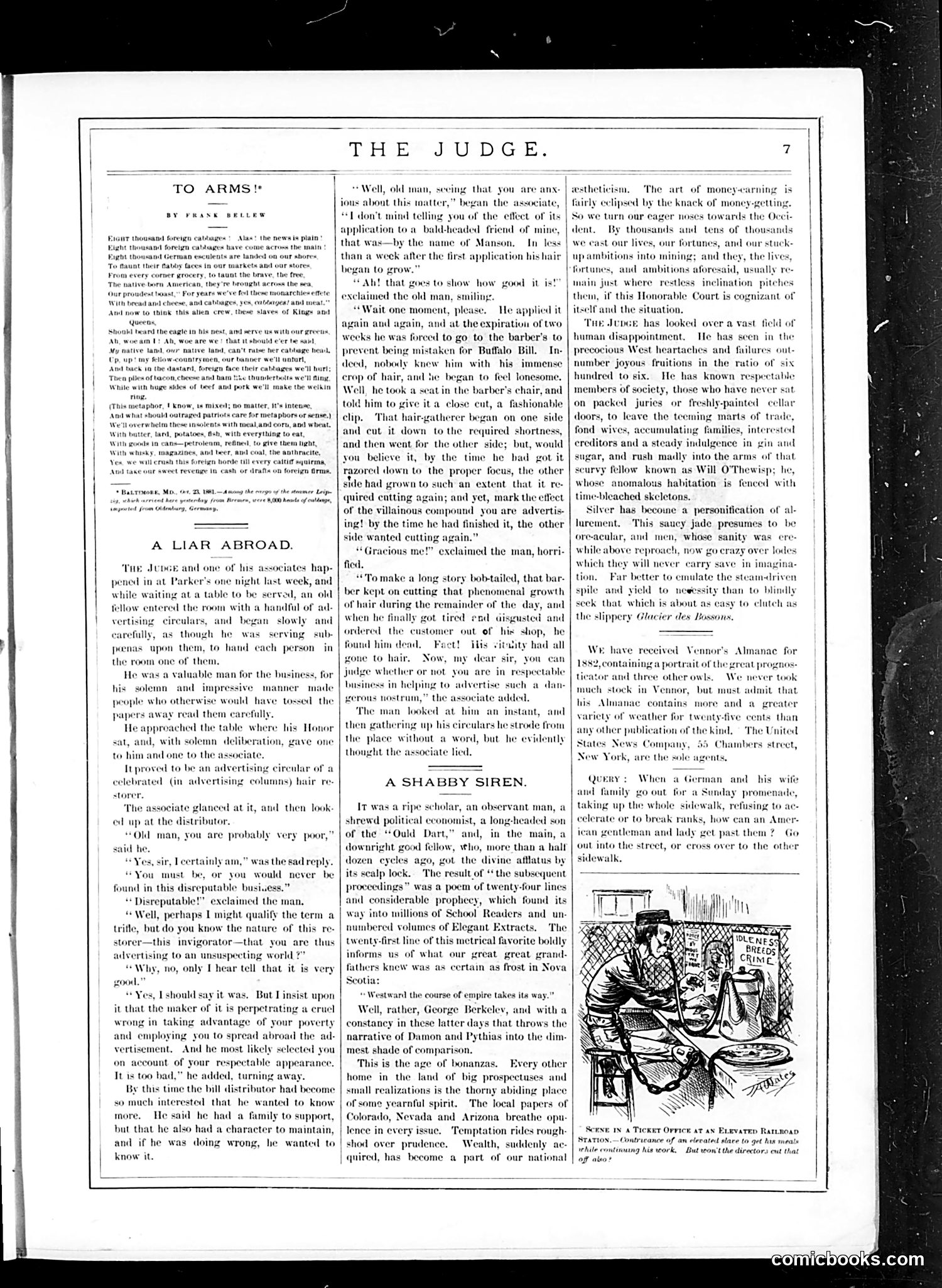
This page contains two distinct pieces of satirical commentary: **"To Arms!" (top left):** A mock-patriotic poem mocking protectionist trade policy. The "arms" reference is ironic—rather than weapons, the call is to economic defense through exaggerated claims about American agricultural superiority (cabbages, cheese, beef, pork). It satirizes nationalist economic rhetoric by treating commercial goods as weapons in trade wars. **"A Liar Abroad" (bottom left):** A morality tale mocking a hair-restorer advertiser. A well-dressed distributor is confronted by a Judge and associate about perpetuating fraud. The twist: the product *actually works too well*—a customer's hair grew back so prolifically the barber couldn't finish cutting it. The satire ridicules both the distributor's false claims and the hypocrisy of the "respectable" men interrogating him about moral business practices. **The cartoon (right):** Shows a ticket office at an elevated railroad station, illustrating urban temptation and crime. The caption references "work" and directors cutting costs—likely satirizing labor disputes or safety corners cut at transit companies. These pieces collectively mock American pretension, fraudulent commerce, and economic hypocrisy of the era.
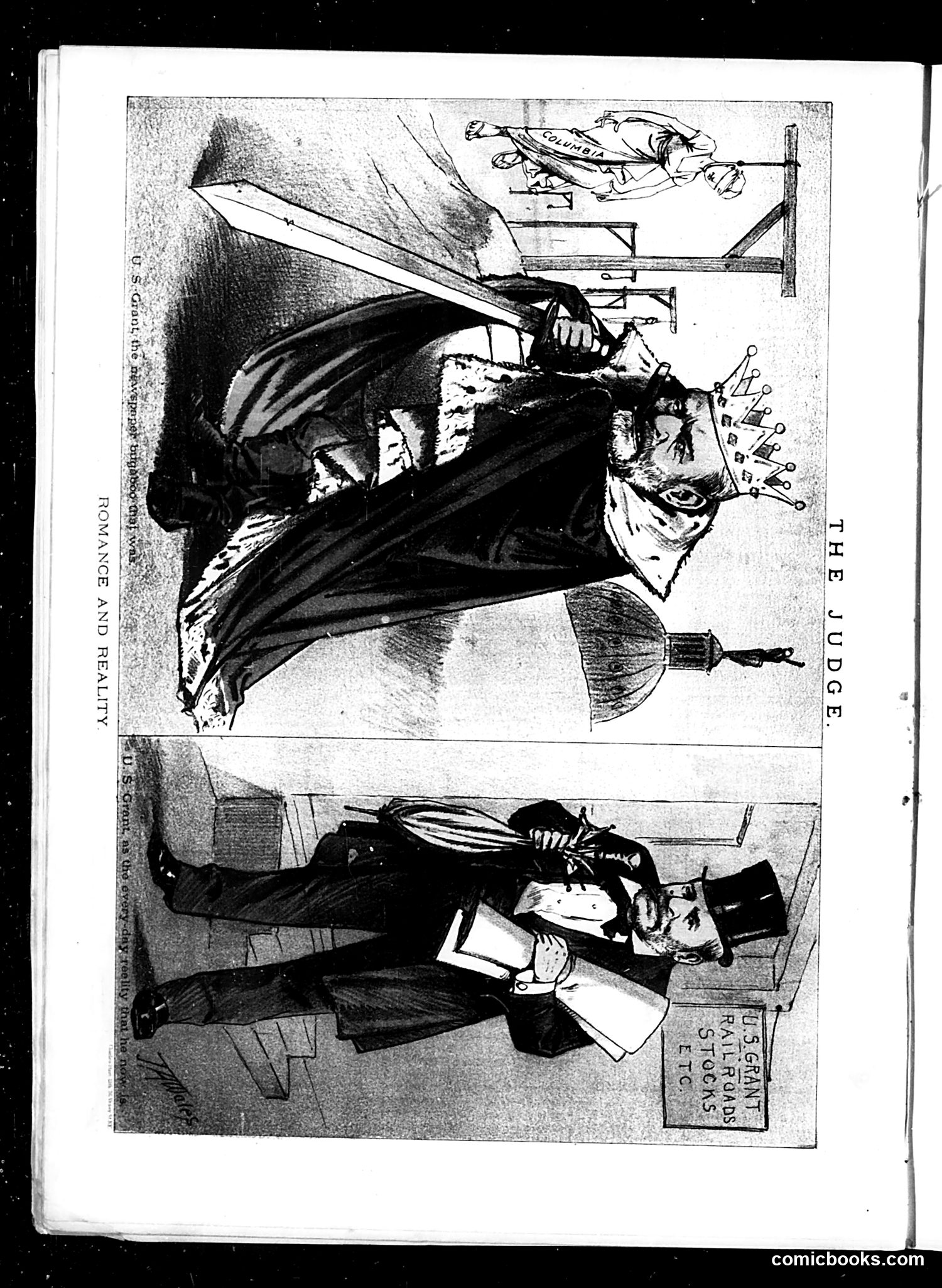
This page contains two vertical cartoon panels titled "Homagr and Reality" (top) and "The Judge" (bottom). The OCR text is too corrupted to read clearly. The top panel appears to show a figure in elaborate judicial or governmental robes with flowing garments, suggesting idealized authority or power. The bottom panel depicts a more plainly-dressed figure, likely representing the same person in "reality" versus the romanticized "homage" above. This format suggests satire comparing how public figures present themselves (or are depicted by supporters) versus their actual conduct. Without readable text, I cannot identify the specific figure or political context, but the visual contrast critiques the gap between appearance and reality in public life.
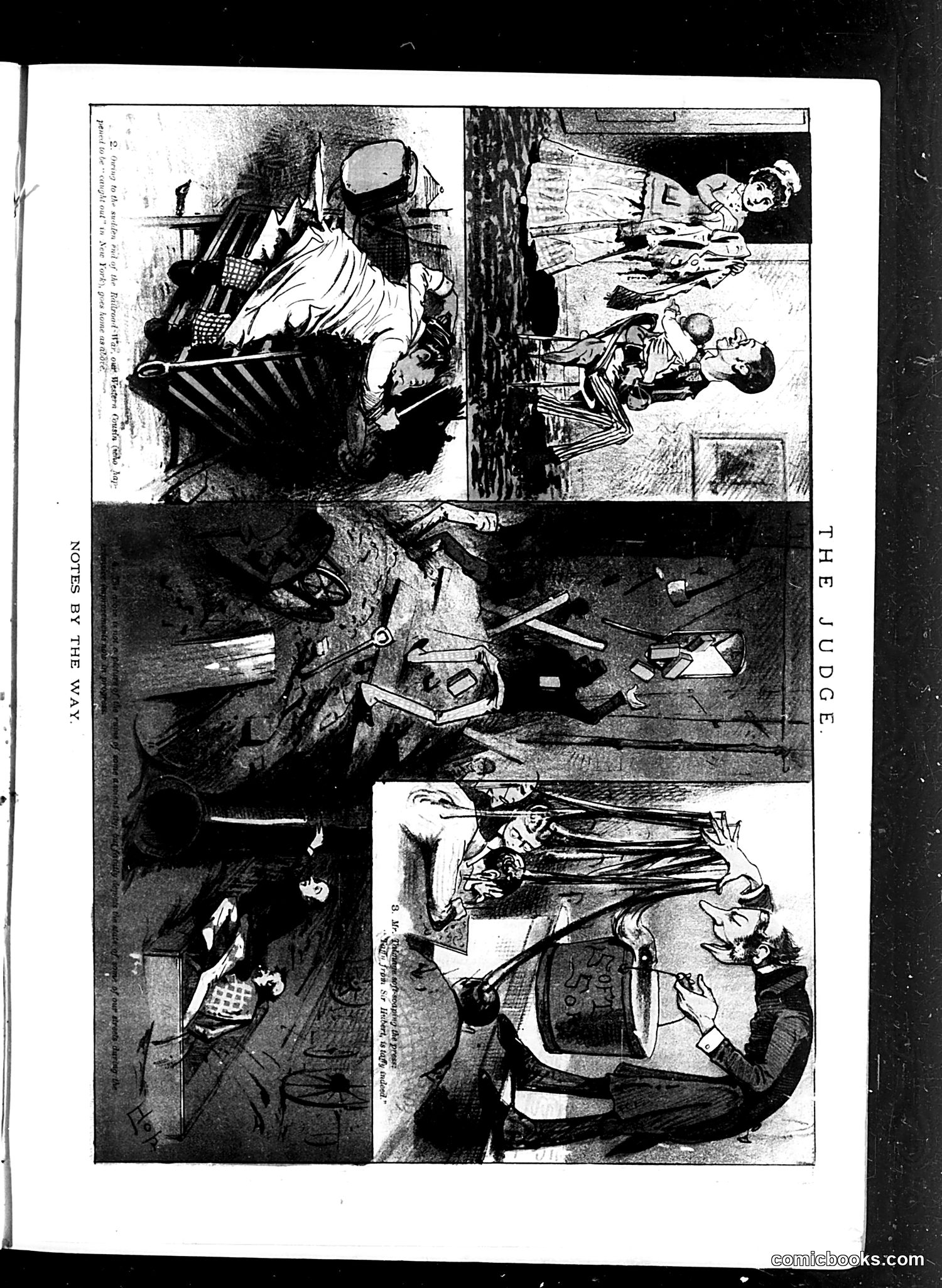
This page is titled "THE JUDGE" and labeled "NOTES BY THE WAY," suggesting it contains editorial commentary through sequential illustrations. The cartoon appears to depict a courtroom or legal proceeding, with figures in formal dress and what seems to be a judge presiding. The sequential panels suggest a narrative unfolding—possibly satirizing a trial, verdict, or legal outcome contemporary to the magazine's publication. Without clearer text or identifying labels in the images, I cannot definitively name the specific case, figures, or political/social references being mocked. The style and composition suggest social or political commentary typical of *Judge*'s satirical approach, but the specific target remains unclear from this reproduction's image quality. **I cannot reliably identify the specific people, case, or satirical point without legible accompanying captions or text.**
This page satirizes a proposed mechanical child-punishment device invented by a well-meaning philanthropist reformer. The satire targets both the inventor's earnest but misguided faith in technological solutions and the absurdity of industrializing parental discipline. The cartoon mocks the inventor's struggle to name his creation with sufficiently dignified language—rejecting "Patent Spanking Machine" as too blunt, then "Instrument whereby impartial justice may be meted out" as too wordy—eventually settling on "Mr. Winslow's Child Persuader." The detailed description of adjustable leather flaps calibrated by clockwork to match offense severity reveals the joke's core: mechanizing what should remain a human parental responsibility. The accompanying poem "Fresh" contrasts natural freshness with the "unsalted cigarette" of youth—possibly mocking the same generation the machine would discipline. The satire reflects late-19th-century anxieties about industrialization intruding into intimate family life, and skepticism toward technocratic "reform" solutions to moral problems.
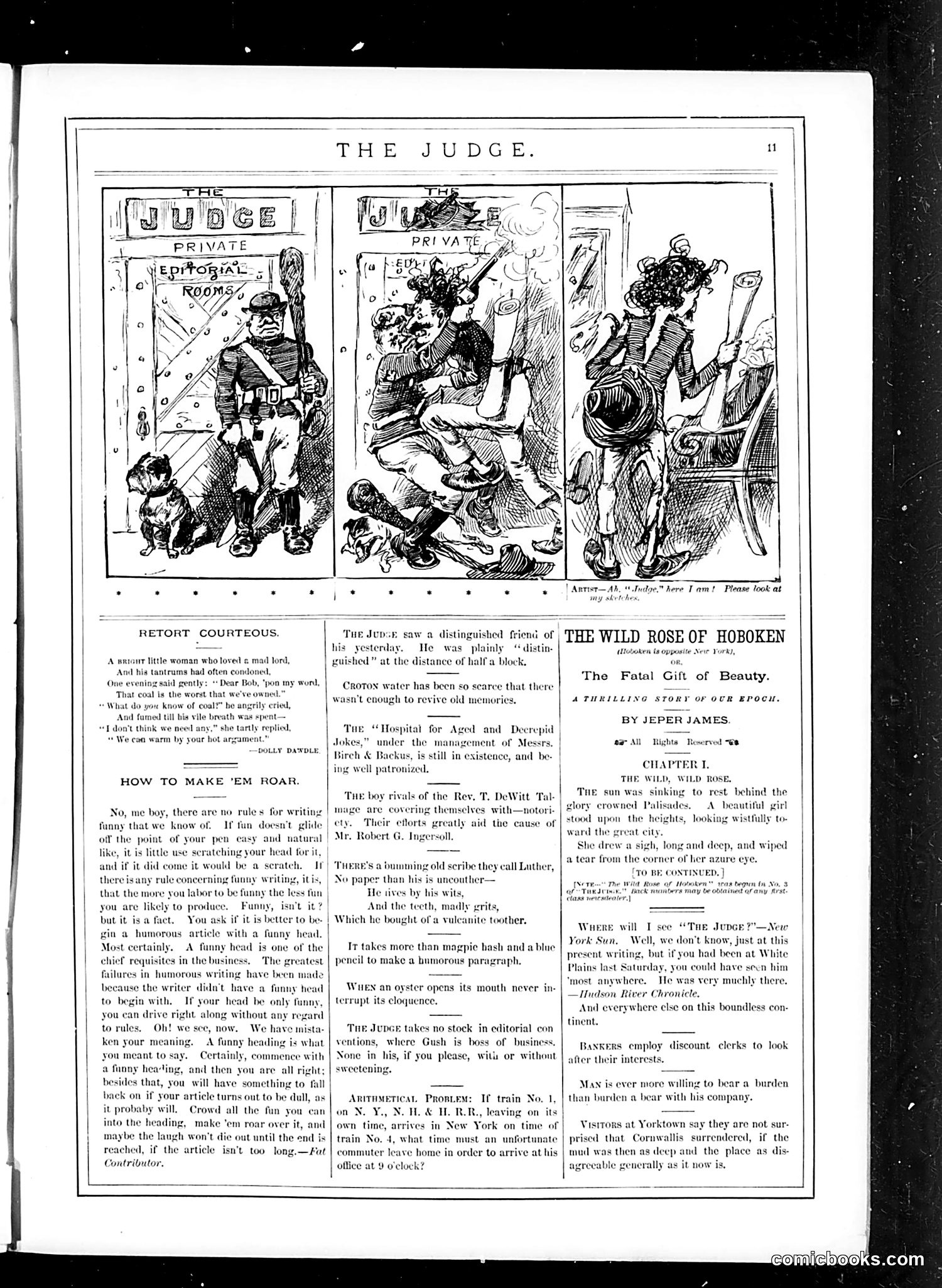
This page from the satirical magazine *Judge* contains three distinct sections: **The Cartoon Strip (top):** Three panels depicting "The Judge" in various scenarios—apparently a recurring character dealing with authority figures and bureaucratic situations, likely mocking judicial pomposity or legal absurdity. **Humor Articles (left column):** Short pieces about writing humorous content, including "How to Make 'Em Roar," offering tongue-in-cheek advice that the best humor requires a funny opening ("funny head") to hook readers, even if the rest is mediocre. This is meta-commentary on journalism itself. **Serial Fiction (right):** The beginning of "The Wild Rose of Hoboken," a melodramatic story about a beautiful girl gazing longingly from heights—parody of overwrought Victorian romance literature popular in the era. The scattered aphorisms mock contemporary life: oyster eloquence, coal shortages, water scarcity, commuter schedules, and discount clerks. This is typical *Judge* content—light satire targeting urban American life, social pretensions, and literary conventions rather than specific political figures.
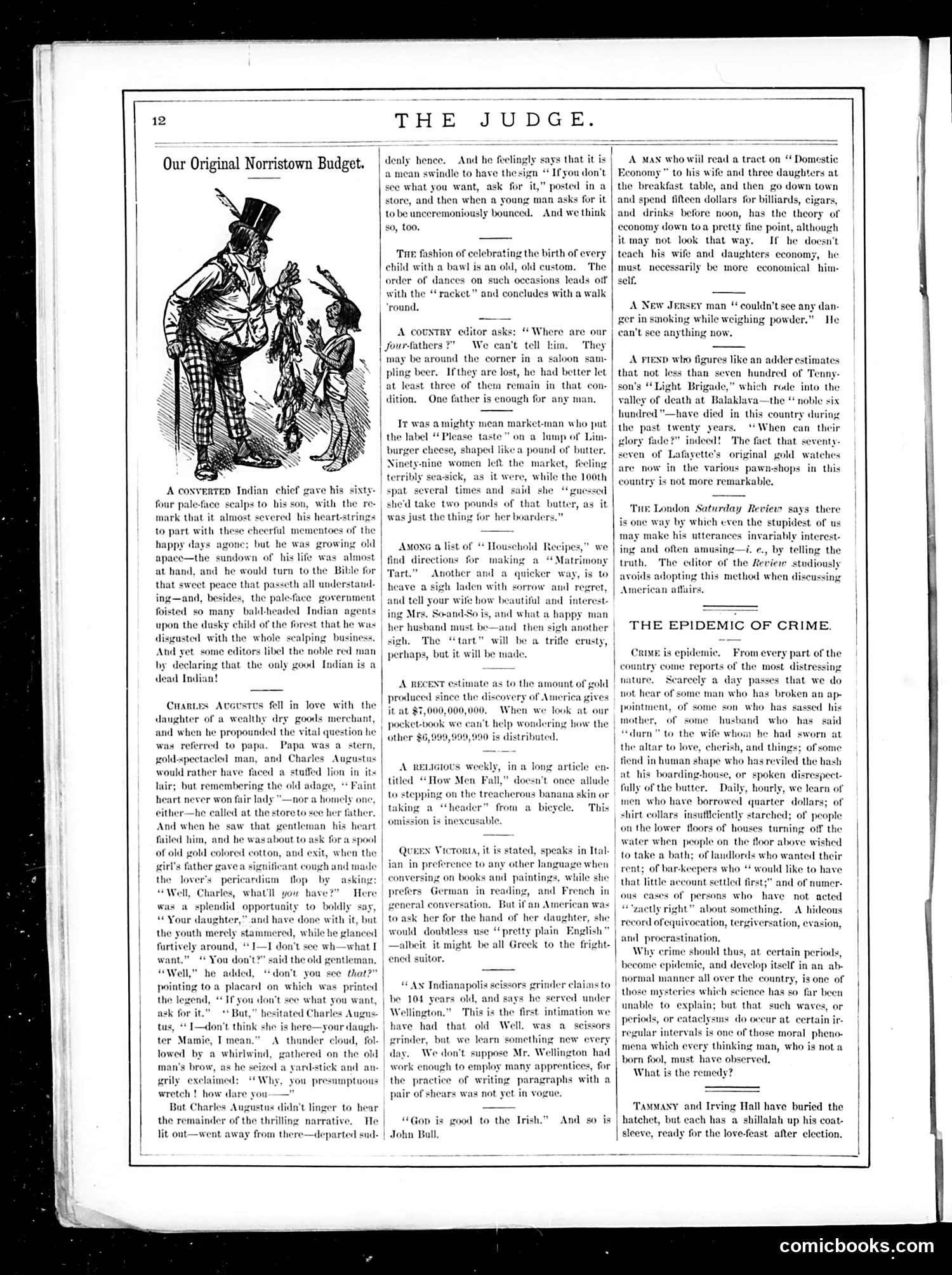
This page contains several short satirical pieces typical of late 19th-century Judge magazine humor. **"Our Original Norristown Budget"** features a cartoon of an Indian chief presenting scalps to his son—a dark joke playing on stereotypes of Native Americans. The accompanying text mocks the common saying "the only good Indian is a dead Indian" by having the chief himself grow weary of scalp-taking because the government keeps appointing corrupt agents to cheat his people. **The Charles Augustus story** is a romantic comedy about a timid young man trying to propose to a girl. He visits her wealthy merchant father, who displays a sign reading "If you don't see what you want, ask for it." When Charles stammers that he doesn't see what he wants, the father attacks him with a yardstick, assuming Charles is asking for his daughter—leading to Charles fleeing. The humor lies in the miscommunication and the father's violent overreaction. **Other brief pieces** include jokes about childbirth customs, missing ancestors in saloons, and a woman preferring rancid butter—typical lowbrow Victorian-era humor focusing on domestic absurdities and physical comedy.
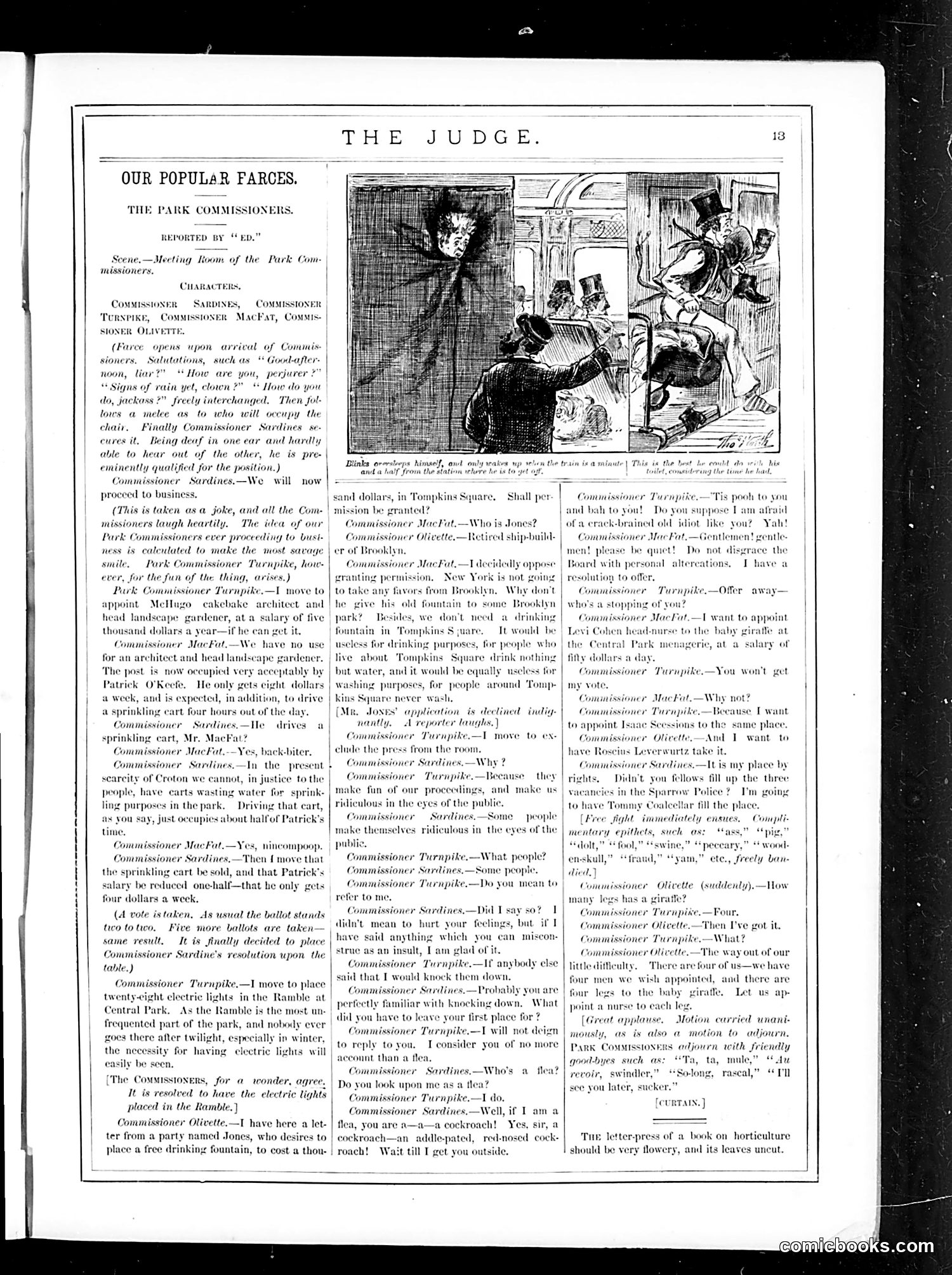
This page satirizes New York City's Park Commission through a comedic play script. The humor targets the commissioners' incompetence and petty bickering during official meetings. The satire focuses on ridiculous decisions: appointing an unqualified landscape gardener at exorbitant salary; debating whether to remove a water cart (voting multiple times before tabling the resolution); installing electric lights in the Ramble, the park's least-frequented area; and rejecting a free fountain from a Brooklyn citizen simply because he's from Brooklyn and "people never wash." Key targets include Commissioner Sardines (portrayed as nearly deaf and thus unfit), and various commissioners' inability to conduct serious business. The final irony: when the press laughs at their proceedings, the commissioners vote to exclude the press from the room—revealing they know their decisions are absurd. This reflects late 19th-century public frustration with municipal government corruption and incompetence in managing New York City's parks.
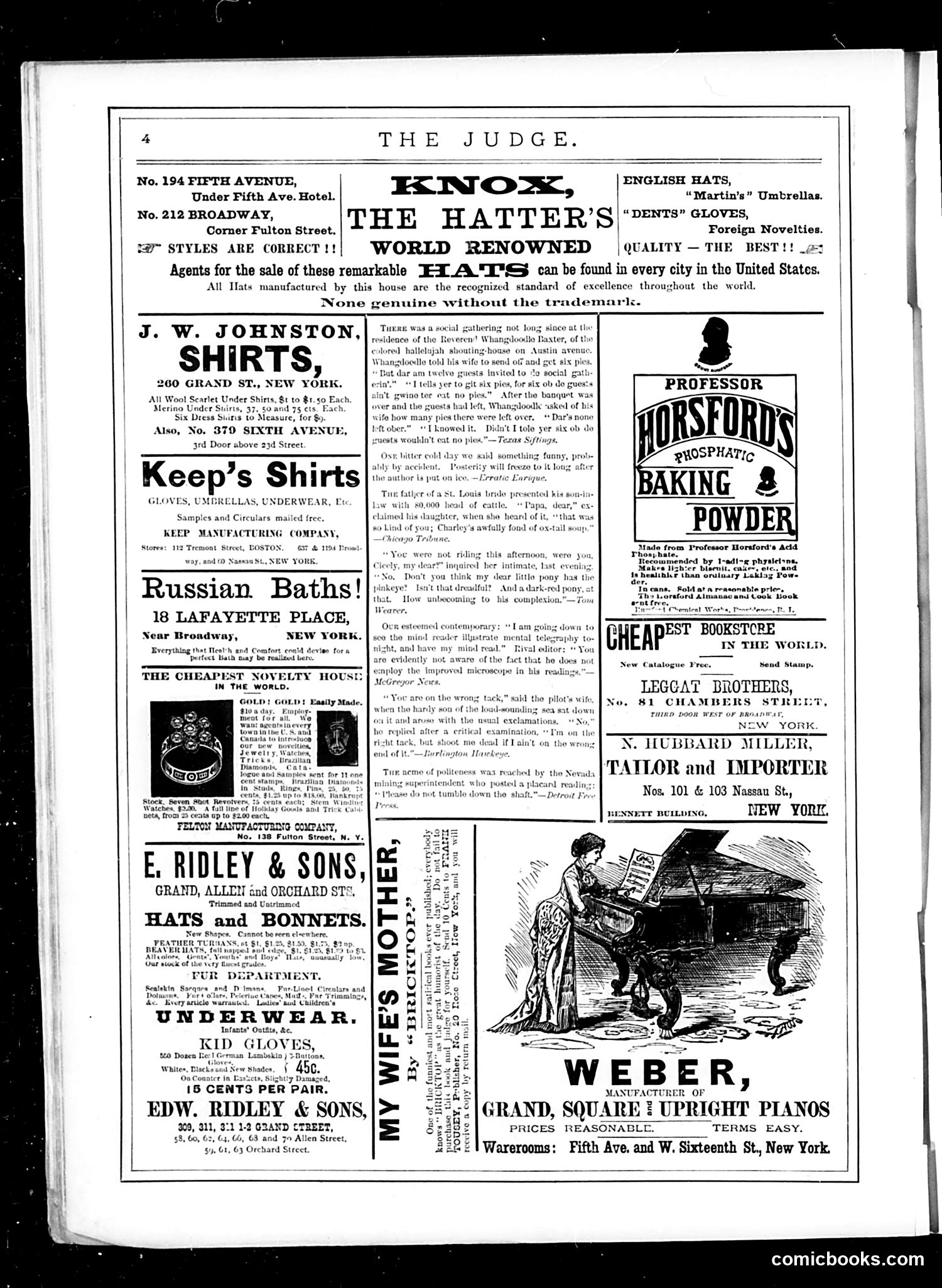
This page is primarily **advertisements**, not political satire or editorial content. It showcases late 19th-century New York businesses selling clothing, hats, pianos, and household goods—typical of Judge's commercial revenue model. The only illustration is a **Weber piano advertisement** featuring a woman at a grand piano, a standard promotional image meant to convey elegance and refinement. The ads themselves reveal period details: Scarlet merino underwear, kid gloves at 15 cents per pair, Russian baths as a leisure service, and the prominence of hat manufacturing (Knox hats claimed "world renowned" status). Many businesses are located on named streets (Grand, Fifth Avenue, Nassau Street) in lower Manhattan. There is **no political cartoon or satirical content visible** on this page—it's purely commercial, showcasing how Judge supplemented editorial content with paid advertisements from retailers.
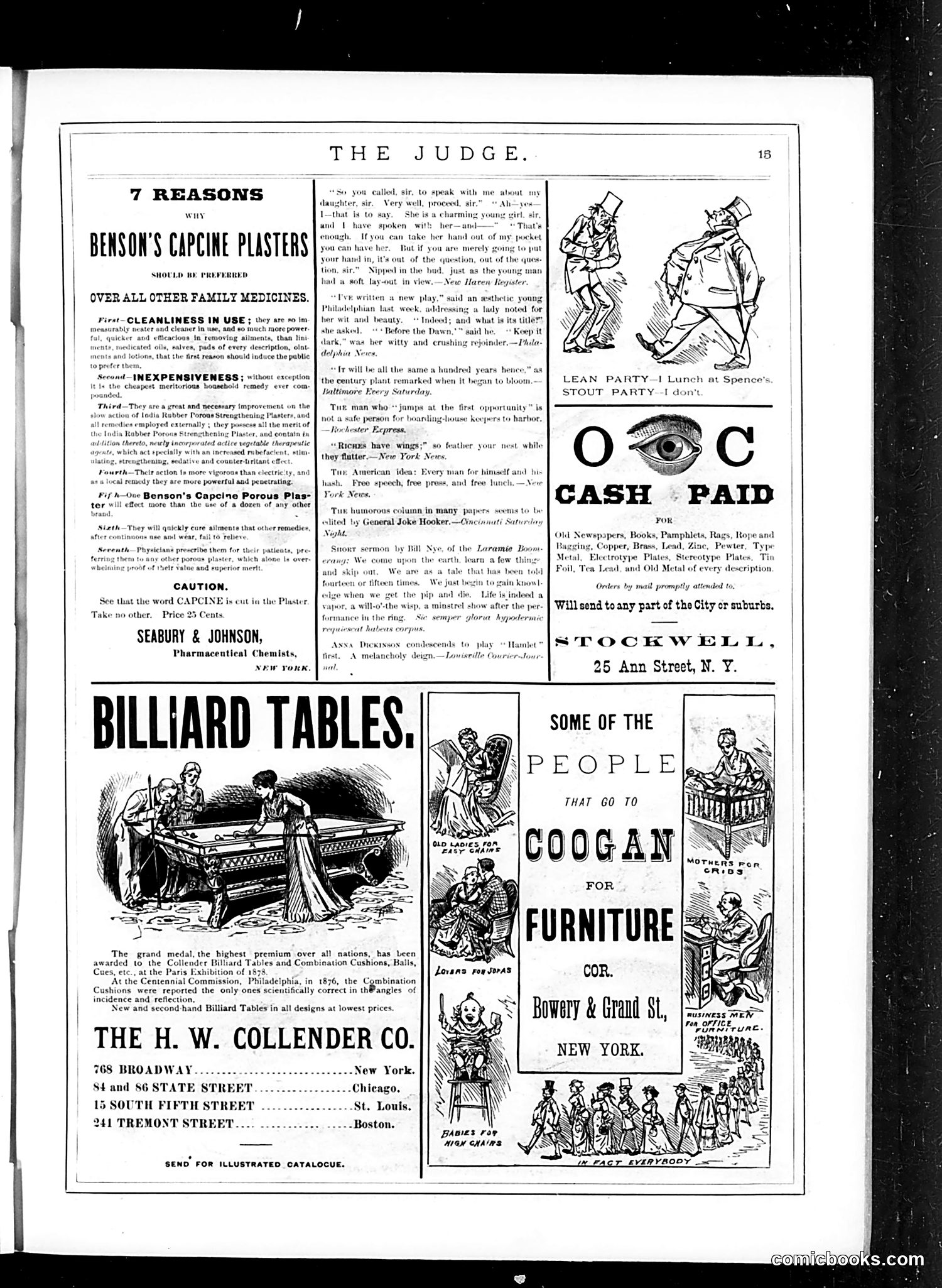
This page is primarily **advertising**, not satirical content. The small cartoon vignettes that appear are character sketches rather than political commentary. The two illustrated figures labeled "LEAN PARTY" and "STOUT PARTY" appear to be a light social joke about dining preferences—depicting contrasting body types with differing lunch habits (one eats at "Spence's," the other doesn't). This is mild social humor based on physical appearance. The Coogan Furniture advertisement features various illustrated "people" representing different social types (old ladies, business men, families, etc.) who patronize their store—a common advertising trope of the era showing broad appeal. The Billiard Tables advertisement shows people at leisure, reflecting the genteel hobby. Overall, this page contains **no significant political satire**—it is primarily a commercial page featuring product advertisements and mild character-based humor that wouldn't translate as meaningful satire for modern readers.
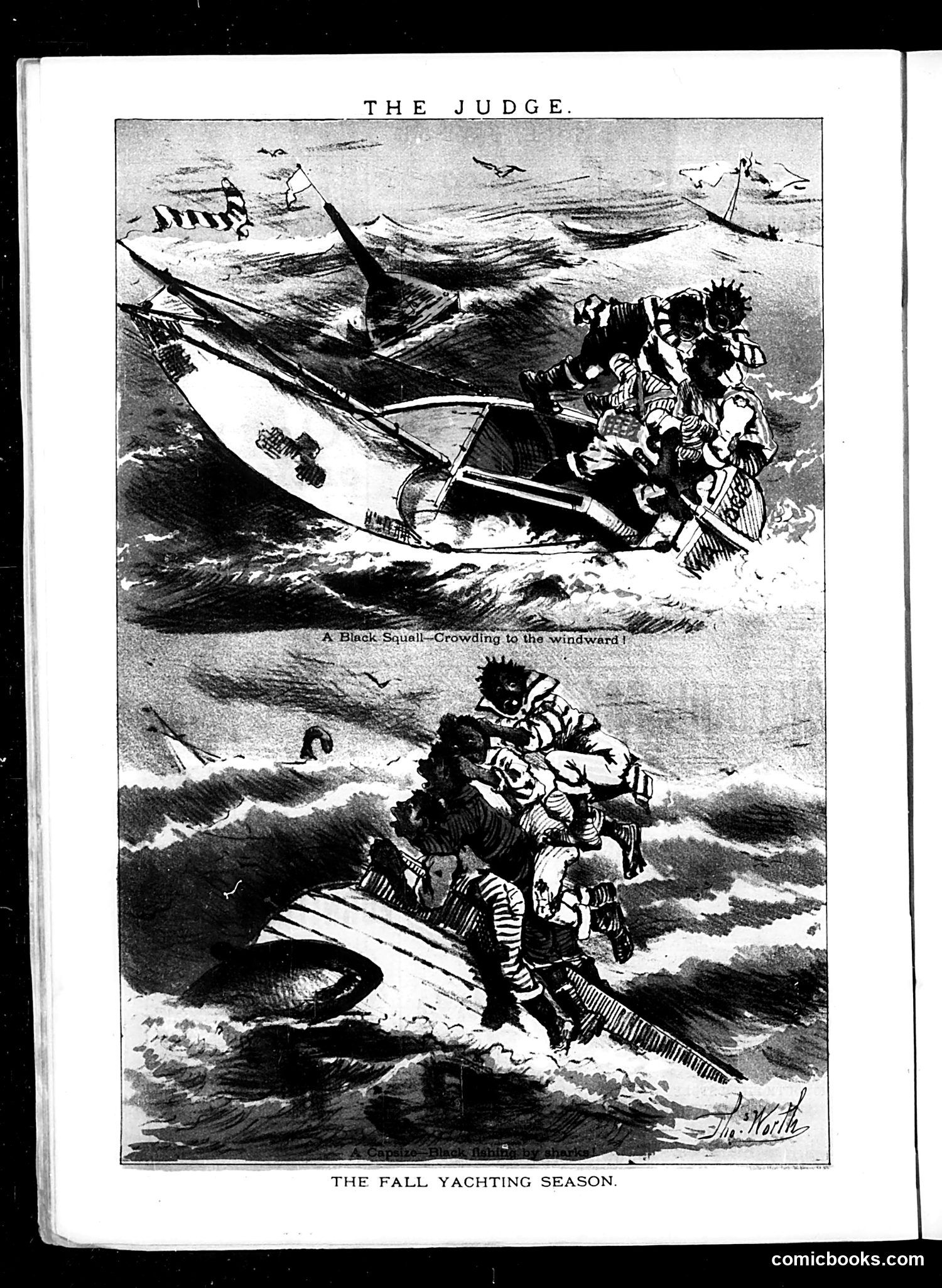
This is a two-panel nautical satire from *Judge* magazine. The top panel shows wealthy passengers crowding toward the windward side of a yacht during rough seas labeled "A Black Squall." The bottom panel depicts the chaotic result—people being swept overboard or struggling in the water. The joke satirizes the foolishness of wealthy yacht enthusiasts who, despite dangerous conditions, instinctively crowd together on one side of the boat (a basic nautical error that destabilizes a vessel). The "fall yachting season" is treated as an annual spectacle of incompetence and peril among the leisure class. This reflects *Judge's* recurring theme of mocking the wealthy elite's pretensions and poor judgment, particularly their reckless pursuit of fashionable pastimes.