
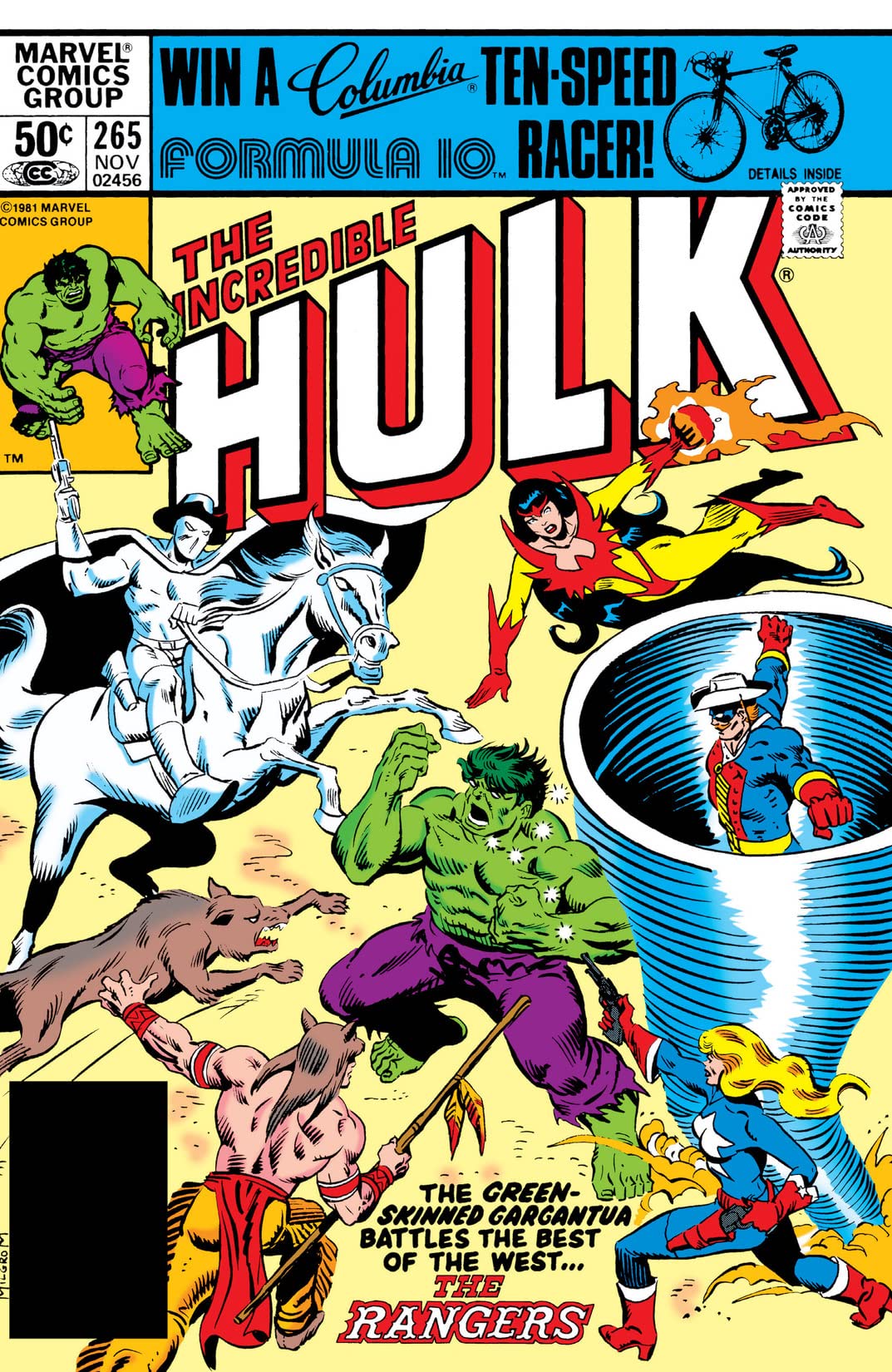
The Incredible Hulk #265
☆ Be the first to review + Add to your collection — Join freeThe Incredible Hulk #265 (November 1981) is the debut issue of the Rangers, Marvel's first sustained superhero team rooted in the American Southwest, and the first appearance of Firebird (Bonita Juárez) and Shooting Star (Victoria Star) — two new female characters introduced in the same issue, a notable gesture toward gender and ethnic diversity at a time when mainstream superhero rosters rarely offered either. Firebird in particular has been recognized by critics and commentators as one of Marvel's most significant early Latina characters, a social worker from New Mexico whose faith, cultural identity, and pyrokinetic powers set her apart from the typical superhero archetype of the era. The issue also marks the only moment the Rangers formally constituted themselves as a team, an origin that grew out of pure accident rather than deliberate assembly — a structurally unusual formation that echoed, in miniature, the accidental birth of the original Avengers. Its downstream creative legacy is substantial: Firebird went on to become a recurring presence in West Coast Avengers, while the Rangers were revived decades later during Civil War and the 50-State Initiative.
ComicBooks.com Value
Show all 16 grades ▾
This exact issue on ebay
CGC 9.8 ▾ $105–$875 4 listings
CGC 9.6 ▾ $89–$220 3 listings
Raw — MINT ▾ $7.7–$240 4 listings
Raw — NM ▾ $12.99–$19.99 5 listings
Raw — NM- ▾ $8–$34.85 2 listings
Raw — VF/NM ▾ $9.99–$24.99 7 listings
Raw — VF ▾ $5.19–$30.54 11 listings
Raw — FN/VF ▾ $9.31–$9.67 2 listings
Raw — FN ▾ $3.99–$33.98 10 listings
Raw — GD ▾ $3.89–$5 2 listings
Raw / ungraded ▾ $3.48–$50 34 listings
More listings for this title
Read it digitally
Sell my copy
Have this issue — or a whole collection? Get a fair offer from us, skip the marketplace fees and the hassle.
We Buy Collections ▸History
The issue was produced during Bill Mantlo's long, character-defining run on The Incredible Hulk, which he began with issue #245 (March 1980) and sustained for roughly six years alongside penciller Sal Buscema. Buscema handled both pencils and inks on this issue, and the credits on the title page of the issue itself also cite Marvel editor and writer Mark Gruenwald as a co-creator of the Rangers alongside Mantlo and Buscema — a collaborative creative arrangement consistent with Gruenwald's active role as an in-house architect of Marvel's shared universe continuity at the time. Al Milgrom, who was Mantlo's editor on the Hulk title throughout this era, is credited as editor. The issue's story title — a paraphrase of the Rolling Stones song 'You Can't Always Get What You Want' — was the actual title printed in the book, signaling the irreverent, pop-culture-inflected tone Mantlo favored across his Hulk tenure.
Trivia · 8 facts
- First appearance of Firebird (Bonita Juárez), a Latina social worker from near Albuquerque, New Mexico, who gained pyrokinetic powers and flight after encountering a meteor; created by Bill Mantlo and Sal Buscema.
- First appearance of Shooting Star (Victoria Star), a Texas-born rodeo sharpshooter and gadgeteer from El Paso with no superhuman powers; also created by Mantlo and Buscema.
- First appearance of the Rangers as a team — a Southwestern superhero group comprising Firebird, Shooting Star, Texas Twister (Drew Daniels), Night Rider/Phantom Rider (Hamilton Slade), and Red Wolf (William Talltrees); the title page credits Mark Gruenwald as co-creator of the team alongside Mantlo and Buscema.
- Of the five founding Rangers, two — Firebird and Shooting Star — had never previously appeared in Marvel Comics; the other three (Texas Twister, Hamilton Slade as Night Rider, and Red Wolf) were existing characters brought together for the first time.
- The team's formation was incidental: the Corruptor, using a mind-controlled Hulk as a weapon, forced Rick Jones to broadcast a distress signal intended for the Avengers; that weakened transmission was intercepted by the five Southwest heroes instead, who converged on a California desert church where Betty Ross and the Teen Brigade were being held.
- The Corruptor (Jackson Day) serves as the issue's principal antagonist; Rick Jones's emotional appeal ultimately breaks the Hulk's mind-controlled state, triggering a reversion to Bruce Banner, who then disarms the Corruptor himself.
- The issue was edited by Al Milgrom, colored by Bob Sharen, and lettered by Diana Albers and Jean Simek, with Buscema handling all interior art duties (pencils and inks).
- The issue is collected in the Incredible Hulk Epic Collection: Devolution (collecting Incredible Hulk #263–279), which was published in a new trade paperback edition in 2026.
Cast · 15 characters
Full credits
Reprints
Reprinted in Spider-Man and Hulk Weekly #448 (1981), L'incroyable Hulk #124/125 (1981), De verbijsterende Hulk #32 (1982), Hulk #12/1982 (1982), La Masa #8 (1983), Fantastici Quattro #17 (1990), Fantastici Quattro #18 (1990), Marvel Héroes #46 (2013), Marvel Masterworks: The Incredible Hulk #17 (2023), Incredible Hulk Epic Collection #11 (2026), Der unglaubliche Hulk #11, Hulk #12/1982
Key issues in The Incredible Hulk
Variants (2)
Reviews
Reader reviews
No reader reviews yet.