
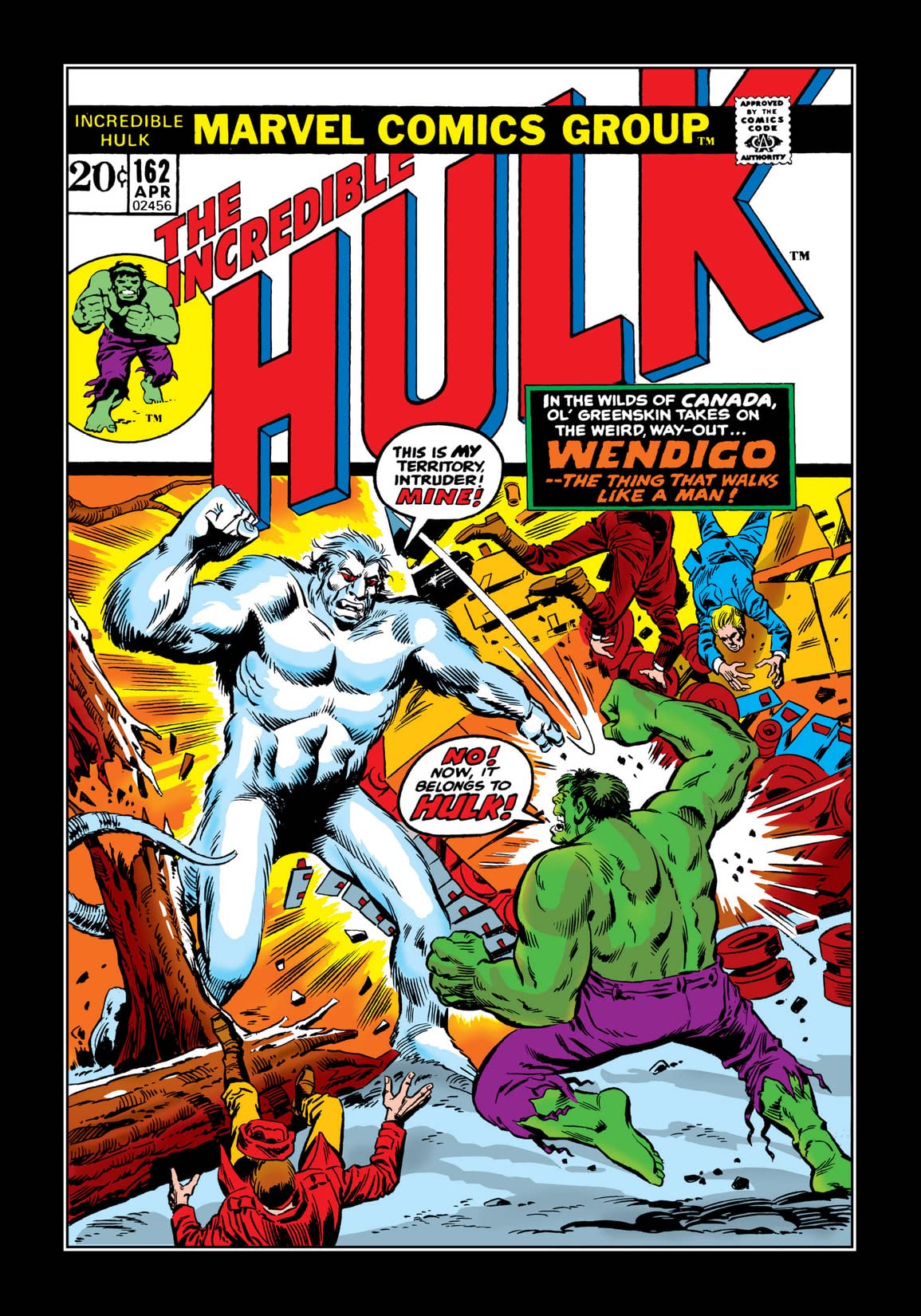
The Incredible Hulk #162
☆ Be the first to review + Add to your collection — Join freeThe Incredible Hulk #162 introduced the Wendigo to the Marvel Universe — a creature rooted in genuine Algonquian folklore about the curse of cannibalism in the Canadian North Woods, making it one of the Bronze Age's most culturally grounded monster debuts. Writer Steve Englehart constructed the story as a deliberate thematic mirror: both the Hulk and the Wendigo are humans imprisoned within monstrous bodies they cannot control, giving the issue an emotional resonance that elevated it well above a standard brawl-of-the-month entry. The Wendigo's debut here also quietly laid the narrative groundwork for the Canadian wilderness setting that Marvel would revisit just eighteen months later in Incredible Hulk #180–181, the issues that introduced Wolverine — meaning this issue is a foundational piece of Marvel's entire Canadian mythology. The character has remained an active part of the Marvel Universe for over fifty years, crossing into Wolverine, Alpha Flight, Spider-Man, and Chaos War storylines, a longevity that speaks to how well-engineered Englehart's original concept was.
In "Spawn of the Flesh-Eater!", the Hulk wanders the frozen Canadian woods and stumbles upon a young woman searching for her missing brother. When he rescues a man from the clutches of a terrifying creature, the survivor’s harrowing tale reveals a gruesome origin tied to the Wendigo—a mythic beast born of cannibalism. Written by Steve Englehart and brought to life by Herb Trimpe’s dynamic art, with Sal Trapani’s inks and David Hunt’s colors, this 1973 issue delivers a chilling descent into folklore and primal fear. The cover by Herb Trimpe and Sal Trapani captures the menace of the Wendigo in stark, haunting detail.
ComicBooks.com Value
Show all 22 grades ▾
This exact issue on ebay
CGC 9 ▾ $285–$410 2 listings
CGC 7.5 ▾ $200–$315 2 listings
CGC 7 ▾ $125–$171 2 listings
CGC 5.5 ▾ $90–$195 2 listings
CGC 5 ▾ $140–$195 2 listings
Raw — VF+ ▾ $179–$238 2 listings
Raw — VF ▾ $108–$215 4 listings
Raw — FN ▾ $52.8–$144 4 listings
Raw / ungraded ▾ $35–$1,500 27 listings
More listings for this title
Read it digitally
Sell my copy
Have this issue — or a whole collection? Get a fair offer from us, skip the marketplace fees and the hassle.
We Buy Collections ▸History
Steve Englehart was Marvel's lead writer during this period — having rapidly risen to prominence by revitalizing Captain America — and brought genuine folklore research to the assignment, later recalling that he was drawn to the Wendigo legend because its combination of physical power and inherently tragic origin made the character a natural counterpart for the Hulk. The issue was produced under editor Roy Thomas, who oversaw the Hulk title during one of Herb Trimpe's most prolific stretches; Trimpe was at this point deep into what would become a nearly continuous seven-year run on the book, and his kinetic, rugged rendering of the white-furred beast gave the Wendigo an immediately distinctive visual identity. Inker Sal Trapani, colorist David Hunt, and letterer Artie Simek rounded out the production team.
Trivia · 8 facts
- First appearance of the Wendigo, created by writer Steve Englehart and penciler Herb Trimpe; the issue carries an April 1973 cover date and was on sale January 2, 1973.
- The story is titled 'Spawn of the Flesh-Eater!' — the Wendigo's in-story origin is Paul Cartier, a French-Canadian man who committed an act of cannibalism in the wilderness to survive and was subsequently transformed by an ancient curse.
- The Wendigo is depicted as a silver-furred, Bigfoot-like creature with a prehensile tail; Marvel's conception diverges significantly from the skeletal, gaunt figure of traditional Algonquian legend, but the cannibalism-as-curse mythology is drawn directly from Algonquian-speaking peoples' folklore.
- Also features the first appearances of supporting characters Marie Cartier and Georges Baptiste, both of whom figure into the Wendigo's origin story; a topical reference places Canadian Prime Minister Pierre Trudeau in the narrative.
- The issue ends on a deliberately unresolved, tragic note: the Hulk is unable to break the Wendigo curse, and Paul Cartier's consciousness dissolves completely, leaving only the monster — an unusually downbeat Bronze Age conclusion.
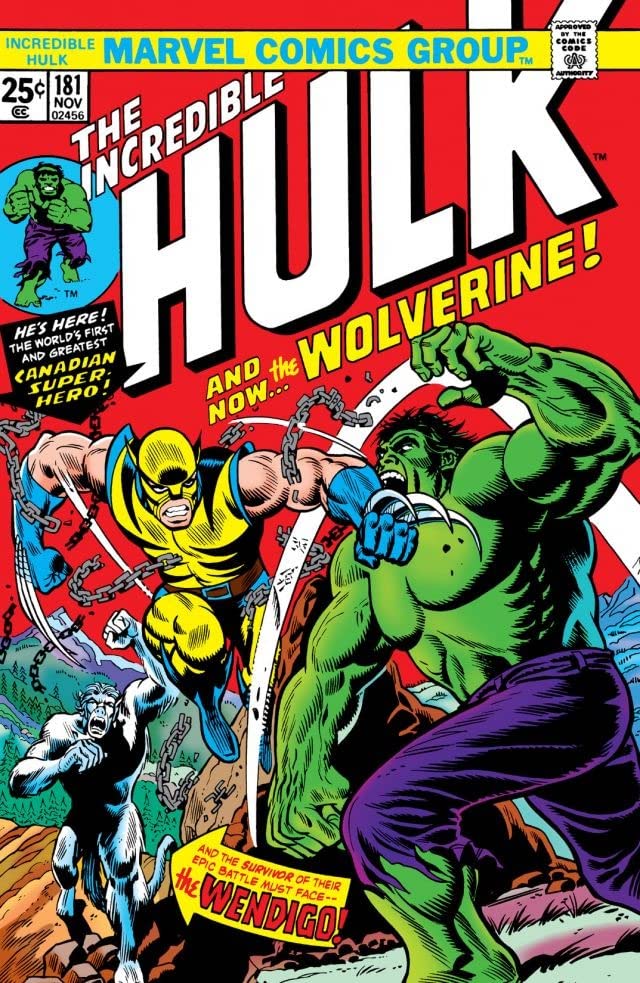
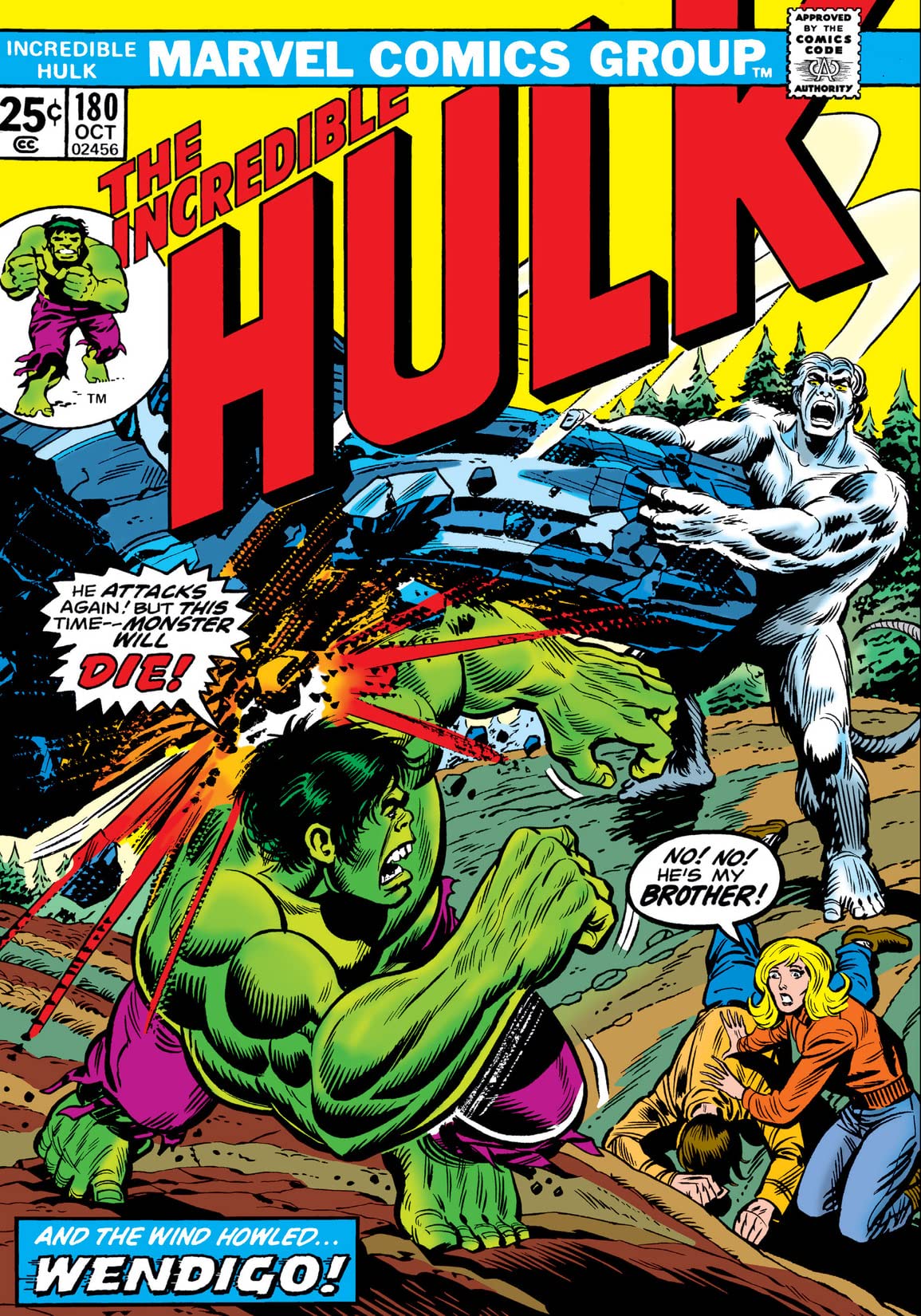
- The Wendigo returns in Incredible Hulk #180–181 (Oct.–Nov. 1974), where the character shares page space with the debut of Wolverine, retroactively amplifying the significance of this first appearance.
- Reprinted in black and white in Essential Hulk, Vol. 4, and in restored color in Marvel Masterworks: The Incredible Hulk, Vol. 9; it was also partially reprinted in the British anthology Mighty World of Marvel #160, and in several French-language editions.
- The Wendigo has been adapted into animation, appearing in the 1990s Incredible Hulk animated series episode 'And the Wind Cries...Wendigo!' and in the Wolverine and the X-Men animated series episode 'Wolverine vs. Hulk.'
Full credits
Reprints
Reprinted in L'incroyable Hulk #21 (1973), Gamma la bombe qui a créé Hulk #[4] (1979), Hulk #3/1980 (1980), Essential Hulk #4 (2006), Marvel Horror Lives Again! Omnibus #[nn] (2020), Incredible Hulk Epic Collection #6 (2021), Marvel Horror Classic Collection #2 (2023), The Incredible Hulk Omnibus #3 (2025), Hulk #3/1980, Χούλκ [Hulk] #4, The Mighty World of Marvel #160
Key issues in The Incredible Hulk
Variants (1)
Reviews
Reader reviews
No reader reviews yet.