
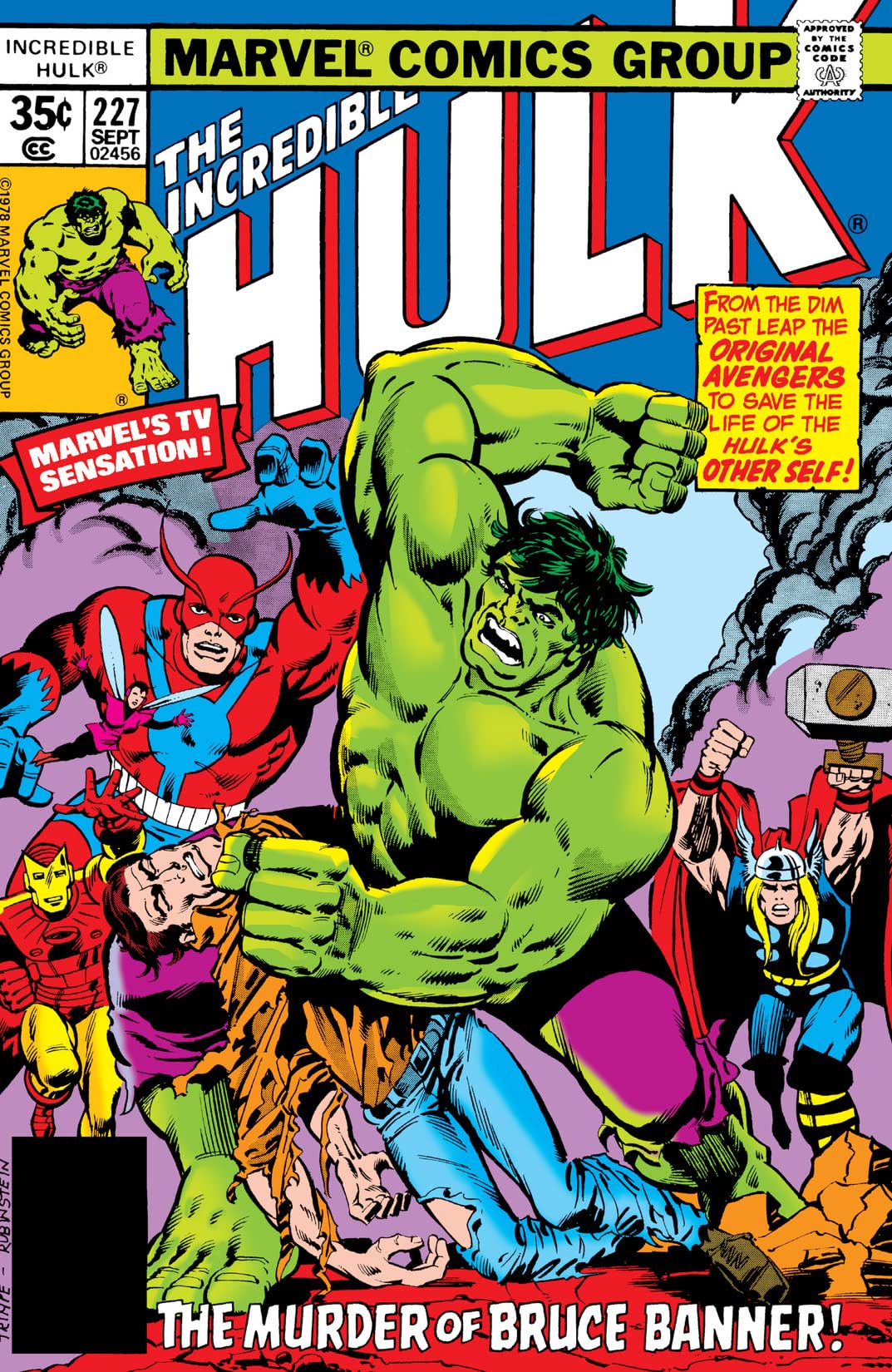
The Incredible Hulk #227
☆ Be the first to review + Add to your collection — Join freeIncredible Hulk #227, titled 'The Monster's Analyst,' is the issue in which Doc Samson formally concludes—through an unprecedented psychotherapeutic experiment—that Bruce Banner and the Hulk are not one fractured mind but two entirely distinct personalities, laying the conceptual groundwork for the dissociative identity disorder (DID) framework that every major subsequent Hulk writer, from Bill Mantlo through Peter David, would build upon. By framing Banner's transformation as a psychological condition rooted in repression and trauma rather than simply a side effect of gamma radiation, writers Roger Stern and Peter Gillis pivoted the Hulk away from the more sentimental 'cuddly monster' characterization that had defined the Len Wein era and pointed the series toward a darker, more psychologically grounded direction. That single narrative pivot would eventually feed directly into Peter David's celebrated 1987–1998 run, where the DID framework became the cornerstone of one of Marvel's most acclaimed long-form character studies. The issue also functions as a rare emotional retrospective, leading the Hulk through a dreamscape populated by every significant friend he has lost, making it a moving survey of the character's full continuity up to that point.
In "The Monster's Analyst," Doc Samson takes a bold new approach to understanding Bruce Banner’s condition, uncovering a startling revelation: the Hulk may not be a transformation, but a separate consciousness. With Peter Gillis and Roger Stern at the helm and Sal Buscema’s dynamic art bringing the tension to life, this 1978 issue dives into the mind of the green giant like never before. The cover by Herb Trimpe and Joe Rubinstein captures the eerie intensity of the moment, making this a standout in the Hulk’s storied history.
ComicBooks.com Value
Show all 16 grades ▾
This exact issue on ebay
CGC 9.8 ▾ $265–$300 2 listings
Raw — FN/VF ▾ $10–$11.99 2 listings
Raw — FINE ▾ $3.99–$7.95 2 listings
Raw / ungraded ▾ $2.11–$25 29 listings
More listings for this title
Read it digitally
Sell my copy
Have this issue — or a whole collection? Get a fair offer from us, skip the marketplace fees and the hassle.
We Buy Collections ▸History
The issue was co-written by Roger Stern and Peter Gillis during the transitional editorial period overseen by editor Bob Hall and editor-in-chief Jim Shooter, with Sal Buscema—who had been the book's steady penciller since issue #194—handling interior art, inked by Klaus Janson. According to a statement Peter Gillis later gave to researcher Frank Lovece in August 2021, he and Stern had a deliberate creative agenda: to move the book decisively away from the affectionate, approachable Hulk of the Wein and Steve Gerber years and toward a Hulk who read as a genuine monster, a tonal shift that required grounding his duality in psychological rather than purely physical terms. The cover was pencilled by Herb Trimpe and inked by Joe Rubinstein, with lettering by Gaspar Saladino and John Costanza and coloring by Glynis Wein (Oliver). The issue was released on June 20, 1978, carrying a September 1978 cover date.
Trivia · 8 facts
- Story title is 'The Monster's Analyst'; released June 20, 1978, with a September 1978 cover date — published by Marvel Comics.
- Written by Roger Stern and Peter Gillis; interior art by Sal Buscema (pencils) and Klaus Janson (inks); cover by Herb Trimpe and Joe Rubinstein; colored by Glynis Wein (Oliver); lettered by John Costanza and Gaspar Saladino; edited by Bob Hall under editor-in-chief Jim Shooter.
- Doc Samson uses a device called the Rem-Integrator to enter the Hulk's dreamscape and concludes, for the first time definitively in the series, that Banner and the Hulk are two entirely distinct personalities — an early in-continuity articulation of what would later be codified as dissociative identity disorder (DID).
- Wikipedia's Hulk article identifies this issue as the one that 'established that the Hulk's separate identity was not due to the mutation affecting his brain, but because Banner was suffering from dissociative identity disorder, with the savage Green Hulk representing Banner's repressed childhood rage.'
- The Hulk's dreamscape revisits a parade of deceased friends from across the character's Silver and Bronze Age continuity, including Crackajack Jackson, an unnamed Russian scientist (Tales to Astonish #65–66), Filius Omen, Mogol, and Jarella, making the issue a comprehensive emotional retrospective of the Hulk's relational history.
- The story is continued in Incredible Hulk Annual #7, which immediately follows this issue in the reading order.
- The issue received early international reprints, including a partial reprint in the UK's The Mighty World of Marvel #316 (October 1978), and was later reprinted in multiple other international markets (Italy, Norway, Spain, France) as well as in the 1981 prose/art hybrid The Incredible Hulk: The Secret Story of Marvel's Gamma-Powered Goliath.
- Issue #227 is collected in Marvel's Essential Incredible Hulk Vol. 7 (2013), which gathers issues #226–244 alongside Incredible Hulk Annual #7–9 and related crossover material.
Full credits
Reprints
Reprinted in The Mighty World of Marvel #315 (1978), L'incroyable Hulk #84/85 (1978), The Mighty World of Marvel #316 (1978), L'Uomo Ragno [Collana Super-Eroi] #271 (1980), The Incredible Hulk: The Secret Story of Marvel's Gamma-Powered Goliath #[nn] (1981), Hulk #10/1981 (1981), Hulk el Hombre Increíble #80 (1983), Gamma la bombe qui a créé Hulk #22 (1983), Essential Hulk #7 (2013), Marvel Masterworks: The Incredible Hulk #14 (2020), Incredible Hulk Epic Collection #9 (2024), Hulk #10/1981, L'Incredibile Hulk #28
Key issues in The Incredible Hulk
Variants (1)
Reviews
Reader reviews
No reader reviews yet.