
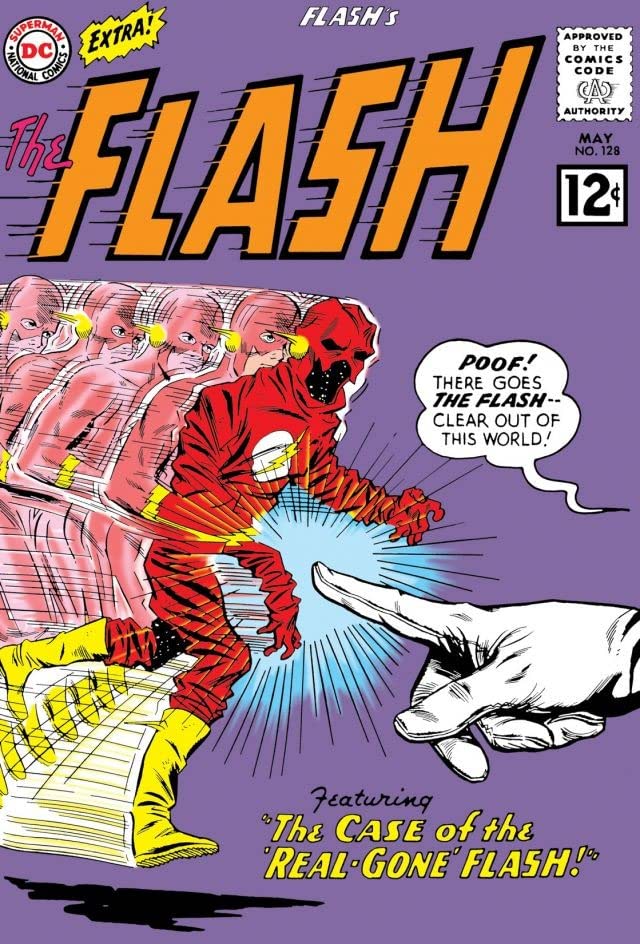
The Flash #128
☆ Be the first to review + Add to your collection — Join freeThe Flash #128 holds a double bill of genuine historical significance for the Silver Age: it introduces Abra Kadabra, one of Barry Allen's most enduring and conceptually original Rogues, whose premise — a frustrated 64th-century stage magician passing off advanced technology as sorcery — gave DC a villain unlike anything in its existing stable. The backup story, 'The Origin of Flash's Masked Identity!', retrofits an in-universe rationale for why Barry chose to conceal his face, a small but narratively tidy piece of world-building that enriched the mythology surrounding his origin. Together, the two stories exemplify the Silver Age formula that editor Julius Schwartz and writer John Broome perfected: playful science-fictional conceits grounded just enough in character logic to feel emotionally coherent. Abra Kadabra went on to become a franchise-wide force, eventually implicated in Wally West's disappearance from continuity in DC Rebirth, proving that a single issue debut can still reverberate decades later.
In "The Case of the Real-Gone Flash!", Barry Allen contemplates a world where the Flash sheds his mask and operates in plain sight, inspired by a Golden Age issue of Flash Comics he’s reading. Written by John Broome and brought to life with dynamic art by Carmine Infantino and inks by Joe Giella, this 1962 classic explores identity and visibility through a clever, thought-provoking twist. The cover by Carmine Infantino and Joe Giella captures the moment with bold, timeless flair.
In "The Case of the Real-Gone Flash!", the Flash faces a bizarre threat when the time-traveling trickster Abra Kadabra arrives from the future, using his powers to commit crimes not for gain, but for the thrill of applause. As the speedster races to stop him, the line between illusion and reality begins to blur in a battle of wits and lightning-fast action.
In a quiet moment of reflection, Barry Allen wonders what it would be like if the Flash—his hero, his inspiration—had never worn a mask, imagining how his life might have changed if the Scarlet Speedster had faced the world without hiding behind a disguise. The thought takes him into a dreamlike journey where the identity of the Flash is tested in a high-stakes encounter with art thieves, and the line between hero and man begins to blur.
ComicBooks.com Value
Show all 18 grades ▾
This exact issue on ebay
Raw / ungraded ▾ $90–$199 5 listings
More listings for this title
Read it digitally
Sell my copy
Have this issue — or a whole collection? Get a fair offer from us, skip the marketplace fees and the hassle.
We Buy Collections ▸History
Both stories in this issue were written by John Broome and drawn by Carmine Infantino, with inks by Joe Giella, under the editorial oversight of Julius Schwartz — the core Silver Age Flash creative unit that had been shaping the title since its relaunch. Broome conceived Abra Kadabra as a time-travel villain with a twist: rather than seeking conquest or revenge, Citizen Abra simply craves an audience, a motivation rooted more in vanity than malice that gave Infantino's designs a theatrical, almost comedic flair. The issue shipped to retailers on March 6, 1962, with a May 1962 cover date, placing it squarely in the era when the Flash's Rogues Gallery was still being assembled issue by issue.
Trivia · 8 facts
- First appearance and origin of Abra Kadabra (Citizen Abra), a time-traveling stage magician from the 64th century who uses advanced technology to simulate magic — created by writer John Broome and artist Carmine Infantino.
- The issue contains two stories: 'The Case of the Real-Gone Flash!' (the Abra Kadabra debut) and 'The Origin of Flash's Masked Identity!' — both written by John Broome, penciled by Carmine Infantino, inked by Joe Giella, and edited by Julius Schwartz.
- Abra Kadabra's core concept: in the year 6363, science has rendered stage magic obsolete; Citizen Abra steals a time machine to travel to the 20th century, where he can find an appreciative audience and gain fame by committing spectacular crimes.
- 'The Origin of Flash's Masked Identity!' is set concurrently with Barry Allen's origin from Showcase #4, exploring — through a daydream — why Barry decided to adopt a mask rather than operate publicly like his predecessor Jay Garrick.
- Abra Kadabra's next appearance after this issue was The Flash #133 (December 1962), beginning a long career as a recurring Rogues Gallery member spanning multiple decades.
- 'The Case of the Real-Gone Flash!' was reprinted in Flash #187, DC Special Blue Ribbon Digest #15, DC Super-Stars #11, The Flash Omnibus Vol. 1, and The Flash Archives Vol. 4; the masked identity story was reprinted in Flash #196, 80-Page Giant #8, and those same omnibus/archive volumes.
- 'The Origin of Flash's Masked Identity' was adapted for a 1967 MGM record album, Official Adventures of Aquaman, The Flash & Green Lantern, narrated by Jackson Beck — making it one of the earliest Flash stories to receive an audio adaptation.
- Abra Kadabra appeared in the DC Rebirth-era Titans comic series as the villain responsible for erasing Wally West from the timeline, and was later portrayed by David Dastmalchian in two episodes of the Arrowverse television series The Flash.
Cast · 5 characters
Full credits
Reprints
Reprinted in The Hundred Comic #72 (1962), 80 Page Giant Magazine #8 (1965), Superman #12/1968 (1968), Flits Classics #2603 (1969), Metal Men #36 (1969), The Flash #187 (1969), The Flash #196 (1970), Flash #3 (1970), Superman Presents World's Finest Comic Monthly #125 (1975), DC Super Stars #11 (1977), Flash #51 (1981), DC Special Blue Ribbon Digest #15 (1981), Roter Blitz #11/1982 (1982), Roter Blitz #12/1982 (1982), More Secret Origins Replica Edition #1 (1999), DC's Greatest Imaginary Stories #[1] (2005), The Flash Archives #4 (2006), Showcase Presents: The Flash #2 (2008), DC Universe Secret Origins #[nn] (2012), DC Universe: Secret Origins #[nn] (2013), The Flash Omnibus #1 (2014), DC Comics Graphic Novel Collection #111 (2017), The Flash: The Silver Age #2 (2017), The Flash: The Silver Age Omnibus #1 (2019) + 3 more
Key issues in The Flash
Reviews
Reader reviews
No reader reviews yet.