
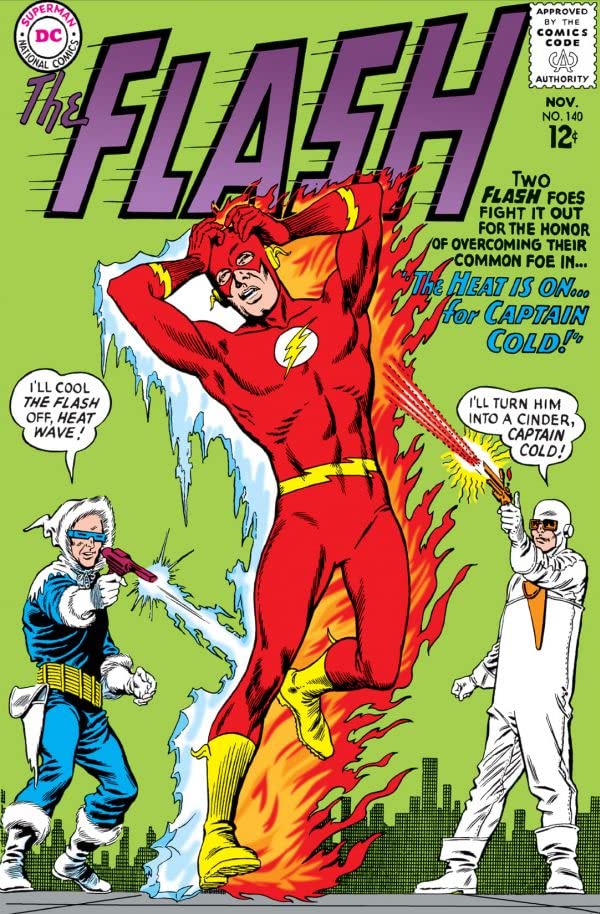
The Flash #140
☆ Be the first to review + Add to your collection — Join freeThe Flash #140 marks the debut of Heat Wave (Mick Rory), a fire-obsessed pyromaniac who arrived as a direct thematic counterpart to the long-established Captain Cold, instantly giving the Flash's rogues gallery a hot-versus-cold duality that writers would mine for decades. By introducing a villain whose psychological damage was rooted in childhood trauma and compulsive pyromania, writer John Broome pushed the Silver Age Flash villains slightly past pure gimmickry toward character-driven motivation — a storytelling shift that later writers, especially Geoff Johns, would deepen substantially. Heat Wave went on to become a founding member of the Rogues and has appeared continuously in Flash comics, animation, and live-action television ever since, cementing this issue's place as a foundational brick in one of superhero comics' most celebrated villain ensembles.
In "The Heat Is On... for Captain Cold," the icy menace of Captain Cold joins forces with a fiery new adversary, Heat Wave, in a high-stakes bid to outshine the Flash and win the favor of Dream Girl, a local TV star. Written by John Broome and brought to life by Carmine Infantino’s dynamic art and Joe Giella’s sharp inks, this 1963 classic sees two contrasting rogues push their limits in a race against speed. The cover, penciled by Infantino and inked by Murphy Anderson, captures the clash of cold and heat with bold, expressive flair.
Captain Cold recruits a fiery new ally, Heat Wave, in a high-stakes bid to outwit the Flash and win the favor of Dream Girl, a local TV star whose attention they both crave. With Iris West caught in the crossfire and the Flash racing to stop them, the heat is on — and not just from Heat Wave’s flames.
ComicBooks.com Value
Show all 19 grades ▾
More listings for this title
Read it digitally
Sell my copy
Have this issue — or a whole collection? Get a fair offer from us, skip the marketplace fees and the hassle.
We Buy Collections ▸History
The issue arrived in November 1963 — the same red-hot creative period in which John Broome and Carmine Infantino, working under editor Julius Schwartz, were methodically populating Central City with a roster of themed, gadget-based criminals. Schwartz ran the DC science-fiction titles with a disciplined 'concept cover first, story second' editorial method: Infantino would render an arresting cover image and Schwartz or his writers would then build a script to justify it, a process that gave the Silver Age Flash its distinctive visual pop. The main story, 'The Heat Is On… For Captain Cold,' was scripted by Broome with interior art by Infantino and inker Joe Giella, while Murphy Anderson — a key Schwartz-stable inker — handled the cover inking over Infantino's pencils. The issue also carried a second story, 'Metal Eater From the Stars,' scripted by Gardner Fox, meaning two of the Silver Age's most prolific SF writers shared a single issue at the height of the book's creative peak.
Trivia · 8 facts
- First appearance and full origin of Heat Wave (Mick Rory), created by writer John Broome and penciler Carmine Infantino; published with a cover date of November 1963.
- The lead story, 'The Heat Is On… For Captain Cold,' introduces Heat Wave as both a rival to Captain Cold and a new Flash adversary — the two villains temporarily team up, competing over a Central City newscaster called 'Dream Girl' (Priscilla Varner), whose own first appearance is also recorded in this issue.
- Cover art was penciled by Carmine Infantino and inked by Murphy Anderson; interior pencils by Infantino are inked by Joe Giella, a division of labor typical of Schwartz-edited Flash issues of the era.
- Editor: Julius Schwartz. The book's two-story format features a second tale, 'Metal Eater From the Stars,' scripted by Gardner Fox, with pencils again by Infantino and inks by Giella.
- Heat Wave's in-story origin establishes Mick Rory as a pyromaniac who built a gun-sized flamethrower ('Hot Rod') and an asbestos protective suit — a detail that has since been noted as a product of its era, written before the dangers of asbestos were publicly understood.
- The issue sits directly in the Rogues-building run of Silver Age Flash comics: the preceding issue (#139) had debuted Professor Zoom/Reverse-Flash, making late 1963 one of the densest stretches of villain introductions in the title's history.
- Heat Wave has been portrayed by actor Dominic Purcell across The CW's Arrowverse, appearing in both The Flash and Legends of Tomorrow television series, giving this debut issue an extended pop-culture footprint.
- The story in this issue has been reprinted in DC's The Flash: The Silver Age Omnibus Vol. 2, which collects The Flash #133–163, as well as in Showcase Presents: The Flash and The Flash: The Silver Age Vol. 2 trade paperback.
Full credits
Reprints
Reprinted in Batman #263 (1965), Superboy-BI #22 (1970), The Flash #208 (1971), DC Special #14 (1971), Showcase Presents: The Flash #2 (2008), The Flash Archives #5 (2009), The Flash vs. the Rogues #[nn] (2010), The Flash: The Silver Age Omnibus #2 (2017), The Flash: The Silver Age #3 (2018)
Key issues in The Flash
Reviews
Reader reviews
No reader reviews yet.