
The Flash #113
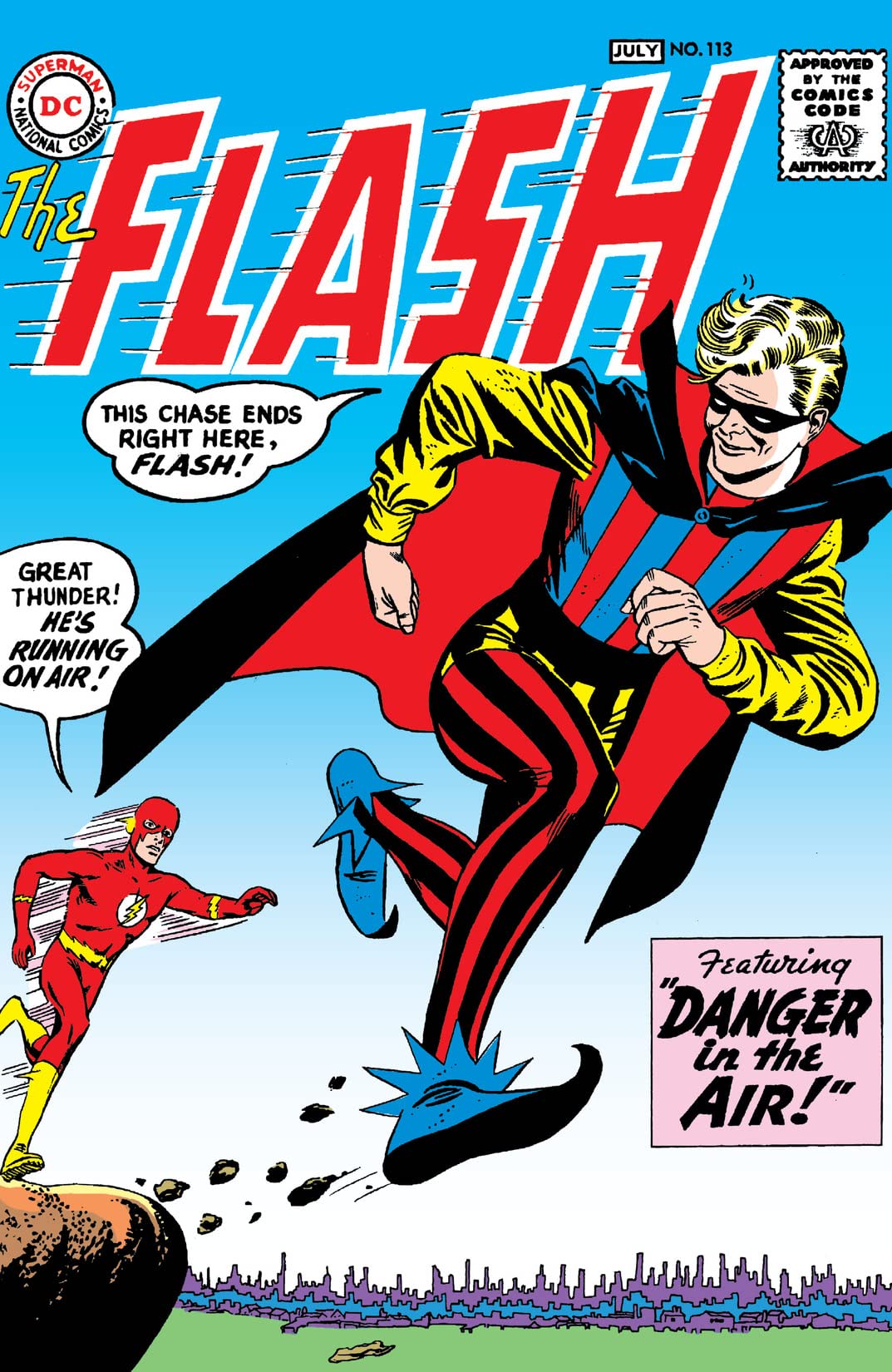
☆ Be the first to review + Add to your collection — Join freeThe Flash #113 introduced James Jesse — the Trickster — to DC's Silver Age Rogues Gallery, giving Barry Allen one of his most theatrically inventive adversaries: a circus-trained acrobat who commits crimes with gadget-laced showmanship and a pair of air-walking shoes. Unlike the raw-power villains common to the era, the Trickster was built entirely around misdirection and spectacle, a design philosophy that made him a model for comedic-yet-dangerous Flash rogues to come. The character's durability across six decades — including FBI-informant arcs, Countdown appearances, and multiple television adaptations — confirms the original issue as the seed of a genuinely elastic creation. The cover itself, depicting a villain casually strolling through mid-air while the Flash looks on in disbelief, became one of the most-cited examples of Carmine Infantino's gift for constructing images that sold a concept in a single glance.
ComicBooks.com Value
Show all 21 grades ▾
This exact issue on ebay
CGC 7 ▾ $650 2 listings
CGC 5 ▾ $203–$347 3 listings
CGC 3 ▾ $144–$180 2 listings
Raw — VG ▾ $149–$150 2 listings
Raw / ungraded ▾ $32–$700 3 listings
More listings for this title
Read it digitally
Sell my copy
Have this issue — or a whole collection? Get a fair offer from us, skip the marketplace fees and the hassle.
We Buy Collections ▸History
The issue was produced by the core Silver Age Flash creative team of writer John Broome, penciller Carmine Infantino, and inker Joe Giella, all working under editor Julius Schwartz — the same editorial machine that had been methodically populating Central City with themed rogues since the late 1950s. According to Wikipedia's Trickster entry, Infantino originally designed the character's look for the issue's cover, with the cover image then serving as the conceptual starting point for Broome's script and the character's backstory — an early example of the cover-first plotting approach Schwartz's office often employed. The Trickster's harlequin-inspired costume, built around clashing orange, black, and yellow stripes, was a deliberate Infantino design choice that made Jesse visually distinct even among Flash's already colorful cast.
Trivia · 8 facts
- First appearance AND full origin of the Trickster (James Jesse, born Giovanni Giuseppe), cover-dated June–July 1960.
- Created by writer John Broome and artist Carmine Infantino; Joe Giella inked both the cover and the interior story.
- The issue contains two stories: the Trickster debut 'Danger in the Air!' and a second tale, 'The Man Who Claimed the Earth!'
- James Jesse's core concept is a reversed-namesake joke: he adopted the alias 'James Jesse' as a deliberate inversion of the outlaw Jesse James, and where Jesse James robbed trains, the Trickster robs airplanes in mid-flight.
- Jesse's signature 'Airwalker Shoes' originated as a practical invention to manage his acrophobia while performing with his family's circus aerialist troupe, the Flying Jesses.
- In the debut story, Barry Allen cancels a date with Iris West to pursue the Trickster, who escapes their first encounter by running on air; Flash ultimately deduces his circus background and apprehends him at the circus.
- 'Danger in the Air!' has been reprinted multiple times: in The Flash #160 (April 1966), The Flash Archives Vol. 2, Showcase Presents: The Flash Vol. 1, The Flash Chronicles Vol. 3, The Flash Omnibus Vol. 1, The Greatest Flash Stories Ever Told, and Countdown Special: The Flash #1.
- The James Jesse incarnation of the Trickster was adapted for live-action television in The CW's The Flash (2014), and actor Mark Hamill portrayed the character in the 1990 CBS Flash series as well as providing a voice performance in Justice League Unlimited.
Cast · 3 characters
Full credits
Reprints
Reprinted in The Hundred Plus Comic #50 (1960), Big Boss #66 (1962), Flash #36 (1962), The Hundred Comic #88 (1964), The Flash #160 (1966), The Flash #169 (1967), Lynet #5/1967 (1967), Lynet #4/1968 (1968), Lynet #5/1968 (1968), The Flash #192 (1969), Flits Classics #2605 (1970), Flash #21 (1975), Flash trois-dans-un #3 (1981), The Greatest Flash Stories Ever Told #[nn] (1991), The Greatest Flash Stories Ever Told #[nn] (1992), The Flash Archives #2 (2000), Showcase Presents: The Flash #1 (2007), Countdown Special: The Flash #1 (2007), The Flash vs. the Rogues #[nn] (2010), The Flash Chronicles #3 (2012), The Flash Omnibus #1 (2014), The Flash: The Silver Age #1 (2016), The Flash: The Silver Age Omnibus #1 (2019), DC Finest: The Flash: The Human Thunderbolt #[nn] (2025) + 1 more
Key issues in The Flash
Reviews
Reader reviews
No reader reviews yet.