
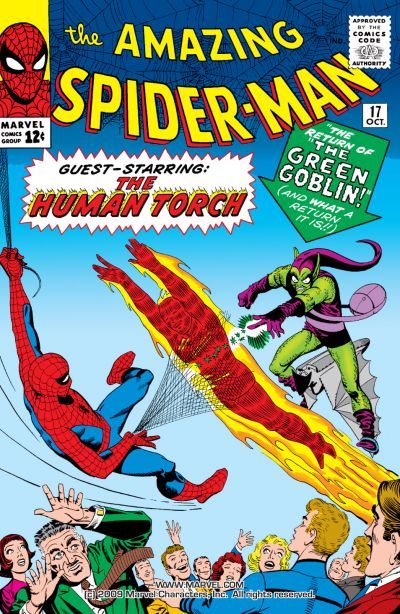
The Amazing Spider-Man #17
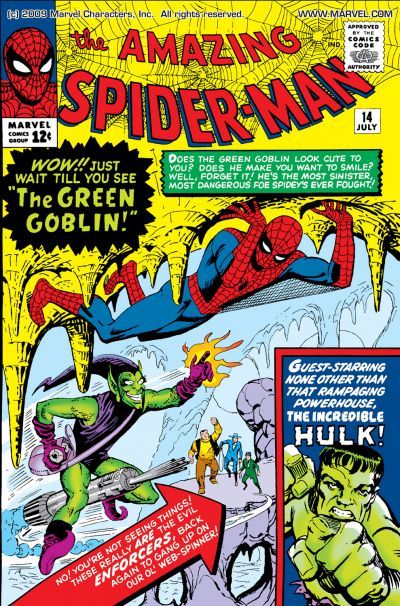
Amazing Spider-Man #17 (cover date October 1964) is the second appearance of the Green Goblin and the issue in which Steve Ditko gave the villain his most enduring visual signature: the bat-shaped glider that replaced the rocket-powered broomstick from issue #14. That single design upgrade transformed a somewhat awkward debut villain into the aerial, acrobatic menace who would become Spider-Man's defining archenemy. Equally important to the strip's developing DNA is the issue's tonal layering: Lee and Ditko deliberately refused, again, to reveal the Goblin's identity — a serial mystery that would sustain reader investment for years — while simultaneously weaving Peter Parker's civilian soap opera (the Betty-vs.-Liz rivalry, Flash Thompson's fan club, Aunt May's hospitalization) so tightly into the action that the two threads are genuinely inseparable, modeling the kind of serialized emotional continuity that would come to define Marvel storytelling.
In "The Return of the Green Goblin!", Spider-Man attends a fan club gathering hosted by Flash Thompson, only to be ambushed by the Green Goblin mid-event. With the Human Torch on hand to lend a hand, the fight escalates—until Spider-Man learns Aunt May has been hospitalized, forcing him to leave abruptly and leaving the crowd convinced he fled in fear. Written by Stan Lee and illustrated by Steve Ditko, with colors by Stan Goldberg and letters by S. Rosen, this 1964 classic features a cover by Steve Ditko that captures the chaos of the moment.
ComicBooks.com Value
Show all 22 grades ▾
This exact issue on ebay
CGC 7 ▾ $830–$1,381 2 listings
CGC 6 ▾ $499–$545 2 listings
CGC 4 ▾ $350–$401 3 listings
CGC 3 ▾ $299–$300 2 listings
Raw — VG ▾ $209–$320 4 listings
Raw — GD ▾ $117–$295 5 listings
Raw / ungraded ▾ $3.74–$825 17 listings
Read it digitally
Sell my copy
Have this issue — or a whole collection? Get a fair offer from us, skip the marketplace fees and the hassle.
We Buy Collections ▸History
The issue was written by Stan Lee, plotted and drawn by Steve Ditko, and lettered by Sam Rosen, with colors by Stan Goldberg; it went on sale July 9, 1964, with an October 1964 cover date. By this point in the Lee-Ditko collaboration, working under the 'Marvel Method' — Ditko creating and thumbnailing the pages from a loose synopsis, Lee scripting dialogue afterward — Ditko exercised significant creative autonomy, and it was his decision on the original Green Goblin story (issue #14) to transform Lee's synopsis of a mythological demon into a masked human criminal whose face was never shown. That unresolved mystery carried directly into issue #17, where Ditko again staged the Goblin so his civilian identity remains hidden; the letters page for this very issue also teased readers that the following issue's plot had been 'dreamed up by Sunny Steve,' signaling how much creative ground Ditko was holding by late 1964.
Trivia · 8 facts
- Second appearance of the Green Goblin (Norman Osborn), continuing the deliberate mystery around his secret identity that would remain unresolved until Amazing Spider-Man #39 (1966).
- First appearance of the Goblin Glider — the iconic bat-shaped flying vehicle that replaced the rocket-powered broomstick the Goblin rode in his debut in ASM #14; the glider became one of the character's defining weapons and visual hallmarks.
- First appearance of the 'Bag of Tricks,' the Green Goblin's over-the-shoulder satchel of Halloween-themed weapons, including early uses of pumpkin bombs and a flame-retarding gas used against the Human Torch.
- Written by Stan Lee, with art, inking, and cover by Steve Ditko; lettered by Sam Rosen (credited as 'S. Rosen' in the indicia); published by Non-Pareil Publishing Corp. (Marvel's indicia publisher of record at the time).
- Flash Thompson organizes the first Spider-Man Fan Club ('Forest Hills Chapter'), but the evening backfires: Spider-Man abandons the fight with the Goblin when he learns Aunt May has suffered a heart attack, and the crowd concludes he is a coward — a pivotal note of irony that Lee and Ditko mine for Peter Parker's inner anguish.
- The letters page carries early correspondence from future comics writers Doug Moench (Master of Kung Fu, Batman) and Bill DuBay, both of whom incorrectly guess at the Green Goblin's identity — a meta-confirmation that Lee and Ditko were building reader suspense deliberately around the mystery, at a time when Norman Osborn had not yet been conceived as the answer.
- The issue has been reprinted in Marvel Tales #12 (January 1968) and #155 (September 1983), the Amazing Spider-Man Omnibus Vol. 1, Marvel Masterworks: The Amazing Spider-Man Vol. 2, Mighty Marvel Masterworks: The Amazing Spider-Man Vol. 2 – The Sinister Six, the Taschen Marvel Comics Library: Spider-Man Vol. 1 (1962–1964), and the Penguin Classics Marvel Collection: The Amazing Spider-Man (2022).
- Aunt May's hospitalization in this issue is her second hospital stay in the series (the first was in ASM #9), establishing the recurring narrative device of her fragile health as a source of helpless anguish for Peter — a storytelling motif that would persist across decades of Spider-Man comics.
Cast · 9 characters
Full credits
Reprints
Reprinted in Mystic #47 (1964), Pow! #40 (1967), Marvel Tales #12 (1968), Demonen #1/1970 (1970), Hit Comics Die Spinne #224 (1971), Marvel #12 (1971), Spider-Man Comics Weekly #11 (1973), Die Spinne #19 (1974), The Amazing Spider-Man #17 (1976), Une Aventure de l'Araignée #1 (1977), Strange #99 (1978), The Amazing Spider-Man #3 (82579-8) (1979), Edderkoppen #8/1980 (1980), El Hombre Araña / El Asombroso Hombre Araña #16 (1980), Spindelmannen #8/1980 (1980), Marvel Tales #155 (1983), Marvel Masterworks #5 (1988), Spider-Man Classic #9 (1994), Spider-Man Megazine #2 (1994), Spider-Man vs. Green Goblin #[nn] (1995), The Essential Spider-Man #1 (1996), Spider-Man Komplett #17 (1999), Marvel Masterworks: The Amazing Spider-Man #2 (2002), Spiderman: Stan Lee y Steve Ditko #2 (2003) + 17 more
Key issues in The Amazing Spider-Man
 ★
★ ★
★ ★
★ ★
★ ★
★ ★
★ ★
★ ★
★Variants (1)
Reviews
Reader reviews
No reader reviews yet.