
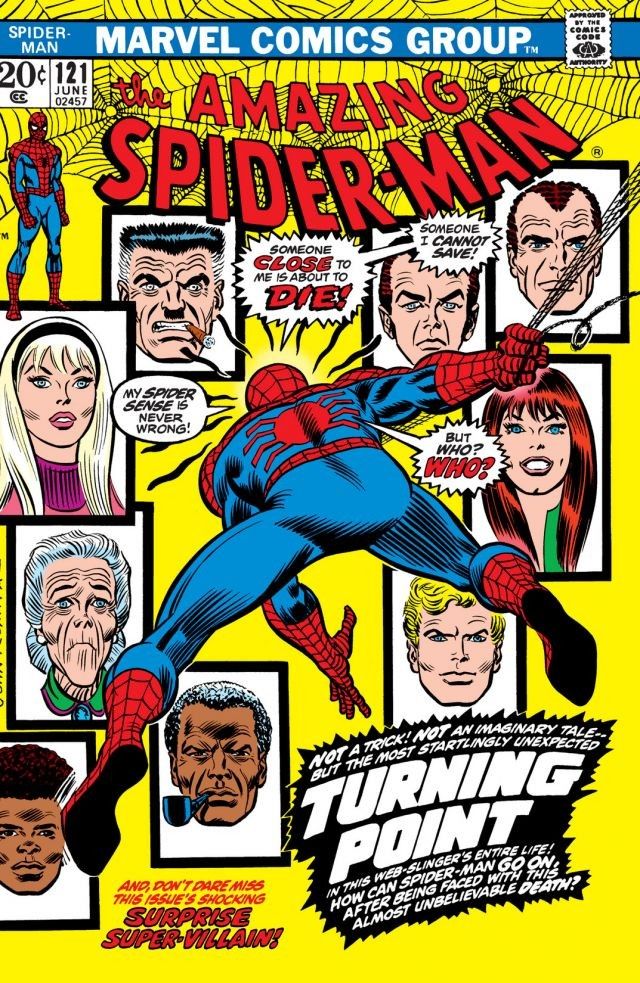
The Amazing Spider-Man #121
☆ Be the first to review + Add to your collection — Join freeAmazing Spider-Man #121 is the issue that permanently dismantled one of superhero comics' most durable unwritten rules: that a hero's primary love interest is untouchable. Before its publication, it was not considered common for major members of a superhero's supporting cast to be killed off in a mainstream title, and the death of Gwen Stacy — Peter Parker's girlfriend — during what appeared to be a successful rescue shattered that assumption in real time, on the page, in front of the reader. The deliberate ambiguity Conway and Kane built into the pivotal panel — the notorious 'snap' sound effect whose authorship remains disputed — planted a moral question about Spider-Man's culpability that writers have been arguing over for more than fifty years, with the debate even surfacing in Marvel's Civil War crossover event decades later. The issue's release is widely cited as the moment that ended the Silver Age of comics and opened the Bronze Age, marking a shift from relatively consequence-free superhero adventure toward stories where supporting characters could die permanently and heroes could fail catastrophically.
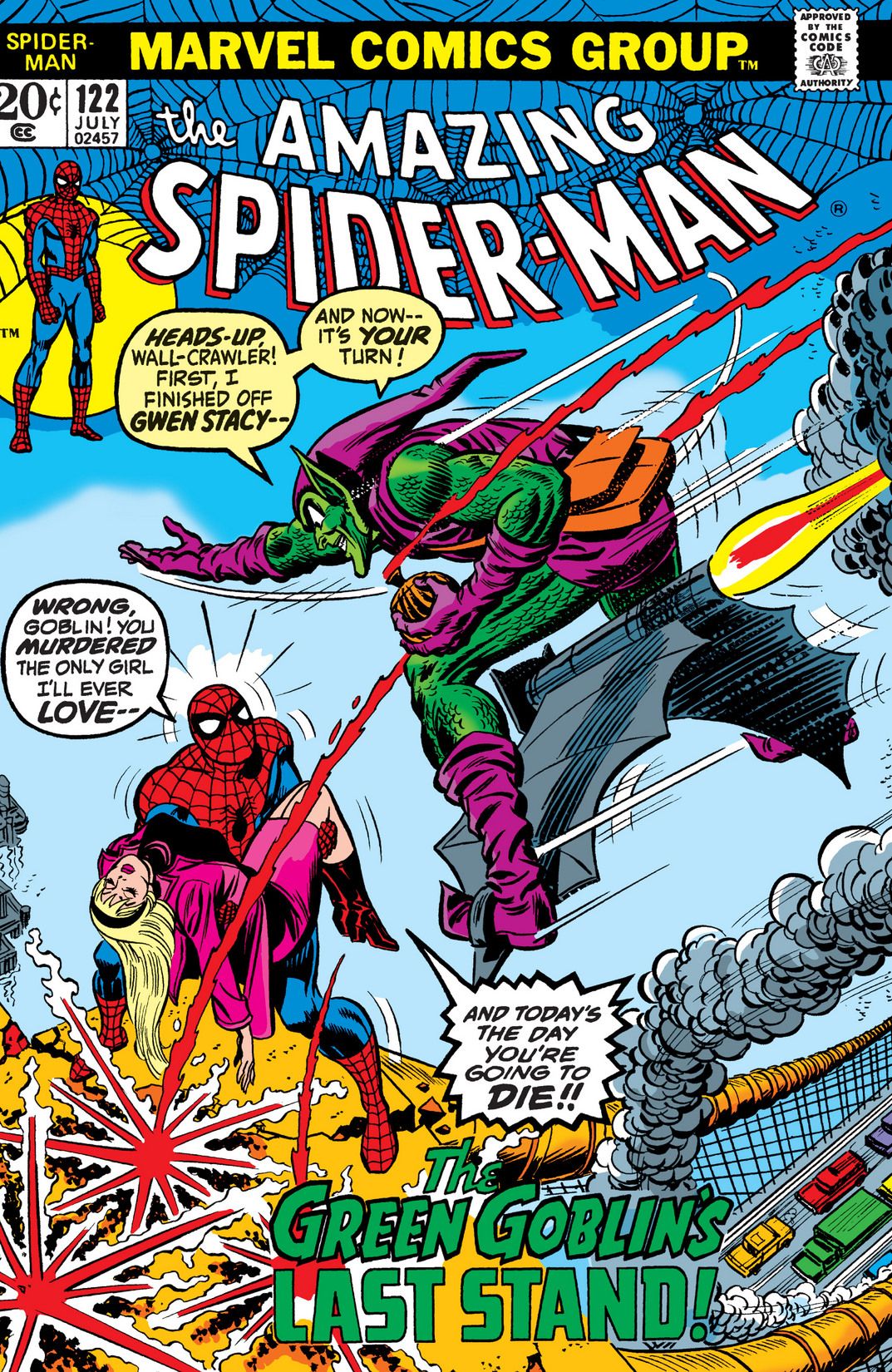
In "The Night Gwen Stacy Died," Spider-Man faces one of his most devastating challenges yet when the Green Goblin targets the woman he cares for most. With Norman Osborn’s grip on reality unraveling and his past as the Goblin resurfacing, the battle escalates to the heights of the Brooklyn Bridge, where a single moment changes everything. Written by Gerry Conway and brought to life with powerful art by Gil Kane and inks by John Romita, this landmark issue features a cover by John Romita that captures the tension in a single, unforgettable image.
ComicBooks.com Value
Show all 22 grades ▾
This exact issue on ebay
CGC 9.8 ▾ $4,619–$5,550 3 listings
CGC 9.4 ▾ $1,300–$1,325 2 listings
CGC 9.2 ▾ $968–$1,120 2 listings
CGC 9 ▾ $798–$960 3 listings
CGC 8.5 ▾ $629–$800 8 listings
CGC 8 ▾ $599–$2,178 6 listings
CGC 7.5 ▾ $625–$695 2 listings
CGC 7 ▾ $424–$600 5 listings
CGC 6.5 ▾ $365–$500 9 listings
CGC 5.5 ▾ $380–$400 2 listings
Raw / ungraded ▾ $59–$825 11 listings
Read it digitally
Sell my copy
Have this issue — or a whole collection? Get a fair offer from us, skip the marketplace fees and the hassle.
We Buy Collections ▸History
Gerry Conway was only twenty years old and roughly eleven issues into his run as Amazing Spider-Man's writer when he scripted this issue, having taken over from Stan Lee. The origins of the decision to kill Gwen remain genuinely contested: John Romita Sr. recalled in a 2015 interview that he and Conway had originally been asked by editors to kill Aunt May, but at a plot session at Conway's apartment the group rejected that idea and Romita proposed Gwen instead, drawing inspiration from cartoonist Milton Caniff's willingness to kill significant characters in strips like Terry and the Pirates. Conway's own accounts have shifted across interviews — in 2008 he told author Sean Howe that it was he and editor Roy Thomas who first floated killing Aunt May before Romita redirected toward Gwen, but at the 2013 Emerald City Comic Con he contradicted that account. Stan Lee's reaction was also disputed: Conway claimed Lee endorsed the decision, while Romita recalled Lee returning from Europe furious and demanding the character be brought back, with Lee himself later saying he was distracted when approached and only realized what had happened after the fact. All four people present in those original discussions — Conway, Romita, Lee, and Thomas — eventually gave differing versions of events, and with Conway's death in April 2026, Roy Thomas is the sole surviving witness.
Trivia · 10 facts
- Title: 'The Night Gwen Stacy Died' (Amazing Spider-Man #121, cover-dated June 1973, released March 13, 1973). Part one of a two-issue arc concluding in #122.
- Creative team: script by Gerry Conway (age 20 at time of writing); pencils by Gil Kane; inks by John Romita Sr. and Tony Mortellaro; letters by Artie Simek; colors by David Hunt; edited by Roy Thomas.
- Story: Norman Osborn, destabilized by his son Harry's drug relapse and mounting business failures, snaps back into his Green Goblin persona, kidnaps Gwen Stacy from Peter Parker's apartment, and throws her from a bridge. Spider-Man fires a web that catches her, but she dies — the cause of death left deliberately ambiguous between the whiplash from the web-catch and the fall itself.
- Bridge continuity error: the comic's text identifies the location as the George Washington Bridge (stated to be Norman Osborn's 'favorite President's bridge' in the issue's interior), but Gil Kane's artwork depicts the Brooklyn Bridge — an inconsistency that has never been officially resolved.
- Death mechanism controversy: the Green Goblin's taunting line — that Gwen was already dead before the web reached her — is the only in-issue explanation offered, and it comes from the villain. A 'snap' sound effect near her neck when the web catches her implies a broken neck from the sudden deceleration, but the issue never confirms which killed her, generating decades of fan and in-universe debate.
- A Marvel Comics fan poll for the series '100 Greatest Marvels of All Time' ranked Amazing Spider-Man #121 sixth-greatest issue of all time, while the companion issue #122 ranked nineteenth.
- The issue is the first time a writer other than Stan Lee contributed to the Spider-Man/Green Goblin conflict, and it marked Conway's roughly eleventh issue on the title — making it an extraordinarily early career milestone for the young writer.
- Collected editions and reprints: the story has been reprinted in the Amazing Spider-Man Epic Collection Vol. 7 and Amazing Spider-Man Omnibus Vol. 4, and Marvel published an exact-replica Facsimile Edition in June 2023, reproduced in its original form including period advertisements.
- Film adaptations: the death was adapted directly in The Amazing Spider-Man 2 (2014, dir. Marc Webb), in which Gwen Stacy (Emma Stone) falls from a clock tower — the clock stopping at 1:21 as a deliberate homage to the issue number. Andrew Garfield's Spider-Man returned in Spider-Man: No Way Home (2021), where his character's arc centered on processing his guilt over failing to save Gwen, and he achieves a moment of redemption by catching MJ in a similar fall.
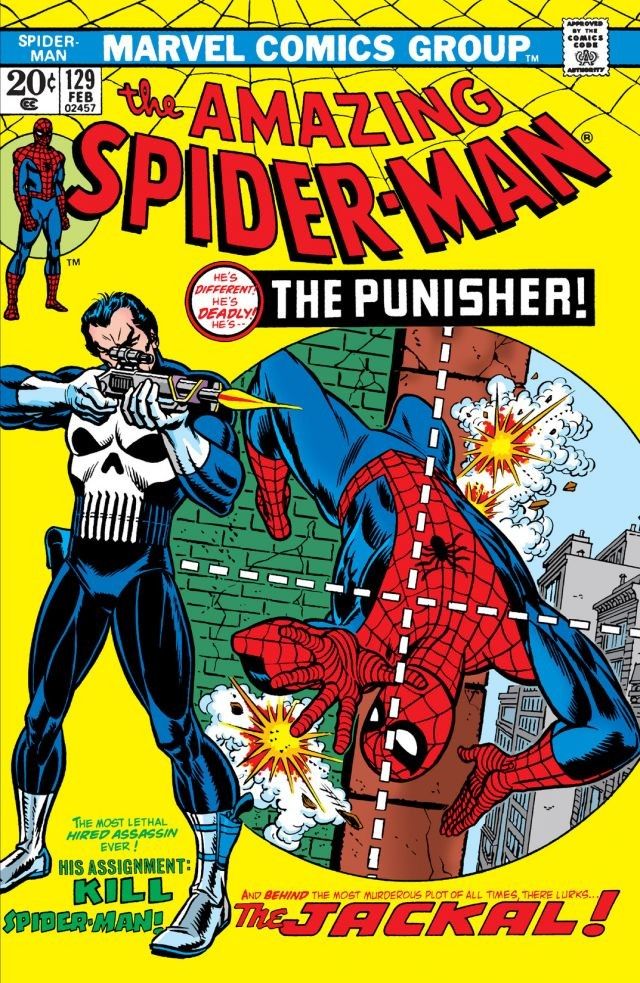
- Narrative aftermath: the issue directly set in motion Harry Osborn adopting the Green Goblin identity (in ASM #136), accelerated Mary Jane Watson's development into a more central and emotionally mature character, and seeded the creation of the Punisher — who first appears in ASM #129, introduced in the context of a villain hired to avenge Gwen's death.
Full credits
Reprints
Reprinted in The Comic Reader #94 (1973), L'étonnant Spider-Man #23 (1973), Edderkoppen #3/1974 (1974), Strange #104 (1978), Marvel Tales #98 (1978), Spiderman #60 (1979), Edderkoppen #8/1979 (1979), Spindelmannen #8/1979 (1979), El Hombre Araña / El Asombroso Hombre Araña #117 (1982), Spider-Man Annual #[1984] (1983), Marvel Tales #192 (1986), Edderkoppen sommer special #[nn] (1990), Edderkoppen klassikere #1/1990 (1990), Spider-Man vs. Green Goblin #[nn] (1995), Spider-Man: The Death of Gwen Stacy #[nn] (1999), The 100 Greatest Marvels of All Time #5 (2001), Spiderman de John Romita #52 (2003), Spider-man: De bästa Spider-Man-historierna! #1 (2004), The Essential Spider-Man #6 (2004), Os Maiores Clássicos do Homem-Aranha #3 (2004), Klassiker der Comic-Literatur #15 (2005), Amazing Spider-Man No. 121 [Marvel Legends Masterworks Figure Reprint] #[nn] (2005), Spider-Man: Death of the Stacys #[nn] (2007), Marvel Masterworks: The Amazing Spider-Man #13 (2011) + 20 more
Key issues in The Amazing Spider-Man
 ★
★ ★
★ ★
★ ★
★ ★
★ ★
★ ★
★ ★
★Reviews
Reader reviews
No reader reviews yet.