
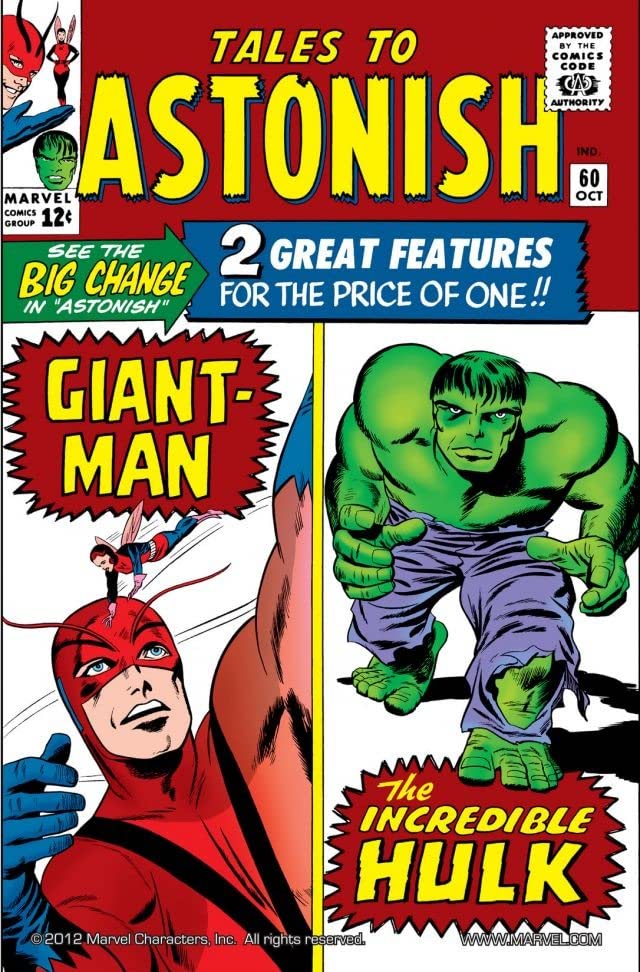
Tales to Astonish #60
☆ Be the first to review + Add to your collection — Join freeTales to Astonish #60 (cover-dated October 1964) is the issue that officially converted an anthology title into Marvel's first true split superhero book, giving the Hulk his own ongoing feature for the first time since his original six-issue series was cancelled in 1962–63. The Hulk's return here was not merely a revival — it introduced the now-foundational concept that emotional stress triggers Bruce Banner's transformation into the Hulk, replacing the earlier gamma-ray-machine mechanism and fragmenting Banner and the Hulk into two barely-aware personas, a storytelling paradigm that has defined the character across every medium for sixty years. That creative pivot, executed in just ten pages, anchored the Hulk's psychology in a way his original title never managed, and the run that began here eventually led directly to the title being retitled The Incredible Hulk with issue #102.
In Tales to Astonish #60, Stan Lee and Steve Ditko deliver a thrilling sci-fi twist as Bruce, overwhelmed by pressure, transforms into the Hulk after completing an indestructible robot capable of surviving a nuclear blast. When a foreign spy hijacks the machine, the Hulk must battle it alone—only to collapse and revert to Banner, leaving him stranded in the desert. Found by Ross and Betty, Bruce resolves to build an even greater machine to reclaim what was stolen. The cover by Jack Kirby and Sol Brodsky captures the moment’s intensity, making this a standout issue in the early Hulk saga.
In "The Beasts of Berlin!", a young man named Lee finds himself captured behind the Iron Curtain, prompting his old friend Henry to risk everything in a daring rescue mission to East Berlin. Armed with the combined powers of Giant-Man and Ant-Man, Henry must outwit enemy forces and dismantle a sinister ray weapon before it turns more animals into dangerous, hyper-intelligent beasts.
Bruce Banner’s latest invention—a robot designed to survive a nuclear blast—becomes a dangerous runaway when the stress of its completion triggers his transformation into the Hulk. Left unattended, the massive machine is hijacked by a foreign spy lurking nearby, turning it into a weapon of unknown threat. As the Hulk struggles to stop it, exhaustion sets in, and he reverts to Banner just as the battle reaches its peak. Found unconscious in the desert by General Ross and Betty, Bruce vows to build a stronger robot to reclaim what’s been stolen—before the first one strikes again.
ComicBooks.com Value
Show all 21 grades ▾
This exact issue on ebay
Raw / ungraded ▾ $33.75–$176 9 listings
Read it digitally
Sell my copy
Have this issue — or a whole collection? Get a fair offer from us, skip the marketplace fees and the hassle.
We Buy Collections ▸History
Stan Lee scripted both stories in this issue, with the Giant-Man lead drawn by penciller Dick Ayers and inker Paul Reinman, while the new Hulk feature paired penciller Steve Ditko with inker George Roussos — the latter working under the house pseudonym 'Geo. Bell.' The cover was pencilled by Jack Kirby and inked by Sol Brodsky. Lee and Ditko had already been collaborating on The Amazing Spider-Man and Strange Tales, and Marvel's ongoing distribution constraints — limiting how many separate titles the company could place on newsstands — made the split-book format the practical vehicle for launching the Hulk's second solo run without adding a new title to the line. The Hulk's TTA feature was structured from the outset as a continuing serialized story rather than the self-contained episodes that dominated the Giant-Man half, a distinction that commentators have noted gave the Hulk strips an unusual narrative momentum for their era.
Trivia · 8 facts
- First issue of Tales to Astonish to adopt the split-book format, pairing a Giant-Man lead story ('The Beasts of Berlin!', 14 pages, art by Dick Ayers/Paul Reinman) with a new ongoing Hulk feature ('The Incredible Hulk', 10 pages, art by Steve Ditko/George Roussos) — marking the Hulk's first solo-feature appearance since The Incredible Hulk #6 (1963).
- Introduces the now-definitive Hulk transformation rule: emotional stress — specifically tension and excitement — causes Bruce Banner to become the Hulk, and he reverts when he physically exhausts himself or calms down. This replaces the original gamma-ray-machine trigger from the cancelled 1962–63 series.
- Also establishes that Banner and the Hulk have entirely separate personalities and only hazy awareness of each other's actions, a dual-identity split that became central to every subsequent creative treatment of the character.
- Cover art pencilled by Jack Kirby, inked by Sol Brodsky, colored by Stan Goldberg — all three stories in the issue written/edited by Stan Lee.
- Giant-Man story features a cameo flashback of Maria Pym (Henry Pym's murdered first wife), only the second time her death behind the Iron Curtain is referenced in the comics; this appearance is used to explain why Pym insists on undertaking the East Berlin rescue mission alone, without the Wasp.
- Lee Kearns, the FBI agent ally of Hank Pym first introduced in Tales to Astonish #44, makes his second and final comics appearance here as the hostage Giant-Man rescues from East Berlin.
- The Hulk feature's narrative picks up directly from Incredible Hulk #6 but with significant continuity changes; sources note the story makes no attempt to reconcile the altered transformation mechanics with the earlier series.
- Both stories in this issue have been collected in multiple Marvel reprint formats, including Marvel Masterworks: The Incredible Hulk Vol. 2 (2004), Essential Incredible Hulk Vol. 1 (1999), Marvel Masterworks: Ant-Man/Giant-Man Vol. 2 (2008), and the Incredible Hulk Epic Collection: The Hulk Must Die (2017); the Hulk story was also reprinted in Marvel Super-Heroes #25 (March 1970).
Cast · 7 characters
Full credits
Reprints
Reprinted in The Incredible Hulk #72-124 (1966), Marvel Super-Heroes #25 (1970), Etranges Aventures #23 (1971), The Mighty World of Marvel #13 (1972), Eclipso #26 (1973), Hulk #6 (1974), The Incredible Hulk #[nn] (1978), L'Incredibile Hulk #13 (1981), Essential Hulk #1 (1999), Essential Ant-Man #1 (2002), Marvel Masterworks: The Incredible Hulk #2 (2004), The Incredible Hulk Omnibus #1 (2008), Marvel Masterworks: Ant-Man / Giant-Man #2 (2008), Marvel Masterworks: The Incredible Hulk #2 (2012), Marvel Gold. El Hombre Hormiga: ¡El Hombre en el Hormiguero! #[nn] (2015), Incredible Hulk Epic Collection #2 (2017), Hulk : L'intégrale #1964-1966 (2021), Ant-Man / Giant-Man Epic Collection #2 (2022), Mighty Marvel Masterworks: The Incredible Hulk #2 (2022), Marvel Origins #17 (2024)
Key issues in Tales to Astonish
Variants (1)
Reviews
Reader reviews
No reader reviews yet.