
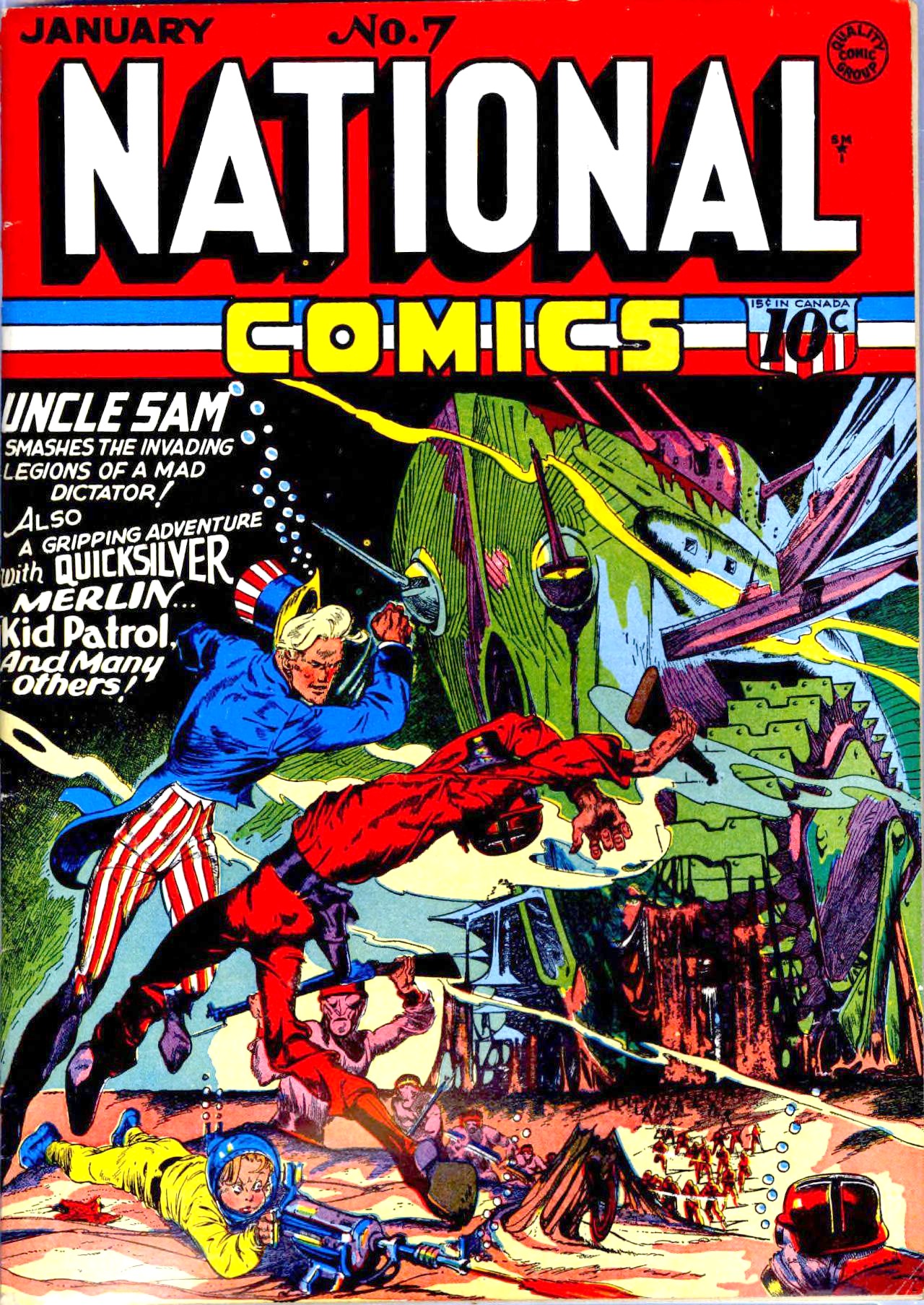
National Comics #7
☆ Be the first to review + Add to your collection — Join freeNational Comics #7 sits squarely within one of Quality Comics' most politically charged runs: a pre-Pearl Harbor anthology built around Will Eisner's Uncle Sam, a character conceived as the literal spirit of American patriotism made flesh at a moment when the United States had not yet entered World War II. The issue's lead Uncle Sam story — in which fictional 'European dictators' construct submarine-tanks to assault the Long Island coast — is a remarkable piece of pre-war interventionist fiction, using pulp adventure storytelling to argue for American military preparedness before the country's public debate had resolved. As part of the broader National Comics run, issue #7 also represents the creative peak of Quality's Eisner-supervised anthology model, where a dense roster of features — each by a different artist, each signed under a house pseudonym — demonstrated the ambition of a publisher determined to rival the superhero titles coming out of National Allied (DC) and Timely simultaneously.
In "Uncle Sam Leads the Way," the iconic patriot is fishing when he stumbles upon a secret underwater threat: a sub tank built by European dictators to invade America via the ocean floor. Written by Will Eisner and illustrated by Dave Berg, this 1941 tale blends wartime urgency with the hero’s unexpected heroism. The cover, a dynamic piece by Lou Fine, captures the moment of discovery with bold, period-accurate flair.
In "Uncle Sam Leads the Way," the iconic hero is fishing when he stumbles upon a secret undersea threat: a sub tank built by European dictators to launch a surprise attack on America. With quick thinking and a patriotic spark, Uncle Sam springs into action to stop the invasion before it begins.
Policewoman Sally O'Neil goes undercover to infiltrate the Lupino Gang's counterfeiting operation after a young boy witnesses their illegal money-printing scheme and a local shopkeeper becomes entangled in their web. With a fake disguise and plenty of nerve, Sally closes in on the gang's cellar hideout—but her cover is blown and she finds herself trapped with criminals who won't let her leave alive. Her boyfriend Barry and a group of street kids race to help her before it's too late.
When the Kid Patrol members show up for class at Prof. Tinker's schoolhouse, mischief-makers Slug Muggins and Daisy Ricco have a nasty plan in mind—but the Professor and his students aren't about to let a couple of bullies get the upper hand. This adventure follows a school day full of pranks, schemes, and a satisfying comeuppance as the Kid Patrol turns the tables on would-be troublemakers.
Wonder Boy helps a band of prospectors achieve their dream of finding the Lost Mountain of Gold in Alaska's Romanzo Range—but the journey tests both his incredible strength and his resolve as the group faces avalanches, freezing waters, and desperate wildlife. With Wonder Boy's superhuman power, the prospectors navigate toward their fortune, though not without sacrifice and danger along the way.
ComicBooks.com Value
Show all 21 grades ▾
More listings for this title
Read it digitally
Sell my copy
Have this issue — or a whole collection? Get a fair offer from us, skip the marketplace fees and the hassle.
We Buy Collections ▸History
National Comics was an anthology series launched by Quality Comics (formally Comic Magazines, Inc., under publisher Everett M. Arnold) in July 1940, with Will Eisner serving as both lead writer and editorial overseer. Eisner supplied scripts and occasional splash-page pencils for the Uncle Sam feature, while story art was distributed across a bullpen that included Dan Zolnerowich, Dave Berg, and Lou Fine. By issue #7 — the first issue dated 1941 — Eisner's studio was running multiple Quality titles simultaneously alongside his newly launched Spirit newspaper insert, and the weekly production demands meant the anthology's interior features were parceled out to a tight roster of contributors, all working under pseudonymous credits per house policy. Issue #7's writing credits include Eisner, Dave Berg, Toni Blum, Klaus Nordling, and Herman Bolstein, with interior art by Berg, Charles Nicholas, John Celardo, Henry Kiefer, and others — a snapshot of the Eisner shop at full industrial output on the eve of U.S. entry into the war.
Trivia · 8 facts
- Cover date: January 1941 (the first issue of National Comics dated in that year); publisher: Quality Comics (Comic Magazines, Inc.).
- The lead Uncle Sam story is titled 'Uncle Sam Leads the Way' — Uncle Sam and his young partner Buddy Smith, while fishing off Montauk Point, discover an invasion fleet of fictional European 'submarine-tanks,' each carrying 1,000 soldiers, and rally local fishermen to repel the attack.
- Will Eisner served as both head writer and editorial supervisor of the issue; interior art on the Uncle Sam chapter was by Dan Zolnerowich, who drew his final issue of Merlin the Magician here (replaced next issue by Arthur Peddy).
- The issue is a multi-feature anthology running approximately 68 pages at a cover price of 10 cents, containing stories starring Uncle Sam, Quicksilver, Sally O'Neil Policewoman, Wonder Boy, Kid Dixon (with art by a young George Tuska, working under a house pseudonym), Merlin the Magician, Kid Patrol, Paul Bunyan, Pen Miller, Prop Powers, and Windy Breeze.
- All contributing artists signed their work under house pseudonyms: George Tuska's Kid Dixon chapter was credited to 'Bob Reynolds,' Klaus Nordling's Pen Miller to an alias, Nick Cardy's Wonder Boy to 'Jerry Maxwell,' John Celardo's Paul Bunyan to 'Storey Weaver,' and Witmer Williams's Prop Powers to 'Lynn Byrd.'
- Quicksilver breaks the fourth wall in the final panel of his chapter — an early, self-aware storytelling device rare in Golden Age superhero comics.
- The Uncle Sam lead story introduces first-appearance supporting and villain characters including Lank Loomis and Count Von Krum in the Prop Powers feature, and the Lupino Gang in the Sally O'Neil chapter.
- The Uncle Sam story from this issue was selected for reprinting in Fantagraphics' 2017 anthology Take That, Adolf!: The Fighting Comic Books of the Second World War, confirming its historical standing as a representative example of pre-Pearl Harbor wartime comics propaganda.
Full credits
Reprints
Reprinted in The Golden Age of Comic Books #[nn] (1977), Men of Mystery Comics #88 (2012), Take That, Adolf!: The Fighting Comic Books of the Second World War #[nn] (2017)
Key issues in National Comics
Reviews
Reader reviews
No reader reviews yet.