
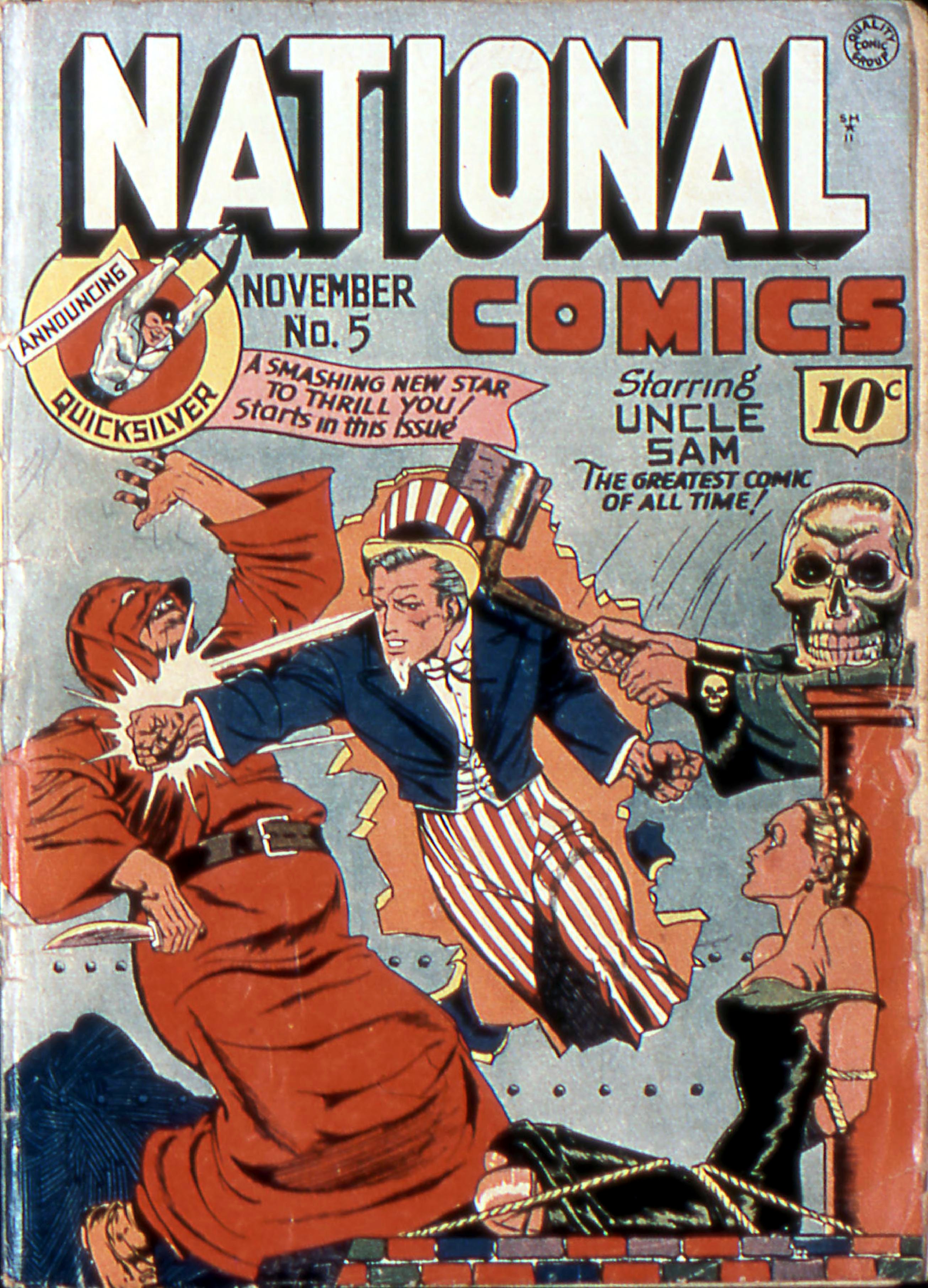
National Comics #5
☆ Be the first to review + Add to your collection — Join freeNational Comics #5 (November 1940) is a double-barreled key for the Golden Age: it delivers the full origin of Will Eisner's Uncle Sam — tracing the character's mystical roots back to a Revolutionary War patriot killed near Valley Forge — and simultaneously debuts Quicksilver, the speedster who would eventually be reinvented at DC Comics as Max Mercury, a foundational figure in the Flash family's Speed Force lore. Together, those two firsts make it arguably the most consequential single issue of Quality Comics' flagship anthology title. The Uncle Sam origin story also carries deliberate political weight, with Eisner drawing a pointed parallel between the Revolutionary-era Hessian soldiers and the Germany of 1940, while Uncle Sam's modern-day antagonists — the Black Legion — reflect real American far-right paramilitary organizations of the era. The issue thus stands as a rare Golden Age comic that weaves genuine historical commentary into its superhero storytelling.
In this 1940 classic, "The True Story of Uncle Sam—Who He Was and How He Came to Be" offers a mythic origin tale rooted in American history, told with the bold visual flair of Lou Fine’s striking cover and the distinctive artistry of Dan Zolnerowich, who both penciled and inked the interior pages. A fascinating blend of folklore and early superhero storytelling, the issue presents Uncle Sam not as a symbol, but as a man with a past, set against the backdrop of a nation’s founding.
In "Presenting Quicksilver," the speedy hero faces off against the vengeful and surprisingly nimble von Lohfer, whose grudge is tied to J. B. Rockland. With lightning reflexes and a cool head, Quicksilver outmaneuvers the small but determined foe in a race against time.
Slugger Mike steps into the ring for his comeback fight against the champion, but his crooked managers have other plans—they lay him out with a blackjack the night before. When his young sparring partner Danny "Kid" Dixon volunteers to take his place instead, the Kid delivers a stunning upset victory and claims the title. Now both men find themselves entangled with the same shady forces, setting the stage for a rivalry that could test their honor as much as their boxing skills.
In "Dr. Morbidd's Zombie," Merlin confronts his first true super-villain in the form of the grotesque Dr. Morbidd, a mad scientist wielding the power to reanimate the dead. When the doctor's undead minions threaten the city, Merlin races to save a young girl named Elaine, caught in the chaos of a resurrection gone wrong.
ComicBooks.com Value
Show all 20 grades ▾
Find on ebay
Read it digitally
Sell my copy
Have this issue — or a whole collection? Get a fair offer from us, skip the marketplace fees and the hassle.
We Buy Collections ▸History
Published under the Comic Magazines, Inc. indicia (Quality Comics' corporate imprint) with a cover date of November 1940, the issue was edited and partly scripted by Will Eisner, who signed the Uncle Sam story under his own name 'William Eisner' — an unusual choice in a shop where most contributors used house pseudonyms. Lou Fine, long credited as the cover artist, is now also identified by researchers as the interior artist on the Uncle Sam origin story, correcting an earlier consensus that attributed those pages to Dan Zolnerowich. The Quicksilver debut was written by Jack Cole (also the creator of Plastic Man) with art by Chuck Mazoujian; like several other contributors that issue, they left their story unsigned. The fact that the Uncle Sam story is set chronologically before the events of National Comics #1 suggests Eisner was deliberately building a cohesive, historically grounded mythology for the character from early in the run.
Trivia · 8 facts
- FIRST APPEARANCE of Quicksilver (Quality Comics), the speedster later renamed Max Mercury by Mark Waid in The Flash vol. 2 #76 (May 1993) to avoid confusion with Marvel's character of the same name.
- ORIGIN of Uncle Sam: titled 'The True Story of Uncle Sam — Who He Was and How He Came To Be,' written by Will Eisner and illustrated by Lou Fine; the story is set before the events of National Comics #1 and traces Uncle Sam's creation to a Revolutionary War soldier killed near Valley Forge whose spirit merged with the nascent Spirit of America.
- The Quicksilver debut was written by Jack Cole (creator of Plastic Man) and drawn by Chuck Mazoujian; almost nothing was revealed about the character except his super-speed and his first name, Max.
- Lou Fine's cover — featuring Uncle Sam in a bondage/skull composition — is among his most-cited Golden Age covers; recent scholarship corrected long-held credits that had attributed the interior Uncle Sam art to Dan Zolnerowich rather than Fine.
- The Uncle Sam origin story was later retold 'rather faithfully' in Secret Origins vol. 2 #19 (1987) by Len Wein and Murphy Anderson, and retooled again in John Ostrander's The Spectre vol. 3 series in 1996.
- Issue also features continuing stories for Wonder Boy (created by Toni Blum and John Celardo), Sally O'Neil Policewoman (Toni Blum and Chuck Mazoujian under the pseudonym 'Frank Kearn'), Pen Miller (Klaus Nordling, signing as 'Klaus'), and Prop Powers (Witmer Williams, signing as 'Lynn Bird').
- Kid Dixon's story in this issue features art by George Tuska; Paul Bunyan's strip features John Celardo on art.
- The issue was later reprinted in part in Gwandanaland Comics #2005 — The Golden Age Firsts of Quality Comics: Volume 1 (May 2018).
Cast · 16 characters
Full credits
Reprints
Reprinted in Men of Mystery Comics #93 (2014), Gwandanaland Comics #2005 (2018)
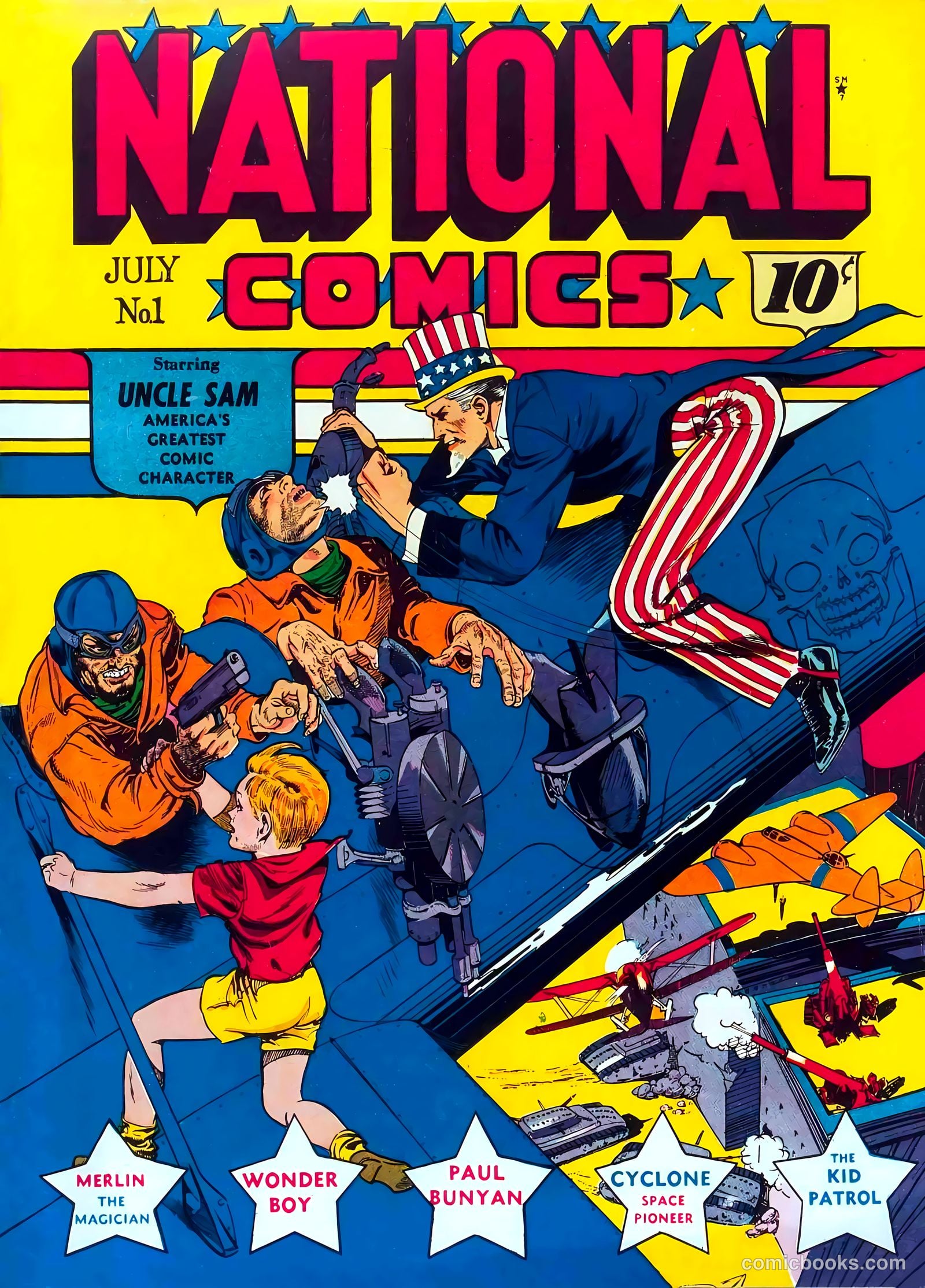
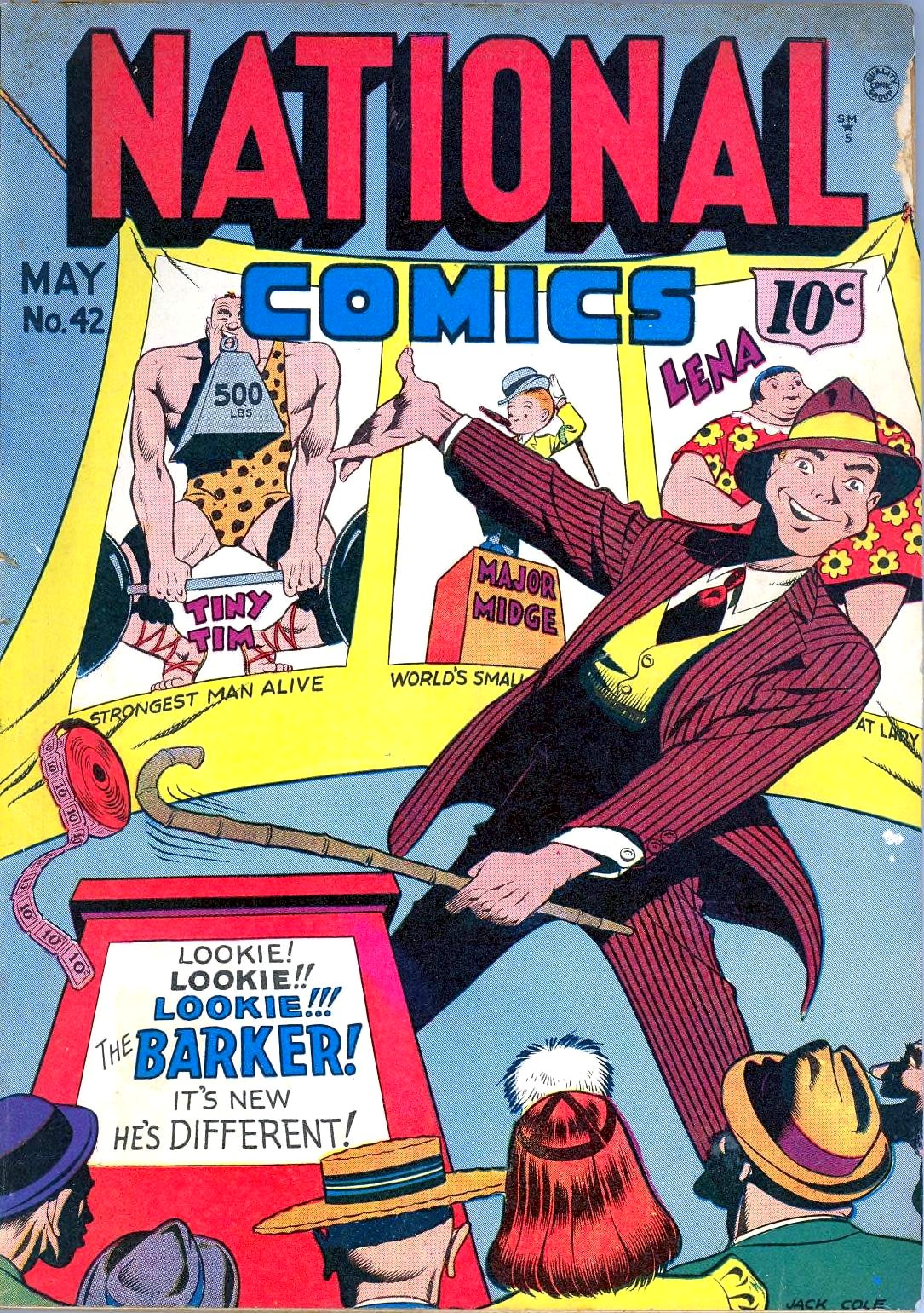
Key issues in National Comics
Reviews
Reader reviews
No reader reviews yet.