
National Comics #42
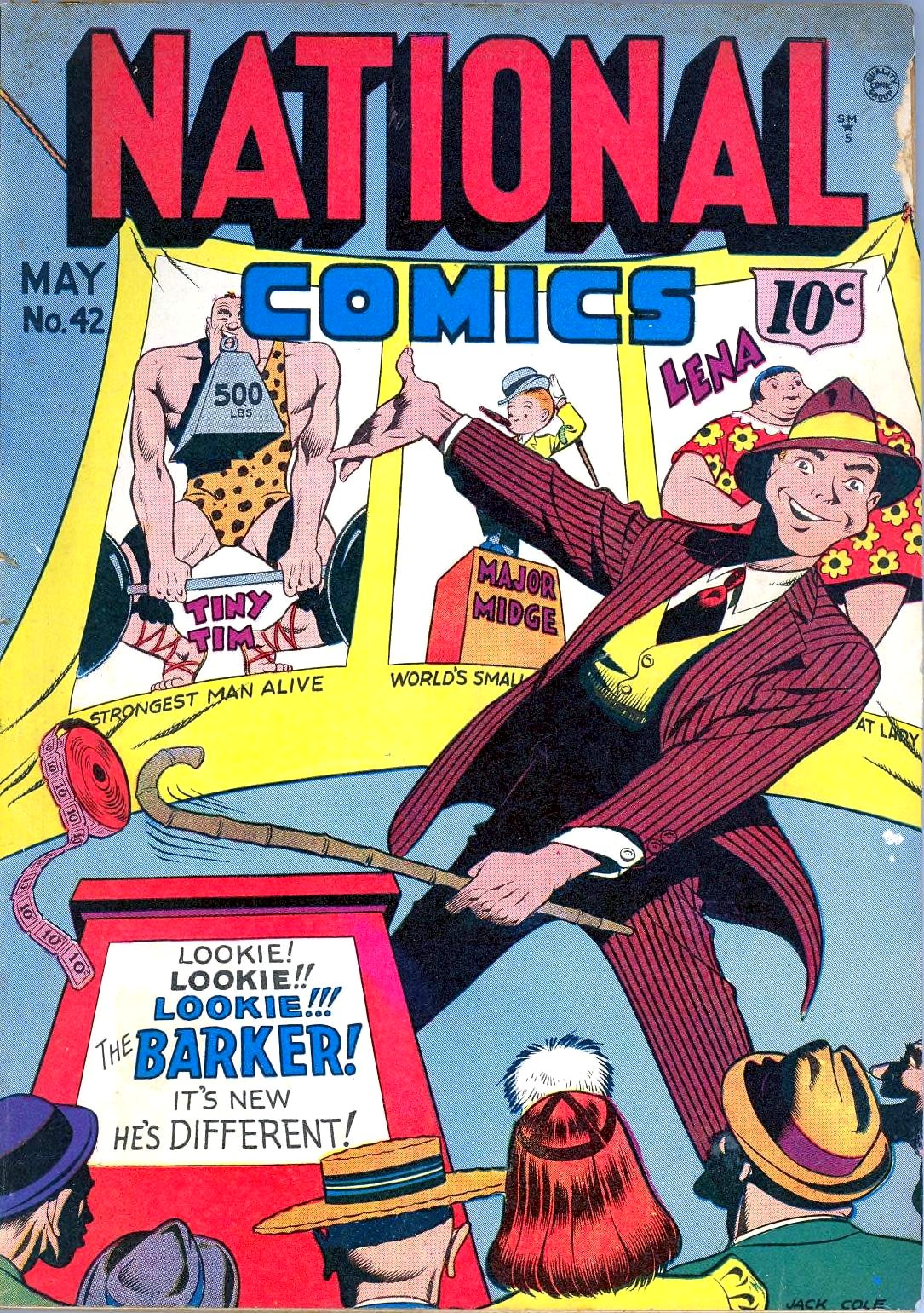
☆ Be the first to review + Add to your collection — Join freeNational Comics #42 (May 1944, Quality Comics) marks the debut of the Barker — Clarence 'Carnie' Calahan, a sharp-tongued circus sideshow pitchman — making it one of the more unusual character introductions of the Golden Age: a protagonist with no superpowers whatsoever, whose world was populated entirely by carnival freaks and con artists rather than costumed heroes. The feature proved durable enough to earn its own solo title in 1946 (running 15 issues), and the character was later revived in a 2005 DC backup series in Detective Comics, cementing this issue's place as the origin point of a genuinely distinctive corner of Quality's anthology universe. The issue also houses one of the earliest in-comic appearances of the Captain Tootsie advertising strip — a one-page commercial feature created by C.C. Beck (co-creator of Captain Marvel/Shazam) that became one of the most widely distributed advertising comics of the 1940s, placing it at the intersection of commercial art history and superhero comics.
In "Prof. Zell, Seer, Sees the Stars," Uncle Sam and his ally Buddy are drawn into a high-stakes wartime deception when a military general warns of a Japanese stronghold at Marusu with inside knowledge of American movements. Written by Harry Stein and illustrated by Art Seymour, this 1944 Quality Comics tale sees the duo willingly captured to uncover enemy plans, their escape setting the stage for a critical counteroffensive. The cover, by Jack Cole, captures the tension of the moment with striking precision.
In "Prof. Zell, Seer, Sees the Stars," a slick fortune teller named Zell steals the spotlight—literally—when he intercepts a telegram meant for Carnie, luring him into Colonel Lane’s circus. With Zell’s mysterious charm leading the way, Carnie and his friends chase him to Waynetown, where a wild twist of fate lands them a contract and a spot under the big top.
In the war-torn landscapes of 1944 China, G-2 encounters the fearless resistance leader known as Lady Wang, a symbol of defiance whose courage inspires those around her. When Japanese forces threaten her village, G-2 steps in to protect her people, turning the tide in a moment of urgent, high-stakes action.
In "It's Your Move, Uncle Sam!" from National Comics #42 (1944), Uncle Sam and his ally Buddy take a daring gamble when they allow themselves to be captured by Japanese forces at the Marusu base. With the enemy aware of America’s logistical challenges, the pair must uncover hidden plans before the tide turns—before the U.S. can respond.
ComicBooks.com Value
Find on ebay
Read it digitally
Sell my copy
Have this issue — or a whole collection? Get a fair offer from us, skip the marketplace fees and the hassle.
We Buy Collections ▸History
The Barker was conceived by writer Joe Millard — a pulp veteran who would later become known for novelizing Sergio Leone Westerns — and drawn by Jack Cole, the artist-writer genius behind Plastic Man. Their collaboration here was, notably, one of Cole's earliest comics made with a separate writer; scholars of his career have identified this as a transitional moment, arising from the mounting demands on Cole as Plastic Man's popularity exploded and Quality publisher Everett 'Busy' Arnold pushed him toward collaborative work. Cole drew only the first two Barker installments (National Comics #42–43) before Klaus Nordling took over the feature and built it into the character's definitive long-running run. The Captain Tootsie one-page ad strip appearing in the issue was produced by Beck's Fawcett studio and appeared across comics from multiple competing publishers simultaneously — an unusual commercial arrangement for the era.
Trivia · 8 facts
- First appearance of the Barker (Clarence 'Carnie' Calahan), a circus sideshow pitchman who would headline his own Quality Comics solo series starting in 1946.
- The Barker was created by writer Joe Millard and artist Jack Cole; cover art and interior story art are by Jack Cole.
- Published by Quality Comics with a cover date of May 1944; editor George Brenner.
- The issue's interior art roster also includes Al Bryant, Don Rico, Vernon Henkel, and Fred Guardineer, reflecting National Comics' dense anthology format with multiple ongoing features (Uncle Sam, Chic Carter, Sally O'Neil, G-2, Quicksilver, Destroyer 171).
- In the debut Barker story, Carnie and his crew — Major Midge (a little person), Lena the fat lady, and Tiny Tim the strongman — compete against the crooked fortune teller Professor Zell for a contract with Colonel Lane's Mammoth Circus.
- Captain Tootsie (with sidekick Rollo) appears in a one-page advertising strip; the character was created in 1943 by C.C. Beck (co-creator of Captain Marvel) and Pete Costanza for the Tootsie Roll candy company.
- Jack Cole drew only two Barker stories (National Comics #42–43) before Klaus Nordling took over, writing and drawing the feature from #44 through #67 and then through most of the solo Barker series.
- The Barker was revived in 2005 in a four-part backup story in DC Comics' Detective Comics #801–804, written by Mike Carey with art by John Lucas, featuring a second-generation Barker named Kitt Calahan.
Cast · 2 characters
Full credits
Reprints
Reprinted in Gwandanaland Comics #247 (2017), Gwandanaland Comics #900 (2017), Men of Mystery Comics #112 (2019)
Key issues in National Comics
Reviews
Reader reviews
No reader reviews yet.