
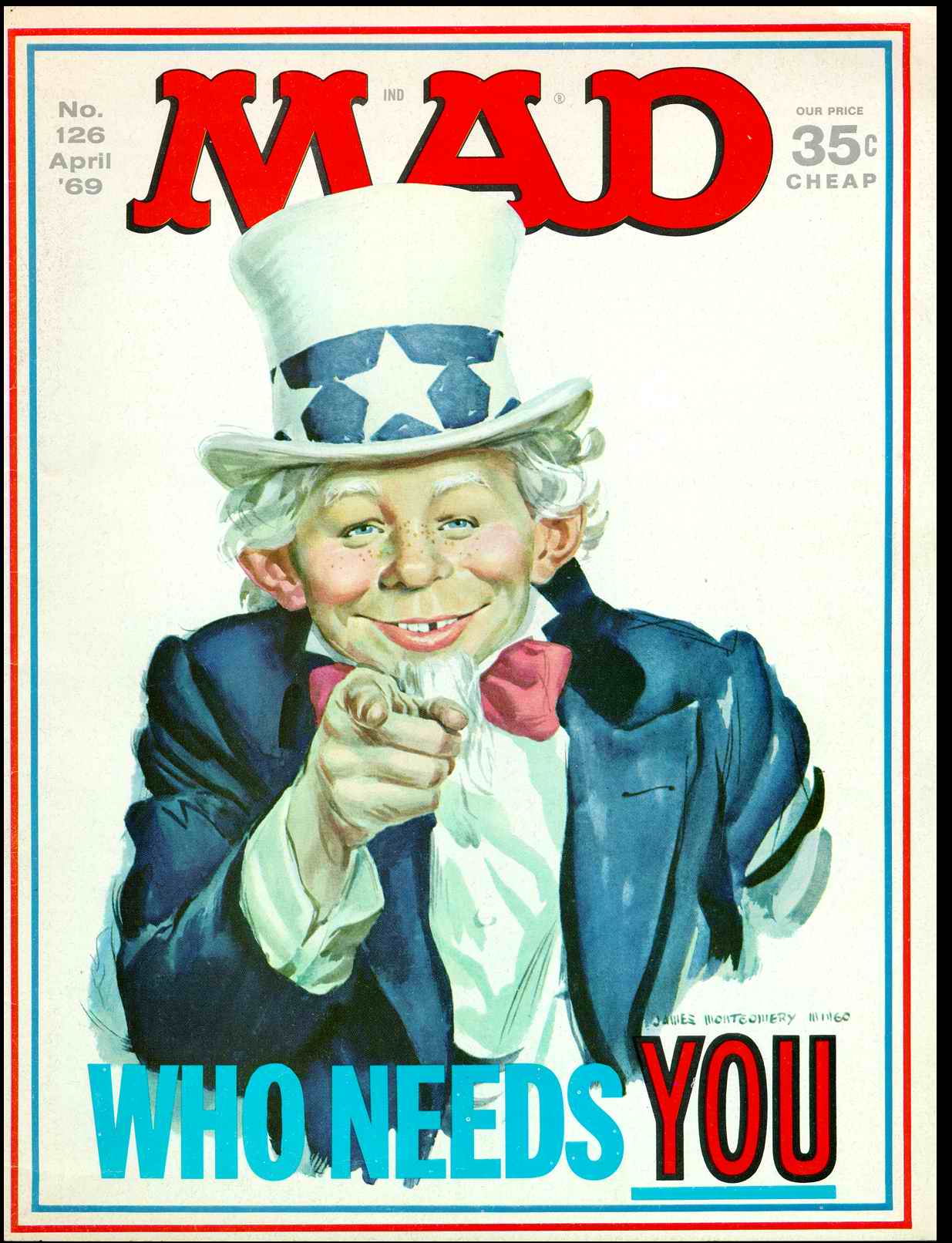
Mad #126
☆ Be the first to review + Add to your collection — Join freeIn "Familiar Affair," Al Jaffee's sharp script and Jack Davis's dynamic art explore the National Football League through two sides of the same play—one from the victor's high, the other from the loser's low. With Norman Mingo's striking cover capturing the game's emotional duality, this 1969 issue delivers a clever, character-driven take on victory and defeat, all rendered in EC's signature blend of wit and visual flair.
In "Familiar Affair," a perpetually exasperated bachelor and his long-suffering butler find themselves unexpectedly tasked with caring for the three impossibly sweet children of their late employer—no easy feat when even the most mundane moments are turned into a sitcom of syrupy charm. Written with a sharp, satirical edge and typeset letters, this 1969 Mad classic skewers the overly sentimental tone of 'Family Affair' with perfectly timed absurdity.
In "Mad's 1968-'69 Football Low Lights," the absurdity of gridiron glory is skewered through two wildly different takes on the same game: one from the high of victory, the other from the low of defeat. Presented in Mad’s signature satirical style, the story captures the exaggerated drama of professional football through the eyes of players on opposite sides of the scoreboard.
In this classic installment of *Spy vs. Spy*, the White Spy sets a clever trap using a toy boat on a string, luring the Black Spy into a storm drain—only to find himself outmaneuvered in a battle of wits and stealth. The escalating cat-and-mouse game unfolds in just a few panels, showcasing the timeless humor and visual gags that made the series a staple of *Mad* magazine.
In this classic Mad twist on espionage, the Black Spy sets a clever trap by attaching a plunger to the inside of the White Spy’s window, then connecting it to a hose to simulate rain. When the White Spy tries to close the window, the plunger comes down with it—right on his head.
In "The Typical 'Success Story'," a young man’s journey toward personal fulfillment unfolds through two contrasting film versions—one from the forties, one from the sixties—each reflecting the era’s ideals with sharp, satirical precision. The story’s clever structure and typeset letters highlight the shifting values in how success and happiness are portrayed, all within the classic Mad magazine style.
ComicBooks.com Value
Show all 9 grades ▾
This exact issue on ebay
Raw — FAIR ▾ $4.99–$9.99 2 listings
Raw / ungraded ▾ $4.75–$1,000 14 listings
More listings for this title
Read it digitally
Sell my copy
Have this issue — or a whole collection? Get a fair offer from us, skip the marketplace fees and the hassle.
We Buy Collections ▸Full credits
Reprints
Reprinted in The Ridiculously Expensive Mad #[nn] (1969), Mad Special [Mad Super Special] #7 (1972), Mad Special [Mad Super Special] #8 (1972), Mad Special [Mad Super Special] #9 (1972), The Mad Morality or the Ten Commandments Revisited #[nn] (1972), Mad #38 (1972), The Completely Mad Don Martin #[nn] (1974), Mad #64 (1974), Mad #84 (1976), Mad Special [Mad Super Special] #36 (1981), Mad Special [Mad Super Special] #50 (1985), Mad Special [Mad Super Special] #102 (1995), Mad #503 (2010), The Comics Journal #301 (2011), Mad's Greatest Artists: Don Martin #[nn] (2014), Mad #17 (2021), Mad #37 (2024)
Key issues in Mad
Reviews
Reader reviews
No reader reviews yet.