
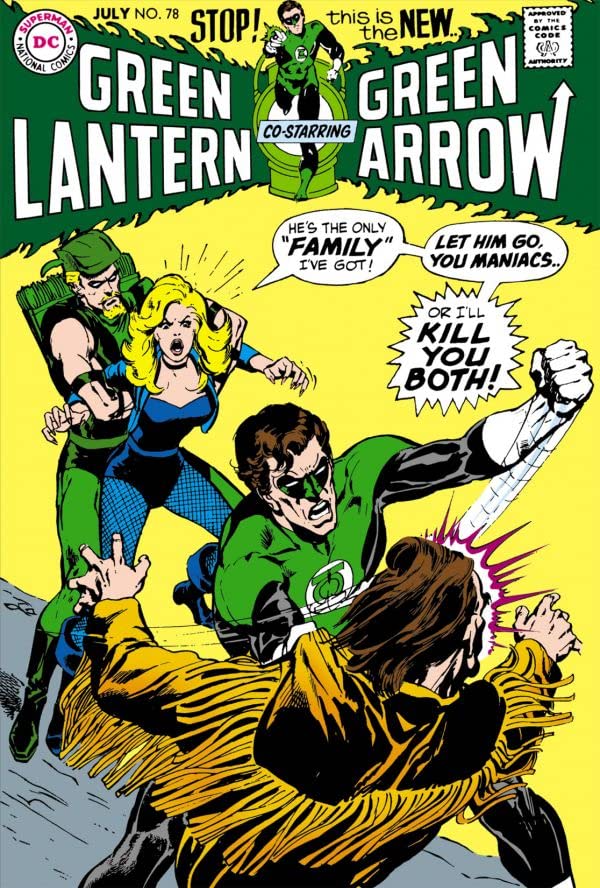
Green Lantern #78
☆ Be the first to review + Add to your collection — Join freeGreen Lantern #78 is the third chapter of Denny O'Neil and Neal Adams's landmark Bronze Age run that turned a flagging Silver Age title into a vehicle for hard-edged social commentary — a creative pivot widely cited as one of the defining moments in the birth of the Bronze Age of comics. The issue's villain, Joshua, is a Charles Manson-inspired cult leader who has brainwashed Black Canary into joining a violent, race-war-preaching commune, translating the real-world horror of the Manson Family murders of 1969 directly onto the comics page barely a year after the events themselves. That willingness to confront contemporary trauma so immediately and unflinchingly — within a mainstream, Comics Code-approved superhero title — demonstrated that the medium could engage culture as it was happening, not years later. The issue also deepens the romantic tension between Oliver Queen and Dinah Lance, using her near-execution of Green Arrow as the emotional crucible that breaks Joshua's hold over her.
In "A Kind of Loving, a Way of Death!", Green Lantern and Green Arrow race to find Black Canary after her bike is stolen by a gang—only to uncover a sinister cult led by the mind-controlling Joshua. Written by Denny O'Neil and illustrated with striking intensity by Neal Adams, with inks by Frank Giacoia and letters by John Costanza, this 1970 issue blends personal peril with psychological tension. The cover, also by Neal Adams, captures the moment of crisis with haunting clarity.
ComicBooks.com Value
Show all 19 grades ▾
Find on ebay
Read it digitally
Sell my copy
Have this issue — or a whole collection? Get a fair offer from us, skip the marketplace fees and the hassle.
We Buy Collections ▸History
Editor Julius Schwartz, faced with steeply declining sales on Green Lantern, effectively handed the book to O'Neil and Adams and told them to overhaul it entirely, with O'Neil's condition being that Green Lantern receive a politically opposite co-star — Green Arrow — to generate dramatic friction. O'Neil, a former journalist with a background in political activism, conceived the road-trip format precisely so the heroes could encounter a new social wound each issue; by issue #78 he was drawing directly on the Manson killings, which had only been in the news for roughly a year, to craft the Joshua storyline. Credits for the script, pencils, and inks on this issue were confirmed from Julius Schwartz's own editorial records, later provided to the Grand Comics Database by DC Comics, establishing the creative team definitively as O'Neil (writer), Neal Adams (penciler), Frank Giacoia (inker), John Costanza (letterer), and Schwartz (editor).
Trivia · 8 facts
- Cover-dated July 1970, published on-sale May 26, 1970; story title is 'A Kind of Loving, A Way of Death!'
- Creative team: writer Dennis O'Neil, penciler Neal Adams, inker Frank Giacoia, letterer John Costanza, editor Julius Schwartz — confirmed from Schwartz's own editorial records held by DC Comics.
- Joshua, the issue's villain — a psychic, Manson-esque cult leader who weaponizes racial hatred and brainwashes followers — is a one-appearance character who dies within the issue; multiple sources identify him as a direct fictional analog of Charles Manson.
- Black Canary (Dinah Drake Lance) plays a major featured role: she is the target of Joshua's mind control and must overcome it to save Green Arrow, with her love for Oliver Queen being the psychological trigger that breaks his hold.
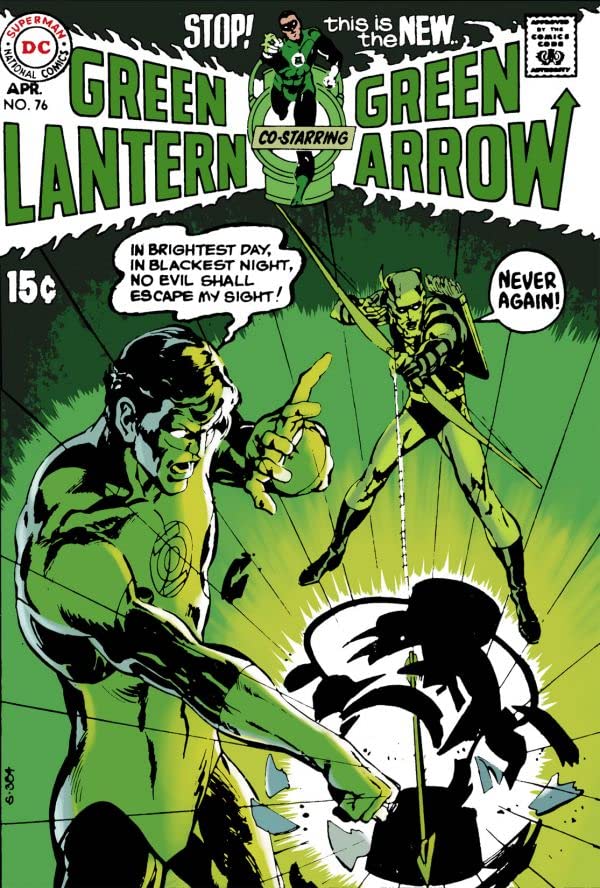
- The issue is the third installment of the O'Neil/Adams 'Hard-Traveling Heroes' run, which began with Green Lantern #76 (April 1970); the covers of issues #76–87 and #89–122 carried the shared 'Green Lantern Co-Starring Green Arrow' branding.
- The run, of which this issue is part, won the Shazam Award for Best Continuing Feature and O'Neil individually won Best Writer (Dramatic Division) for 1970, recognizing the entire GL/GA output of that year.
- The issue has been reprinted continuously since the early 1970s, appearing in formats including the 1972 Paperback Library collection, the 1983 DC limited series, the 1992 'Hard-Traveling Heroes' trade paperback, the 2004 DC collected edition, the 2015 Absolute Edition, the 2018 Hard-Traveling Heroes Deluxe Edition hardcover, and the 2024 Hard-Traveling Heroes Omnibus.
- Multiple scholars and critics cite the broader O'Neil/Adams GL/GA run — of which this issue is a core chapter — as a foundational moment in the transition from the Silver Age to the Bronze Age, marking the turn from sci-fi melodrama toward grounded, socially conscious superhero storytelling.
Full credits
Reprints
Reprinted in Groene Lantaarn Classics #2722 (1971), Green Lantern and Green Arrow #2 (1972), Green Lantern Album #4 (1976), Green Lantern #26 (1979), Gigant #3/1979 (1979), Gigant #3/1979 (1979), Green Lantern / Green Arrow #2 (1983), Heróis em Ação #6 (1984), Hard-Traveling Heroes: The Green Lantern / Green Arrow Collection Volume One #[nn] (1992), The Green Lantern / Green Arrow Collection #[nn] (2001), Green Lantern / Green Arrow #1 (2004), Showcase Presents: Green Lantern #5 (2011), Green Lantern / Green Arrow #[nn] (2012), Absolute Green Lantern / Green Arrow #[nn] (2016), DC Comics Graphic Novel Collection #60 (2016), Green Lantern/Green Arrow #[nn] (2017), Green Lantern / Green Arrow: Hard-Traveling Heroes Deluxe Edition #[nn] (2018), Top Comics Die Grüne Laterne #116
Key issues in Green Lantern
 ★
★ ★
★ ★
★ ★
★ ★
★ ★
★ ★
★ ★
★Reviews
Reader reviews
No reader reviews yet.