
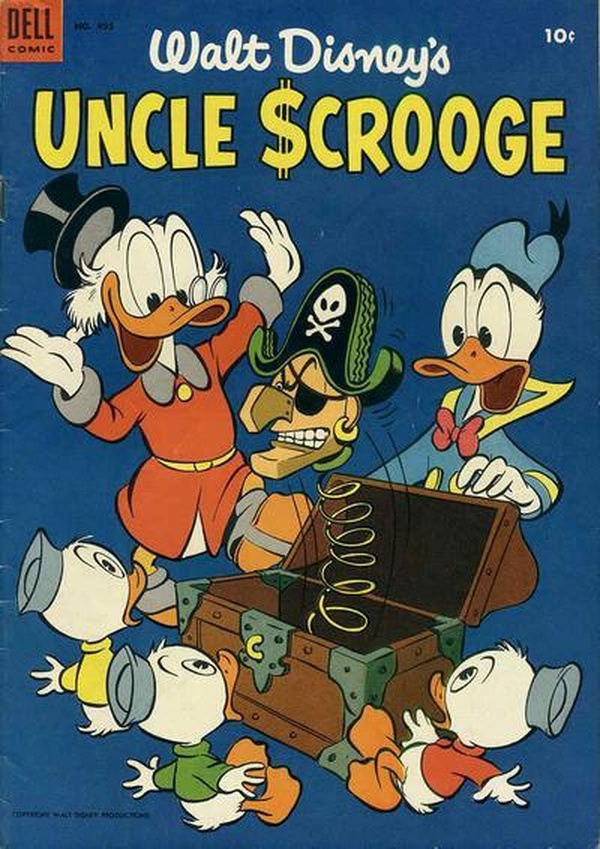
Four Color #495
☆ Be the first to review + Add to your collection — Join freeFour Color #495 is the third installment of Carl Barks's Uncle Scrooge series and contains two contributions of lasting importance to the Duck mythos. The backup story 'The Round Money Bin' marks the first appearance of Scrooge's Old Number One Dime — referred to here simply as the first dime he ever earned — a talisman that would become one of the most recurring and emotionally resonant props in all of Duck comics, later central to stories by Barks himself, Don Rosa, and the DuckTales animated series. The lead story, 'The Horse-Radish Treasure,' introduces the one-off antagonist Chisel McSue and showcases Barks's gift for building globe-spanning adventure plots around a single absurd contractual premise — an ancestor's failure to deliver a case of horseradish to Jamaica in 1753 — demonstrating that even early in the solo Scrooge run, Barks was pushing the character well beyond funny-animal comedy into genuine serialized world-building.
In "Barber College," Scrooge McDuck faces a bizarre and urgent challenge: reclaiming his fortune by fulfilling a long-forgotten contract from a century ago, one that hinges on a lost case of horseradish and a forgotten debt to Chisel McSue’s ancestor. With the help of his nephews, Scrooge sets sail in a small ship on a quest through the Caribbean to recover the fabled root—before time runs out. Written and illustrated by Carl Barks, this 1953 adventure blends whimsy and determination, with Barks' distinctive art and storytelling on full display, both in the story and on the cover.
In "Horseradish Treasure," Scrooge McDuck faces a peculiar financial crisis when a long-forgotten contract threatens to strip him of his fortune—his ancestor once failed to deliver a case of horseradish to Jamaica, and now Scrooge must fulfill that ancient obligation. With the help of his nephews, he sets sail in a small ship across the Caribbean, searching for the sunken vessel that may still hold the missing horseradish.
In "The Round Money Bin," Scrooge McDuck tries a new way to keep his fortune safe—converting his coins into greenbacks and stashing them in an old water tank—but even that clever plan can't keep the Beagle Boys at bay. With his usual mix of caution and stubbornness, Scrooge faces a classic challenge that tests just how far he'll go to protect his money.
ComicBooks.com Value
Show all 17 grades ▾
This exact issue on ebay
Raw — VERY GOOD ▾ $130–$150 2 listings
Raw / ungraded ▾ $19–$99.97 7 listings
Read it digitally
Sell my copy
Have this issue — or a whole collection? Get a fair offer from us, skip the marketplace fees and the hassle.
We Buy Collections ▸History
All stories in the issue were written, drawn, and lettered by Carl Barks, with GCD records noting the artwork was submitted to Dell's Western Publishing operation on February 26, 1953, for a September 1953 cover date. The issue was published under Dell's long-running Four Color anthology framework, which functioned as a try-out and scheduling vehicle for licensed character titles; Scrooge had already proven his solo viability across FC #386 and #456, and this third outing fed directly into the launch of a numbered Uncle Scrooge series beginning with issue #4. Story notes and credits in the Grand Comics Database draw on Alberto Becattini's authoritative Disney Index research (published in Italy in 1992 and 1994) and synopses by comics historian Michael Barrier.
Trivia · 8 facts
- Published September 1953 by Dell Comics as part of the Four Color anthology series; retroactively counted as Uncle Scrooge #3.
- All interior stories written, drawn, and lettered by Carl Barks; art submitted February 26, 1953.
- Lead 32-page story 'The Horse-Radish Treasure': Chisel McSue threatens to claim Scrooge's entire fortune under a 200-year-old contract tied to an ancestor's failure to deliver horseradish to Jamaica — first and most prominent appearance of the character Chisel McSue.
- Backup story 'The Round Money Bin' contains the first appearance of Scrooge's Old Number One Dime, identified in the story only as the first dime he ever earned — the coin was not yet given its later formal name but became one of the most significant recurring objects in the Duck comics universe.
- Short story 'Follow the Rainbow' depicts Scrooge's money bin at the end of a rainbow as seen by Huey, Dewey, and Louie.
- The issue continues directly into the numbered Uncle Scrooge series; the next issue, Uncle Scrooge (Dell) #4, was published December 1953–February 1954.
- Both major stories from this issue — 'The Horse-Radish Treasure' and 'The Round Money Bin' — were reprinted in Fantagraphics' The Complete Carl Barks Disney Library Vol. 12: Walt Disney's Uncle Scrooge: 'Only a Poor Old Man' (2012).
- Stories from this issue were also reprinted in the Gladstone series Uncle Scrooge Adventures in Color by Carl Barks (1996), with accompanying editorial commentary by Geoffrey Blum.
Cast · 6 characters
Full credits
Reprints
Reprinted in Le Journal de Mickey #117 (1954), Donald Duck #4/1955 (1955), Walt Disney's serier #3/1955 (1955), Donald Duck #42/1955 (1955), Donald Duck #43/1955 (1955), Donald Duck #44/1955 (1955), Donald Duck & Co #15/1957 (1957), Walt Disney's månedshefte #2/1970 (1970), Walt Disney's Comics #326 (1973), Walt Disney Uncle Scrooge #105 (1973), The Best of Walt Disney Comics #96172 (1974), Walt Disney Uncle Scrooge #172 (1980), Walt Disney Uncle Scrooge #181 (1980), Uncle Scrooge, His Life and Times #1 (1981), The Complete Carl Barks #13 (1984), The Carl Barks Library #3 (1984), Kalle Ankas bästisar #22 (1985), The Complete Carl Barks #32 (1985), Walt Disney's Beste Historier om Donald Duck & Co [Disney-Album] #25 (1985), Donald Duck bøker [Gullbøker] #[1986] (1986), Walt Disney's Uncle Scrooge #212 (1986), Walt Disney's Comics and Stories #514 (1987), Disney's DuckTales #3 (1989), Kalle Ankas bästisar #32 (1990) + 17 more
Key issues in Four Color
 ★
★ ★
★ ★
★ ★
★ ★
★ ★
★ ★
★Reviews
Reader reviews
No reader reviews yet.