
Four Color #1173
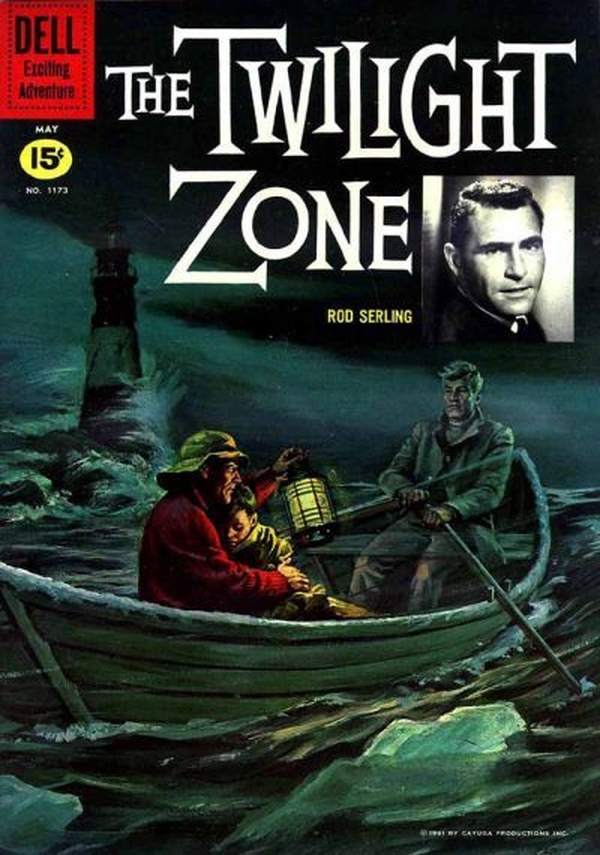
☆ Be the first to review + Add to your collection — Join freeFour Color #1173 holds the distinction of being the first comic book appearance of The Twilight Zone, translating Rod Serling's CBS television phenomenon into the comics medium for the very first time. Published in the spring of 1961 while the show was still airing its second season, the issue established the template that would define all subsequent Twilight Zone comics: original, standalone tales of the uncanny introduced by a rendered likeness of Serling himself, rather than direct adaptations of televised episodes. Its success as a Four Color one-shot trial directly led to a follow-up issue (#1288) and then two standalone Dell issues, ultimately paving the way for Gold Key's landmark 91-issue run — one of the longest-running licensed fantasy comics of the Silver and Bronze Ages. For a single 36-page saddle-stitched comic, its cultural footprint is outsized: it brought Serling's dimension of imagination to newsstands and proved that anthology horror-fantasy could sustain an ongoing comics franchise decades beyond the television series that inspired it.
In "Specter of Youth," a father and son on an ice-fishing trip encounter an enigmatic old fisherman whose urgent warning about a storm leads to a perilous journey across the frozen Great Lakes. When the ice cracks and they're stranded on a drifting floe, their survival hinges on a sudden landfall at a remote island—and the lighthouse keeper who seems to know more than he should. Written by Paul S. Newman and illustrated by Reed Crandall, with lettering by Ben Oda, this atmospheric tale blends suspense and mystery in a 15-cent 1961 classic.
In "Specter of Youth," an elderly merchant, long accustomed to the weight of age and the thrill of forbidden treasures, is handed a mysterious jar said to hold a liquid that grants eternal youth. Written by an unknown hand and illustrated by an unknown artist, the story unfolds with quiet dread as the promise of endless life begins to unravel something far older than time.
In "The Phantom Lighthouse," a father and son on an ice-fishing trip encounter an enigmatic old fisherman who warns them of an approaching storm and the urgent need to find his lost boat. When the ice breaks and they’re stranded on a drifting floe, they’re miraculously rescued when it washes ashore at a remote island—and the lighthouse keeper they find there is the very man they met earlier.
ComicBooks.com Value
Show all 20 grades ▾
This exact issue on ebay
Raw / ungraded ▾ $35–$55 2 listings
Read it digitally
Sell my copy
Have this issue — or a whole collection? Get a fair offer from us, skip the marketplace fees and the hassle.
We Buy Collections ▸History
Around 1960, during production on the show's second season, Western Publishing licensed the rights to produce a Twilight Zone comic; Western served as packager while Dell, its longtime distributor partner, published it as part of the Four Color anthology — a series routinely used to test-drive properties before committing to ongoing titles. The issue was designed and produced by Western Printing & Lithographing Co. and carries a copyright held by Cayuga Productions, Inc. — Serling's own production company — confirming that the license ran through Serling's organization even though Serling himself had no direct hand in creating the comic's content. The editor has been confirmed as Harris (first name not fully documented in public sources), per bibliographic records published in Robin Snyder's industry journal The Comics! in 2018. Because the Dell Four Color format was explicitly a proving ground, the strong reader response to #1173 was the direct trigger for a second Four Color issue and then two standalone Dell titles before Western Publishing spun off the property under its new Gold Key imprint in November 1962.
Trivia · 8 facts
- First comic book appearance of The Twilight Zone property, published by Dell as part of the Four Color anthology series (issue #1173), cover-dated March–May 1961.
- The issue contains three original fantasy-supernatural stories — 'Specter of Youth,' 'The Phantom Lighthouse,' and 'Doom by Prediction' — all written by Leo Dorfman (with at least one story's script later partially re-attributed to Paul S. Newman per updated bibliographic research), drawn primarily by Reed Crandall and George Evans.
- Interior art credits for 'Specter of Youth' are shared between Reed Crandall and George Evans on both pencils and inks; 'The Phantom Lighthouse' and 'Doom by Prediction' are largely Crandall's work, with letterer Ben Oda handling the text throughout.
- Rod Serling appears in the issue via photo — not as a drawn character — serving as narrator framing device for each story, consistent with his role on the television series; Serling had no creative involvement in writing or producing the comic's content.
- The cover is a painted illustration (not a photo cover), attributed to Reed Crandall and George Evans.
- The issue exists in at least two domestic back-cover variants (one with a house ad, one with a 'Travelers in the Twilight Zone' feature page) and a British edition distributed under the Dell Exciting Adventure brand.
- Stories from this issue were later reprinted in The Twilight Zone (Western/Gold Key series) #21 (May 1967), and at least one story was also reprinted in the Mexican publication Domingos Alegres (Editorial Novaro) #438.
- The Four Color #1173 one-shot served as the direct commercial test that launched the entire Twilight Zone comics lineage, which eventually ran 91 issues under Gold Key from November 1962 through mid-1979 (with a final reprint issue in 1982).
Cast · 1 character
Full credits
Reprints
Reprinted in The Twilight Zone #21 (1967), The Twilight Zone #25 (1968), The Twilight Zone #26 (1968), The Twilight Zone #29 (1969), Mystery Comics Digest #18 (1974), Mystery Comics Digest #21 (1975), Domingos Alegres #438, Gespenster Geschichten #33, Gespenster Geschichten #35, Gespenster Geschichten #36
Key issues in Four Color
 ★
★ ★
★ ★
★ ★
★ ★
★ ★
★ ★
★ ★
★Variants (1)
Reviews
Reader reviews
No reader reviews yet.