
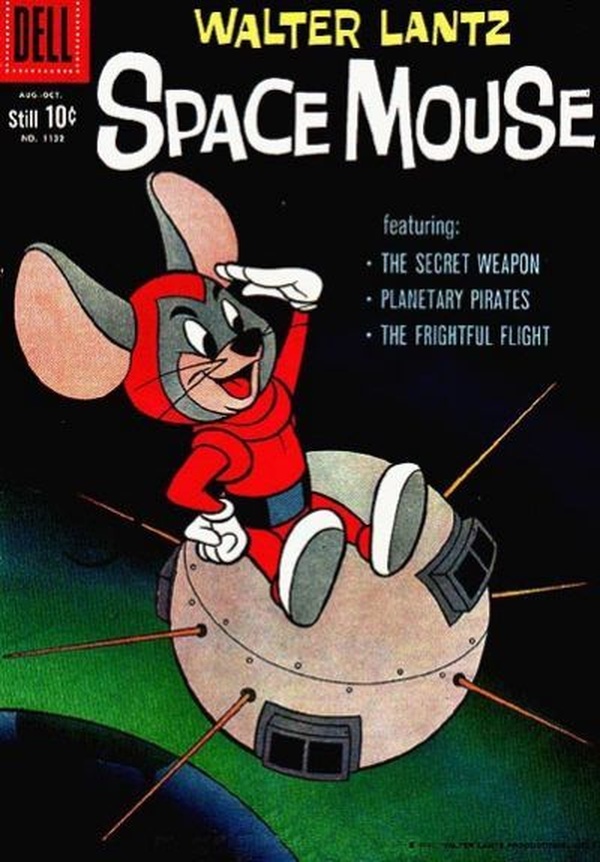
Four Color #1132
☆ Be the first to review + Add to your collection — Join freeFour Color #1132 marks the debut of Space Mouse, a funny-animal science-fiction character conceived entirely within the pages of a comic before he ever appeared in animation — a reversal of the usual licensed-property workflow that defined the Dell Four Color line. The issue is a snapshot of the Space Age's grip on popular culture: a spy-adventure-comedy strip set on the planet Rodentia, clearly riffing on both the Buck Rogers tradition and the real-world space race happening contemporaneously. Its publication directly prompted Walter Lantz to produce a theatrical animated pilot adapting the lead story, making this one of the few Four Color one-shots where the comic preceded and, in effect, generated its licensed animation rather than the other way around. The character subsequently carried through two more Dell appearances, a Dell Comic Album issue, and a five-issue Gold Key solo series, giving the concept a longer comics life than it achieved on screen.
In "The Kickback," Space Mouse finds himself in a high-stakes chase after his Lunar Schooner is stolen by the Vermin Brothers, two rascally rodents who've hijacked his ship during a rescue on an asteroid. With no time to waste, he follows their trail to Goofoffus, a planet where the inhabitants are famously the laziest in the universe. Written by Carl Fallberg and illustrated by John Carey, this 1960 adventure blends sci-fi mischief with classic cartoon energy, all captured in a vibrant cover by Carey.
When Space Mouse stops to aid a stranded rocket on an asteroid, his Lunar Schooner is stolen by the Vermin Brothers—two scheming rats with a taste for interstellar hijinks. Forced to chase them across the galaxy, he lands on Goofoffus, a planet where the inhabitants have perfected the art of doing absolutely nothing at all.
ComicBooks.com Value
Show all 13 grades ▾
This exact issue on ebay
Raw — VG+ ▾ $13.99–$14.97 2 listings
Raw / ungraded ▾ $8.49–$74.99 7 listings
Read it digitally
Sell my copy
Have this issue — or a whole collection? Get a fair offer from us, skip the marketplace fees and the hassle.
We Buy Collections ▸History
The origin of Space Mouse is an unusually well-documented piece of Silver Age editorial history. Western Publishing held the Lantz license and its senior editor, Chase Craig, spotted a press release announcing a Lantz cartoon short titled 'Space Mouse'; he envisioned a Buck Rogers-style mouse hero and wanted to build a comic around that premise. When the actual Lantz storyboard arrived, it turned out to depict an Earth-bound trio — Hickory, Dickory, and Doc — with no connection to space adventure. Craig nevertheless pursued the sci-fi concept, enlisting writer Carl Fallberg and artist John Carey to develop the strip from scratch. Because an unresolved ownership dispute between Dell and Western over non-licensed characters made Craig reluctant to launch the character as a Western property, he brought the completed pages to Lantz's office and offered him the copyright; Lantz accepted, and the book went to press under the Lantz banner with Western's creative team entirely responsible for the character's look, world, and stories.
Trivia · 8 facts
- First appearance of the Dell/Walter Lantz version of Space Mouse, a distinct character from the earlier 1953 Avon Publications Space Mouse created by Frank Carin.
- Published August–October 1960 as part of Dell's Four Color anthology series (Series II), issue #1132; 36 pages, full color, 10-cent cover price.
- Written by Carl Fallberg and illustrated (including cover) by John Carey — both Western Publishing staff creators, not Lantz studio employees.
- The lead story, 'The Secret Weapon,' introduces Space Mouse's home planet of Rodentia, its capital Miceapolis, the ruler King Size, and villain Count De Penny — the full supporting cast that would carry through the character's run.
- Space Mouse was conceived before any Lantz animated version existed; editor Chase Craig transferred the copyright to Walter Lantz to sidestep a Dell vs. Western publishing ownership dispute, making Lantz the legal owner of a character his studio did not create.
- Following the comic's publication, Lantz produced a theatrical animated pilot also titled 'The Secret Weapon' (1960), directed by Alex Lovy with Johnny Coons as the voice of Space Mouse; its plot closely mirrors the debut comic story.
- The animated pilot was released in theaters in 1960 and later televised in 1963 as part of The Woody Woodpecker Show, but failed to generate a regular animated series.
- Space Mouse appeared in two Four Color issues (#1132 and #1244), Dell's Comic Album #7 (1962), and then received a five-issue solo series from Gold Key Comics beginning in 1962, with stories reprinted in Gold Key's Golden Comics Digest through 1972.
Full credits
Reprints
Reprinted in Golden Comics Digest #16 (1971)
Key issues in Four Color
 ★
★ ★
★ ★
★ ★
★ ★
★ ★
★ ★
★Reviews
Reader reviews
No reader reviews yet.