
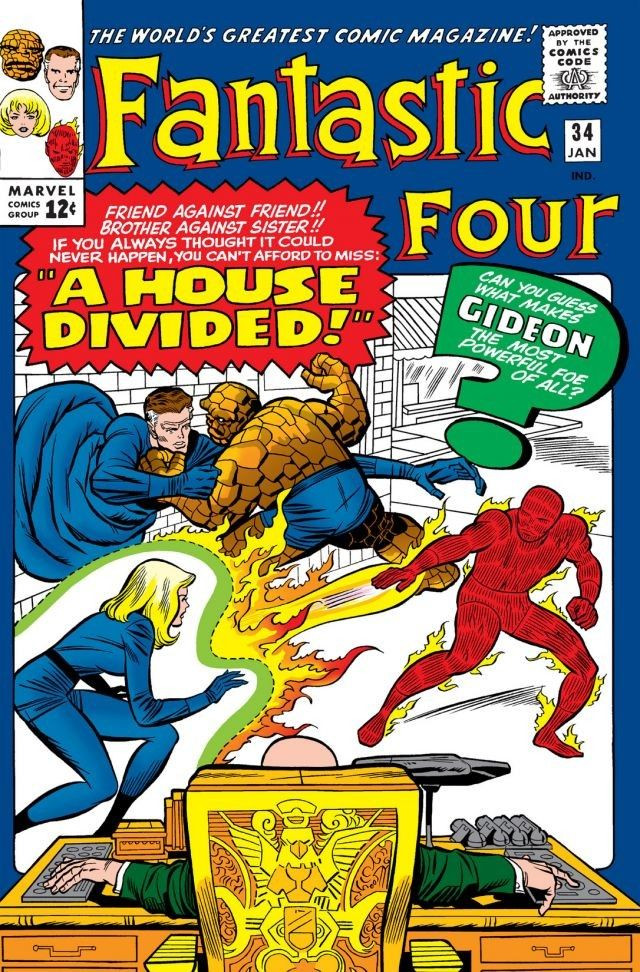
Fantastic Four #34
☆ Be the first to review + Add to your collection — Join freeFantastic Four #34 introduces Gregory Gideon, a cold-eyed billionaire whose scheme to destroy the FF by turning them against one another anticipates a recurring Marvel villain archetype: the supremely wealthy man who treats super-powered beings as chess pieces. More durably, it gives readers their first glimpse of Gideon's young son Thomas, whose own story arc across subsequent years eventually transforms him into the cosmic reality-shaper Glorian — making this issue the quiet origin point of a character whose mythology stretched well into the Bronze Age and beyond. The issue also carries an early fan letter from a teenage George R.R. Martin, a trivia footnote that has only grown in resonance as Marvel Comics' role in shaping a generation of storytellers has become better understood.
In "A House Divided!", the Fantastic Four face a rift that threatens to tear the team apart, as personal tensions and hidden secrets come to a head. This pivotal 1965 issue features Jack Kirby and Steve Ditko on art, with inks by Sol Brodsky and Chic Stone, and letters by Sam Rosen and Artie Simek, all under Kirby’s dynamic cover pencils and Chic Stone’s inks. The cover teases upcoming Marvel titles, including reprinted covers from Strange Tales #128, The Avengers #11, and Tales to Astonish #63, all now on sale.
ComicBooks.com Value
Show all 21 grades ▾
This exact issue on ebay
CGC 5.5 ▾ $95–$130 2 listings
Raw — VG+ ▾ $39.99–$55.99 3 listings
Raw — VG ▾ $29.99–$160 9 listings
Raw — GD ▾ $14.99–$175 11 listings
Raw / ungraded ▾ $2–$161 46 listings
Read it digitally
Sell my copy
Have this issue — or a whole collection? Get a fair offer from us, skip the marketplace fees and the hassle.
We Buy Collections ▸History
The issue was produced by the core Lee-Kirby creative team at the height of their collaborative momentum, going on sale October 8, 1964 with a January 1965 cover date. Chic Stone inked Kirby's pencils, Stan Goldberg handled coloring, and Art Simek lettered the story — the same production unit responsible for much of the run in this period. No distinctive behind-the-scenes production anecdotes for this specific issue have surfaced in available sources beyond what the credits themselves convey.
Trivia · 8 facts
- First appearance of Gregory Gideon (Greg Gideon), a multi-billionaire industrialist who weaponizes his fortune against the Fantastic Four; written by Stan Lee, pencilled by Jack Kirby, inked by Chic Stone.
- First appearance of Thomas Gideon (Tommy), Gregory's young son and devoted FF fan, who later becomes the cosmic reality-manipulator Glorian (debut in that role: Incredible Hulk #190, August 1975, as developed by Gerry Conway and John Buscema).
- The story, titled 'A House Divided!', turns on Gideon manipulating the Thing into believing Reed Richards is a Skrull impostor, and Sue Storm into believing Johnny Storm is a Doom-built robot — a divide-and-conquer tactic that foreshadows later villain strategies.
- Gideon exploits a repurposed version of Dr. Doom's time machine, hidden in the Baxter Building floor, as his primary trap — connecting the story to established FF mythology rather than introducing new technology.
- The issue's letters column features a published letter from a teenage George R.R. Martin, one of several he sent to the Fantastic Four title during this period; Wikipedia's biography of Martin specifically names issues #20, #32, and #34 among those that printed his correspondence.
- Cover date January 1965; on-sale date October 8, 1964 (per Library of Congress copyright records); published under the Canam Publishers Sales Corp. indicia.
- The story has been reprinted in Marvel Collectors' Item Classics #15 (June 1968), Marvel's Greatest Comics #35 (June 1972), Marvel Masterworks #21 (November 1992), Marvel Masterworks: The Fantastic Four Vol. 4 (2003), Fantastic Four Omnibus Vol. 2 (2007), Fantastic Four Epic Collection Vol. 3: The Coming of Galactus (2018), and a German-language edition in Marvel Origins #27 (2024).
- The issue also includes a Fantastic Four pin-up page, an MMMS (Merry Marvel Marching Society) memo, a Special Announcements section, and The Mighty Marvel Checklist — standard editorial features of the mid-1960s Marvel line.
Cast · 34 characters
Full credits
Reprints
Reprinted in Marvel Collectors' Item Classics #15 (1968), Pow! and Wham! #75 (1968), Hit Comics #97 (1969), Marvel's Greatest Comics #26 (1970), Marvel #7 (1970), I Fantastici Quattro #29 (1972), Marvel's Greatest Comics #35 (1972), The Mighty World of Marvel #40 (1973), The Mighty World of Marvel #71 (1974), The Mighty World of Marvel #72 (1974), Une Aventure des Fantastiques #34 (1984), Marvel Masterworks #21 (1992), Marvel Masterworks: The Fantastic Four #4 (2003), Biblioteca Marvel: Hulk #24 (2005), Fantastic Four : L'intégrale #1965 (2006), Fantastic Four Omnibus #2 (2007), Marvel Masterworks: The Fantastic Four #4 (2010), Fantastic Four Epic Collection #3 (2018), Marvel Origins #27 (2024), Die Fantastischen Vier #31, Fantastiska fyran #22, I Fantastici Quattro Gigante #20, Los 4 Fantásticos #54
Key issues in Fantastic Four
 ★
★ ★
★ ★
★ ★
★ ★
★ ★
★ ★
★ ★
★Reviews
Reader reviews
No reader reviews yet.