
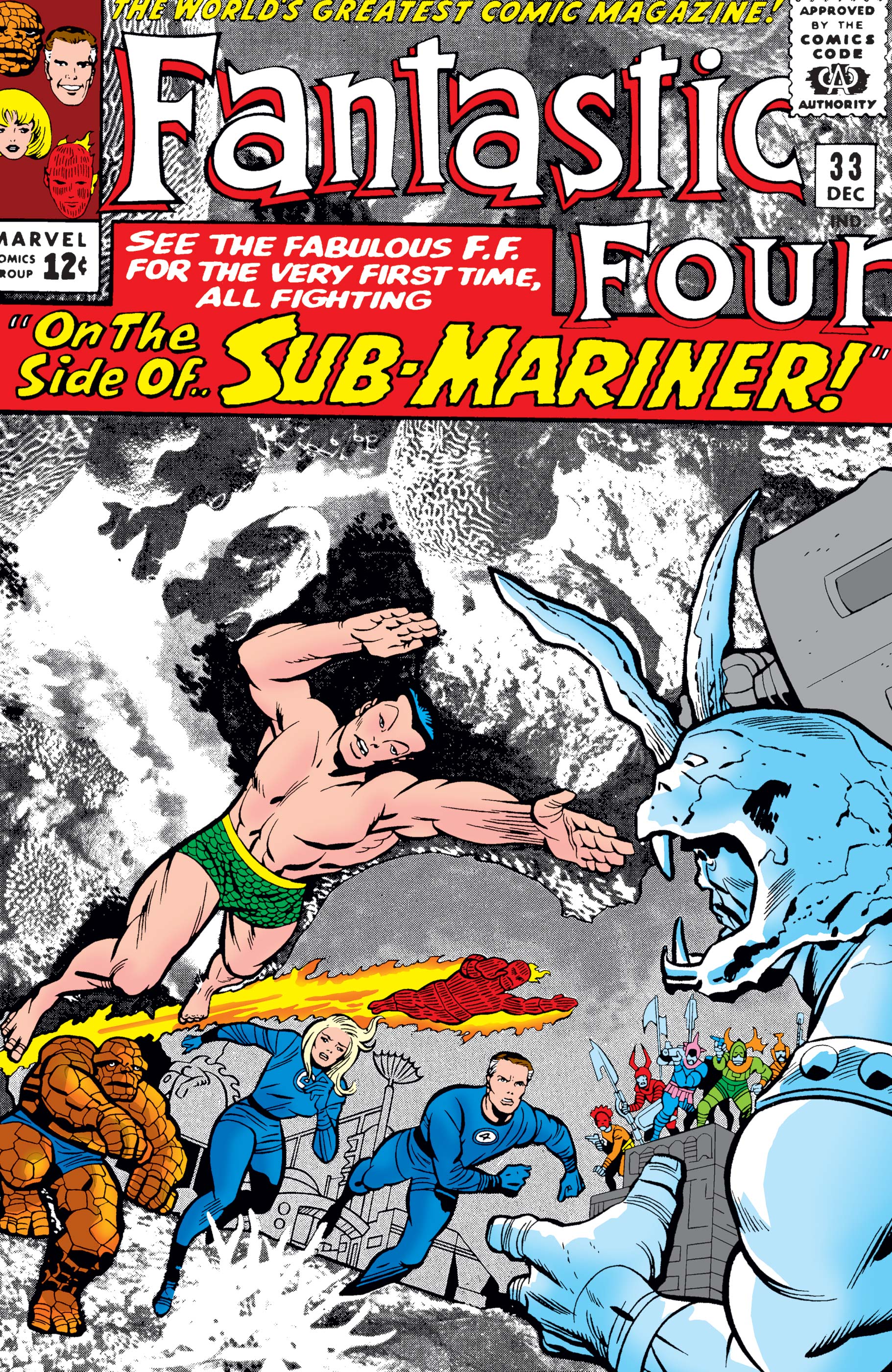
Fantastic Four #33
☆ Be the first to review + Add to your collection — Join freeFantastic Four #33 (cover-dated December 1964) marks the debut of Attuma, the Atlantean warlord who would become one of Namor's most persistent and formidable antagonists across six decades of Marvel storytelling. By staging an underwater civil war that forces the Fantastic Four to secretly ally with their longtime foe Sub-Mariner, Stan Lee and Jack Kirby deepened the political mythology of Atlantis in ways that writers would mine for generations — from the 'Atlantis Attacks' crossover to the Fear Itself event. The issue also laid crucial emotional groundwork for Reed and Sue's relationship, with the story's resolution nudging them toward their engagement, which followed almost immediately after. Attuma's MCU live-action debut in Black Panther: Wakanda Forever (2022) confirmed that this single issue planted a character durable enough to anchor a blockbuster film nearly sixty years later.
In "Side-by-Side with Sub-Mariner!", the Fantastic Four answer a desperate call from Lady Dorma as Prince Namor faces off against the relentless forces of the Barbaric Attuma. With Jack Kirby’s dynamic pencils and Chic Stone’s bold inks bringing the clash of sea and surface to life, this 1964 classic captures the team’s first true alliance with the Sub-Mariner in a story that sets the stage for underwater conflict and uneasy alliances.
ComicBooks.com Value
Show all 22 grades ▾
This exact issue on ebay
CGC 8 ▾ $399–$650 3 listings
CGC 6.5 ▾ $140–$265 4 listings
CGC 6 ▾ $99–$220 2 listings
CGC 5.5 ▾ $140–$235 2 listings
CGC 4.5 ▾ $89–$95 2 listings
CGC 4 ▾ $80–$200 4 listings
Raw — FN ▾ $74.99–$195 5 listings
Raw — VG ▾ $39.95–$110 12 listings
Raw / ungraded ▾ $2.5–$225 39 listings
More listings for this title
Read it digitally
Sell my copy
Have this issue — or a whole collection? Get a fair offer from us, skip the marketplace fees and the hassle.
We Buy Collections ▸History
Produced by the Lee–Kirby creative engine at its most prolific mid-Silver Age peak, the issue was written and edited by Stan Lee with pencils, cover, and photo-collage elements by Jack Kirby, inked by Chic Stone, colored by Stan Goldberg, and lettered by Sam Rosen. The Grand Comics Database records an on-sale date placing it in late 1964, with a cover date of December 1964. One of Kirby's noted formal experiments at this stage of the run was the integration of halftone photo collages directly into the page art — a technique that appears on the cover itself and was already generating reader comment; a letters page in FF #36 praised Kirby's 'fantastic imagination for depicting outlandish machinery and barbaric splendor.' Unusually, the letters column of this very issue preserves early correspondence from two future creative figures: Don McGregor and a then-16-year-old George R. R. Martin.
Trivia · 8 facts
- First appearance of Attuma, created by Stan Lee (writer/editor) and Jack Kirby (artist), cover-dated December 1964.
- Story title: 'Side-By-Side with Sub-Mariner!' — the Fantastic Four covertly help Namor defend Atlantis from Attuma's attempted coup, with Lady Dorma serving as the go-between who recruits the FF.
- Attuma is established as leader of the exiled Skarka tribe, a sect of Atlantean barbarians driven by an ancient prophecy that one of their blood would conquer Atlantis by force.
- The issue features a Sub-Mariner pin-up by Kirby and Chic Stone, and the cover incorporates Kirby's photo-collage technique, a formal experiment the artist had been developing since approximately FF #29.
- Jack Kirby handled pencils, inks on the photo-collage portions, and cover art; Chic Stone inked the main story; Artie Simek and Sam Rosen shared lettering duties across the issue's features.
- The letters column includes early correspondence from future Marvel writer Don McGregor and a 16-year-old George R. R. Martin — both preserved in the Grand Comics Database record for this issue.
- Domestic and international reprints include Marvel's Greatest Comics #25 (February 1970), the UK's Pow! and Wham! #71 (May 1968) and Mighty World of Marvel #73–74 (1974), a Mexican edition (Los 4 Fantásticos #52), a German edition (Die Fantastischen Vier #30), and a French edition (Une Aventure des Fantastiques #34), as well as the modern Fantastic Four Epic Collection Vol. 3: The Coming of Galactus (2018).
- The story was adapted for the 1967 Hanna-Barbera Fantastic Four animated series as 'Danger in the Depths,' with Sub-Mariner renamed 'Prince Triton' due to a licensing conflict with CBS, while Attuma and Lady Dorma appeared under their original names; Atlantis was renamed Lemuria for the same reason.
Cast · 7 characters
Full credits
Reprints
Reprinted in The Fantastic Four Return #72-169 (1967), Pow! and Wham! #70 (1968), Pow! and Wham! #71 (1968), Pow! and Wham! #72 (1968), Marvel's Greatest Comics #25 (1970), Marvel #7 (1970), I Fantastici Quattro #28 (1972), FOOM Magazine #4 (1974), The Mighty World of Marvel #73 (1974), The Mighty World of Marvel #74 (1974), Tales to Astonish #14 (1981), Une Aventure des Fantastiques #34 (1984), Marvel Masterworks #21 (1992), Marvel Masterworks: The Fantastic Four #4 (2003), Fantastic Four Omnibus #2 (2007), Marvel Masterworks: The Fantastic Four #4 (2010), L'ère des Comics Marvel 1961-1978 #[nn] (2017), Fantastic Four Epic Collection #3 (2018), Namor, the Sub-Mariner Epic Collection #1 (2021), Namor: Conquered Shores #1 (2022), Giant-Size Fantastic Four #1 (2024), Marvel Origins #27 (2024), Namor the Sub-Mariner Omnibus #1 (2025), Creepy Worlds #55 + 2 more
Key issues in Fantastic Four
 ★
★ ★
★ ★
★ ★
★ ★
★ ★
★ ★
★ ★
★Reviews
Reader reviews
No reader reviews yet.