
A complete issue · 68 pages · 1922
Captain Billy's Whiz Bang #29
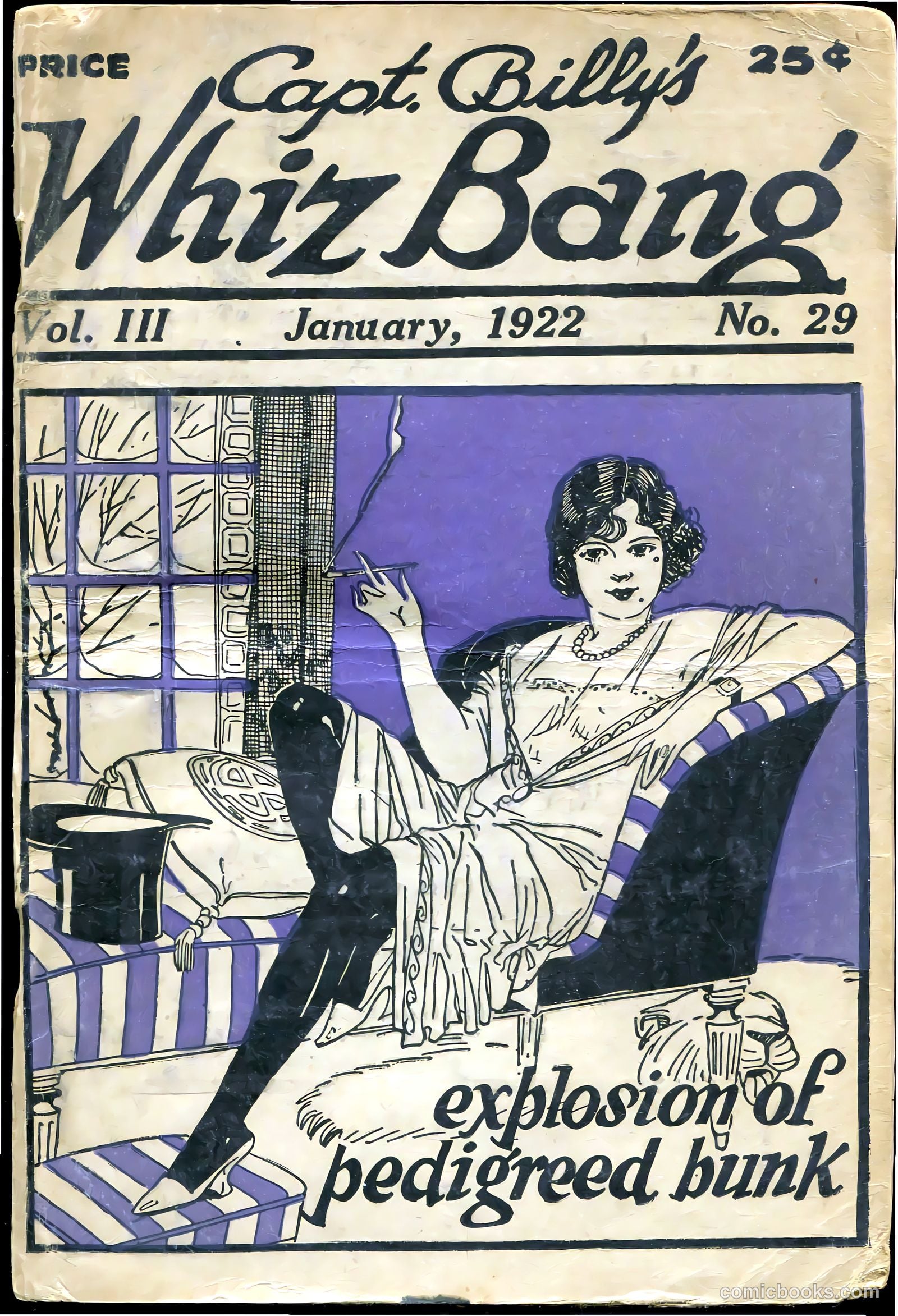
This is the cover of *Capt. Billy's Whiz Bang*, a satirical humor magazine. The illustration depicts a fashionable woman lounging on a striped chaise, smoking a cigarette in an exaggerated pose. The subtitle "explosion of pedigreed bunk" suggests the magazine's purpose: deflating pretense and upper-class affectation. The image likely mocks 1920s "modern woman" stereotypes—the bobbed hair, cigarette smoking, and lounging posture would have scandalized conservative readers. The term "pedigreed bunk" implies the magazine satirizes high-society pretension and humbug. This was typical of post-WWI American humor magazines that challenged Victorian social norms and class pretensions through irreverent cartoons and jokes.
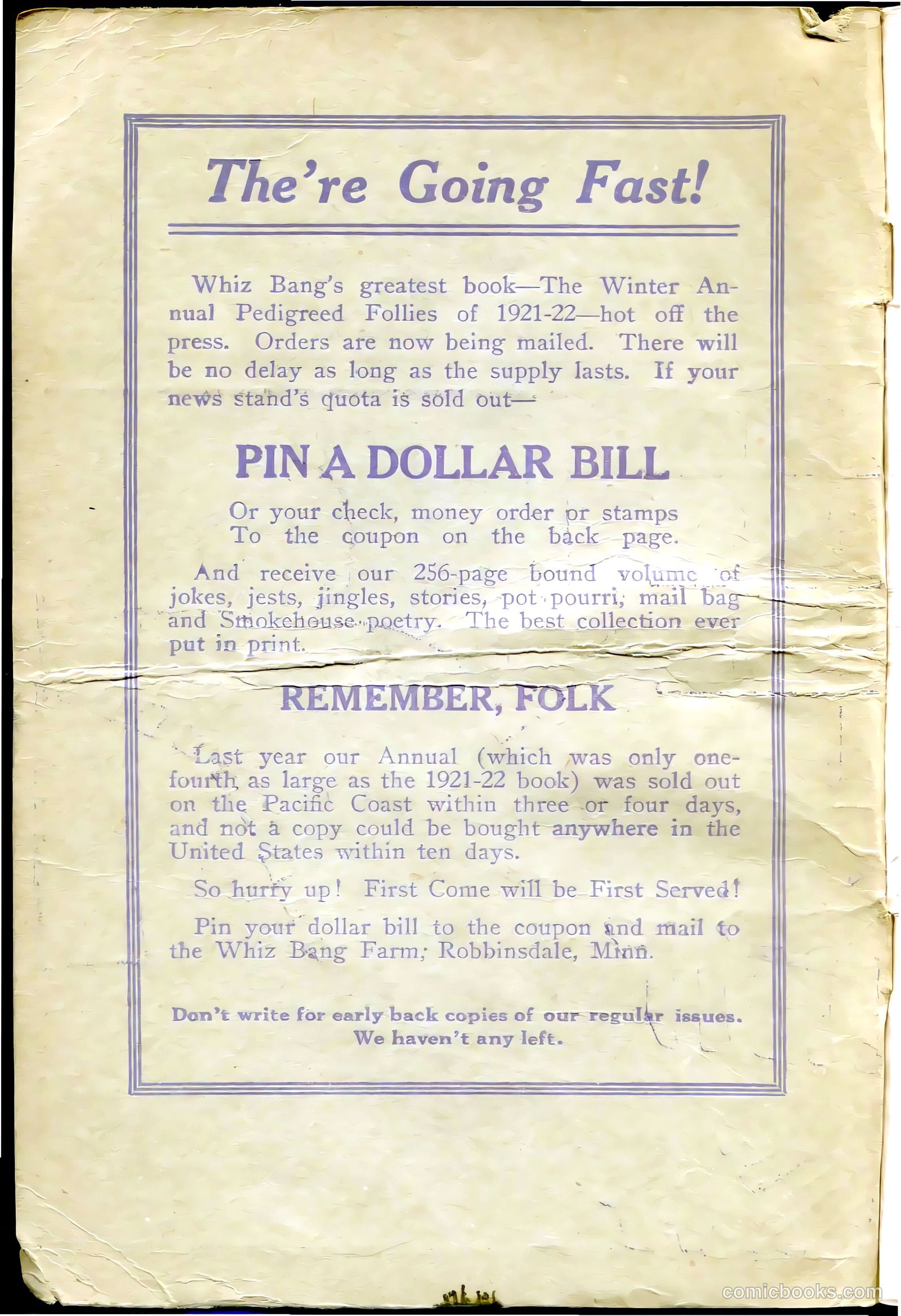
This is **not a cartoon page**, but rather a **promotional advertisement** for *Whiz Bang* magazine's annual collection book from 1921-22. The ad uses urgency marketing tactics common to the era: claiming rapid sell-out (referencing last year's Pacific Coast depletion), emphasizing scarcity ("First Come will be First Served"), and requesting payment via dollar bill pinned to a coupon—a direct-mail method typical of the 1920s. The publication describes itself as containing "jokes, jests, jingles, stories, pot pourri, mail bag and Smokehouse poetry," indicating *Whiz Bang* was a humor/entertainment magazine. The tone is casual and folksy ("Remember, Folk"), targeting working-class readers via newsstand distribution. The final line—declining requests for back issues—suggests the magazine was genuinely popular and production couldn't keep up, adding credibility to the scarcity pitch. No political satire or caricatures are present here; this is purely commercial promotion.
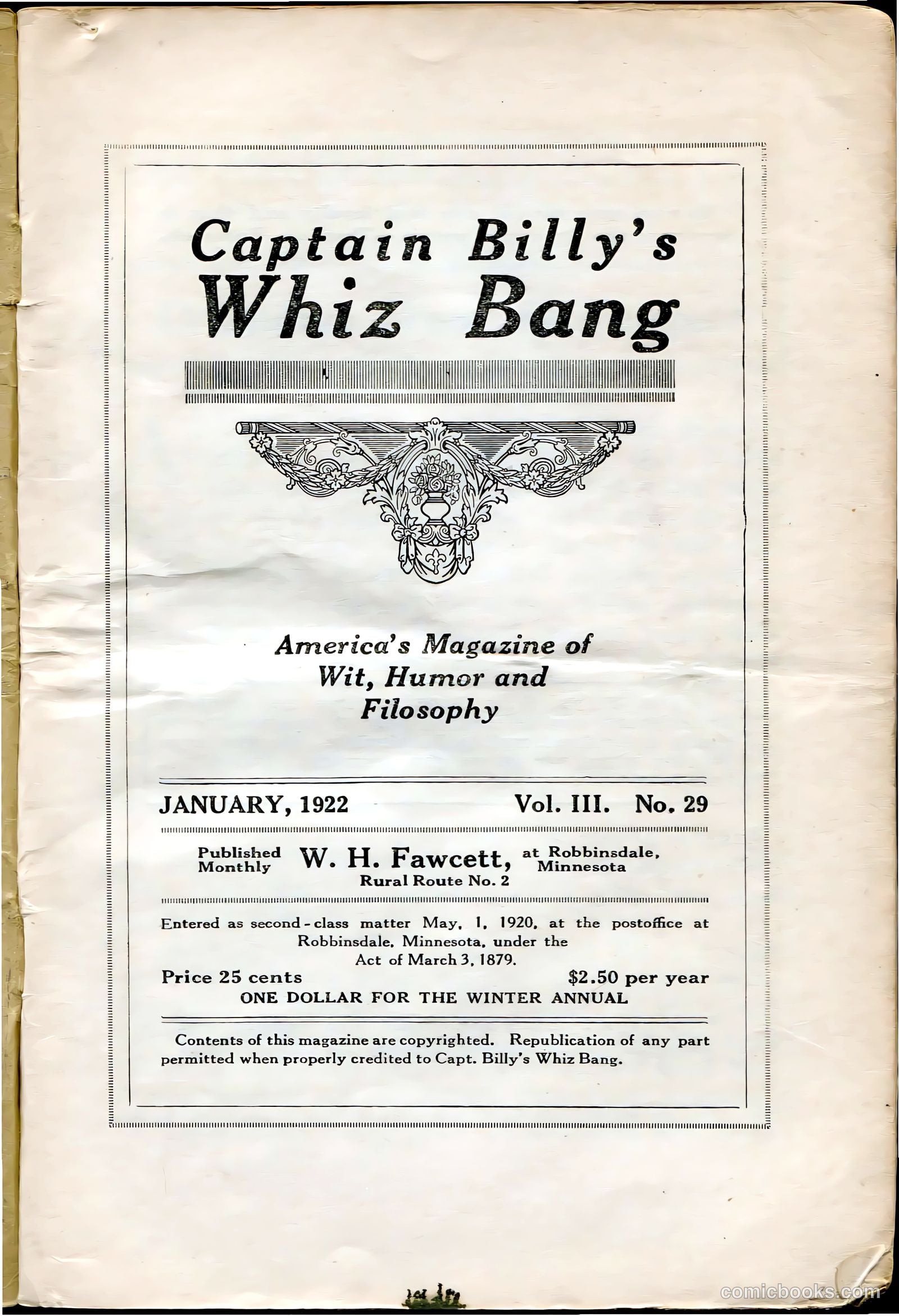
This is the title page for *Captain Billy's Whiz Bang*, a humor magazine published by W.H. Fawcett in Minnesota. The page contains no cartoons or satirical content—it's purely a cover/masthead identifying the publication as "America's Magazine of Wit, Humor and Philosophy." The ornamental header design is decorative rather than illustrative. The page provides publication details: January 1922 (Vol. III, No. 29), price 25 cents per issue or $2.50 annually, with copyright notice. No specific political or social commentary appears on this particular page—it functions solely as the magazine's introductory/identifying page.
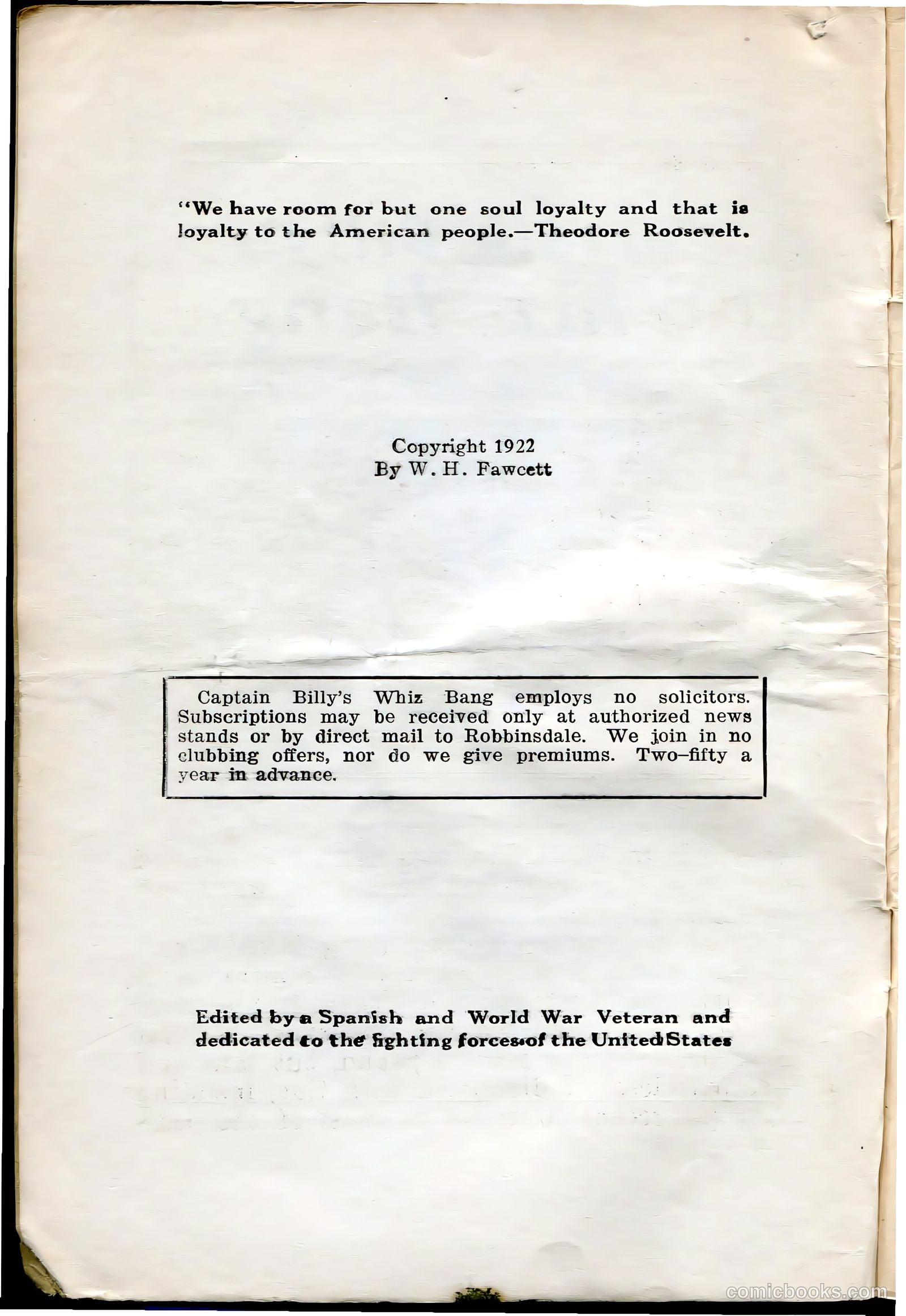
This is a title/masthead page for *Captain Billy's Whiz Bang*, a 1922 satirical magazine edited by a Spanish-American War and World War I veteran. The page features a Theodore Roosevelt quote about undivided loyalty to America—likely referencing debates of that era about immigrant loyalties and "hyphenated Americans." The boxed text announces the magazine's subscription policy: no solicitors, only authorized newsstand sales or direct mail to Robbinsdale, Minnesota, and no clubbing offers or premiums. This suggests the publisher wanted to control distribution and maintain editorial independence. The Roosevelt epigraph frames the publication as patriotic, positioning it within post-WWI American nationalism concerns about divided allegiances and foreign influences.
This is a prose column titled "Drippings From the Fawcett," not a political cartoon. It's a folksy, humorous narrative by the magazine's editor ("Captain Billy") describing his return to a small Midwestern farming town after a two-month trip. The piece uses gentle small-town satire: it affectionately mocks local characters like postmaster "Bud Nasett" and meat-market owner "Gus Urban" through their mannerisms and dialogue. The narrator's comment about disagreeing with Gus's assertion that "bull was priceless" sets up what appears to be an incomplete joke or pun (the text cuts off mid-sentence at "pedi-"). The reference to "Gopher Prairie" is likely an allusion to Sinclair Lewis's 1920 novel *Main Street*, which satirized small-town American life—suggesting the magazine is using similar humor about rural communities. The tone is warmly satirical rather than biting, celebrating small-town characters while gently poking fun at their quirks.
This page contains no cartoon or caricature—it's prose and poetry. The text describes Captain Billy's return to his hometown of Robbinsdale, Minnesota after financial hardship ("flat broke"). He recounts the local bank's stability under cashier Joe Roche and celebrates small-town life through a sentimental poem. The satirical angle appears mild: the piece gently mocks the contrast between small towns and big cities while ultimately praising small-town virtues—neighborliness, familiarity, and genuine welcome. The phrase "Whiz-Zing through my jaded mind" suggests wry affection rather than sharp critique. This represents Whiz Bang's characteristic blend of nostalgic Americana with light social commentary.
This is a humorous anecdote from an American satirical magazine, likely early 20th century. The joke concerns Bobby Nelson, a chronic gambler among schoolchildren. The setup: Bobby's father enlists the schoolteacher to cure him of betting. Bobby wagers that the teacher has a wart on her knee. The teacher, confident she doesn't, accepts the bet to make Bobby lose and reform him. She wins the two-dollar bet. **The punchline**: When she proudly tells Bobby's father how she "cured" him, he reveals Bobby actually *won*—he'd bet his father ten dollars that morning that he'd see the teacher's knee before day's end. By accepting the wager and proving her knee, she inadvertently fulfilled Bobby's bet. The satire mocks both adult naiveté and the clever manipulation of a habitual young gambler who outsmarts even those trying to help him. The final line about New York needing "cold cash to have a hot time" shifts to general cynicism about urban morality.
This page from the satirical magazine contains four separate humorous anecdotes with no accompanying cartoons or illustrations. The jokes target various social groups through ethnic and class stereotypes common to 1920s American humor: 1. **Irish wedding guests** are mocked as rude and greedy for grabbing food. 2. **Idaho natives** are criticized for making homemade alcohol using a chewing/fermentation method—a dig at both indigenous peoples and Prohibition-era bootlegging. 3. **A destitute man** makes a pun about "close shave" when his coin nearly falls into a sewer, choosing drinking over grooming—mocking poverty and alcoholism. 4. **"Helen of Troy"** reference plays on a man named Gus who claims to have dated laundry workers, conflating classical beauty with working-class women—a crude class joke. The overall tone is irreverent, relying on period stereotypes about ethnicity, poverty, and gender for humor that modern readers would find offensive.
This page contains three brief humorous anecdotes rather than political cartoons: 1. **The Robbinsdale druggist's observation** mocks Minnesota Swedes as ahead of their time—implying they're progressive drinkers (the "pure alcohol" reference suggests Prohibition-era humor about their drinking habits). 2. **The Coon Creek stranger anecdote** satirizes small-town Prohibition enforcement. A traveler asks for whiskey; the druggist claims spirits are "medicinal only." The joke: the stranger's response ("this town gives me a pain") suggests he'll use alcohol as medicine for his discomfort—a common Prohibition-era workaround. 3. **The raisin/book exchange** is a playground con: a kid trades a Whiz Bang magazine for raisins, then dismisses the magazine as inferior ("punk"). The humor reflects the publication's self-aware, irreverent tone.
This page from *Captain Billy's Whiz Bang* (a 1920s satirical magazine) contains no cartoon—it's prose narrative describing a trip to Tijuana during Prohibition. The humor targets: 1. **Prohibition evasion**: The narrator, a "thirsty Minnesota farmer," seeks alcohol in San Diego and California but finds only poor substitutes ("sympathy gin"). Tijuana becomes the solution—just an hour away. 2. **"Soaks"** (drinkers) and references to quality liquors like "Scotch" and "Haig and Haig" mock those desperate for forbidden drinks. 3. **Nostalgia for vice districts**: The narrator compares Tijuana to defunct red-light and gambling areas in Omaha, Duluth, and San Francisco—implying these were once thriving establishments. 4. **Ironic frustration**: Even in vice-friendly Tijuana, gambling is temporarily banned by the Mexican government, thwarting the narrator's final temptation. The satire ridicules Prohibition's ineffectiveness and Americans' determined pursuit of illegal pleasures across borders.
This page contains no cartoon imagery—it's prose narrative from Captain Billy's satirical magazine. The author recounts visiting San Francisco institutions: Alcatraz Island (holding ~500 soldiers awaiting court martial), and the city morgue and jail. The satire is subtle. The author mocks military bureaucracy ("tough and tedious red tape of Uncle Sam's court martial system") while describing being invited by the Jewish Welfare Board to perform for imprisoned soldiers. The tone shifts to dark humor when describing the morgue visit—he notes the "gruesome" nature is mitigated by the "marvelous furniture and apparatus," a darkly comic understatement about mortuary equipment. The piece appears to document a USO-style entertainment tour while simultaneously critiquing military justice and institutional life, typical of *Whiz Bang*'s irreverent humor targeting authority and American institutions. No specific political figures are named or caricatured here.
This page from the satirical magazine recounts a tour of San Francisco's Chinatown, presented as a humorous travelogue. The narrator—a farmer—describes accompanying police on a vice squad raid of gambling dens and opium joints ("hop joints"), using crude period language ("Chink") now recognized as offensive. The satire operates on multiple levels: the farmer's observations of Chinatown residents are presented with exoticizing, stereotypical detail (silken robes, jade beads, "Oriental grace"). The humor derives from the contrast between the narrator's rural background and urban vices, culminating in his reference to "Get Gertie's Garter"—likely a contemporary musical or entertainment—and his doubt about returning to farm life. The piece reflects early 20th-century American attitudes toward Asian immigrants and urban vice, framing police raids as entertainment worthy of tourism. Modern readers should recognize this reflects deeply problematic racial attitudes standard to the era.
This is a satirical commentary on 1920s Broadway theater, not a cartoon. The piece mocks the desperate sensationalism of New York stage productions during a financially sluggish season. The author sarcastically compares Broadway's alleged decadence to Paris theater's notorious reputation, claiming New York now rivals or exceeds it. The satire targets producers' strategies to attract audiences through increasingly explicit content—describing scenes of actors in beds together and women playing strip poker—presented as "Art." The author notes the economic desperation: with ticket sales down, producers resort to shock value to entice jaded theatergoers. The tone is derisively witty, using exaggeration ("everything done in the name of Art") to expose the gap between artistic pretense and commercial exploitation. Somerset Maugham's "The Circle" is cited as a counterexample—a play with actual quality that addresses unconventional relationships with "lively cleverness" rather than relying on nudity or explicit scenes. The satire critiques both theater producers' cynical pandering and audiences' appetite for sensationalism over substance.
This is a book review page from *Captain Billy's Whiz Bang*, a 1921 satirical magazine. The critic reviews several literary works and entertainments targeting "flappers" (young women of the Jazz Age). The reviews discuss morality tales by W. Somerset Maugham and stories about infidelity and youthful rebellion. The critic notes that "Getting Gertie's Garter"—a sexually suggestive work—was once scandalous but has lost its shock value because women's fashion (shorter skirts) has made garters less provocative. The satire targets both the works themselves (calling some "decadent" and "insolently sensational") and the era's changing moral standards. The critic suggests that what once scandalized society is now mundane, reflecting broader 1920s anxieties about rapidly shifting social norms and youth culture defying Victorian propriety.
This is a satirical critique of three contemporary Broadway plays deemed excessively risqué for the era. The author mocks films featuring sexual innuendo and infidelity presented under thin moral pretexts. "Bluebeard's Eighth Wife" is attacked for depicting a wife seducing her husband's rival—undressing him nearly nude onstage—ostensibly to "teach" her husband a lesson. The critic sarcastically notes they must "make concession to the police," implying censorship concerns. "The Demi-Virgin" is ridiculed most sharply: its heroine (a movie actress) abandons her new husband on their wedding night, abandoning marital duties. The author carefully defines "demi-virgin" for his family-paper audience as a woman "broadminded up to a certain point"—coded language for sexual permissiveness. The satire targets 1920s Hollywood's celebration of infidelity and female sexual autonomy, framed as entertainment for young "flappers." The tone suggests moral alarm at modern sexual attitudes.
This is a satirical complaint about the sexual double standard in 1920s entertainment. The writer contrasts what's happening on the New York stage—a "strip cupid" poker game where six women remove clothing while audiences applaud—with film content, noting the stage faces no censorship while cinema does. The satire targets the hypocrisy: dramatic theater producers are "getting away with anything" in terms of nudity and sexual content, while musical comedy producers (an older entertainment form) are constrained. The writer sarcastically claims not to support censorship while clearly criticizing that stage productions can display near-naked women personifying "Art" without consequence. The reference to "little Rollo" suggests a family-friendly film context, emphasizing the contrast between what children might see on screen versus what happens in live theater. The piece mocks the unfair competitive advantage drama has gained through increasingly explicit content, at musical comedy's expense.
This page contains three brief satirical columns rather than cartoons. "Captain Billy's Whiz Bang" discusses Broadway musical comedy producers and their escalating costume standards—particularly the trend toward increasingly revealing women's costumes (bare legs replacing stockings). The humor mocks whether producers will eventually abandon modesty entirely. "Hibrow Column" parodies high-brow poetry by quoting absurdist verses about consuming rotten food and moonshine, mocking pretentious literary affectation. "Pathfinder Pulls This" presents a prisoner angry about receiving only serialized stories in magazines while awaiting execution, sarcastically complaining about cliffhangers when facing imminent death. All three pieces exemplify Whiz Bang's irreverent, mocking tone toward contemporary culture and human folly.
This page contains four short humor pieces rather than political cartoons: 1. **"Reversed English"** - A joke about three Black men competing over their wives' abilities, with the punchline hinging on a misunderstanding. 2. **"Watch 'em Run"** - A risqué joke about a sportsman commenting on a female runner's physique at a track meet. 3. **"Stop That, Horace!"** - A brief exchange about digestive distress from eating a hot dog. 4. **"Courtroom Pot Pourri"** - A joke about Roy Gardner (likely a notorious criminal) being caught on a Virginia highway. These pieces reflect 1920s-era humor—bawdy, reliant on racial stereotypes, and featuring contemporary references. The content is primarily entertainment rather than political satire, typical of Whiz Bang's irreverent comedy magazine style.
This page from the satirical magazine contains three brief humorous anecdotes typical of early 20th-century American comic magazines: **"Towser Likes His Morsel"** jokes about a barber's dog watching intently during haircuts—the punchline reveals the dog isn't admiring the barber's skill but anticipating accidents where the barber accidentally cuts customers' ears. **"A Tit-Bit"** plays on a child's literal misunderstanding: a baby has dug a hole in the garden and wants to bring "it" (the hole itself) into the house—absurdist humor based on childish logic. **"Misplaced Vertebra"** mocks chiropractic treatment (then a newer, often-ridiculed medical practice) and male modesty: a patient endures the chiropractor's front-side treatment as long as possible before making a flirtatious, suggestive comment. All three rely on wordplay, unexpected punchlines, and gentle ridicule of everyday situations—typical humor for this era's mass-market comic publications.
This is a humorous story exploiting Victorian-era propriety anxieties. A young man visiting a lady stays late; when a storm prevents his departure, she offers him a spare bedroom—a gesture that would raise eyebrows in strict society, implying impropriety. The joke's punchline reveals Charlie's "delicate habit": he runs home through the downpour to fetch his nightshirt rather than spend the night in her house without it. This demonstrates exaggerated concern for propriety—he'll endure pneumonia rather than compromise appearances by wearing borrowed sleeping clothes or (implied) going without. The brief exchange at the bottom about a train smoking and choosing appears unrelated, possibly a separate joke or advertisement filler. The satire mocks both Charlie's excessive prudishness and the rigid social conventions that make such absurd behavior seem necessary to maintain respectability.
This page is an advice column called "Captain Billy's Whiz Bang," featuring humorous Q&A exchanges. The humor relies on absurdist, sardonic responses that subvert expectations. The jokes target common domestic situations: party timing, nighttime fears, marital jealousy, new clothing, hiccups, and dancing preferences. Captain Billy's responses are deliberately unhelpful or ridiculous—suggesting dogwood bark for protection, soap-hunting as entertainment, standing with a "dumb" sign, accepting hiccups as "distinction," and shoulder braces for a wandering husband. The satire mocks both the questioners' mundane complaints and the advice-column genre itself, where readers expect earnest guidance but receive cynical, flip responses instead. This reflects the magazine's satirical approach to 1920s middle-class domestic life and relationships.
This page contains a humor advice column ("Captain Billy's Whiz Bang") and a short comedic story, not political cartoons. The advice column features reader letters seeking guidance on romantic and social matters. Captain Billy responds with humorous, practical advice—such as telling "Gloom Gus" to pursue an "established firm" (older woman) rather than a young girl. "A Story With Teeth In It" is a brief joke about two robbers (Pat and Mike) hesitating to rob a house because of a barking dog. The humor derives from Mike's logical observation: while both men know barking dogs don't typically bite, the dog itself is unaware of this fact—so the danger remains real despite conventional wisdom. This reflects typical early-20th-century American humor magazines' mix of ribald jokes and satirical advice columns targeting working-class male audiences.
This page contains two pieces of satirical content: **"Dusky Diana's Devotion"**: A dialect-heavy joke depicting a soldier attempting to court a woman of mixed race ("mulatto girl"). The humor relies on stereotypical speech patterns and the woman's repeated rejections despite the soldier's persistence. She ultimately refuses him, claiming to be "very partickler" (particular). The satire appears to mock both the soldier's persistence and, through exaggerated dialect, racial stereotypes common to 1920s-era humor. **"Oh, Mother, Lookit Daughter!"**: An acrostic poem criticizing women's fashion, specifically short skirts. Each letter spells concerns about modest hemlines, knee visibility, and "thin, transparent" clothing. The concluding line expresses hope these styles won't persist in "this sweet land of liberty"—reflecting conservative anxieties about women's changing fashion and social roles during the 1920s. Both pieces reflect period attitudes toward race, gender, and social propriety.
This page contains three humor sections with no visible cartoons—it's primarily text-based comedy content. **"Press Agent Stuff"** satirizes Hollywood casting decisions, mocking the difficulty of finding actors acceptable to various working-class groups (garment workers, laundry operators). It names M. T. Dome, an actor cast in a film called "The Questionable Residence," and references his previous role in "The Passionate Plumber." **"Indignation Personified"** is a brief anecdote from a reader ("Brother Toole") complaining about a hotel clerk who placed two women in his room at the Blank Hotel, creating an embarrassing situation he had to resolve by getting management involved. The content reflects typical 1920s-era satirical humor targeting Hollywood pretension and everyday service-industry mishaps.
This page contains three humorous prose pieces with no visible cartoons or illustrations—just text on a white background. "The Guy Who Kin Sling It" by Walter Wolf uses dialect humor about a man who lies about making pies (likely a sexual innuendo, given the era's slang). "In Deah Old Hingland" mocks English and American accents through exaggerated dialect—"rough-neck Western Yankee" versus "English Cockney." "The Last Waltz" uses extended metaphor about a divorced couple who met dancing to jazz. Their dancing styles ("shook," "shaking shoulders") represent marital conflict; reunion is humorously unlikely. The final joke mocks nagging wives as repetitive speakers. These pieces exemplify Whiz Bang's humor style: bawdy wordplay, ethnic/regional dialect comedy, and cynical observations about marriage and relationships—typical of 1920s American humor magazines.
This page contains four brief humor pieces rather than political cartoons: 1. **"Whizzical Whams"** - A joke about sheet music titled "Toyland Sketches," specifically mocking "The Arrival of the Teddy Bears" as undesirable. 2. **A verse** - A short romantic poem with a pun ("My roll is dwindling"). 3. **"Hymn 999"** - A dialog joke: a tenant asks about cursing heard Sunday morning; the janitor explains it was Mrs. McFadden swearing because she lost her prayer book before church—ironic humor about hypocrisy. 4. **"Our Old Friend Sal"** - A brief exchange where "Sal Hepatica" (a laxative brand name used as a pun for a woman's name) "worked" someone to exhaustion, ending with a joke about having a Sedan car to wear. These are light, pun-heavy humor pieces typical of 1920s satirical magazines.
This is a dialect humor piece from *Captain Billy's Whiz Bang*, a post-WWI American satirical magazine. The joke relies on ethnic stereotyping common to that era. The sketch features a father and son ("Papa" and "Ikey") speaking in exaggerated Yiddish-influenced English ("cannot vas," "goil" for "girl," "vat" for "what"). Ikey repeatedly announces he's "in love" with suitable women—praising their appearance, domestic skills, and wealthy fathers. However, Papa repeatedly forbids each match, eventually revealing he has a hidden past: he was previously married to the mother of Ikey's intended brides, making them his half-sisters. The humor targets Jewish immigrant communities, mocking both their accent and implying moral/family complications. The satire reflects 1920s American attitudes toward recent Jewish immigrants, presenting them as figures of ridicule through caricature and linguistic exaggeration.
This is a joke relying on ethnic caricature, specifically mocking Jewish-American immigrants through exaggerated Yiddish-inflected English ("cannot vas," "fathair," "goil"). The humor centers on Ikey's rejection by his father for wanting to marry a woman (apparently named Rosa Lipshuts or related to her), because Papa was previously married and Rosa is Ikey's "sister." When Ikey despairs, his mother casually reveals she was also previously married and Papa isn't actually Ikey's biological father—so the marriage is permissible after all. The joke trades on both family scandal and the stereotype of Jewish immigrants having complicated domestic situations. The tone is lighthearted mockery rather than malicious, typical of *Captain Billy's Whiz Bang*, a humor magazine popular in the 1920s-30s that frequently featured such ethnic humor. The "movie title" at the bottom appears unrelated filler.
This page from *Captain Billy's Whiz Bang* (a 1920s-era humor magazine) contains three separate jokes: **"Her Sprinkling System"**: A wealthy woman, identified by her diamonds, attempts to sound sophisticated about landscaping but malaproposes "salvia" (a flower) as "saliva" (spit). The architect, playing along sarcastically, suggests planting "spitunians" (spittoons) in front. The joke mocks nouveau-riche pretension and malapropisms. **"Dark/Darker"**: A brief ethnic joke. The wordplay suggests someone so poor they can't afford a razor for grooming—thus can't attend a dance. **"William Tell O'Toole"**: An absurdist joke about reckless Irish immigrants (suggested by the Irish names). One character bets another he can shoot a peanut off his head with a shotgun, confident he'll miss—a darkly comedic reference to William Tell, but played for laughs about poor judgment and danger. These represent typical working-class and ethnic humor of the era, relying on malapropisms, Irish stereotypes, and slapstick danger.
This page from *Captain Billy's Whiz Bang* (a 1920s-era satirical magazine) contains celebrity gossip presented as humor. **First item**: Shannon Day, a Ziegfeld Follies dancer, is romantically linked with Monte Katterjohn, a screenwriter. The joke mocks both her disinterest in intellectual pursuits (she fell asleep at a formal Authors League dinner) and her vanity—she cares more about a dress from the famous Dolly Sisters than "authors." It's satirizing shallow starlet culture. **Second item**: Opera singer Geraldine Farrar deliberately avoided socializing during a California visit, keeping herself isolated at a hotel. The gossip implies she was snubbing former Hollywood friends, though her reasoning remains unclear from this excerpt. Both items reflect the magazine's comedic focus on Hollywood scandal and the perceived frivolousness or pretension of entertainment industry figures—typical satirical content for this era.
This page contains Hollywood gossip and jokes rather than political cartoons. The content includes: **The Arbuckle affair**: References to scandal involving someone named Arbuckle, with church questions about his "predicament" and commentary on the film industry's moral judgment. **Virginia Rappe**: Appears to be a person of "aristocratic blood" connected to the scandal, with mention of "Henry Lehrman, the lover of Miss Rappe." **Pickford family wedding**: Gossip about Lottie Pickford marrying Alan Forrest, a film actor. **Humor section "She Had Mud On Her Shoes"**: A flirtatious exchange joke with a punchline playing on gender expectations. The page reflects 1920s-era Hollywood scandal journalism and the film industry's emerging celebrity gossip culture.
This page contains three brief humorous pieces rather than political cartoons: 1. **"Old Stuff"**: A joke playing on tall tales. A stranger asks an old man if he remembers Washington crossing the Delaware. The man claims he steered the boat; when asked about Washington chopping down a cherry tree, he claims he drove the hack (axe). The humor relies on the man absurdly taking credit for famous historical events—exaggerating his own importance through obvious lies. 2. **"Rastus Johnsing Says"**: A brief dialect joke about bathing. 3. **"Sing It In High Tenor"**: Sentimental song lyrics, followed by commentary about lonely women looking at photographs of children—likely referencing WWI-era separation or loss. The page is primarily comedic and sentimental rather than political satire.
This editorial from *Captain Billy's Whiz Bang* (a 1920s satirical magazine) discusses American longevity and changing social patterns. The text cites Census Bureau data showing Americans live eight years longer than previous generations—a result of health education, not fad treatments like "monkey glands" (a contemporary pseudo-scientific longevity craze). The piece notes that elderly Americans increasingly marry and even divorce. It references a popular song's appeal to the "subconscious mind," suggesting people intuitively knew what statistics confirmed: that older people could have "young ideas" and active romantic lives. The editorial's title—"The Ball is Mightier Than the Bullet"—likely celebrates life force and vitality (the "ball" of energy and social activity) over destructive force, fitting the Jazz Age optimism about modernity improving human life. No specific political figures or caricatures appear visible on this page—it's primarily text-based editorial commentary.
This page contains no cartoon. Instead, it features two text sections: The first discusses divorce and remarriage statistics during the "Jazz Age," noting that divorced people frequently remarry multiple times. The author speculates that negative effects of this social trend won't fully manifest for generations. The second section, titled "They Named the Soap After Him," reprints a letter from a Minneapolis Journal advice column. A parent describes their seventeen-year-old son's lifelong gender dysphoria—his persistent identification as female since childhood, his resistance to masculine grooming, and his preference for girls' clothing and accessories. The satirical title suggests the magazine is mocking both the earnest medical/advice column format and the subject matter itself, treating genuine psychological distress as fodder for humor.
This page contains a letter-to-the-editor format discussing a boy who prefers wearing dresses and playing with dolls. Dr. Evans responds by labeling this "third or intermediate sexism" and recommends stage, music, or painting as suitable careers for such individuals. The editorial commentary that follows sarcastically compares Dr. Evans' advice to Army officials who recruited criminals with the condition they enlist—suggesting the advice is misguided social policy. The page concludes with "Blank Verse," a poem about maintaining emotional distance from friends and enemies, as both may change allegiances. The satire appears to mock pseudoscientific gender categorization and well-meaning but patronizing advice about nonconforming behavior.
This page contains no cartoon—it's a poetry section from *Whiz Bang* magazine titled "Smokehouse Poetry." "The Blanket Stiff" by Gifford and Whitney is a first-person narrative poem about a hobo or vagrant traveling westward. The speaker describes physical exhaustion, hunger, and emotional decline during a difficult journey counting railroad ties to pass time. The colloquial language ("gittin' dim," "Gawdl," "gettin'-old") captures the voice of a working-class wanderer. The poem likely reflects post-WWI America's economic hardship, when unemployed workers—including veterans—rode the rails seeking work. It's sentimental social commentary dressed as humor, typical of *Whiz Bang's* mix of satire and pathos aimed at working-class readers.
This page contains a poem titled "Know what the gangs a doin' now" that appears to be a satirical narrative about vagrant or homeless men ("the Bo," "the Hobo," "the Bum"). The poem tells of desperate, starving men in "Elephant Slough" who are so hungry they've resorted to eating stew made from questionable sources. It describes one character's hunger, another's prayer before an oncoming train, and ultimately depicts a hobo being hit by a train—presented as a darkly comedic "solution" to his suffering. The final stanza offers religious consolation: the deceased hobo awakens in "a nice white gown" on a "golden path," suggesting redemption through death. This reflects early 20th-century American attitudes toward poverty and vagrancy, using dark humor to address economic desperation and social marginalization.
This page contains a narrative poem by Budd L. McKillips, not a political cartoon. The poem tells a tragic story of a young woman who dies by suicide after being seduced and abandoned by a man who promised marriage. The narrative addresses early 20th-century social concerns: women's vulnerability to seduction, the "fallen woman" trope, and the devastating consequences of broken promises. The poem contrasts her earlier happiness with her despair, culminating in her death "in silent morgue, somber and drab" with no mourners. The final stanza introduces an ironic final twist: the man who wronged her now enjoys himself in a restaurant with a younger woman, suggesting the cyclical nature of his callousness and the disposability of women in his eyes.
This page contains two poems with no political cartoon or caricature. "Captain Billy's Whiz Bang" presents a narrative poem about a ghostly female figure appearing at a dance hall—likely a supernatural or moralistic tale about a dead woman's spirit interrupting revelry. Below it, "The Ballad of Yukon Jake" by Edward E. Paramore, Jr. (originally published in Vanity Fair) tells a frontier story about Jacob Kaime, a hermit in the Yukon who was once a pious youth before allegedly seducing a girl named Ruth. The poem chronicles his transformation into the notorious "Yukon Jake." Neither poem appears satirical—both are straightforward narrative verses typical of early 20th-century pulp magazine content.
This page contains a narrative poem that parodies Robert Service's famous Yukon ballads (particularly "The Shooting of Dan McGrew" and "The Cremation of Sam McGee"), which were wildly popular early 20th-century adventure tales. The poem tells of a farm boy from Iowa who abandons moral respectability for the lawless Yukon gold rush, becoming "Yukon Jake, the Killer"—a ruthless, hard-drinking criminal who terrorizes saloon patrons in Nome, Alaska. It references actual Service characters (Dan McGrew, Sam McGee, Lou) while mocking the romanticization of frontier violence and debauchery. The satire targets the era's fascination with sensationalized tales of the Klondike. The exaggerated descriptions ("tough as a steak," "hardboiled as a picnic egg") and crude humor mock both the original poetry's dramatic tone and readers' appetite for such colorful criminality.
This page contains a serialized poem titled "Captain Billy's Whiz Bang," a satirical ballad mocking melodramatic narratives popular in early 20th-century literature and pulp fiction. The poem parodies morality tales by presenting absurdly exaggerated scenarios: a virtuous maiden from Keokuk, Iowa attempts missionary work in the Alaskan frontier (Nome), shipwrecks at Shark Tooth Shoal, and encounters a hermit ("Yukon Jake") living in depraved isolation. The satire targets several elements: overwrought Victorian moral language ("Original Sin," "immortal soul"), religious hypocrisy (the Baptist Church's duplicitous righteousness), frontier mythology, and crude characterizations of Alaskan life as lawless and depraved. The comedy derives from clashing registers—genteel religious language juxtaposed with crude frontier behavior—and the deliberate undermining of sentimental rescue narratives. Jake's betrayal and sale of Ruth to "Dan Megrew" (a character likely referencing Robert Service's popular frontier poetry) completes the cynical deflation.
This page contains three satirical pieces: 1. **"Captain Billy's Whiz Bang"** (top): A ribald poem about "ruthless Ruth," a woman from sealing ships in the North, characterized as morally loose. The satire mocks rough frontier life and the men it produces. 2. **"God Bless the 'Y'"** (middle): A humorous anecdote about a young man ejected from a YMCA hut by staff who reserved front seats for officers. The joke is the youth's weary resignation—he'd just been kicked out before, suggesting the Y's class-conscious gatekeeping. 3. **"A Test For You"** (bottom): A drinking philosophy attributed to "Ham Beall," presented as a riddle distinguishing between different levels of intoxication. The magazine's humor targets social hypocrisy and class divisions of the era.
This is a text article, not a cartoon. The page presents "The Flesh Pots of Egypt," a moralistic piece by Rev. "Golightly" Morrill describing Alexandria's vice districts. The author presents a sensationalized account of Lower Egypt's seedy port area—gambling, drinking establishments, and sex work—using lurid language about "crooked people," drunkenness, and street prostitutes ("Fleshy Fatimas"). The piece includes quoted song lyrics romanticizing women. The satire appears directed at the **contrast between historical grandeur and modern degradation**: Alexandria, founded by Alexander the Great, is now a cesspool of moral corruption. For Whiz Bang's readers, this likely functioned as both entertainment (exotic scandal) and implicit social commentary on imperialism's effects and urban vice. The reverend's moralistic tone itself may invite reader mockery given the magazine's satirical nature.
This is a humorous travel narrative mocking both tourist experiences and cultural encounters in Cairo, Egypt. The unnamed narrator describes visiting mosques, the Whirling Dervishes, and encountering Arab youth along railroad tracks. The satire operates on multiple levels: it ridicules American tourists (called "black sheep" tourists at the Shepherds Hotel), pokes fun at the narrator's own awkwardness navigating sacred spaces (the extended "sole" pun about shoe profanation), and offers exaggerated, somewhat derisive descriptions of Egyptian cultural practices—particularly the Dervishes, whose spiritual dance is reduced to "human tops" with unflattering physical descriptions. The humor relies on period-typical travel-writer superiority and cultural stereotyping. Terms like "exposed anatomy" and the mocking tone toward young Egyptians reflect the casual prejudices common in 1920s American satire. The piece appears designed to amuse readers through irreverent, self-aware traveler's observations rather than serious commentary.
This page from *Captain Billy's Whiz Bang* (a WWI-era satirical magazine) contains a lengthy prose description of Cairo's entertainments, presented as travel commentary. There are **no visible cartoons or illustrations** on this page—only text. The passage catalogs Cairo's attractions with exaggerated, moralistic disapproval typical of American satire of the 1910s-20s. It mocks colonial-era stereotypes: belly dancers, fortune-tellers, street performers, and particularly the red-light district, described with lurid Victorian language ("women outcasts," "caged like wild beasts"). The satire seems aimed at American travelers' fascination with "exotic" Cairo vice and seediness. The concluding anecdote about a beggar woman demanding "backsheesh" (alms) appears designed to deflate romantic notions of Eastern mystique through crude cynicism. The tone reflects contemporary American prejudices toward colonized spaces and working-class women abroad—presented as entertainment for readers back home.
This page from *Captain Billy's Whiz Bang* (a 1920s-era satirical magazine) contains no visible cartoon—it's text only, appearing to be from a serialized article or story. The content is a moralistic travelogue describing exotic entertainment venues, likely in Egypt or the Middle East. The narrator describes belly dancing ("hooche-cooche"), hashish dens, and what appears to be cross-dressing performers in Cairo's Fish Market, presenting them as morally questionable but "Christian" compared to Western establishments. The satire operates through overwrought, judgmental language—the author feigns shock at foreign customs while also finding them somewhat amusing. The translation of a song about a woman's worn clothing suggests ironic humor at the gap between the "delicate" food and "indelicate" entertainment. The underlying joke appears to target both prudish Western attitudes toward non-Western cultures and the hypocrisy of condemning foreign vice while tolerating domestic equivalents. The tone is typical of early 20th-century American male-oriented humor magazines.
This page from *Whiz Bang* contains literary prose rather than cartoons. The passage is a satirical monologue mocking Egypt and Oriental culture, featuring deliberately exaggerated, derogatory stereotypes: "faro-banks and Pharaoh mummies," "sphinx and blase globe-trotters," "donkeys, dirt and dervishes," and "turbaned thieves and veiled vampires." The narrator also ridicules Oriental music as "unspeakably unspiritual and nasally noisome," comparing it unfavorably to a lovesick cat's cry. The piece employs crude ethnic and cultural mockery typical of 1920s American humor magazines, treating Egypt and the Middle East as exotic, backward, and comedic subjects. The closing line—"Even cultivated girls sometimes grow wild"—suggests the preceding rant reflects a character's exaggerated reaction, possibly to romantic entanglement.
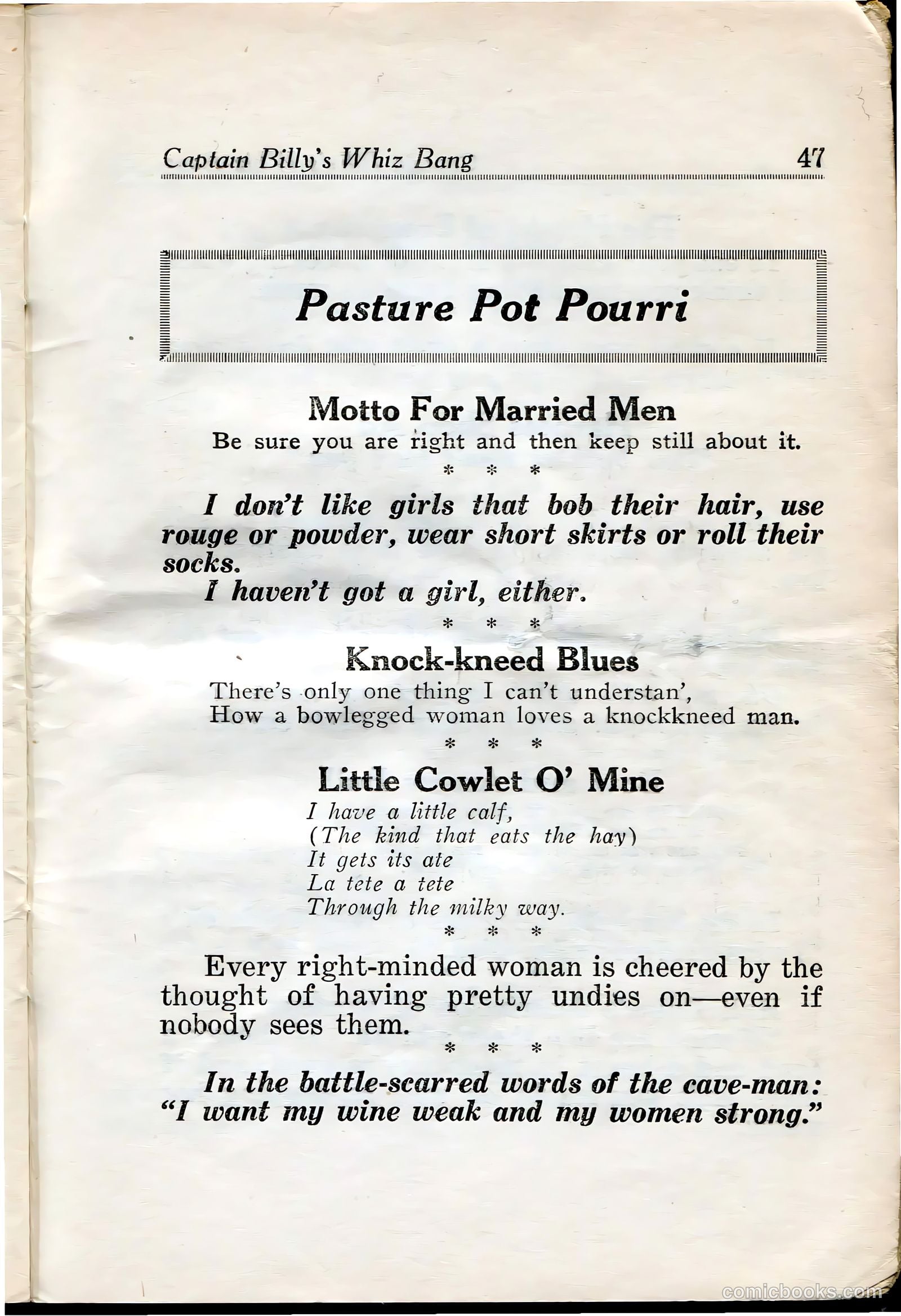
This page from *Whiz Bang* presents a collection of satirical verses and humorous observations, rather than a cartoon. The content mocks traditional attitudes of the 1920s era: **"Motto For Married Men"** satirizes outdated views about women's appearance, critiquing men who disapprove of bobbed hair, makeup, short skirts, and rolled socks—all fashionable innovations women were adopting during this period. **"Knock-kneed Blues"** expresses bewilderment at women's romantic preferences, likely referencing contemporary debates about changing gender dynamics. **"Little Cowlet O' Mine"** is a humorous, nonsensical verse. The final quotes about "pretty undies" and wine/women reflect the magazine's irreverent approach to contemporary social conventions and gender relations. Overall, the page uses satire to comment on modernizing social attitudes of the 1920s.
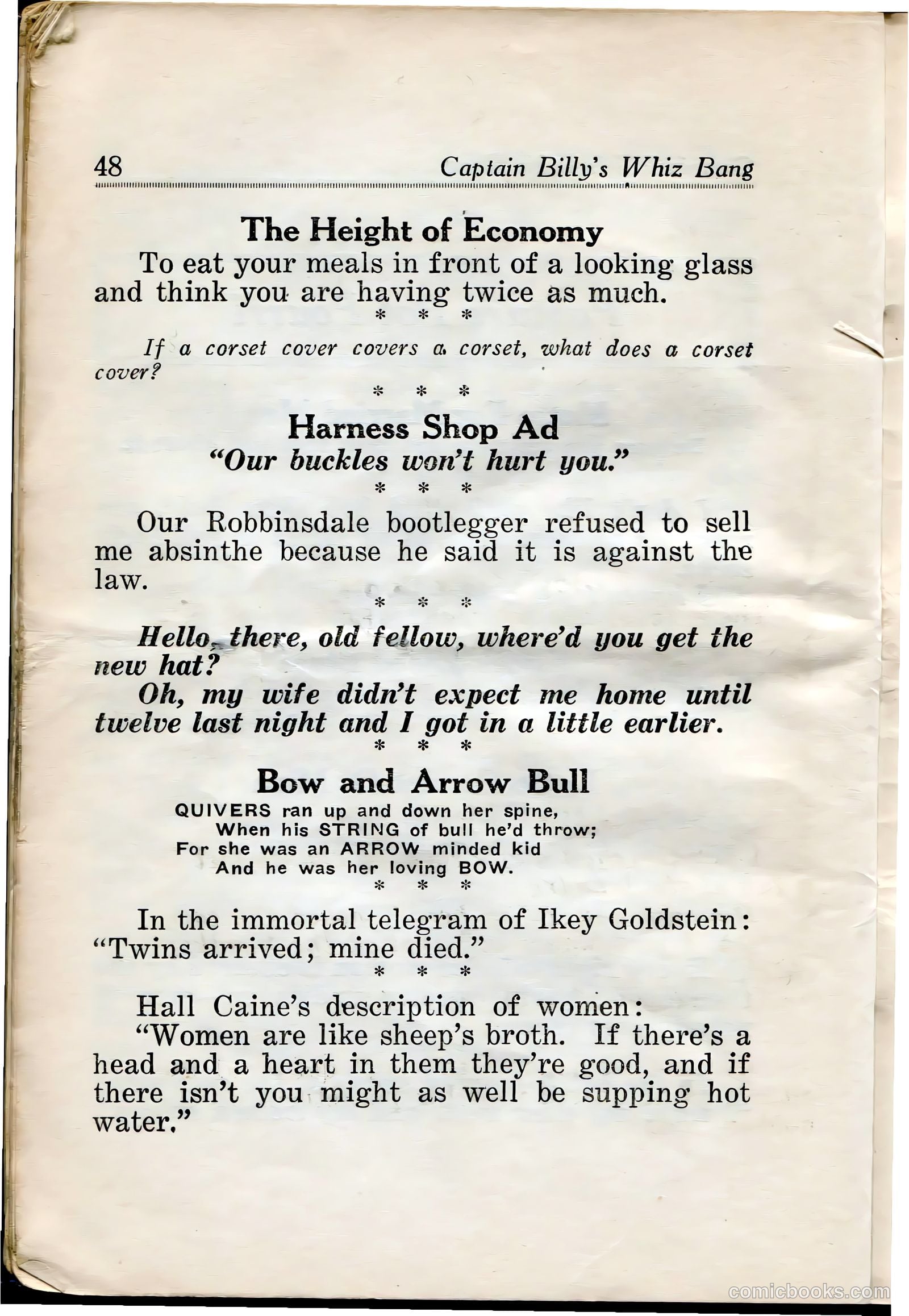
This is a humor/joke page from an early 20th-century satirical magazine. The content consists of short jokes and witticisms rather than political cartoons: - **"The Height of Economy"** jokes about using mirrors to appear to eat more - **"Harness Shop Ad"** is a mock advertisement with an innuendo about buckles - A **dialogue joke** about a man arriving home early with a new hat, implying infidelity - **"Bow and Arrow Bull"** is a rhyming joke playing on the names "Quivers" and "String" (sexual pun) - **Quotes** from Ikey Goldstein and Hall Caine offer observational humor The page targets everyday domestic situations, consumer culture, and male-female relationships through double entendres and wordplay typical of 1920s-era men's humor magazines.
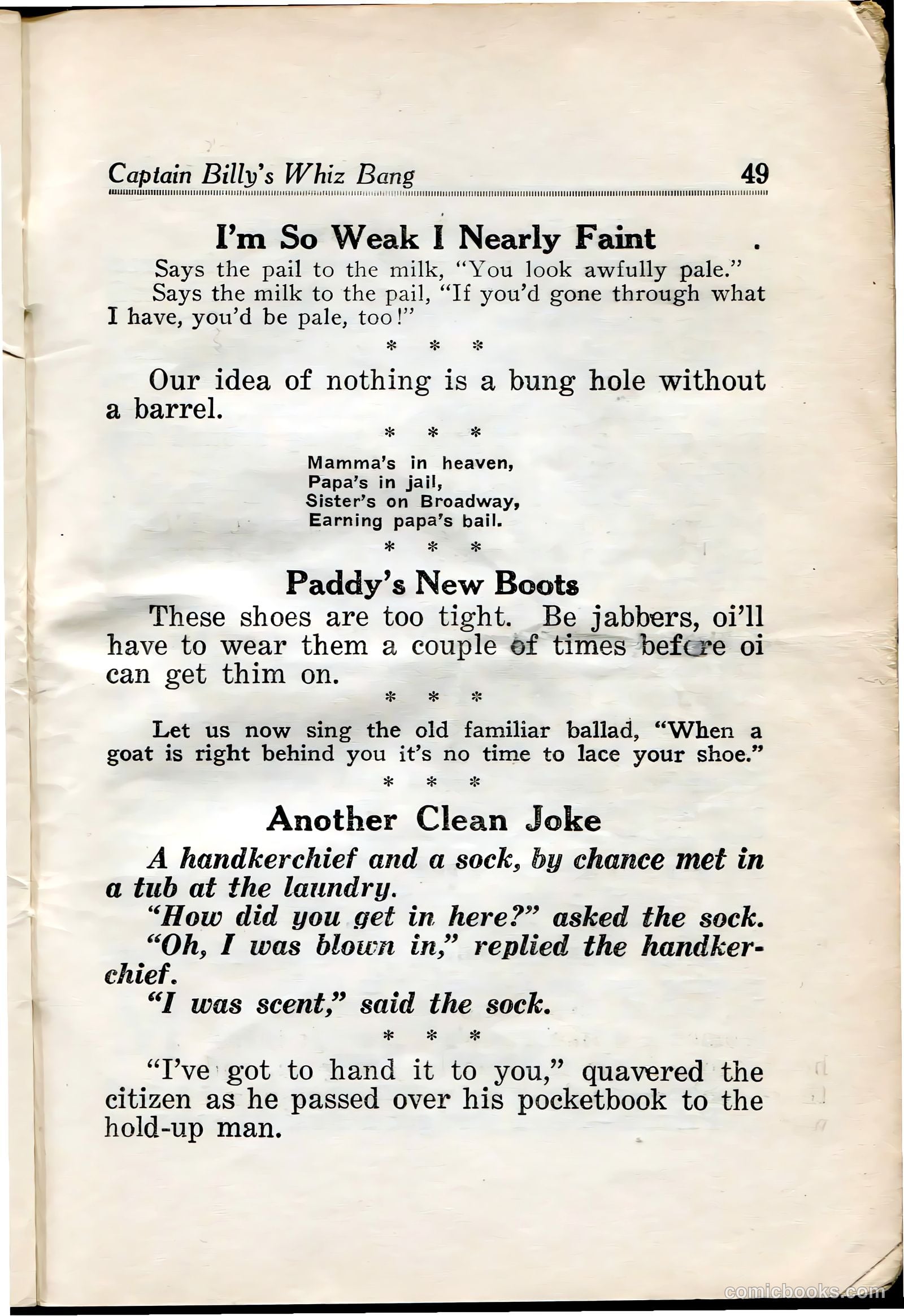
This page contains a collection of short jokes and quips rather than political cartoons. The humor relies on wordplay and situational comedy typical of 1920s American magazines: - **"I'm So Weak I Nearly Faint"** uses a dialogue between a pale person and milk as metaphor for shared suffering - **"Paddy's New Boots"** employs Irish dialect humor (marked by "oi'll" and "thim"), common in period publications - **"Another Clean Joke"** features a laundry-based pun involving a handkerchief and sock meeting in a tub—the sock was "scent" (sent) - The final joke plays on "hand it to you" as a literal gesture during a robbery The content reflects working-class humor with mild social commentary, typical of Whiz Bang's irreverent, populist satirical style.
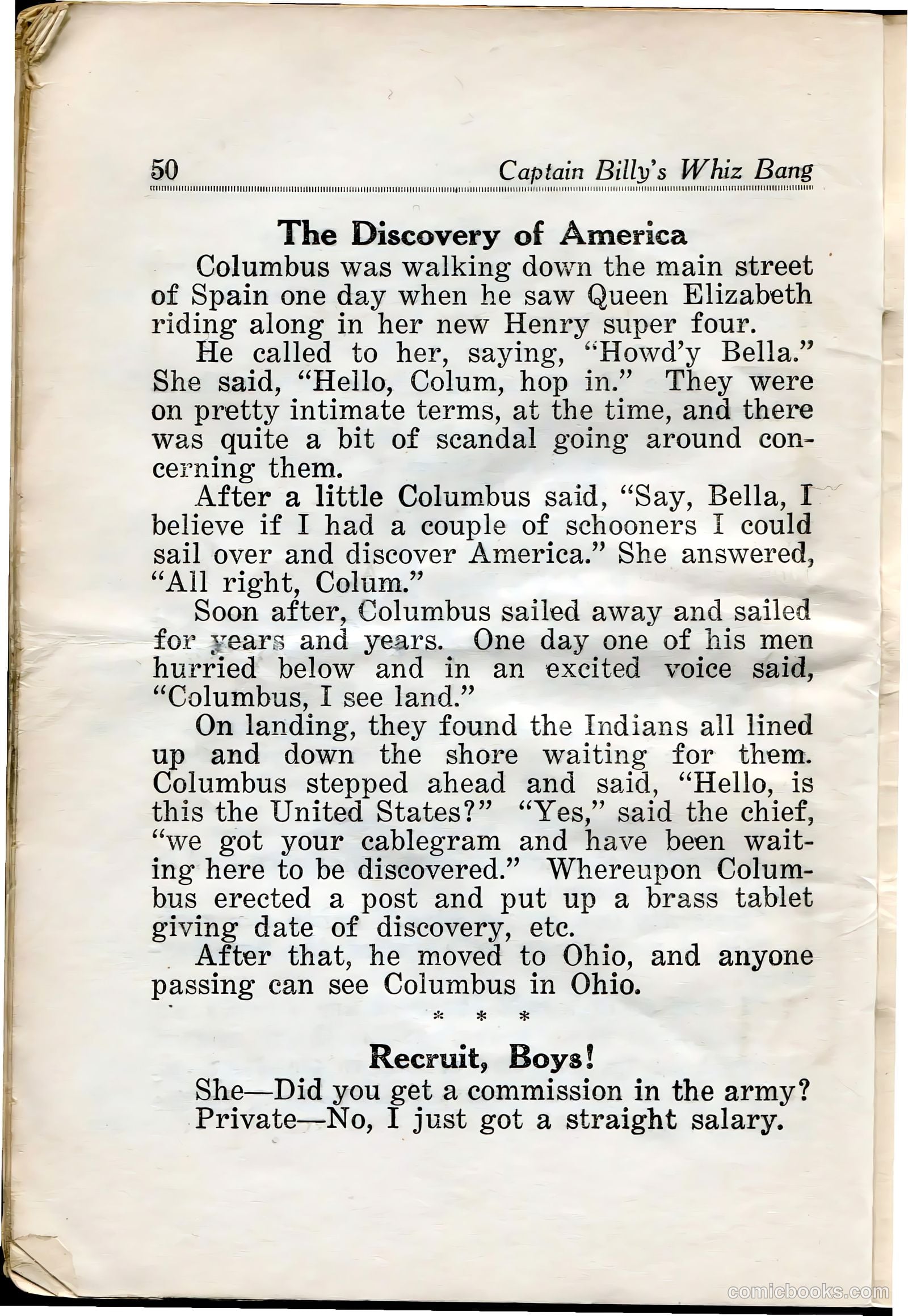
This is a humorous satire about Columbus discovering America, structured as an absurdist joke. The humor relies on anachronism and role-reversal: Columbus encounters Native Americans who are apparently *expecting* him, having received his "cablegram" (telegraph) in advance. They've waited to be "discovered," and Columbus erects a commemorative tablet. The final punchline—"After that, he moved to Ohio, and anyone passing can see Columbus in Ohio"—is a play on words: the city of Columbus, Ohio exists, so the joke suggests Columbus himself relocated there. The brief "Recruit, Boys!" joke below mocks military recruitment by contrasting officers' commissions with enlisted soldiers' "straight salary." The satire targets American historical mythology by making the discovery narrative absurd and contemporary.
This "Movie Hot Stuff" gossip column from *Captain Billy's Whiz Bang* contains three Hollywood scandal items from the 1920s: 1. **Clara Smith Hamon**: An actress whose film "Fate" flopped commercially, partly due to renewed film censorship following the Roscoe "Fatty" Arbuckle scandal (a major 1921-22 controversy involving rape allegations that damaged Hollywood's reputation and triggered industry self-regulation). 2. **Charlie Chaplin**: The column debunks newspaper rumors of romance between Chaplin and actress Claire Windsor, claiming investigators discovered he was actually spending time with young May Collins and her mother—implying Chaplin was courting May, not Claire. The "Pretty foxie, Charlie!" is sarcastic commentary on his discretion. 3. **Western crime**: A brief joke that California criminals and con artists migrate west seasonally to prey on wealthy tourists. The column's tone is gossipy and cynical, using "astute investigators" to frame itself as exposing Hollywood's true doings behind publicized stories.
This page from the satirical magazine contains gossip and social commentary rather than cartoons. The main content mocks infidelity and exposes a vulnerability of adulterous men: they cannot report being robbed during illicit encounters without revealing their affairs to police—and thereby to reporters and the public. The text also includes celebrity scandal items. It notes actress Alice Brady's retirement, likely hinting at pregnancy. More substantially, it ridicules Texas Guinan, a famous entertainer and nightclub hostess, who spent fifteen hours in jail over an unpaid grocery bill. The passage jokes that prison guards were so smitten they cleaned up for her, suggesting her glamorous reputation preceded her even in custody. The satire targets both the hypocrisy of married men and the absurdity of minor debts landing celebrities in jail during this era.
This page contains a brief gossipy anecdote about theatrical performers (mentioning "Texas," Mrs. Peete, and Madalynne Obenchain) followed by a romantic poem titled "Lost" by James Whitcomb Riley. The anecdote appears to satirize Broadway/theater world jealousy, referencing obscure figures and their professional rivalries. Without additional context, the specific identities and scandal referenced are unclear to modern readers. The poem itself—a sentimental piece about lost love with a twist ending (the lover "is lost, for he married me")—is presented straight rather than satirically, suggesting *Whiz Bang* mixed humorous gossip with sincere literary content.
This page contains four brief satirical jokes rather than political cartoons: 1. **"How to Get the Dough"**: Mocks a movie ticket seller's con—deliberately miscounting change to keep the overage. 2. **"Wet Times Ahead"**: A sinking ship joke where a passenger claims to be collecting money for "widows and orphans" while the captain urges evacuation—dark humor about self-interest during disaster. 3. **"He'd Tested Her"**: A quick quip about a fast typist being someone's only complaint—likely a marriage joke. 4. **Marriage commentary**: A cynical observation comparing marriage maintenance costs unfavorably to dairy expenses. The humor is broadly cynical and anti-establishment, targeting con artists, greed, and marital discord—typical of *Whiz Bang's* irreverent, working-class comic style popular in the 1920s-30s.
This page contains several brief satirical pieces rather than a single cartoon: **"The Tramp's Plea"** depicts a homeless man making escalating requests (water, liquor, food, shelter)—standard Depression-era humor about vagrants. **"Raspin' Rastus"** uses dialect humor and a Black character (common in period comics) to joke about Biblical passages, suggesting the poor can't escape their circumstances. **"Let This Be Your Philosophy of Life"** offers mock-serious life advice. **"Our History Lesson"** satirizes Medieval history, where wealthy nobles paid substitutes to serve death sentences—dark commentary on how money buys escape from consequences, likely resonating during economically unequal times. The final italicized line appears to be a flirtatious joke about opening a pay envelope.
This page contains three humorous pieces rather than cartoons: **"Puff Me Up, Kid"** - A sentimental poem about an adoring young daughter, written in vernacular style. The speaker boasts of his masculine appeal while acknowledging the girl's affection. **"Hard Boiled Muggsy"** - A brief anecdote about a street-tough kid's crude retelling of the Adam and Eve story, using slang terms ("broad," "'snitched'," "'peached'") to describe biblical events. The humor derives from lowbrow language applied to religious narrative. **"Smackum Smackaday"** - A playful poem using alliteration and repetition ("Someday," "Somebody," "Somewhere") to express vague romantic intentions toward an unnamed woman. All three pieces employ working-class vernacular and casual irreverence typical of Whiz Bang's satirical tone.
This page contains classified advertisements presented as humor. Rather than traditional ads, these are satirical "notices" mocking contemporary social situations: - **"A Serious Accident"**: Ridicules a frivolous lawsuit where a woman sued for $5,000 after getting a splinter on a toboggan slide - **"A Soft Job"**: Makes light of women seeking easy home decoration work - **"Our Agony Column"**: Mimics advice columns with a cheeky response to a woman's complaint - **"Suppose He Comes Home?"**: Humorously advises renting rooms to lodgers while the husband is away - **"The Corset Revue"**: Seeks a model for a corset display The page concludes with an unrelated aphorism about friendship and enmity. These are parodies of genuine classified advertisements, using humor to comment on contemporary manners, lawsuits, and social expectations of the 1920s era.
This page contains satirical humor pieces typical of 1920s *Whiz Bang* magazine. "Everybody's Winner" presents a racist caricature using exaggerated dialect to mock an African American woman celebrating her husband's divorce settlement. The humor relies on period stereotypes about Black women and marriage. The subsequent pieces—"Blank Verse," a Luther quote about God, "Atchew!" (a brief joke), and "If She Squeaks, Oil Her"—are unrelated vignettes. The final piece satirizes military culture by equating gun maintenance with marital care, suggesting Marines should treat rifles with the same attention (and dismissiveness implied) as wives. The page reflects *Whiz Bang's* lowbrow comedy style: crude racial humor mixed with sex jokes and military satire, typical of the magazine's working-class male readership during the Jazz Age.
This page contains three separate satirical pieces typical of 1920s humor magazines: 1. **"Shall We Forgive Her?"** - A story mocking a young woman who loses her temper in a phone booth, contradicting her refined appearance and "soft sweet voice." The satire targets the gap between genteel presentation and actual behavior. 2. **"Liberal Wife"** - A domestic joke about a wife encouraging her husband to kiss the new cook, then calling him "stupid" for hesitating. It satirizes what the author considers hypocritical or absurdly "liberal" attitudes toward marital propriety. 3. **"People who live in rag houses..."** - A one-liner playing on the proverb "people in glass houses shouldn't throw stones," substituting "rag" for "glass" as humor based on poverty or flimsy construction. All reflect working-class and middle-class social conventions of the era.
This page contains brief satirical jokes and witticisms typical of 1920s humor magazines. The content mocks hypocrisy and human nature: **"Honesty, the Cheap Policy"** jokes that stealing a horse earns prison time, but simply refusing to pay for one goes unpunished—satirizing selective enforcement of morality. **The Preacher/Johnnie exchange** has a boy deceive a preacher about using worms as bait, then boast that onlookers ("suckers") believed the lie—mocking both religious hypocrisy and gullibility. **"All Some Have to Tell"** cynically observes that men relish recounting youthful misdeeds regardless of age or piety, suggesting people never truly reform. **The marriage aphorism** presents divorce as the inevitable "exposure" of what marriage merely "composed"—implying matrimony masks fundamental incompatibility. **"That Waltz"** by "Georgia Cracker" fragments a romantic scene, describing a beautiful woman dancing poorly with an incompetent partner—suggesting romantic ideals clash with reality. Throughout, the humor targets human contradiction and self-deception.
This page contains a humorous short story from *Captain Billy's Whiz Bang*, a 1920s American satirical magazine known for risqué jokes and comedic fiction. The joke is a classic case of mistaken identity during a romantic moment. A man dances with a woman he believes is "Kathleen," delivering increasingly overwrought romantic declarations—comparing her to sprites, suggesting the universe was made for this moment, claiming she *is* his whole world. The humor builds through his theatrical, exaggerated passion. The punchline: both parties realize they've been kissing and confessing love to complete strangers. Neither is who the other thought. This satirizes the earnest, flowery romantic rhetoric common in sentimental fiction of the era, mocking how easily passionate declarations can occur between people who don't actually know each other—suggesting that intense romantic feeling can be based on circumstance rather than genuine connection. The absurdist reversal was typical humor for *Whiz Bang*.
This page contains humorous advice letters from fictional rural correspondents, a common satirical format of early 20th-century magazines. The humor relies on absurd, dangerous, or immoral "solutions" to everyday problems: - **Jack Tar's** advice about a balloon appears to be a nonsensical non-answer (likely sexual innuendo) - **Ima Frade** jokes about women becoming accustomed to physical contact with soldiers - **Fumey Gait** suggests card-playing would suit someone named Pedro - **Gracie** sarcastically denies cross-eyed people have infections - **Dora Knobs** recommends cigarettes and beer as a "breakfast" for morally loose women - **Tooth Ache Kid** humorously suggests increasingly dangerous alcohol treatments for toothaches The satire targets rural simplicity, loose morality, and questionable folk remedies through exaggerated advice.
This page contains a collection of humorous one-liners and short jokes typical of the magazine's satirical format. The content includes: - **"Brother Eagle"**: A comedic "cure" for exhaustion involving Scotch, soda, and phonograph music—satirizing both medical quackery and the Jazz Age's recreational drinking during Prohibition. - **"Ab. Doman"**: A quip about married men as husbands, poking fun at marriage itself. - **"Kauph E. Keuler"**: A joke about drinking coffee from a bowl instead of a saucer—mocking etiquette. - **"Herr Nett"**: Satire of consumerism, suggesting leaving price tags on gifts so recipients can return items. - **Captain Billy's question** about zebra coloring is simply a philosophical riddle posed to readers. - **"Pee-Ess"**: A Prohibition-era joke about bootleggers and breaking the law.
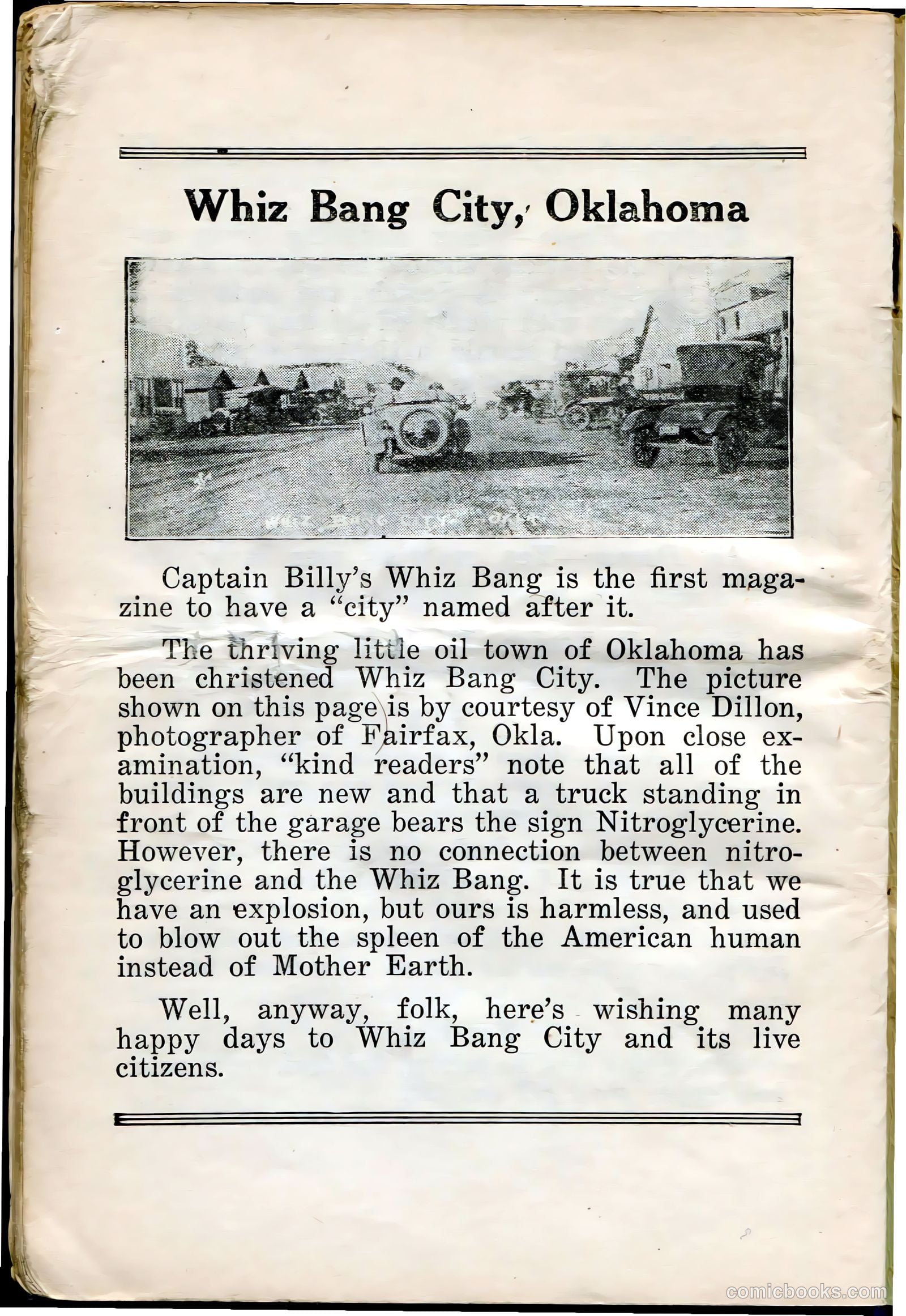
This is a promotional piece celebrating an Oklahoma oil town named after *Captain Billy's Whiz Bang* magazine itself—apparently the first town to receive such an honor. The photograph shows a new, developing oil boom town with modern buildings and vehicles. The humor works on multiple levels: The text jokes about a truck labeled "Nitroglycerin" visible in the photo, then self-consciously reassures readers there's no actual danger. The magazine playfully claims its own "explosion" is metaphorical—meant to provide comedic relief ("blow out the spleen") to American readers rather than cause real destruction. This reflects *Whiz Bang's* brand of irreverent, slapstick humor popular in 1920s satirical magazines. The piece is essentially self-congratulatory advertising disguised as journalism, celebrating both the magazine's cultural reach and the economic boom represented by the new oil town.
This is a **title page and order form** for "Our Winter Annual," a 1921-22 compilation issue of *Captain Billy's Whiz Bang*, a satirical humor magazine. Rather than containing cartoons or political commentary, it's primarily **advertising material**. The page promotes the annual as a collection of jokes, jests, poetry, and stories from earlier issues—offering "four times as much reading matter" as regular issues for one dollar. It lists included pieces like "Johnnie and Frankie" and "The Girl in the Blue Velvet Band," though these titles suggest lighthearted, possibly risqué humor typical of 1920s comedy magazines. The bottom half contains an **order form** for readers to mail payment to Robbinsdale, Minnesota. This is essentially a **sales pitch**, not satirical content.
This is primarily an **advertisement/promotional page** for *Whiz Bang* magazine itself, not a political cartoon. The page announces distribution channels and pricing for the publication. The only visual element is a **cartoon cow** at the bottom—likely the magazine's mascot or trademark—depicted in a humorous, exaggerated style typical of the era's satirical publications. The text emphasizes the magazine's availability "Everywhere!" across multiple retail venues (hotels, newsstands, trains), positioning it as widely accessible. Pricing ranged from 25 cents for single copies to $2.50 annually, with a special "Winter Annual" edition at one dollar—substantial costs for the 1920s era. The page serves as both advertisement and mastheads, reflecting *Whiz Bang*'s popularity as a humor and satire magazine of that period.