
Captain Billy's Whiz Bang, January 1922 · page 15 of 68
Captain Billy's Whiz Bang #29 — page 15: what you’re looking at
What you’re looking at
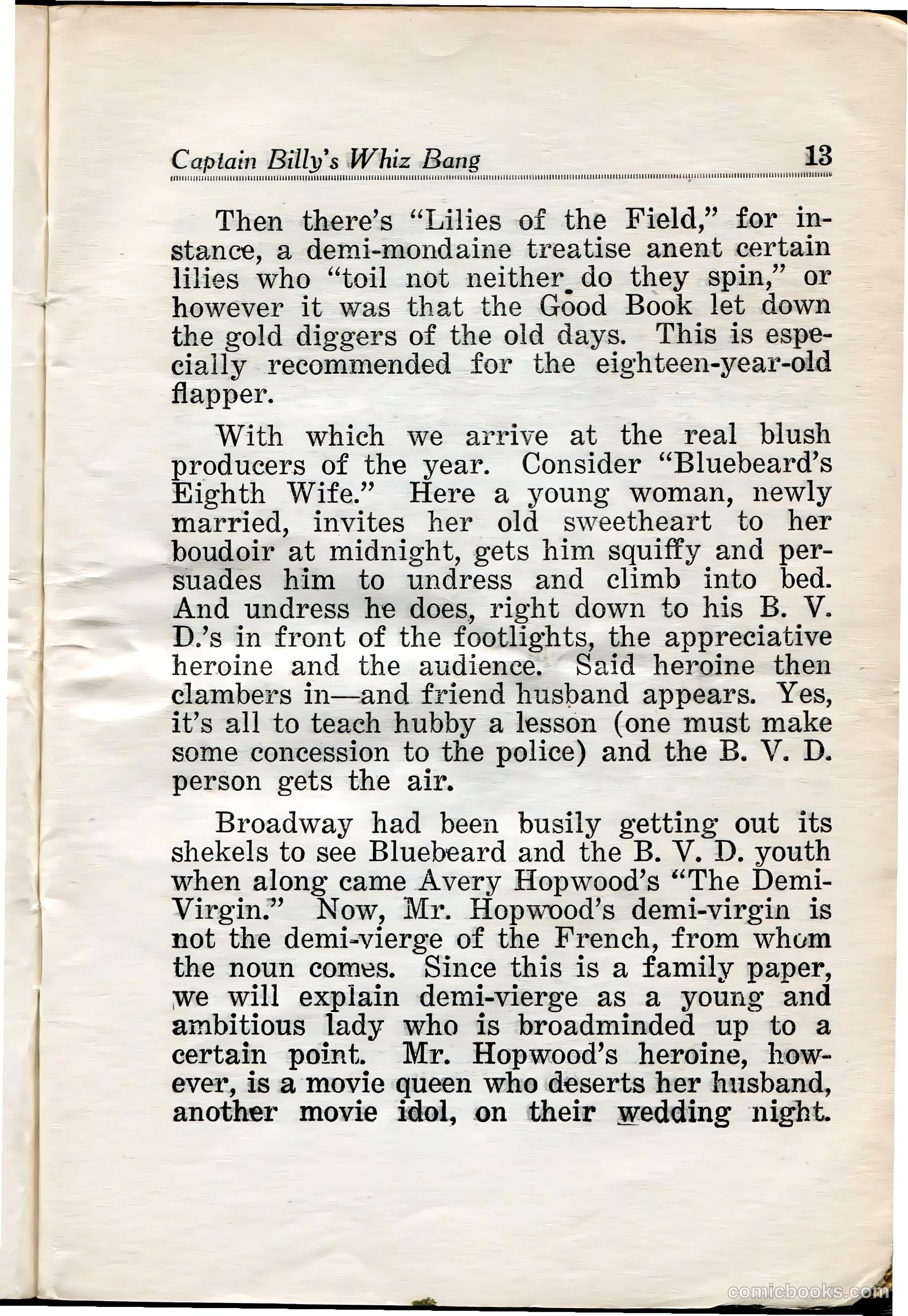
This is a satirical critique of three contemporary Broadway plays deemed excessively risqué for the era. The author mocks films featuring sexual innuendo and infidelity presented under thin moral pretexts. "Bluebeard's Eighth Wife" is attacked for depicting a wife seducing her husband's rival—undressing him nearly nude onstage—ostensibly to "teach" her husband a lesson. The critic sarcastically notes they must "make concession to the police," implying censorship concerns. "The Demi-Virgin" is ridiculed most sharply: its heroine (a movie actress) abandons her new husband on their wedding night, abandoning marital duties. The author carefully defines "demi-virgin" for his family-paper audience as a woman "broadminded up to a certain point"—coded language for sexual permissiveness. The satire targets 1920s Hollywood's celebration of infidelity and female sexual autonomy, framed as entertainment for young "flappers." The tone suggests moral alarm at modern sexual attitudes.
📄 Transcribed text from this page (OCR, searchable)
Machine-transcribed from the original scan — historical spelling and the odd misread are preserved.
13 Captain Billy's Whiz Bang Then there's “Lilies of the Field,” for in- stance, a demi-mondaine treatise anent certain lilies who “toil not neither do they spin,” or however it was that the Good Book let down the gold diggers of the old days. This is espe- cially recommended for the eighteen-year-old flapper. With which we arrive at the real blush producers of the year. Consider “Bluebeard's Eighth Wife.” Here a young woman, newly married, invites her old sweetheart to her boudoir at midnight, gets him squiffy and per- suades him to undress and climb into bed. And undress he does, right down to his B. V. D.'s in front of the footlights, the appreciative heroine and the audience. Said heroine then clambers in—and friend husband appears. Yes, it's all to teach hubby a lesson (one must make some concession to the police) and the B. V. D. person gets the air. Broadway had been busily getting out its shekels to see Bluebeard and the B. V. D. youth when along came Avery Hopwood's “The Demi- Virgin.” Now, Mr. Hopwood's demi-virgin is not the demi-vierge of the French, from whom the noun comes. Since this is a family paper, we will explain demi-vierge as a young and ambitious lady who is broadminded up to a certain point. Mr. Hopwood's heroine, how- ever, is a movie queen who deserts her husband, another movie idol, on their wedding night.